
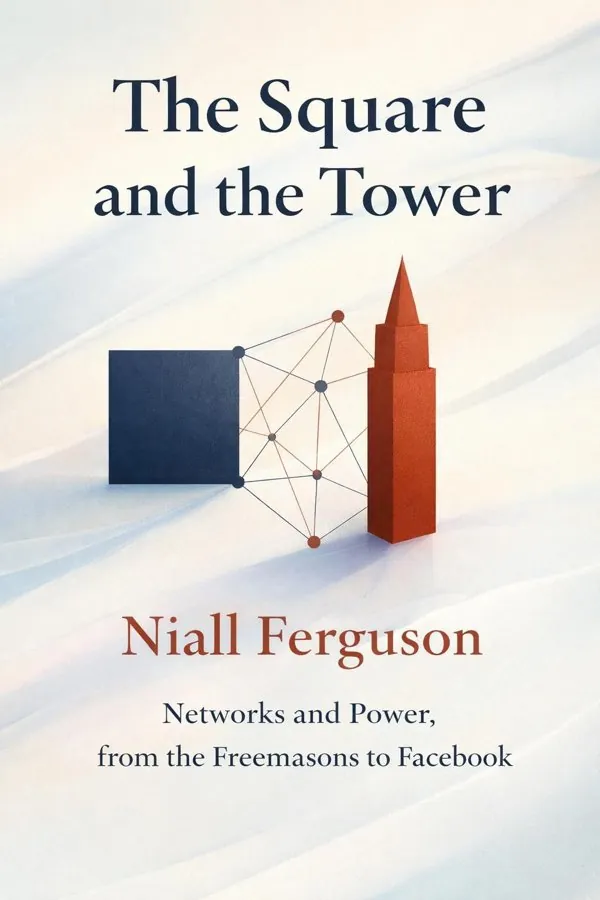
The Square and the Tower: Networks and Power, from the Freemasons to Facebook: Summary & Key Insights
 10 min9 chaptersAudio available
Key Takeaways from The Square and the Tower: Networks and Power, from the Freemasons to Facebook
Most people imagine power as a pyramid, but Ferguson asks us to picture it as a web attached to a pyramid.
An age that looks rigid from afar can be surprisingly networked up close.
New ideas rarely spread by official permission.
Revolutions do not begin only with misery; they begin when communication becomes contagious.
Networks may ignite change, but large-scale order usually depends on hierarchy.
What Is The Square and the Tower: Networks and Power, from the Freemasons to Facebook About?
The Square and the Tower: Networks and Power, from the Freemasons to Facebook by Niall Ferguson is a world_history book spanning 11 pages. Power rarely works the way official charts suggest. Governments, churches, armies, and corporations present themselves as orderly hierarchies, yet history is also driven by looser, less visible webs of influence: friendships, clubs, conspiracies, trading links, intellectual circles, and now digital platforms. In The Square and the Tower, Niall Ferguson argues that to understand how societies really change, we must look not only at towers of authority but also at the networks running through and around them. Ranging from the medieval Church and Renaissance merchant families to the Freemasons, revolutionary movements, Cold War institutions, and Facebook-era social media, Ferguson shows that networks have repeatedly disrupted established power, only to be absorbed, regulated, or replaced by new hierarchies. His central insight is that history is shaped by a constant struggle between centralized institutions and decentralized connections. The book matters because our age is often described as uniquely networked, yet Ferguson demonstrates that networked power is not new. What is new is its speed, scale, and global reach. As a leading historian of empire, finance, and geopolitics, Ferguson brings both scholarly depth and sweeping historical range to a question that affects politics, technology, business, and everyday life.
This FizzRead summary covers all 9 key chapters of The Square and the Tower: Networks and Power, from the Freemasons to Facebook in approximately 10 minutes, distilling the most important ideas, arguments, and takeaways from Niall Ferguson's work. Also available as an audio summary and Key Quotes Podcast.
The Square and the Tower: Networks and Power, from the Freemasons to Facebook
Power rarely works the way official charts suggest. Governments, churches, armies, and corporations present themselves as orderly hierarchies, yet history is also driven by looser, less visible webs of influence: friendships, clubs, conspiracies, trading links, intellectual circles, and now digital platforms. In The Square and the Tower, Niall Ferguson argues that to understand how societies really change, we must look not only at towers of authority but also at the networks running through and around them.
Ranging from the medieval Church and Renaissance merchant families to the Freemasons, revolutionary movements, Cold War institutions, and Facebook-era social media, Ferguson shows that networks have repeatedly disrupted established power, only to be absorbed, regulated, or replaced by new hierarchies. His central insight is that history is shaped by a constant struggle between centralized institutions and decentralized connections.
The book matters because our age is often described as uniquely networked, yet Ferguson demonstrates that networked power is not new. What is new is its speed, scale, and global reach. As a leading historian of empire, finance, and geopolitics, Ferguson brings both scholarly depth and sweeping historical range to a question that affects politics, technology, business, and everyday life.
Who Should Read The Square and the Tower: Networks and Power, from the Freemasons to Facebook?
This book is perfect for anyone interested in world_history and looking to gain actionable insights in a short read. Whether you're a student, professional, or lifelong learner, the key ideas from The Square and the Tower: Networks and Power, from the Freemasons to Facebook by Niall Ferguson will help you think differently.
- ✓Readers who enjoy world_history and want practical takeaways
- ✓Professionals looking to apply new ideas to their work and life
- ✓Anyone who wants the core insights of The Square and the Tower: Networks and Power, from the Freemasons to Facebook in just 10 minutes
Want the full summary?
Get instant access to this book summary and 100K+ more with Fizz Moment.
Get Free SummaryAvailable on App Store • Free to download
Key Chapters
Most people imagine power as a pyramid, but Ferguson asks us to picture it as a web attached to a pyramid. That shift changes everything. Hierarchies are visible: governments, armies, churches, bureaucracies, corporations. Networks are often less formal: families, friendships, patronage systems, secret societies, merchant circles, online communities. The central claim of the book is that neither structure alone explains history. Real power emerges from their interaction.
Hierarchies are good at coordination, continuity, and command. They can collect taxes, wage war, enforce rules, and preserve institutions over time. Networks, by contrast, are better at spreading ideas, adapting quickly, mobilizing trust, and circumventing formal control. They thrive in the gaps of official systems. A weak hierarchy may be held together by strong networks; a strong hierarchy may be undermined by hidden ones.
Ferguson draws on network theory to show that the structure of a network matters. Some networks are dense and decentralized. Others are dominated by central hubs. Information does not move evenly through them; it flows through connectors, gatekeepers, and clusters. That is why rumor, innovation, and rebellion often travel in surprising ways.
You can apply this lens beyond history. In a workplace, the official org chart may say one thing, but influence often belongs to the colleague everyone trusts. In politics, a formal institution may look stable while informal alliances quietly reshape decisions. In digital life, a platform may seem open, yet a few highly connected users can dominate attention.
Actionable takeaway: When analyzing any institution, ask two questions at once: Who formally holds authority, and who actually connects people, information, and trust behind the scenes?
An age that looks rigid from afar can be surprisingly networked up close. Medieval Europe is often remembered as a world of kings, nobles, and the towering authority of the Church. Yet Ferguson shows that beneath this imposing hierarchy lived vibrant networks of monks, merchants, scholars, dynastic families, and urban communities. The visible structure was feudal and ecclesiastical; the operating reality was more interconnected.
Religious orders linked monasteries across long distances, allowing ideas, practices, and influence to travel outside local political chains. Merchant networks connected fairs, ports, and banking centers long before modern capitalism. Universities created intellectual communities that crossed borders and languages. Family and marriage ties bound ruling houses together in ways that often mattered more than territorial lines on a map.
These networks could strengthen hierarchy, but they could also weaken it. Trade networks enriched cities that demanded autonomy. Clerical and scholarly links gave rise to critiques of authority. Informal alliances helped channel information faster than rulers could control it. Even in a supposedly static world, power was being negotiated through relationships, not just decrees.
The medieval example is useful because it challenges the idea that networks belong only to modern technology. Human beings have always built influence through connection. The tools change, but the pattern remains. Where there is authority, there are also intermediaries, brokers, and communities operating within, across, or beyond it.
Actionable takeaway: Do not mistake institutional grandeur for total control. In any apparently rigid system, look for the smaller communities, exchange routes, and trust-based ties that make the system function or quietly subvert it.
New ideas rarely spread by official permission. Ferguson highlights the Enlightenment as a striking example of networked influence, showing how salons, clubs, correspondence circles, and secret societies helped ideas move faster than state and church authorities could contain them. The Freemasons, in particular, serve as a symbol of this world: semi-private, transnational, sociable, and often politically suggestive.
The Enlightenment was not just a set of books written by famous thinkers. It was also a communications network. Intellectuals exchanged letters across borders. Printers, publishers, and patrons acted as nodes in a wider system of circulation. Salons brought elites together in conversational settings where status could be softened and unconventional thought tested. Secret societies offered ritual, trust, and exclusivity, making them powerful channels for cohesion.
Ferguson does not claim that the Freemasons secretly controlled history in a simplistic conspiratorial sense. Rather, he argues that such groups mattered because they created lateral connections among people who might otherwise have remained isolated within local hierarchies. They provided infrastructure for influence. In this way, networks can become engines of cultural and political transformation long before they openly challenge power.
The modern parallel is obvious. Today, podcasts, encrypted chats, niche online forums, and invite-only communities play roles once filled by salons and lodges. They shape what influential people talk about before those ideas appear in formal institutions.
Actionable takeaway: If you want to understand where change is coming from, look not only at official speeches and institutions but also at the social spaces where ambitious people exchange ideas before they become public policy.
Revolutions do not begin only with misery; they begin when communication becomes contagious. One of Ferguson’s most powerful insights is that revolutionary moments often occur when networks of dissent become more agile than the hierarchies trying to suppress them. Pamphlets, clubs, rumors, coffeehouses, and conspiratorial groups can create a shared political imagination before governments realize how fast legitimacy is eroding.
The American and French Revolutions, among others, reveal how informal connections amplified ideological energy. Activists, printers, intellectuals, and local organizers formed networks that spread arguments, coordinated actions, and transformed grievance into movement. Once enough people are connected around a common narrative, authority can collapse with startling speed. Hierarchies look solid until they suddenly do not.
But Ferguson also stresses that revolutions often replace one hierarchy with another. The network that helps bring down an old regime may struggle to govern afterward. Horizontal mobilization is excellent for disruption, not always for durable administration. This is why many revolutions end with stronger centralized states, military leadership, or party control. The energy of the square often yields to the demands of the tower.
You can see echoes of this pattern in modern protest movements. Social media can rapidly create visibility and solidarity, but translating momentum into institutions, laws, and governance is far harder. Viral coordination is not the same as state capacity.
Actionable takeaway: When evaluating any movement, ask two separate questions: Can it mobilize people quickly through networks, and can it build or reform institutions strong enough to sustain change once the initial uprising passes?
Networks may ignite change, but large-scale order usually depends on hierarchy. Ferguson shows that the industrial age and the great imperial era were marked by the extraordinary rise of centralized institutions capable of ruling populations, moving armies, managing capital, and standardizing administration over vast distances. Railways, telegraphs, civil services, and corporate structures gave hierarchical power new reach and precision.
This was not the death of networks. Rather, hierarchies learned to harness them. Industrial capitalism relied on networks of finance, supply, and communication, but increasingly placed them inside larger organizational shells such as firms, ministries, and imperial bureaucracies. The British Empire, for example, was sustained not only by military command but also by merchant networks, elite schools, and informal ties among administrators. Yet these connections functioned within an increasingly hierarchical architecture.
Ferguson’s point is that modernity did not simply liberate society into openness. It also produced powerful towers that could collect information, classify populations, and project authority at unprecedented scale. The same technologies that linked people horizontally also empowered centralized control.
This has practical relevance today. Businesses often celebrate flat culture and agile teams, but once they scale, they rely on systems, compliance, and managerial layers. States that embrace open markets still depend on tax agencies, regulatory bodies, and security institutions. Networks help things grow; hierarchies keep them legible and governable.
Actionable takeaway: Whenever a network succeeds, ask what hierarchy is emerging around it. Growth almost always creates pressure for structure, rules, and central coordination.
The Cold War was not simply a contest between two superpower hierarchies. It was also a struggle shaped by espionage networks, ideological alliances, proxy relationships, dissident circles, and transnational institutions. Ferguson shows that both blocs relied on a mixture of formal command and hidden connection. The Soviet Union projected a highly centralized image, while the United States championed open society, yet both depended on intricate networks to compete globally.
Spy rings, intelligence-sharing arrangements, academic exchanges, military alliances, and propaganda channels all mattered. NATO itself was a hierarchy of command wrapped around a network of member states with different interests. Communist parties, revolutionary movements, and anti-colonial struggles formed overlapping webs of influence that did not always align neatly with state control. Dissident networks inside authoritarian systems could remain weak for years, then suddenly become potent when wider cracks appeared.
One lesson Ferguson draws is that networked resilience can challenge even powerful surveillance states, but timing matters. Authoritarian hierarchies may suppress networks for long periods if they monopolize communication and fear. Once communication costs fall or legitimacy cracks, however, seemingly marginal networks can trigger rapid destabilization.
The Cold War also demonstrates that open societies are not immune to network vulnerabilities. Influence operations, infiltration, disinformation, and covert funding all exploit the connective tissue of free institutions.
Actionable takeaway: In geopolitical or organizational conflict, pay attention not just to official capabilities but to alliance quality, trust patterns, and hidden channels of influence. The side with better networks may outperform the side with superior formal structure.
The internet promised decentralization, liberation, and the end of gatekeepers. Ferguson treats that promise with caution. Digital technology undeniably lowered the cost of connection, allowing information, communities, and movements to spread at extraordinary speed. But as he argues, the digital revolution did not eliminate hierarchy. It often replaced older hierarchies with new, less accountable ones.
At first glance, platforms such as Google, Facebook, and Twitter appeared to empower users through open networks. Anyone could publish, organize, or build an audience. Yet these systems quickly became dominated by hubs, algorithms, and platform owners with immense control over visibility, incentives, and data. In network terms, they were not flat democracies but highly concentrated systems with powerful central nodes.
This is one of the book’s most contemporary contributions. Ferguson challenges the romantic belief that digital connection automatically produces freedom or truth. Networks can spread innovation and solidarity, but also outrage, tribalism, surveillance, and manipulation. The architecture of connection matters. A platform designed to maximize engagement may reward extremity over accuracy, speed over reflection, and virality over responsibility.
You can apply this insight personally. A social feed may feel like an open public square, but your attention is being shaped by invisible ranking systems. Organizations using digital tools may believe they are becoming more collaborative while actually becoming more dependent on a handful of technological gatekeepers.
Actionable takeaway: Treat digital networks as governed environments, not neutral spaces. Ask who owns the infrastructure, how attention is ranked, and what behaviors the system rewards before trusting its claims of openness.
What makes a network strong can also make it dangerously unstable. Ferguson argues that highly connected systems spread not only ideas and opportunities but also shocks, panics, and failures. The same speed that empowers innovation can accelerate contagion, whether financial, political, informational, or epidemiological. Connectivity increases capacity, but it also amplifies vulnerability.
Social media offers an obvious example. It can mobilize aid, expose wrongdoing, and build communities across borders. But it can also produce mob dynamics, misinformation cascades, and emotional polarization at massive scale. Financial markets behave similarly: interconnection can improve liquidity and coordination until stress turns linkages into channels of systemic collapse. In politics, networked outrage can destabilize trust faster than institutions can respond.
Ferguson’s broader point is that societies periodically swing back toward hierarchy when network disorder becomes intolerable. People who celebrate openness in one decade may demand regulation, censorship, stronger borders, tougher leadership, or institutional discipline in the next. When networks generate too much noise or insecurity, the appeal of the tower returns.
This cycle helps explain why periods of decentralization often end with renewed efforts to centralize authority. It is not simply that leaders seek control; publics themselves may crave it once complexity becomes exhausting.
For individuals and organizations, resilience means designing buffers rather than maximizing connection at all costs. Too many links without trust, verification, and redundancy can create brittleness.
Actionable takeaway: Build systems that value resilience over pure speed. Whether in media, business, or civic life, introduce checkpoints, diverse channels, and trusted intermediaries so that one viral surge or one point of failure does not destabilize the whole system.
All Chapters in The Square and the Tower: Networks and Power, from the Freemasons to Facebook
About the Author
Niall Ferguson is a British historian, author, and commentator known for his wide-ranging work on empire, finance, geopolitics, and the history of institutions. Educated at Oxford, he has held academic positions at leading universities including Oxford, Harvard, and Stanford, and has been affiliated with the Hoover Institution. Ferguson became internationally recognized through bestselling books such as Empire, The Ascent of Money, Civilization, and Doom, as well as television documentaries that brought complex historical subjects to broad audiences. His writing is marked by ambitious scope, strong arguments, and a willingness to connect historical patterns to present-day debates. In The Square and the Tower, he applies that signature style to the long history of networks and hierarchies, showing how informal connections have shaped power across centuries.
Get This Summary in Your Preferred Format
Read or listen to the The Square and the Tower: Networks and Power, from the Freemasons to Facebook summary by Niall Ferguson anytime, anywhere. FizzRead offers multiple formats so you can learn on your terms — all free.
Available formats: App · Audio · PDF · EPUB — All included free with FizzRead
Download The Square and the Tower: Networks and Power, from the Freemasons to Facebook PDF and EPUB Summary
Key Quotes from The Square and the Tower: Networks and Power, from the Freemasons to Facebook
“Most people imagine power as a pyramid, but Ferguson asks us to picture it as a web attached to a pyramid.”
“An age that looks rigid from afar can be surprisingly networked up close.”
“New ideas rarely spread by official permission.”
“Revolutions do not begin only with misery; they begin when communication becomes contagious.”
“Networks may ignite change, but large-scale order usually depends on hierarchy.”
Frequently Asked Questions about The Square and the Tower: Networks and Power, from the Freemasons to Facebook
The Square and the Tower: Networks and Power, from the Freemasons to Facebook by Niall Ferguson is a world_history book that explores key ideas across 9 chapters. Power rarely works the way official charts suggest. Governments, churches, armies, and corporations present themselves as orderly hierarchies, yet history is also driven by looser, less visible webs of influence: friendships, clubs, conspiracies, trading links, intellectual circles, and now digital platforms. In The Square and the Tower, Niall Ferguson argues that to understand how societies really change, we must look not only at towers of authority but also at the networks running through and around them. Ranging from the medieval Church and Renaissance merchant families to the Freemasons, revolutionary movements, Cold War institutions, and Facebook-era social media, Ferguson shows that networks have repeatedly disrupted established power, only to be absorbed, regulated, or replaced by new hierarchies. His central insight is that history is shaped by a constant struggle between centralized institutions and decentralized connections. The book matters because our age is often described as uniquely networked, yet Ferguson demonstrates that networked power is not new. What is new is its speed, scale, and global reach. As a leading historian of empire, finance, and geopolitics, Ferguson brings both scholarly depth and sweeping historical range to a question that affects politics, technology, business, and everyday life.
More by Niall Ferguson

Doom: The Politics of Catastrophe
Niall Ferguson
10 min
Empire: How Britain Made the Modern World
Niall Ferguson
10 min
The Ascent Of Money: A Financial History Of The World
Niall Ferguson
10 min
The House of Rothschild: Money's Prophets 1798–1848
Niall Ferguson
10 minYou Might Also Like
The Age of Capital
Eric Hobsbawm
10 min
The Gulag Archipelago
Aleksandr Solzhenitsyn
10 min
Jerusalem: The Biography
Simon Sebag Montefiore
10 min
The Anglo-Saxons
James Campbell
10 min
The Boer War
Thomas Pakenham
10 min
The Industrial Revolutionaries: The Making of the Modern World 1776–1914
Gavin Weightman
10 minBrowse by Category
Ready to read The Square and the Tower: Networks and Power, from the Freemasons to Facebook?
Get the full summary and 100K+ more books with Fizz Moment.