
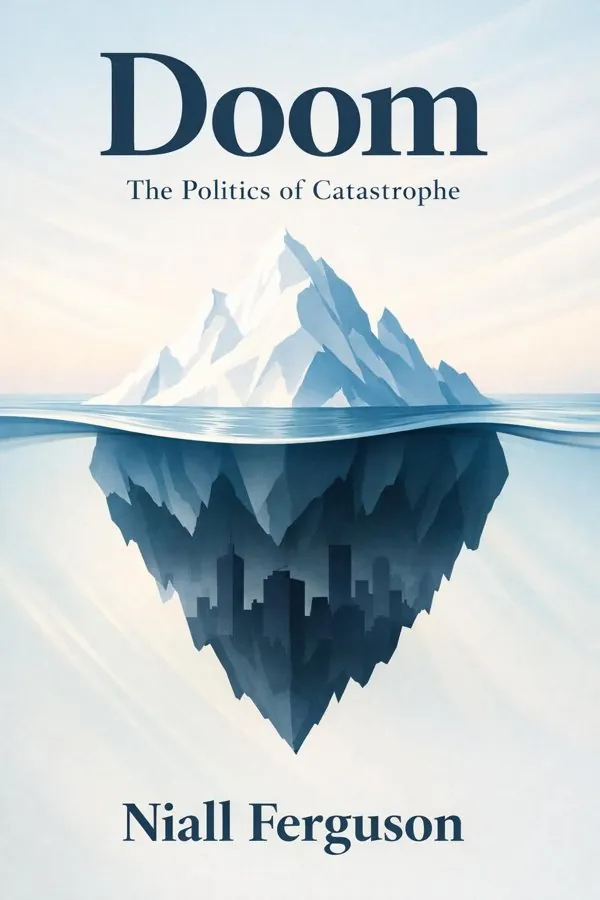
Doom: The Politics of Catastrophe: Summary & Key Insights
 10 min9 chaptersAudio available
Key Takeaways from Doom: The Politics of Catastrophe
A disaster does not begin when nature strikes; it begins when human systems fail to absorb the shock.
The future cannot be predicted with precision, but it can be approached with historical imagination.
The more connected a society becomes, the more efficiently it functions in normal times and the more quickly failure can spread in abnormal ones.
Catastrophes often look like failures of nature, but on closer inspection they are frequently failures of judgment.
Science can identify threats, but it cannot by itself produce wise public action.
What Is Doom: The Politics of Catastrophe About?
Doom: The Politics of Catastrophe by Niall Ferguson is a world_history book spanning 11 pages. Why do some societies survive catastrophe with surprising resilience while others collapse into confusion, blame, and institutional failure? In Doom: The Politics of Catastrophe, historian Niall Ferguson tackles that question through a sweeping study of pandemics, wars, famines, financial crashes, and other large-scale disasters. His central argument is both unsettling and clarifying: catastrophes are rarely just natural events. They become true disasters through political misjudgment, bureaucratic weakness, bad incentives, broken communication, and the inability of leaders to act under uncertainty. Ferguson draws on centuries of history, from the Black Death to modern pandemics, to show that human systems are often more fragile than we admit. He explores why experts miss obvious warnings, why governments repeat old mistakes, and why highly advanced societies can still respond chaotically when crisis strikes. Rather than offering a narrow history of disease or war, the book presents a broader theory of catastrophe in which networks, institutions, psychology, and power all matter. This matters because modern life is more interconnected than ever. Ferguson, one of the best-known historians of global power, finance, and empire, shows that understanding past disasters is essential if we want to prepare intelligently for the next one.
This FizzRead summary covers all 9 key chapters of Doom: The Politics of Catastrophe in approximately 10 minutes, distilling the most important ideas, arguments, and takeaways from Niall Ferguson's work. Also available as an audio summary and Key Quotes Podcast.
Doom: The Politics of Catastrophe
Why do some societies survive catastrophe with surprising resilience while others collapse into confusion, blame, and institutional failure? In Doom: The Politics of Catastrophe, historian Niall Ferguson tackles that question through a sweeping study of pandemics, wars, famines, financial crashes, and other large-scale disasters. His central argument is both unsettling and clarifying: catastrophes are rarely just natural events. They become true disasters through political misjudgment, bureaucratic weakness, bad incentives, broken communication, and the inability of leaders to act under uncertainty.
Ferguson draws on centuries of history, from the Black Death to modern pandemics, to show that human systems are often more fragile than we admit. He explores why experts miss obvious warnings, why governments repeat old mistakes, and why highly advanced societies can still respond chaotically when crisis strikes. Rather than offering a narrow history of disease or war, the book presents a broader theory of catastrophe in which networks, institutions, psychology, and power all matter.
This matters because modern life is more interconnected than ever. Ferguson, one of the best-known historians of global power, finance, and empire, shows that understanding past disasters is essential if we want to prepare intelligently for the next one.
Who Should Read Doom: The Politics of Catastrophe?
This book is perfect for anyone interested in world_history and looking to gain actionable insights in a short read. Whether you're a student, professional, or lifelong learner, the key ideas from Doom: The Politics of Catastrophe by Niall Ferguson will help you think differently.
- ✓Readers who enjoy world_history and want practical takeaways
- ✓Professionals looking to apply new ideas to their work and life
- ✓Anyone who wants the core insights of Doom: The Politics of Catastrophe in just 10 minutes
Want the full summary?
Get instant access to this book summary and 100K+ more with Fizz Moment.
Get Free SummaryAvailable on App Store • Free to download
Key Chapters
A disaster does not begin when nature strikes; it begins when human systems fail to absorb the shock. One of Ferguson’s most important insights is that catastrophe is never purely a matter of bad luck. Earthquakes, viruses, crop failures, financial panics, and wars may have different causes, but their human consequences depend heavily on political choices, institutional capacity, and social trust. In other words, the event itself is only part of the story. The scale of suffering is shaped by the way societies prepare, interpret warning signs, distribute resources, and coordinate action.
This distinction matters because it changes how we think about blame and responsibility. If disasters are seen as unavoidable acts of fate, leaders can present themselves as helpless victims of circumstance. Ferguson rejects that comfort. He argues that many catastrophes become devastating because governments react too slowly, experts become trapped in rigid assumptions, and institutions prioritize appearance over adaptation. The same pathogen or economic shock can produce radically different outcomes in different countries because political systems do not process risk in the same way.
History offers many examples. A disease outbreak in one era may devastate a region with weak administration while another area limits deaths through quarantine, communication, and public cooperation. Likewise, a financial crisis can become a social collapse when leaders deny the problem, delay intervention, or pursue self-protective politics. The lesson applies beyond governments. Businesses, schools, hospitals, and households also turn hazards into catastrophes when they neglect contingency planning.
The practical implication is simple but demanding: stop asking only what caused the shock, and start asking what made the system so vulnerable. Actionable takeaway: evaluate crises through a political lens by identifying where incentives, communication, and decision-making structures increase the damage of inevitable shocks.
The future cannot be predicted with precision, but it can be approached with historical imagination. Ferguson argues that history is our best laboratory for understanding catastrophe because societies have repeatedly faced versions of the same problem: low-probability events with massive consequences. By studying how past communities responded to plague, famine, war, and panic, we gain a richer understanding of recurring patterns in human behavior and institutional stress.
This historical method pushes against the belief that modern technology has made older lessons obsolete. Ferguson shows that while our tools have changed, our vulnerabilities have not disappeared. Leaders still minimize threats to avoid panic. Bureaucracies still move too slowly. Populations still oscillate between denial, fear, rumor, and scapegoating. The Black Death, for example, was a biological event, but it also transformed labor markets, social hierarchies, religion, and political authority. It revealed that catastrophe is never confined to one domain; it radiates across the whole structure of society.
The same applies to modern examples. The influenza pandemic of 1918, twentieth-century wars, and more recent financial and public-health crises all show that timing, trust, and administrative coherence often matter as much as technical expertise. Historical comparison helps us recognize when present-day debates are not new at all, but replays of older failures in a new vocabulary.
For readers, the value of this approach is practical. A company facing cyber risk can learn from military logistics. A city planning for climate shocks can learn from historical responses to fire, flood, and epidemic. History widens the menu of possibilities and warns us against naïve confidence.
Actionable takeaway: treat major past disasters as case studies, not distant curiosities, and regularly ask what your institution would do differently if tested under similar pressure.
The more connected a society becomes, the more efficiently it functions in normal times and the more quickly failure can spread in abnormal ones. Ferguson places great emphasis on networks and complexity. Modern civilization runs on dense webs of transportation, supply chains, communications, finance, data, and administrative coordination. These networks create prosperity, but they also create pathways along which panic, disease, and disruption can race.
This helps explain why advanced societies are not automatically safer than earlier ones. In fact, their sophistication can hide fragility. A tightly optimized system often has little slack. Hospitals rely on just-in-time delivery. Financial markets depend on confidence. Governments depend on interoperable layers of bureaucracy. When one critical node fails, the damage can cascade outward. A local outbreak becomes a global pandemic through travel networks. A software breach disrupts energy, transport, or health services. A shortage in one region triggers inflation and unrest elsewhere.
Ferguson’s point is not that complexity is bad, but that it changes the shape of risk. Catastrophe in a networked world is rarely linear. Small triggers can produce enormous consequences because systems are interdependent. That is why conventional forecasting often fails. Analysts may focus on individual threats while missing the architecture through which shocks propagate.
This insight has broad application. Organizations should map dependencies, identify single points of failure, and build redundancy where efficiency has gone too far. Governments should stress-test infrastructure and communication systems, not just estimate average performance. Individuals can apply the same principle by diversifying savings, developing backup plans, and not relying on a single channel for essential needs.
Actionable takeaway: examine the networks you depend on, identify where one breakdown could trigger many others, and build buffers before efficiency turns into systemic fragility.
Catastrophes often look like failures of nature, but on closer inspection they are frequently failures of judgment. Ferguson highlights the role of human error and institutional failure in turning manageable dangers into historic disasters. Leaders delay action because they fear overreaction. Officials suppress bad news because incentives reward calm rather than truth. Experts cling to outdated models. Bureaucracies follow procedure even when procedure no longer fits reality.
These failures are not random. They arise from predictable distortions in human systems. Organizations resist admitting uncertainty because it weakens authority. Political leaders prefer short-term reassurance to unpopular precautions. Agencies protect turf instead of sharing information. In crisis, these tendencies become lethal. The issue is not simply incompetence; it is the way institutions are structured to avoid embarrassment, diffuse responsibility, and reward conformity.
Ferguson’s analysis is especially useful because it goes beyond blaming individuals. He shows that bad outcomes often emerge from systems in which no one person sees the whole picture and no one is fully accountable for the result. This helps explain why highly educated, well-funded societies can still perform badly. Institutional design matters more than prestige.
The lesson extends beyond national emergencies. In a business, a product failure worsens when departments hide defects. In a hospital, communication lapses can turn routine complications into tragedy. In a family, a crisis spirals when everyone assumes someone else is handling it. Good systems make it easy to surface problems early and hard to ignore warning signals.
Actionable takeaway: create decision processes that reward fast reporting, dissenting views, and clear accountability, because the most dangerous error in a crisis is often the system’s refusal to recognize its own mistakes.
Science can identify threats, but it cannot by itself produce wise public action. Ferguson is careful not to dismiss expertise; in fact, he treats scientific knowledge as indispensable in confronting pandemics, environmental risks, and technological dangers. Yet he also argues that expertise alone is insufficient because crises are never merely technical. They are social and political events in which evidence must be interpreted, communicated, trusted, and translated into collective behavior.
One recurring problem is that experts are often asked to speak with certainty when certainty is impossible. During fast-moving emergencies, data are incomplete and models are provisional. This creates tension between scientific caution and political pressure. If experts overstate confidence, they damage credibility when facts change. If they speak too tentatively, leaders and citizens may fail to act. Ferguson shows that the relationship between science and policy is therefore fragile: good advice can be ignored, distorted, or weaponized.
Another problem is specialization. A virologist may understand pathogens but not social compliance. An economist may understand incentives but not public fear. Effective crisis management requires integrating multiple forms of knowledge rather than treating one discipline as sovereign. Ferguson’s broader message is that expertise must be embedded in institutions capable of learning, adapting, and communicating honestly.
In practical terms, this means leaders should not ask experts to remove politics from catastrophe. That is impossible. They should instead build transparent systems where evidence, trade-offs, and uncertainty are openly discussed. Citizens, too, need a more mature relationship with expertise: neither blind faith nor reflexive suspicion.
Actionable takeaway: respect expert knowledge, but pair it with clear communication, cross-disciplinary decision-making, and a willingness to revise plans as reality changes.
A pandemic is not only a public-health emergency; it is an X-ray of the entire political order. Ferguson uses epidemics and pandemics to show how disease reveals the true quality of governance. In ordinary times, weak institutions can hide behind growth, routine, and public optimism. In a fast-spreading health crisis, those weaknesses are suddenly visible. Delays in testing, confusion over authority, contradictory messaging, and administrative bottlenecks all expose whether a state can actually coordinate under pressure.
This is one reason pandemics matter so much in Ferguson’s framework. They combine uncertainty, speed, fear, and broad social disruption. They test hospitals, supply chains, border systems, research institutions, welfare mechanisms, and public trust all at once. A government may possess technical expertise yet still fail if agencies compete, laws are inflexible, or citizens no longer believe official statements. Conversely, less wealthy societies can sometimes perform better if they mobilize quickly, communicate clearly, and sustain civic cooperation.
Ferguson also shows that pandemics generate second-order effects that leaders often underestimate. School closures alter labor markets. Supply disruptions affect inflation and politics. Isolation worsens mental health. Emergency powers can expand state authority in ways that outlast the crisis itself. The management of disease therefore becomes a test not just of medicine, but of constitutional balance and social resilience.
For contemporary readers, the lesson is clear: preparedness should be broader than stockpiling equipment. It includes legal clarity, public trust, flexible administration, and systems for rapid learning. Households and organizations face similar truths. The stress of a health crisis often reveals hidden fragilities in childcare, finances, communication, and contingency planning.
Actionable takeaway: judge preparedness not by official plans alone, but by whether institutions can coordinate quickly, adapt transparently, and maintain trust when normal routines break down.
In a catastrophe, information is as decisive as food, medicine, or money. Ferguson emphasizes that crises are fought not only through logistics and policy, but through narratives, signals, and trust. People do not respond to events directly; they respond to what they believe is happening. That makes information management central to whether a society acts wisely or self-destructs through rumor, denial, panic, and blame.
This insight is especially powerful in modern media environments. Information now moves faster than institutions can verify it. Falsehoods spread because they are emotionally vivid, politically useful, or algorithmically rewarded. At the same time, official communication often fails because it is slow, sanitized, or openly inconsistent. When authorities lose credibility, citizens seek alternative sources, some of which are accurate and many of which are not. The result can be fragmentation at the exact moment coordinated action is most necessary.
Ferguson’s argument is not simply that misinformation is dangerous, though it is. It is that communication systems themselves shape the crisis. If people cannot distinguish guidance from propaganda, compliance drops. If media incentives favor outrage over clarity, social trust erodes. If leaders manipulate facts for political advantage, they make future emergency communication less effective, even when the threat is real.
This has practical relevance everywhere. Companies handling recalls must communicate early and honestly. Schools facing emergencies need one trusted channel and clear procedures. Families benefit from agreed plans rather than contradictory assumptions. Credibility is built before a crisis and spent during one.
Actionable takeaway: in any high-stakes situation, prioritize timely, transparent, and consistent communication, because when trust collapses, even good policies become difficult to implement.
The societies that weather catastrophe best are not necessarily the richest or the most technologically advanced; they are often the ones with stronger institutions and healthier civic habits. Ferguson compares how different countries and systems respond to crisis and finds that resilience emerges from a combination of administrative competence, social trust, flexibility, and cultural expectations about responsibility.
This comparative lens matters because it challenges simplistic explanations. Wealth helps, but it is not decisive. Authoritarian control may appear efficient in the short term, yet secrecy and fear can undermine adaptation. Democracies may seem disorderly, but if they maintain trust and decentralize effective action, they can perform extremely well. What matters is not ideology alone but the practical capacity to gather information, make decisions, correct errors, and secure public cooperation.
Culture also plays a subtle role. Some societies are better at delayed gratification, rule-following, local initiative, or mutual aid. Others are more vulnerable to polarization, distrust, or symbolic politics. These traits influence how populations respond to emergency measures and whether sacrifice is seen as collective duty or political coercion. Ferguson’s point is not that culture is destiny, but that resilience is social before it is mechanical.
For institutions, this means preparedness should include drills, redundancy, and legal clarity, but also trust-building and norms of responsibility. A workplace with open communication and shared purpose can adapt faster than one filled with fear and blame. A neighborhood where people know each other is safer in a crisis than one made up of isolated strangers.
Actionable takeaway: build resilience by strengthening both formal systems and informal trust, because the ability to endure catastrophe depends as much on relationships and habits as on resources.
One of the great paradoxes of catastrophe is that many disasters are foreseeable in general but unpredictable in exact form. Ferguson is skeptical of the fantasy that experts can tell us precisely when and how the next major crisis will arrive. Yet he is equally critical of the fatalistic response that says prediction is impossible, so preparation is pointless. The real challenge is to prepare for classes of catastrophe without pretending to know the details in advance.
This is what makes the politics of prediction so difficult. Politicians are rewarded for visible short-term results, not for spending on hypothetical future threats. Citizens often ignore warnings that lack immediate emotional force. Bureaucracies build plans around the last crisis rather than the next one. As a result, societies oscillate between complacency before disaster and overreaction after it. Ferguson sees this cycle as one of the core failures of modern governance.
The answer is not prophecy but scenario thinking. Institutions should ask what kinds of shocks could cascade through health, energy, finance, food, or security systems. They should model dependencies, maintain strategic reserves where sensible, and cultivate adaptable rather than rigid plans. The same mindset applies personally. You may not know whether your next disruption will be illness, job loss, cyberattack, or natural disaster, but you can still improve liquidity, communication plans, and practical readiness.
Ferguson’s broader warning is moral as well as strategic: false confidence is dangerous, but so is learned helplessness. Mature societies accept uncertainty without surrendering initiative.
Actionable takeaway: stop waiting for precise forecasts and instead prepare flexible responses to broad categories of disruption, because resilience comes from adaptability, not clairvoyance.
All Chapters in Doom: The Politics of Catastrophe
About the Author
Niall Ferguson is a British historian, author, and public intellectual known for his work on economic history, empire, finance, and global power. He has taught at leading institutions including Oxford, Harvard, and Stanford, and is a senior fellow at the Hoover Institution. Ferguson became widely recognized through bestselling books such as The Ascent of Money, Empire, Civilization: The West and the Rest, and The Square and the Tower. His writing often connects large historical developments to contemporary political and economic questions, making him one of the most influential historians in public debate. In Doom: The Politics of Catastrophe, he applies that broad historical lens to the study of disasters, examining how institutions, networks, and leadership shape the way societies endure or mishandle crisis.
Get This Summary in Your Preferred Format
Read or listen to the Doom: The Politics of Catastrophe summary by Niall Ferguson anytime, anywhere. FizzRead offers multiple formats so you can learn on your terms — all free.
Available formats: App · Audio · PDF · EPUB — All included free with FizzRead
Download Doom: The Politics of Catastrophe PDF and EPUB Summary
Key Quotes from Doom: The Politics of Catastrophe
“A disaster does not begin when nature strikes; it begins when human systems fail to absorb the shock.”
“The future cannot be predicted with precision, but it can be approached with historical imagination.”
“The more connected a society becomes, the more efficiently it functions in normal times and the more quickly failure can spread in abnormal ones.”
“Catastrophes often look like failures of nature, but on closer inspection they are frequently failures of judgment.”
“Science can identify threats, but it cannot by itself produce wise public action.”
Frequently Asked Questions about Doom: The Politics of Catastrophe
Doom: The Politics of Catastrophe by Niall Ferguson is a world_history book that explores key ideas across 9 chapters. Why do some societies survive catastrophe with surprising resilience while others collapse into confusion, blame, and institutional failure? In Doom: The Politics of Catastrophe, historian Niall Ferguson tackles that question through a sweeping study of pandemics, wars, famines, financial crashes, and other large-scale disasters. His central argument is both unsettling and clarifying: catastrophes are rarely just natural events. They become true disasters through political misjudgment, bureaucratic weakness, bad incentives, broken communication, and the inability of leaders to act under uncertainty. Ferguson draws on centuries of history, from the Black Death to modern pandemics, to show that human systems are often more fragile than we admit. He explores why experts miss obvious warnings, why governments repeat old mistakes, and why highly advanced societies can still respond chaotically when crisis strikes. Rather than offering a narrow history of disease or war, the book presents a broader theory of catastrophe in which networks, institutions, psychology, and power all matter. This matters because modern life is more interconnected than ever. Ferguson, one of the best-known historians of global power, finance, and empire, shows that understanding past disasters is essential if we want to prepare intelligently for the next one.
More by Niall Ferguson
The Square and the Tower: Networks and Power, from the Freemasons to Facebook
Niall Ferguson
10 min
Empire: How Britain Made the Modern World
Niall Ferguson
10 min
The Ascent Of Money: A Financial History Of The World
Niall Ferguson
10 min
The House of Rothschild: Money's Prophets 1798–1848
Niall Ferguson
10 minYou Might Also Like
The Age of Capital
Eric Hobsbawm
10 min
The Gulag Archipelago
Aleksandr Solzhenitsyn
10 min
Jerusalem: The Biography
Simon Sebag Montefiore
10 min
The Anglo-Saxons
James Campbell
10 min
The Boer War
Thomas Pakenham
10 min
The Industrial Revolutionaries: The Making of the Modern World 1776–1914
Gavin Weightman
10 minBrowse by Category
Ready to read Doom: The Politics of Catastrophe?
Get the full summary and 100K+ more books with Fizz Moment.