
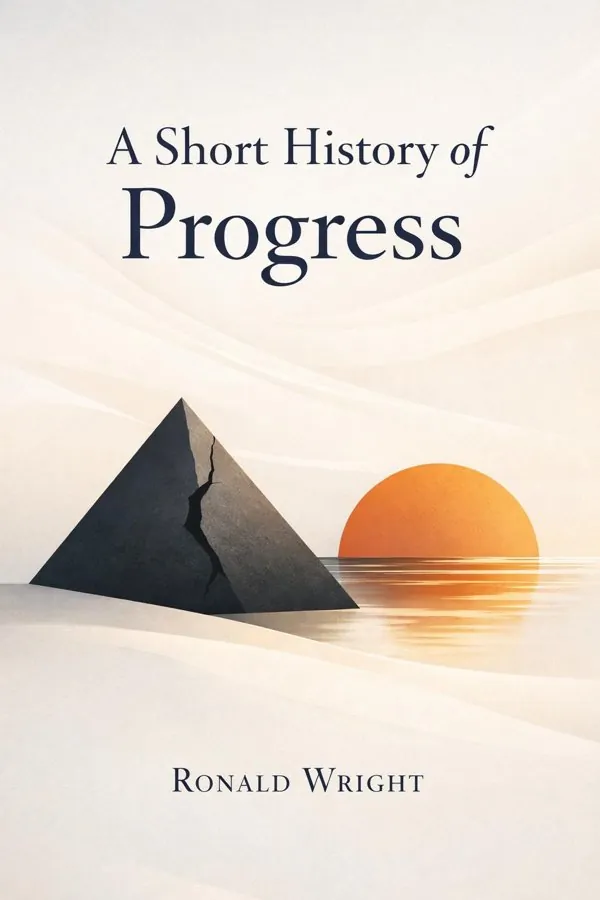
A Short History of Progress: Summary & Key Insights
 10 min9 chaptersAudio available
What Is A Short History of Progress About?
A Short History of Progress by Ronald Wright is a civilization book spanning 9 pages. A Short History of Progress is a nonfiction work by Canadian author Ronald Wright that examines the patterns of progress and collapse in past civilizations. Drawing on archaeology, anthropology, and history, Wright argues that humanity’s technological and social advances often lead to overexploitation of resources, resulting in societal decline. The book warns that modern industrial civilization may be repeating the same mistakes that doomed earlier societies.
This FizzRead summary covers all 9 key chapters of A Short History of Progress in approximately 10 minutes, distilling the most important ideas, arguments, and takeaways from Ronald Wright's work. Also available as an audio summary and Key Quotes Podcast.
A Short History of Progress
A Short History of Progress is a nonfiction work by Canadian author Ronald Wright that examines the patterns of progress and collapse in past civilizations. Drawing on archaeology, anthropology, and history, Wright argues that humanity’s technological and social advances often lead to overexploitation of resources, resulting in societal decline. The book warns that modern industrial civilization may be repeating the same mistakes that doomed earlier societies.
Who Should Read A Short History of Progress?
This book is perfect for anyone interested in civilization and looking to gain actionable insights in a short read. Whether you're a student, professional, or lifelong learner, the key ideas from A Short History of Progress by Ronald Wright will help you think differently.
- ✓Readers who enjoy civilization and want practical takeaways
- ✓Professionals looking to apply new ideas to their work and life
- ✓Anyone who wants the core insights of A Short History of Progress in just 10 minutes
Want the full summary?
Get instant access to this book summary and 100K+ more with Fizz Moment.
Get Free SummaryAvailable on App Store • Free to download
Key Chapters
Easter Island stands as perhaps the most haunting microcosm of the progress trap. Imagine a small, isolated island in the vast Pacific, home to people who possessed remarkable organizational skill and spiritual fervor. They carved and raised colossal stone statues—moai—that still gaze over the landscape, silent witnesses to their builders’ fate. When I first studied the archaeological record of Easter Island, I saw not a mystery but a mirror: a culture that expanded its vision beyond the carrying capacity of its land.
The islanders cut down trees to move statues, to build canoes, to cook food. Gradually, the forest vanished. With the trees went the soil, the birds, the means of fishing and shelter. The population grew even as resources dwindled, faith intensifying in cults that promised supernatural intervention. In short, the islanders trapped themselves in a system that could not last—a civilization feeding on its own foundations. By the time Europeans arrived, Easter Island was a shadow of its former self, its people impoverished and divided, its statues reminders of ambition gone awry.
What makes this tragedy instructive is not simply the islanders’ folly, but their humanity. They were not irrational; they were doing what humans have always done—pushing boundaries, harnessing nature, celebrating achievement. The progress trap emerges precisely when success blinds us to limits. Easter Island’s fate was sealed when its culture elevated glory over sustainability. When I look at our modern cities lit through the night, our factories humming without pause, our markets demanding perpetual growth, I see the same logic—scaled from an island to a planet. The warning from Easter Island is clear: even the cleverest civilization cannot survive if it consumes the source of its life.
In the fertile lands between the Tigris and Euphrates rivers, the Sumerians invented civilization as we know it—writing, cities, laws, and organized religion. Their ingenuity transformed wild floodplains into irrigated farmland, feeding populations that grew rapidly. But progress once again led into a trap. Sumer’s irrigation systems, ingenious as they were, slowly poisoned the land. The salt left behind by constant watering built up in the soil, reducing yields decade by decade until the once-green plain turned barren.
Here, we glimpse a pattern that recurs throughout history: a short-term solution that creates long-term decay. The Sumerians expanded their capacity to produce food, but failed to understand the environmental feedback loops they unleashed. They were locked in the logic of growth—more grain, more wealth, more power—unaware that their system had no room for renewal. Their decline was gradual, imperceptible to those living through it. Political instability and warfare compounded ecological stress, and the center could not hold.
In telling Sumer’s story, I wish to highlight how innovation alone cannot insure survival. Knowledge must be coupled with restraint, foresight, and, above all, a sense of interdependence between human systems and natural ones. The story of Sumer is not simply about ancient farmers and kings; it is about us. We mine the Earth for resources, we irrigate markets with credit, we harvest fossil fuels as they harvested grain—all to sustain growth we treat as sacred. But the Earth’s ecology, like Sumer’s soil, has limits. Progress, unchecked by humility, corrodes its own foundations.
+ 7 more chapters — available in the FizzRead app
All Chapters in A Short History of Progress
About the Author
Ronald Wright is a Canadian author, historian, and essayist known for his works on history, culture, and the environment. His writing often explores the relationship between human progress and ecological sustainability. Wright’s background in archaeology and anthropology informs his critical perspective on civilization’s trajectory.
Get This Summary in Your Preferred Format
Read or listen to the A Short History of Progress summary by Ronald Wright anytime, anywhere. FizzRead offers multiple formats so you can learn on your terms — all free.
Available formats: App · Audio · PDF · EPUB — All included free with FizzRead
Download A Short History of Progress PDF and EPUB Summary
Key Quotes from A Short History of Progress
“Easter Island stands as perhaps the most haunting microcosm of the progress trap.”
“In the fertile lands between the Tigris and Euphrates rivers, the Sumerians invented civilization as we know it—writing, cities, laws, and organized religion.”
Frequently Asked Questions about A Short History of Progress
A Short History of Progress by Ronald Wright is a civilization book that explores key ideas across 9 chapters. A Short History of Progress is a nonfiction work by Canadian author Ronald Wright that examines the patterns of progress and collapse in past civilizations. Drawing on archaeology, anthropology, and history, Wright argues that humanity’s technological and social advances often lead to overexploitation of resources, resulting in societal decline. The book warns that modern industrial civilization may be repeating the same mistakes that doomed earlier societies.
You Might Also Like

The Structure of Scientific Revolutions
Thomas S. Kuhn
10 min
Genius
Harold Bloom
10 min
A Cultural History of the Medieval Age
Various Editors
10 min
A History of God: The 4,000-Year Quest of Judaism, Christianity and Islam
Karen Armstrong
10 min
A History of the World in 10½ Chapters
Julian Barnes
10 min
A Study of History
Arnold J. Toynbee
10 minBrowse by Category
Ready to read A Short History of Progress?
Get the full summary and 100K+ more books with Fizz Moment.