
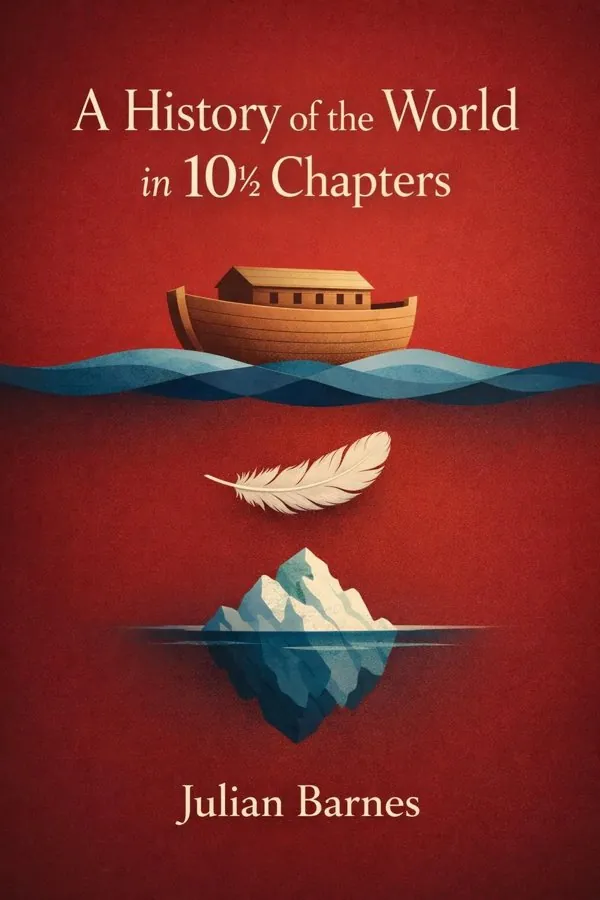
A History of the World in 10½ Chapters: Summary & Key Insights
 10 min9 chaptersAudio available
Key Takeaways from A History of the World in 10½ Chapters
One of the book’s sharpest insights is that history often begins not with truth, but with whoever survives to tell the story.
Modernity likes to imagine that it has outgrown ancient chaos, yet Barnes repeatedly suggests that violence simply changes costume.
Barnes does not attack belief in a simple or dismissive way.
Many stories celebrate survival as an unquestioned good, but Barnes insists that survival is often ethically ambiguous.
In “Shipwreck,” Barnes turns to painting, especially the representation of catastrophe in art, to ask how suffering becomes culture.
What Is A History of the World in 10½ Chapters About?
A History of the World in 10½ Chapters by Julian Barnes is a civilization book spanning 11 pages. Julian Barnes’s A History of the World in 10½ Chapters is not a conventional novel and certainly not a conventional history. Instead, it is a dazzling sequence of interconnected stories that move from Noah’s Ark to modern terrorism, from shipwreck paintings to obsessive quests for religious proof, all while asking a destabilizing question: who gets to tell the story of the world? Across ten chapters and one “half chapter,” Barnes blends fiction, essay, satire, myth, and philosophical reflection to expose how history is shaped by fear, desire, power, and memory rather than neutral fact alone. The result is a book that feels playful and unsettling at the same time. It can be read as a meditation on civilization, on the stories societies invent to survive chaos, and on the fragile human search for meaning in the face of disaster. Barnes is one of the most intellectually agile novelists in contemporary English literature, celebrated for his wit, formal invention, and deep interest in memory, love, and mortality. This book remains one of his boldest achievements: a brilliant challenge to the stories we trust most.
This FizzRead summary covers all 9 key chapters of A History of the World in 10½ Chapters in approximately 10 minutes, distilling the most important ideas, arguments, and takeaways from Julian Barnes's work. Also available as an audio summary and Key Quotes Podcast.
A History of the World in 10½ Chapters
Julian Barnes’s A History of the World in 10½ Chapters is not a conventional novel and certainly not a conventional history. Instead, it is a dazzling sequence of interconnected stories that move from Noah’s Ark to modern terrorism, from shipwreck paintings to obsessive quests for religious proof, all while asking a destabilizing question: who gets to tell the story of the world? Across ten chapters and one “half chapter,” Barnes blends fiction, essay, satire, myth, and philosophical reflection to expose how history is shaped by fear, desire, power, and memory rather than neutral fact alone. The result is a book that feels playful and unsettling at the same time. It can be read as a meditation on civilization, on the stories societies invent to survive chaos, and on the fragile human search for meaning in the face of disaster. Barnes is one of the most intellectually agile novelists in contemporary English literature, celebrated for his wit, formal invention, and deep interest in memory, love, and mortality. This book remains one of his boldest achievements: a brilliant challenge to the stories we trust most.
Who Should Read A History of the World in 10½ Chapters?
This book is perfect for anyone interested in civilization and looking to gain actionable insights in a short read. Whether you're a student, professional, or lifelong learner, the key ideas from A History of the World in 10½ Chapters by Julian Barnes will help you think differently.
- ✓Readers who enjoy civilization and want practical takeaways
- ✓Professionals looking to apply new ideas to their work and life
- ✓Anyone who wants the core insights of A History of the World in 10½ Chapters in just 10 minutes
Want the full summary?
Get instant access to this book summary and 100K+ more with Fizz Moment.
Get Free SummaryAvailable on App Store • Free to download
Key Chapters
One of the book’s sharpest insights is that history often begins not with truth, but with whoever survives to tell the story. Barnes announces this immediately in “The Stowaway,” where Noah’s Ark is retold by a woodworm. By choosing a tiny, despised creature rather than a prophet or patriarch, Barnes mocks the grandeur of sacred history and invites us to question every official version of events. The Ark, usually remembered as a story of divine order and salvation, becomes instead a cramped vessel of hierarchy, violence, and arbitrary privilege. Some animals are valued, others are exterminated, and survival depends less on virtue than on power and convenience.
This reversal matters because it reveals how civilization constructs noble stories out of messy realities. Nations, religions, families, and institutions all create heroic narratives that conceal exclusion, suffering, and chance. Barnes is not simply being irreverent; he is showing that the past is always filtered through perspective. The woodworm’s account reminds us that marginal voices can expose what official records suppress.
In practical terms, this chapter encourages skeptical reading. When you encounter a triumphant corporate case study, a patriotic national myth, or a family legend about the past, ask what has been omitted. Who benefited? Who was silenced? Which details were polished into moral lessons after the fact?
Actionable takeaway: whenever you hear a tidy story about the past, look for the viewpoint missing from the record and let that absence change your interpretation.
Modernity likes to imagine that it has outgrown ancient chaos, yet Barnes repeatedly suggests that violence simply changes costume. In “The Visitors,” a luxury cruise is seized by terrorists, turning a leisure voyage into a floating theater of fear. The setting is contemporary, but the emotional logic is ancient: panic, tribal division, false leadership, and rituals of sacrifice. What appears at first to be a break from biblical or mythic history turns out to be a continuation of it.
Barnes uses the ship as a miniature civilization. It is ordered, comfortable, and governed by rules until crisis strips away the illusion of stability. Then people improvise explanations, cling to authority, and search for meaning in random events. This echoes the book’s broader claim that history is not a smooth ascent into reason. Human beings remain vulnerable to fanaticism, miscommunication, and sudden brutality, no matter how technologically advanced they become.
The practical significance is clear. We often assume systems are secure because they function normally in ordinary times. But institutions, organizations, and even personal identities are tested under stress, not comfort. A workplace during a merger, a family during illness, or a society during political unrest reveals how quickly civility can fray.
Barnes’s lesson is not pure pessimism. Rather, he warns against complacency. If terror, disorder, and irrationality recur across centuries, then the responsible response is vigilance, empathy, and institutional humility.
Actionable takeaway: judge the strength of any system not by how elegant it looks in calm conditions, but by how humanely and intelligently it behaves in crisis.
Several chapters, especially “The Wars of Religion,” “The Mountain,” and “Project Ararat,” explore a difficult idea: faith can inspire meaning and endurance, but it can also harden into obsession. Barnes does not attack belief in a simple or dismissive way. Instead, he studies what happens when people become so attached to sacred explanations that they distort evidence, justify cruelty, or sacrifice reality itself. Religious conflict in the book is never merely theological; it is political, psychological, and deeply human.
In “The Mountain,” the attempt to climb toward a sacred site becomes a study in projection. In “Project Ararat,” the search for physical proof of Noah’s Ark reflects a modern desire to stabilize belief through material confirmation. Yet the quest reveals something paradoxical: certainty is often less spiritual than insecurity. The more a person needs proof, the more fragile belief may already be.
This insight extends beyond religion. Ideologies of all kinds can behave like faith systems. Political movements, wellness doctrines, investment manias, and even personal self-images can become unquestionable frameworks. Once people define themselves through belief, contrary evidence feels like an attack on identity.
Barnes asks readers to distinguish between humility and dogmatism. Genuine faith may coexist with doubt, metaphor, and compassion. Fanaticism cannot. It seeks control, purity, and final answers.
Actionable takeaway: when a belief system promises total certainty and discourages questioning, pause and examine whether it is offering wisdom or merely protecting itself from truth.
Many stories celebrate survival as an unquestioned good, but Barnes insists that survival is often ethically ambiguous. In “The Survivor,” this ambiguity becomes especially vivid. Survival may require endurance, imagination, denial, compromise, or selfishness. It can be heroic, but it can also be absurd, lonely, and morally compromised. Barnes resists sentimental narratives in which those who endure are automatically noble or those who perish somehow failed.
This is one of the book’s most important challenges to the way civilization tells stories. Historical accounts often divide people into victors and victims, survivors and losers, then assign moral meaning to outcomes that may have depended largely on chance. But Barnes shows that catastrophe does not distribute justice. Those who survive may do so by luck, adaptation, or a willingness to accept intolerable realities.
This idea has strong contemporary resonance. In careers, relationships, health crises, or economic downturns, people often romanticize resilience without acknowledging unequal conditions. Telling someone to “be strong” can erase the structural and random factors shaping their situation. Barnes asks us to look more honestly at endurance: what did survival cost, and who was never given the same chance?
At a personal level, the chapter also suggests that survival includes storytelling. We narrate our lives to make continuing possible. Sometimes those narratives are accurate; sometimes they are sustaining illusions.
Actionable takeaway: respect survival, but do not moralize it too quickly; always ask what conditions, sacrifices, and accidents shaped who made it through.
In “Shipwreck,” Barnes turns to painting, especially the representation of catastrophe in art, to ask how suffering becomes culture. A shipwreck is a brutal event of panic, drowning, and human helplessness. Yet once painted, narrated, or exhibited, it can become beautiful, meaningful, and even prestigious. Barnes is fascinated by this conversion. Art preserves disaster, but it also reshapes it, selecting angles, symbols, and emotional tones that may distance us from the original pain.
This chapter deepens the book’s argument about history. The past does not reach us raw; it arrives mediated through images, archives, institutions, and stories. A painting of catastrophe may reveal truth, but it can also aestheticize suffering. The viewer admires composition and symbolism while real victims become material for interpretation.
That tension matters in modern life too. News media, documentaries, social platforms, and memorial culture all turn trauma into representation. We may become informed, compassionate, or politically active through those representations. But we may also become spectators, consuming suffering at a safe distance.
Barnes does not conclude that art is exploitative. On the contrary, he recognizes its power to rescue events from oblivion and to force moral attention. But he asks us to remain aware of the gap between event and image, victim and viewer, pain and narrative.
Actionable takeaway: when encountering artistic or media portrayals of tragedy, appreciate their insight while also asking what they illuminate, what they beautify, and what reality remains outside the frame.
The famous half chapter, “Parenthesis,” shifts the book into a more direct meditation on love and may initially seem disconnected from the surrounding stories of disaster, faith, and history. In fact, it provides their emotional counterweight. Barnes argues that love is one of the few human experiences that can temporarily resist the deadening abstractions of historical explanation. History categorizes, generalizes, and reduces people to patterns. Love restores singularity. It says this person mattered, this moment mattered, this life was not interchangeable.
Yet Barnes is too subtle to treat love as a simple solution. Love does not abolish death, randomness, or suffering. It is vulnerable to idealization, loss, misunderstanding, and time. Still, it remains essential because without it, history becomes merely a sequence of power struggles and catastrophes. Love interrupts that bleakness by insisting on attachment, tenderness, and subjective value.
This chapter also changes how we read the rest of the book. The earlier episodes of violence and absurdity are not canceled, but they are reframed. If history is unreliable, fragmented, and often cruel, then private acts of care become all the more meaningful. Love may not explain the world, but it makes living in it possible.
In practical life, this insight reminds us not to let productivity, ideology, or public narratives eclipse intimate human commitments. Achievement and explanation matter, but so do affection, loyalty, and presence.
Actionable takeaway: protect the relationships that make your life feel personally meaningful, because they provide a form of truth that no historical system can replace.
A conventional history of civilization often suggests movement from barbarism to enlightenment, from superstition to reason, from danger to control. Barnes dismantles that comforting storyline. Across “Three Simple Stories,” “Upstream!,” and other chapters, he shows that human history is less a steady ladder than a series of repetitions, reversals, and ironic detours. New technologies, new institutions, and new ideas do not erase old patterns of vanity, domination, error, and self-deception.
This is not to say nothing improves. Rather, Barnes challenges the confidence with which societies declare themselves advanced. A more modern world may still be deeply irrational. It may produce better machines while preserving ancient prejudices. It may expand knowledge without increasing wisdom. In that sense, civilization is not a finished achievement but a precarious arrangement maintained against recurring disorder.
This perspective is useful whenever institutions celebrate their own progress. A university may tout inclusion while reproducing elitism. A company may champion innovation while mistreating employees. A nation may praise freedom while rewriting uncomfortable parts of its history. Barnes teaches readers to separate progress as rhetoric from progress as lived reality.
Personally, the same insight applies to self-improvement. Growth is not linear. People revisit old fears, repeat old mistakes, and discover that maturity requires continual revision rather than final arrival.
Actionable takeaway: treat claims of progress as hypotheses to be tested, not slogans to be accepted; ask what has genuinely changed and what has merely acquired a more modern vocabulary.
What makes A History of the World in 10½ Chapters so memorable is not just its themes but its structure. The chapters seem separate at first, yet Barnes links them through recurring images of boats, floods, voyages, trials, survival, judgment, and longing. These echoes suggest that the past does not vanish; it reappears in altered forms. Myths become politics, voyages become invasions, religious stories become psychological patterns, and private grief mirrors public catastrophe.
This structural method teaches an important idea about civilization: history is not merely chronological accumulation. It is associative. Human beings understand the world by connecting events across time, often through symbols and narrative resemblance rather than strict causality. Barnes’s fragmented form captures how memory actually works. We do not experience the past as a neat timeline. We experience it as recurring motifs, emotional parallels, and uneasy recognitions.
That approach also changes the role of the reader. Instead of passively receiving a thesis, the reader becomes an active interpreter, noticing patterns and building meaning from fragments. This is one reason the novel remains so rewarding: it treats understanding as participation.
In everyday life, we do something similar. We make sense of careers by noticing repeated choices, of families by tracing inherited habits, and of societies by seeing how old anxieties return under new labels. Recognizing patterns can reveal deeper truths than simply memorizing dates or facts.
Actionable takeaway: when trying to understand a complex situation, do not just list events in order; look for recurring images, habits, and emotional patterns that connect them.
In “The Dream,” Barnes offers one of the book’s most darkly comic and profound reflections: even our fantasies of perfect fulfillment may collapse under scrutiny. Heaven, imagined as the place where every desire is satisfied, turns out to be tedious, thin, and strangely empty. Without risk, limitation, loss, or longing, fulfillment loses its meaning. The chapter extends the book’s broader skepticism toward all totalizing narratives, including religious consolation and secular utopias.
This insight is surprisingly practical. People often organize their lives around imagined endpoints: the ideal career, the perfect relationship, financial freedom, retirement, recognition, peace of mind. Yet Barnes suggests that human beings do not simply want satisfaction. We also need striving, surprise, difficulty, and the resistance of reality. A life with nothing to overcome may feel less like paradise than sedation.
The chapter also critiques consumer culture’s promise that happiness can be delivered through endless choice and comfort. If every wish is instantly granted, desire itself weakens. Meaning comes not only from having, but from caring, pursuing, risking, and sometimes failing.
Barnes is not glorifying suffering. He is warning against shallow versions of happiness that remove everything difficult and therefore everything significant. A meaningful life requires texture, not permanent ease.
Actionable takeaway: instead of chasing a fantasy of flawless completion, build a life rich in purpose, challenge, affection, and curiosity—the conditions under which satisfaction remains alive rather than empty.
All Chapters in A History of the World in 10½ Chapters
About the Author
Julian Barnes is an English novelist, essayist, and short story writer born in Leicester in 1946. Educated in London and Oxford, he became one of the most admired voices in contemporary British literature through fiction that combines stylistic precision, irony, and emotional intelligence. His work frequently explores memory, history, love, art, and mortality, often questioning the stories people tell to make sense of their lives. Barnes has written numerous acclaimed books, including Flaubert’s Parrot, England, England, Arthur & George, and The Sense of an Ending, which won the Man Booker Prize in 2011. He has also published essays and nonfiction on literature, music, and French culture. A History of the World in 10½ Chapters remains one of his most inventive and intellectually ambitious works.
Get This Summary in Your Preferred Format
Read or listen to the A History of the World in 10½ Chapters summary by Julian Barnes anytime, anywhere. FizzRead offers multiple formats so you can learn on your terms — all free.
Available formats: App · Audio · PDF · EPUB — All included free with FizzRead
Download A History of the World in 10½ Chapters PDF and EPUB Summary
Key Quotes from A History of the World in 10½ Chapters
“One of the book’s sharpest insights is that history often begins not with truth, but with whoever survives to tell the story.”
“Modernity likes to imagine that it has outgrown ancient chaos, yet Barnes repeatedly suggests that violence simply changes costume.”
“Several chapters, especially “The Wars of Religion,” “The Mountain,” and “Project Ararat,” explore a difficult idea: faith can inspire meaning and endurance, but it can also harden into obsession.”
“Many stories celebrate survival as an unquestioned good, but Barnes insists that survival is often ethically ambiguous.”
“In “Shipwreck,” Barnes turns to painting, especially the representation of catastrophe in art, to ask how suffering becomes culture.”
Frequently Asked Questions about A History of the World in 10½ Chapters
A History of the World in 10½ Chapters by Julian Barnes is a civilization book that explores key ideas across 9 chapters. Julian Barnes’s A History of the World in 10½ Chapters is not a conventional novel and certainly not a conventional history. Instead, it is a dazzling sequence of interconnected stories that move from Noah’s Ark to modern terrorism, from shipwreck paintings to obsessive quests for religious proof, all while asking a destabilizing question: who gets to tell the story of the world? Across ten chapters and one “half chapter,” Barnes blends fiction, essay, satire, myth, and philosophical reflection to expose how history is shaped by fear, desire, power, and memory rather than neutral fact alone. The result is a book that feels playful and unsettling at the same time. It can be read as a meditation on civilization, on the stories societies invent to survive chaos, and on the fragile human search for meaning in the face of disaster. Barnes is one of the most intellectually agile novelists in contemporary English literature, celebrated for his wit, formal invention, and deep interest in memory, love, and mortality. This book remains one of his boldest achievements: a brilliant challenge to the stories we trust most.
More by Julian Barnes




You Might Also Like
The Structure of Scientific Revolutions
Thomas S. Kuhn
10 min
Genius
Harold Bloom
10 min
A Cultural History of the Medieval Age
Various Editors
10 min
A History of God: The 4,000-Year Quest of Judaism, Christianity and Islam
Karen Armstrong
10 min
A Short History of Progress
Ronald Wright
10 min
A Study of History
Arnold J. Toynbee
10 minBrowse by Category
Ready to read A History of the World in 10½ Chapters?
Get the full summary and 100K+ more books with Fizz Moment.