
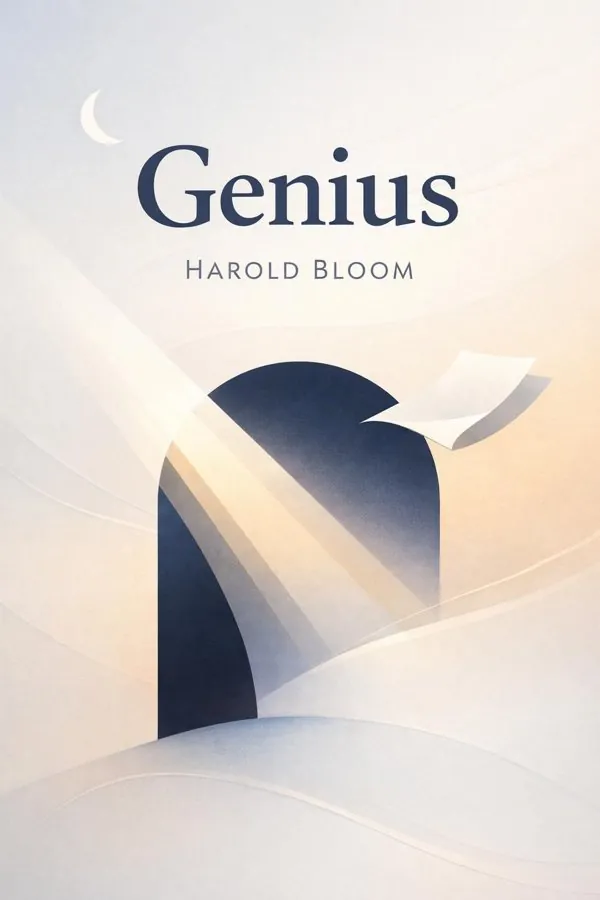
Genius: Summary & Key Insights
by Harold Bloom
 10 min9 chaptersAudio available
Key Takeaways from Genius
The surest sign of genius, Bloom suggests, is not fame or technical mastery, but the power to change how we think and feel through language.
Many works are new; very few are original in the way Bloom values.
A canon, in Bloom’s view, is not simply a school reading list or a cultural badge of prestige.
One of Bloom’s most provocative claims is that reading at the highest level is not primarily a social duty but a mode of individual liberation.
Bloom does not deny that writers emerge from particular times and places, but he resists the idea that context can fully explain greatness.
What Is Genius About?
Genius by Harold Bloom is a civilization book. What makes a writer, thinker, or artist truly unforgettable? In Genius, Harold Bloom takes on that ambitious question by guiding readers through a vast gallery of the world’s greatest creative minds. Rather than offering a scientific theory of intelligence or a self-help formula for brilliance, Bloom explores genius as a literary and cultural force: a rare capacity to reshape language, deepen human consciousness, and alter how later generations imagine reality. Moving across centuries and civilizations, he considers figures such as Shakespeare, Dante, Cervantes, Tolstoy, and many others, asking what sets them apart and why their work continues to feel alive. The book matters because it defends the enduring value of reading deeply in an age often distracted by speed, fashion, and ideology. Bloom writes not as a neutral cataloger but as one of the most influential literary critics of the modern era, known for his passionate engagement with the Western canon and his bold, often controversial judgments. Genius is both a celebration of extraordinary creativity and an invitation to become a more serious, attentive reader.
This FizzRead summary covers all 9 key chapters of Genius in approximately 10 minutes, distilling the most important ideas, arguments, and takeaways from Harold Bloom's work. Also available as an audio summary and Key Quotes Podcast.
Genius
What makes a writer, thinker, or artist truly unforgettable? In Genius, Harold Bloom takes on that ambitious question by guiding readers through a vast gallery of the world’s greatest creative minds. Rather than offering a scientific theory of intelligence or a self-help formula for brilliance, Bloom explores genius as a literary and cultural force: a rare capacity to reshape language, deepen human consciousness, and alter how later generations imagine reality. Moving across centuries and civilizations, he considers figures such as Shakespeare, Dante, Cervantes, Tolstoy, and many others, asking what sets them apart and why their work continues to feel alive. The book matters because it defends the enduring value of reading deeply in an age often distracted by speed, fashion, and ideology. Bloom writes not as a neutral cataloger but as one of the most influential literary critics of the modern era, known for his passionate engagement with the Western canon and his bold, often controversial judgments. Genius is both a celebration of extraordinary creativity and an invitation to become a more serious, attentive reader.
Who Should Read Genius?
This book is perfect for anyone interested in civilization and looking to gain actionable insights in a short read. Whether you're a student, professional, or lifelong learner, the key ideas from Genius by Harold Bloom will help you think differently.
- ✓Readers who enjoy civilization and want practical takeaways
- ✓Professionals looking to apply new ideas to their work and life
- ✓Anyone who wants the core insights of Genius in just 10 minutes
Want the full summary?
Get instant access to this book summary and 100K+ more with Fizz Moment.
Get Free SummaryAvailable on App Store • Free to download
Key Chapters
The surest sign of genius, Bloom suggests, is not fame or technical mastery, but the power to change how we think and feel through language. Great writers do more than tell stories or express ideas. They expand consciousness itself. After reading them, we do not simply remember their plots or arguments; we perceive human experience differently. Shakespeare, for Bloom, is the supreme example because his characters seem to invent inwardness as we now understand it. Their self-awareness, contradictions, and verbal energy make readers feel that the mind can be larger, stranger, and more fluid than common speech allows.
Bloom’s idea pushes us beyond simple admiration. Genius is not merely excellence performed at a high level. It is originality so deep that it alters the available possibilities of expression for everyone who comes after. Dante reimagines the moral universe in poetic form. Cervantes transforms narrative irony. Tolstoy enlarges the novel’s moral and psychological range. In each case, language becomes an instrument for remaking reality, not just describing it.
This matters in practical terms because it changes how we read. Instead of asking whether a classic is "relevant," Bloom asks whether it enlarges our capacity for attention, judgment, and imagination. A reader approaching Hamlet, The Divine Comedy, or Don Quixote should listen for the ways these works create new forms of thinking rather than simply reflecting old ones.
A useful application is to keep a reading journal focused on moments when a text changes your way of naming experience. Notice sentences, scenes, or images that make you understand jealousy, grief, ambition, or love in a new way.
Actionable takeaway: Read one major classic slowly and ask not what it means, but how it changes your inner language.
Many works are new; very few are original in the way Bloom values. Novelty can be fashionable, clever, or disruptive for a moment, but genius possesses a deeper originality: it feels inevitable once encountered, even though no one before fully achieved it. Bloom is fascinated by creators who seem to arrive with a voice no predecessor can entirely explain. Their work may absorb influences, yet it ultimately exceeds them. True originality is not random difference. It is a new order of expression that others must reckon with.
This distinction helps explain why Bloom resists reducing genius to social trends, historical accidents, or political utility. A genius may arise from a specific culture, but the work outlives that setting because it creates an enduring mode of seeing. Whitman does not merely write unconventional poetry; he invents a vast democratic singing self. Kafka does not just describe alienation; he establishes a whole imaginative climate in which bureaucracy, guilt, and absurdity become inseparable. The work becomes a point of reference for later consciousness.
For readers, this means learning to recognize the difference between what surprises us briefly and what reorients us permanently. In modern life, where constant novelty is marketed as value, Bloom’s emphasis is corrective. We can apply it by asking which books still feel generative after the excitement fades. Which authors produce imitators? Which works become part of the way culture speaks?
A practical test is rereading. Novelty often weakens on a second encounter, while originality becomes more powerful because its structure, rhythm, and insight reveal deeper layers. If a work feels larger the more time you give it, that is a clue to genuine power.
Actionable takeaway: Revisit one book you once found startling and ask whether it still expands under rereading or merely repeats its initial effect.
A canon, in Bloom’s view, is not simply a school reading list or a cultural badge of prestige. At its best, it is the record of works that continue to exercise exceptional imaginative power across time. Bloom defends the canon because he believes human beings need contact with the strongest minds and most enduring creations available to them. The canon is not sacred because institutions say so; it survives because readers repeatedly discover that certain works cannot be exhausted.
This defense is central to Genius. Bloom knows that canons can be disputed, revised, and criticized, but he argues that the existence of disagreement does not eliminate standards. Some writers possess a verbal force, cognitive depth, and aesthetic originality that distinguish them from the merely competent. Shakespeare, Milton, Dante, and Proust remain because they continue to challenge and reshape readers. Their value does not depend on ideological agreement. In fact, Bloom often reads against the grain of contemporary intellectual fashion, insisting that greatness must be encountered directly in the work itself.
In everyday terms, this matters because many readers feel overwhelmed by abundance. Thousands of books compete for attention, and recommendation systems often reward popularity over depth. Bloom’s canon offers a practical principle: if reading time is limited, spend a meaningful portion of it on works that have survived serious scrutiny over generations.
That does not mean reading only old books or dismissing emerging voices. It means balancing curiosity with standards. A healthy reading life may include contemporary fiction, essays, memoir, and genre work, but Bloom reminds us not to neglect authors who have shaped civilization’s most powerful conversations.
Actionable takeaway: Build a personal reading canon of ten authors whose work has endured, and commit to reading one major book from that list each quarter.
One of Bloom’s most provocative claims is that reading at the highest level is not primarily a social duty but a mode of individual liberation. We often speak about books in terms of education, citizenship, or cultural literacy, all of which matter. But Bloom returns again and again to the solitary, inward dimension of reading. To encounter genius is to escape ready-made opinions and enter a more demanding conversation with the self. Great literature does not flatter us. It complicates us.
This idea is especially important in a world saturated with fast reactions, public performance, and algorithmic reinforcement. Bloom sees serious reading as an antidote to mental passivity. When we grapple with King Lear, In Search of Lost Time, or Crime and Punishment, we cannot remain simplistic for long. These works expose us to motives that conflict, values that collide, and language that resists easy summary. The reward is not certainty but greater inward freedom: the ability to think beyond clichés and inherited scripts.
Practically, Bloom’s view encourages us to reclaim reading from productivity culture. Not every book must yield a career skill, moral lesson, or discussion point. Sometimes the highest use of reading is to sharpen perception and deepen inner life. That kind of reading can influence daily decisions in subtle but profound ways. A person who reads deeply may listen more carefully, judge less quickly, and recognize complexity where others see slogans.
A practical application is to create protected reading time free from multitasking. Even twenty-five uninterrupted minutes with a difficult text can train patience and attention. Keep notes not for social media sharing, but for private reflection on passages that challenge your assumptions.
Actionable takeaway: Set aside one distraction-free reading session each week devoted solely to a demanding classic and your own honest response to it.
Bloom does not deny that writers emerge from particular times and places, but he resists the idea that context can fully explain greatness. A historical account can tell us about influences, conditions, institutions, and audiences. What it cannot completely explain is the singular leap by which a creator exceeds those conditions. For Bloom, genius always retains an element of irreducible strangeness. It belongs to history, yet somehow outstrips it.
This is one reason Bloom often appears skeptical of criticism that treats literature mainly as a document of social forces. Such approaches can be illuminating, but they risk flattening the creative act. If Shakespeare were only a product of Elizabethan theater, or Emily Dickinson only an expression of nineteenth-century domestic culture, we would fail to grasp what is unprecedented in their language and vision. Bloom insists that genius cannot be exhausted by sociology, biography, or politics, even though all three may provide useful background.
For contemporary readers, this is a helpful reminder not to confuse explanation with encounter. Learning about an author’s life or era can enrich reading, but it should not replace direct attention to the work. The text itself remains primary. How does it sound? What emotional weather does it create? How does it think? Why do its images or cadences remain memorable long after context fades?
A practical way to apply this insight is to separate reading into stages. First, read a poem, play, or chapter without secondary commentary. Let the language affect you directly. Then return with historical notes and criticism. This sequence preserves the shock of first contact while still allowing for informed understanding.
Actionable takeaway: Before reading commentary on a major author, spend one session with the text alone and record what feels unexplainably powerful.
If Genius has a gravitational center, it is Shakespeare. Bloom regards him not simply as the greatest dramatist in English but as the writer who most fully created the modern sense of personality. Shakespeare’s characters do not merely enact roles; they overhear themselves, revise themselves, and become more complex through speech. Hamlet, Falstaff, Cleopatra, Lear, and Iago seem capable of surprising even their creator. For Bloom, this capacity for inward change marks an unparalleled imaginative achievement.
Why does this matter beyond literary admiration? Because Bloom sees Shakespeare as a benchmark for what genius can accomplish. He does not just entertain or moralize. He enlarges the map of the human. Readers and audiences continue returning to Shakespeare not because of cultural obligation but because his language and characterization remain uncannily alive. We still recognize ourselves in his figures, even when their world is remote from ours.
There is also a practical lesson in Bloom’s Shakespeare-centered vision: the greatest works repay repeated encounter. Many people assume classics are to be "got through" once. Bloom would insist the opposite. Shakespeare becomes more illuminating with age because readers change. Ambition, betrayal, eros, regret, vanity, tenderness, exhaustion, and mortality all look different at twenty, forty, and seventy. The text grows because we do.
If Shakespeare feels intimidating, begin with one play rather than the complete works. Read a scene aloud. Listen to the movement of thought inside the speech. Notice how often a character seems to discover himself or herself while speaking. That process is one key to Bloom’s admiration.
Actionable takeaway: Choose one Shakespeare play, read it slowly, and pay special attention to moments when a character’s language changes the character’s own self-understanding.
Bloom is famous for the idea that major writers struggle with those who came before them. In Genius, this concern remains vital. Great creators do not emerge in innocence. They inherit forms, voices, myths, and masterpieces that threaten to overwhelm them. Their originality often develops through a difficult contest with predecessors. They imitate, resist, revise, misread, and transform inherited material until something distinctively their own appears.
This insight is liberating because it corrects the myth that genius means effortless spontaneity. Even towering figures write in the shadow of earlier greatness. Dante absorbs classical and Christian traditions. Milton wrestles with scripture, Homer, and Virgil. Later novelists must contend with Cervantes, Austen, Dickens, or Tolstoy. The anxiety of influence is not a weakness; it can be the engine of originality.
The idea applies well beyond literature. In any field, serious creators face strong examples that can intimidate them. A musician hears canonical recordings. A founder studies legendary companies. A scholar works under the pressure of influential theories. The challenge is not to avoid influence but to engage it actively. What can be learned, what must be rejected, and what can be transformed?
Readers can use this principle to deepen appreciation. Instead of treating masterpieces as isolated objects, look for the conversations between them. Reading Paradise Lost after Genesis, or Joyce after Homer, reveals how genius often arises through revision rather than invention from nothing.
For creators, the practical lesson is equally valuable. If you feel overshadowed by excellence, that may be a sign you are entering the real work. Study your precursors closely enough to understand their strengths, then identify where your own voice departs.
Actionable takeaway: Trace one great work back to an important predecessor and note how the later creator transforms inherited material into something unmistakably new.
Bloom’s criticism repeatedly returns to a simple but demanding truth: the greatest works cannot be consumed quickly. Genius asks for rereading because its meanings are layered, its style compressed or expansive in complex ways, and its emotional force difficult to absorb in one pass. In a culture trained for speed, Bloom’s method feels almost radical. He invites us to slow down enough for literature to act upon us.
Rereading is not mere repetition. It is a change in relationship. On a first encounter, we may follow plot, argument, or surface impression. On a second or third, pattern emerges. We notice structure, tonal shifts, echoes, ambiguities, and unsuspected ironies. A line that seemed decorative becomes central. A minor character becomes crucial. A scene once admired becomes devastating. Bloom’s celebration of genius depends on this belief that the strongest works are inexhaustible.
The practical implications are substantial. If you want a richer reading life, fewer books read more attentively may be better than many books skimmed. A serious reader might spend a month with one major work rather than racing through four. This does not diminish pleasure; it deepens it. It also builds intellectual patience, a quality increasingly rare and increasingly valuable.
You can apply Bloom’s principle with a simple method. First read for movement: what happens, who speaks, what changes. Then reread selectively with a pencil, marking recurring images, tonal turns, and sentences that seem to hold more than they first reveal. Discussing the text with another thoughtful reader can also sharpen perception, especially if the goal is understanding rather than winning an argument.
Actionable takeaway: Choose one difficult but great book this year and commit to reading at least one substantial section twice before moving on.
At the heart of Genius is a defense of permanence in a culture often suspicious of it. Bloom argues, implicitly and explicitly, that human beings need access to the highest achievements of imagination. Not because these works solve every social problem or represent every viewpoint perfectly, but because they preserve forms of wisdom, intensity, and verbal power that would otherwise be lost. Greatness endures because it continues to answer recurring human needs: the need to understand suffering, ambition, eros, mortality, memory, faith, doubt, and the mystery of selfhood.
Bloom’s position can sound unfashionable, yet it remains compelling. Civilizations are held together not only by laws and institutions but by remembered language and shared encounters with difficult beauty. The best books become long-term companions. They offer not instruction manuals but enlarging presences. In times of confusion, readers return to Homer, Dante, Shakespeare, Austen, or Proust not for comfort alone, but for depth. These writers remind us that our private struggles belong to a much larger human continuum.
This idea has practical significance for anyone building a life of mind. To read genius is to invest in durable nourishment rather than disposable stimulation. Just as physical health benefits from recurring habits rather than occasional bursts of intensity, intellectual life thrives on steady contact with demanding, enduring work.
A useful practice is to create a small shelf, physical or digital, of "return books" you revisit at different stages of life. These become landmarks of self-renewal. Bloom’s faith is that truly great works do not age with us; they meet us anew.
Actionable takeaway: Identify three books of lasting greatness and make them part of a long-term rereading cycle over the next five years.
All Chapters in Genius
About the Author
Harold Bloom was an American literary critic, professor, and public intellectual widely regarded as one of the most influential readers of literature in the modern era. Born in 1930 in New York City, he studied at Cornell and Yale and spent much of his academic career teaching at Yale University. Bloom became especially known for his book The Anxiety of Influence, his passionate defense of the Western canon, and his major works on Shakespeare, poetry, religion, and literary tradition. His criticism combined immense erudition with strong personal judgment, making him both celebrated and controversial. Across dozens of books, Bloom argued for the enduring importance of reading the greatest writers closely and seriously. He died in 2019, leaving a towering legacy in literary studies and cultural criticism.
Get This Summary in Your Preferred Format
Read or listen to the Genius summary by Harold Bloom anytime, anywhere. FizzRead offers multiple formats so you can learn on your terms — all free.
Available formats: App · Audio · PDF · EPUB — All included free with FizzRead
Download Genius PDF and EPUB Summary
Key Quotes from Genius
“The surest sign of genius, Bloom suggests, is not fame or technical mastery, but the power to change how we think and feel through language.”
“Many works are new; very few are original in the way Bloom values.”
“A canon, in Bloom’s view, is not simply a school reading list or a cultural badge of prestige.”
“One of Bloom’s most provocative claims is that reading at the highest level is not primarily a social duty but a mode of individual liberation.”
“Bloom does not deny that writers emerge from particular times and places, but he resists the idea that context can fully explain greatness.”
Frequently Asked Questions about Genius
Genius by Harold Bloom is a civilization book that explores key ideas across 9 chapters. What makes a writer, thinker, or artist truly unforgettable? In Genius, Harold Bloom takes on that ambitious question by guiding readers through a vast gallery of the world’s greatest creative minds. Rather than offering a scientific theory of intelligence or a self-help formula for brilliance, Bloom explores genius as a literary and cultural force: a rare capacity to reshape language, deepen human consciousness, and alter how later generations imagine reality. Moving across centuries and civilizations, he considers figures such as Shakespeare, Dante, Cervantes, Tolstoy, and many others, asking what sets them apart and why their work continues to feel alive. The book matters because it defends the enduring value of reading deeply in an age often distracted by speed, fashion, and ideology. Bloom writes not as a neutral cataloger but as one of the most influential literary critics of the modern era, known for his passionate engagement with the Western canon and his bold, often controversial judgments. Genius is both a celebration of extraordinary creativity and an invitation to become a more serious, attentive reader.
You Might Also Like
The Structure of Scientific Revolutions
Thomas S. Kuhn
10 min
A Cultural History of the Medieval Age
Various Editors
10 min
A History of God: The 4,000-Year Quest of Judaism, Christianity and Islam
Karen Armstrong
10 min
A History of the World in 10½ Chapters
Julian Barnes
10 min
A Short History of Progress
Ronald Wright
10 min
A Study of History
Arnold J. Toynbee
10 minBrowse by Category
Ready to read Genius?
Get the full summary and 100K+ more books with Fizz Moment.