
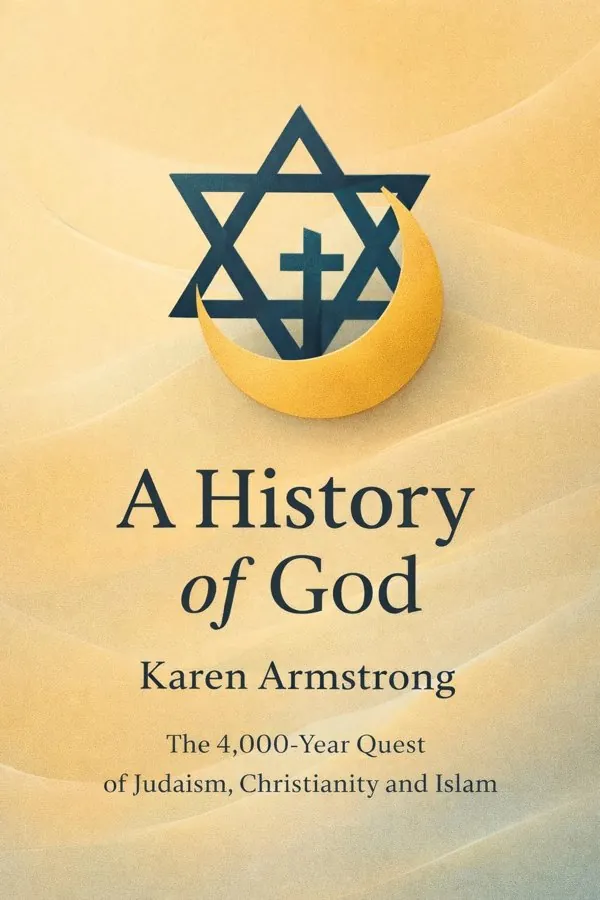
A History of God: The 4,000-Year Quest of Judaism, Christianity and Islam: Summary & Key Insights
 10 min10 chaptersAudio available
What Is A History of God: The 4,000-Year Quest of Judaism, Christianity and Islam About?
A History of God: The 4,000-Year Quest of Judaism, Christianity and Islam by Karen Armstrong is a civilization book spanning 10 pages. This book explores the evolution of the concept of God in the three major monotheistic religions—Judaism, Christianity, and Islam—over a span of four millennia. Karen Armstrong traces how human understanding of the divine has changed from ancient times through modern theology, examining philosophical, mystical, and cultural influences that shaped religious thought.
This FizzRead summary covers all 10 key chapters of A History of God: The 4,000-Year Quest of Judaism, Christianity and Islam in approximately 10 minutes, distilling the most important ideas, arguments, and takeaways from Karen Armstrong's work. Also available as an audio summary and Key Quotes Podcast.
A History of God: The 4,000-Year Quest of Judaism, Christianity and Islam
This book explores the evolution of the concept of God in the three major monotheistic religions—Judaism, Christianity, and Islam—over a span of four millennia. Karen Armstrong traces how human understanding of the divine has changed from ancient times through modern theology, examining philosophical, mystical, and cultural influences that shaped religious thought.
Who Should Read A History of God: The 4,000-Year Quest of Judaism, Christianity and Islam?
This book is perfect for anyone interested in civilization and looking to gain actionable insights in a short read. Whether you're a student, professional, or lifelong learner, the key ideas from A History of God: The 4,000-Year Quest of Judaism, Christianity and Islam by Karen Armstrong will help you think differently.
- ✓Readers who enjoy civilization and want practical takeaways
- ✓Professionals looking to apply new ideas to their work and life
- ✓Anyone who wants the core insights of A History of God: The 4,000-Year Quest of Judaism, Christianity and Islam in just 10 minutes
Want the full summary?
Get instant access to this book summary and 100K+ more with Fizz Moment.
Get Free SummaryAvailable on App Store • Free to download
Key Chapters
In the earliest records of the Middle East—among Sumerians, Babylonians, and Canaanites—the divine world was teeming with gods who embodied storm, fertility, war, and wisdom. Each tribe or city had its patron deity, whose favor ensured prosperity. Yet beneath this multiplicity lay an intuition: that there was a unifying force behind the chaos of nature. The Israelites inherited this spiritual environment. Early Israelite religion was not purely monotheistic; it evolved gradually from henotheism, where Yahweh was worshiped as the highest god among others. Over time, through historical crises and prophetic reform, Yahweh was transformed—from a storm-warrior god who protected his people in battle into a moral and transcendent deity who demanded justice and mercy.
It is crucial to remember that this shift was not merely theological but existential. When the Israelites experienced exile and the loss of their temple, they could no longer imagine God as tied to one place or tribe. Out of suffering emerged a higher vision: a single God who transcended the boundaries of geography and politics. This was the beginning of ethical monotheism—the idea that God is one and that human beings, made in His image, are called to live righteously. The early scriptures, with their blend of mythic memory and moral urgency, laid the foundation for later transformations in Judaism, Christianity, and Islam.
The Hebrew prophets—Amos, Hosea, Isaiah, Jeremiah—were not philosophers in the Greek sense but voices of social conscience. They reinterpreted Israel’s covenant with God, making morality more important than ritual. For them, worship was meaningless unless grounded in justice and compassion. Yahweh ceased to be the god of victory and became the God who sides with the oppressed. The prophetic vision turned tribal religion into a universal ethic. In calling for repentance, they articulated a radically moral monotheism: true knowledge of God is inseparable from ethical behavior.
This insight transformed religious thought forever. God was no longer a being who demanded sacrifices but a presence who demanded righteousness. Prophecy thus became the seedbed for later religious revolutions. The prophets did not discard human suffering; they found holiness within it. As exile scattered Israel, the conviction grew that suffering could reveal divine intimacy—that God could be known through compassion and self-transcendence rather than cosmic power.
+ 8 more chapters — available in the FizzRead app
All Chapters in A History of God: The 4,000-Year Quest of Judaism, Christianity and Islam
About the Author
Karen Armstrong is a British author and scholar known for her works on comparative religion. A former Roman Catholic nun, she has written extensively on the history of faith and the role of religion in the modern world, advocating for interfaith understanding and compassion.
Get This Summary in Your Preferred Format
Read or listen to the A History of God: The 4,000-Year Quest of Judaism, Christianity and Islam summary by Karen Armstrong anytime, anywhere. FizzRead offers multiple formats so you can learn on your terms — all free.
Available formats: App · Audio · PDF · EPUB — All included free with FizzRead
Download A History of God: The 4,000-Year Quest of Judaism, Christianity and Islam PDF and EPUB Summary
Key Quotes from A History of God: The 4,000-Year Quest of Judaism, Christianity and Islam
“In the earliest records of the Middle East—among Sumerians, Babylonians, and Canaanites—the divine world was teeming with gods who embodied storm, fertility, war, and wisdom.”
“The Hebrew prophets—Amos, Hosea, Isaiah, Jeremiah—were not philosophers in the Greek sense but voices of social conscience.”
Frequently Asked Questions about A History of God: The 4,000-Year Quest of Judaism, Christianity and Islam
A History of God: The 4,000-Year Quest of Judaism, Christianity and Islam by Karen Armstrong is a civilization book that explores key ideas across 10 chapters. This book explores the evolution of the concept of God in the three major monotheistic religions—Judaism, Christianity, and Islam—over a span of four millennia. Karen Armstrong traces how human understanding of the divine has changed from ancient times through modern theology, examining philosophical, mystical, and cultural influences that shaped religious thought.
More by Karen Armstrong

You Might Also Like

The Structure of Scientific Revolutions
Thomas S. Kuhn
10 min
Genius
Harold Bloom
10 min
A Cultural History of the Medieval Age
Various Editors
10 min
A History of the World in 10½ Chapters
Julian Barnes
10 min
A Short History of Progress
Ronald Wright
10 min
A Study of History
Arnold J. Toynbee
10 minFeatured In
Browse by Category
Ready to read A History of God: The 4,000-Year Quest of Judaism, Christianity and Islam?
Get the full summary and 100K+ more books with Fizz Moment.