
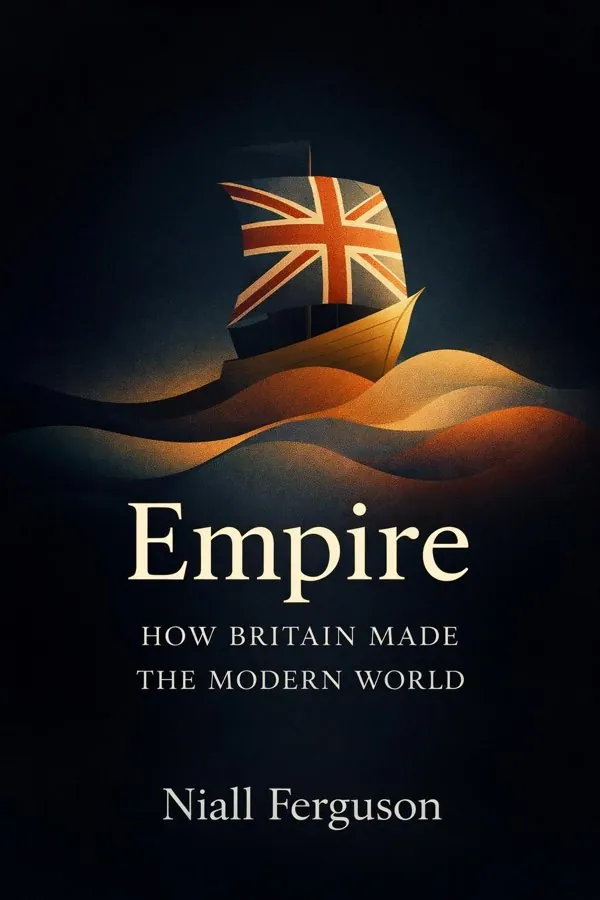
Empire: How Britain Made the Modern World: Summary & Key Insights
 10 min10 chaptersAudio available
What Is Empire: How Britain Made the Modern World About?
Empire: How Britain Made the Modern World by Niall Ferguson is a world_history book spanning 10 pages. This book explores the rise and global influence of the British Empire, arguing that its legacy shaped the modern world through trade, governance, and cultural exchange. Ferguson presents a revisionist view, suggesting that despite its flaws, the empire contributed significantly to globalization and modern institutions.
This FizzRead summary covers all 10 key chapters of Empire: How Britain Made the Modern World in approximately 10 minutes, distilling the most important ideas, arguments, and takeaways from Niall Ferguson's work. Also available as an audio summary and Key Quotes Podcast.
Empire: How Britain Made the Modern World
This book explores the rise and global influence of the British Empire, arguing that its legacy shaped the modern world through trade, governance, and cultural exchange. Ferguson presents a revisionist view, suggesting that despite its flaws, the empire contributed significantly to globalization and modern institutions.
Who Should Read Empire: How Britain Made the Modern World?
This book is perfect for anyone interested in world_history and looking to gain actionable insights in a short read. Whether you're a student, professional, or lifelong learner, the key ideas from Empire: How Britain Made the Modern World by Niall Ferguson will help you think differently.
- ✓Readers who enjoy world_history and want practical takeaways
- ✓Professionals looking to apply new ideas to their work and life
- ✓Anyone who wants the core insights of Empire: How Britain Made the Modern World in just 10 minutes
Want the full summary?
Get instant access to this book summary and 100K+ more with Fizz Moment.
Get Free SummaryAvailable on App Store • Free to download
Key Chapters
To understand how Britain evolved from a small island kingdom into a global empire, we must begin with the sea. In the seventeenth century, Britain’s destiny turned upon its mastery of maritime trade. The navy became not only a military instrument but the lifeblood of national prosperity. Sea power transformed Britain from a peripheral European state into a global trader connecting continents.
The early successes of Britain’s naval enterprise were born out of rivalry—with Spain, Portugal, and later Holland. Piracy and privateering were among the methods by which British merchants carved their way into global exchange. Yet what truly defined British maritime ascendancy was organization: the state’s ability to integrate commerce, navigation, and military might into a coherent system of national strategy.
This maritime culture demanded innovation. Advances in shipbuilding, navigation, and finance made overseas trade both profitable and sustainable. It was through control of sea routes that Britain positioned itself as the nerve center of a growing web of international commerce. The Royal Navy did not only defend Britain’s interests; it guaranteed the movement of goods, people, and ideas on a scale no other power could match.
That naval supremacy forged the worldview of the empire—an outlook of connectivity. The sea was not a boundary but a bridge, linking Britain to every shore touched by its sails. Ports like London, Bristol, and Liverpool became gateways to a global economy. Maritime expansion laid the groundwork for colonial settlement and for the industrial and financial revolutions to follow.
The roots of empire in North America and the Caribbean reveal how Britain’s ambitions were at first driven by mercantile calculation rather than moral mission. The seventeenth and eighteenth centuries were dominated by the logic of mercantilism—the belief that national power grew from control of resources and trade. Colonies existed to feed the metropolis.
In North America, settlements began as fragile outposts, born of hope and desperation. In the Caribbean, the plantation system defined the empire’s earliest identity. Sugar, tobacco, and later cotton turned into the most profitable commodities on earth. These crops required immense labor, and the exploitation of enslaved Africans became the empire’s darkest foundation.
Yet it would be wrong to regard these colonies as purely extractive. They were also laboratories of governance, places where the first experiments in self-administration and representation appeared. The contradictions between freedom and servitude, profit and principle, would come to define the empire. British colonists carried with them the Protestant ethic, English law, and a belief in individual enterprise, planting ideological seeds that would eventually yield rebellion and independence.
In these colonial beginnings, we see the emergence of the imperial paradox: Britain as both oppressor and liberator, mercenary and missionary, modernizer and exploiter. The structures built to exploit mercantile gain inadvertently generated the institutions of liberty.
+ 8 more chapters — available in the FizzRead app
All Chapters in Empire: How Britain Made the Modern World
About the Author
Niall Ferguson is a British historian known for his works on economic and political history, including studies of empire, finance, and international relations. He has taught at Harvard, Oxford, and Stanford, and is recognized for his accessible yet scholarly approach to global history.
Get This Summary in Your Preferred Format
Read or listen to the Empire: How Britain Made the Modern World summary by Niall Ferguson anytime, anywhere. FizzRead offers multiple formats so you can learn on your terms — all free.
Available formats: App · Audio · PDF · EPUB — All included free with FizzRead
Download Empire: How Britain Made the Modern World PDF and EPUB Summary
Key Quotes from Empire: How Britain Made the Modern World
“To understand how Britain evolved from a small island kingdom into a global empire, we must begin with the sea.”
“The roots of empire in North America and the Caribbean reveal how Britain’s ambitions were at first driven by mercantile calculation rather than moral mission.”
Frequently Asked Questions about Empire: How Britain Made the Modern World
Empire: How Britain Made the Modern World by Niall Ferguson is a world_history book that explores key ideas across 10 chapters. This book explores the rise and global influence of the British Empire, arguing that its legacy shaped the modern world through trade, governance, and cultural exchange. Ferguson presents a revisionist view, suggesting that despite its flaws, the empire contributed significantly to globalization and modern institutions.
More by Niall Ferguson
Doom: The Politics of Catastrophe
Niall Ferguson
10 min
The Square and the Tower: Networks and Power, from the Freemasons to Facebook
Niall Ferguson
10 min
The Ascent Of Money: A Financial History Of The World
Niall Ferguson
10 min
The House of Rothschild: Money's Prophets 1798–1848
Niall Ferguson
10 minYou Might Also Like
The Age of Capital
Eric Hobsbawm
10 min
The Gulag Archipelago
Aleksandr Solzhenitsyn
10 min
Jerusalem: The Biography
Simon Sebag Montefiore
10 min
The Anglo-Saxons
James Campbell
10 min
The Boer War
Thomas Pakenham
10 min
The Industrial Revolutionaries: The Making of the Modern World 1776–1914
Gavin Weightman
10 minBrowse by Category
Ready to read Empire: How Britain Made the Modern World?
Get the full summary and 100K+ more books with Fizz Moment.