
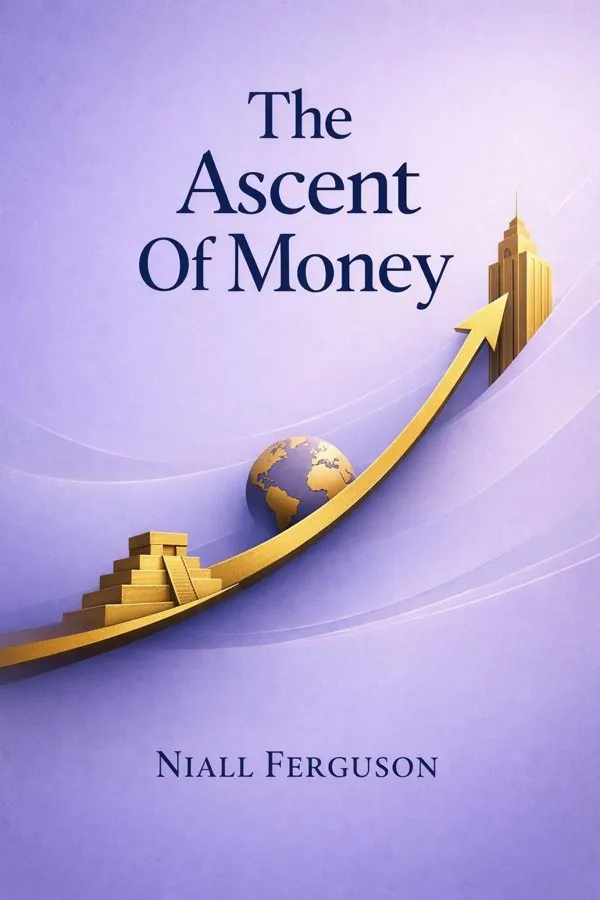
The Ascent Of Money: A Financial History Of The World: Summary & Key Insights
 10 min9 chaptersAudio available
What Is The Ascent Of Money: A Financial History Of The World About?
The Ascent Of Money: A Financial History Of The World by Niall Ferguson is a economics book spanning 9 pages. The Ascent of Money traces the evolution of finance from ancient Mesopotamia to the modern global economy. Niall Ferguson explores how money, credit, and banking have shaped human history, driving empires, revolutions, and technological progress. Through vivid historical examples, he demonstrates that financial systems are not merely economic mechanisms but fundamental forces behind civilization’s development.
This FizzRead summary covers all 9 key chapters of The Ascent Of Money: A Financial History Of The World in approximately 10 minutes, distilling the most important ideas, arguments, and takeaways from Niall Ferguson's work. Also available as an audio summary and Key Quotes Podcast.
The Ascent Of Money: A Financial History Of The World
The Ascent of Money traces the evolution of finance from ancient Mesopotamia to the modern global economy. Niall Ferguson explores how money, credit, and banking have shaped human history, driving empires, revolutions, and technological progress. Through vivid historical examples, he demonstrates that financial systems are not merely economic mechanisms but fundamental forces behind civilization’s development.
Who Should Read The Ascent Of Money: A Financial History Of The World?
This book is perfect for anyone interested in economics and looking to gain actionable insights in a short read. Whether you're a student, professional, or lifelong learner, the key ideas from The Ascent Of Money: A Financial History Of The World by Niall Ferguson will help you think differently.
- ✓Readers who enjoy economics and want practical takeaways
- ✓Professionals looking to apply new ideas to their work and life
- ✓Anyone who wants the core insights of The Ascent Of Money: A Financial History Of The World in just 10 minutes
Want the full summary?
Get instant access to this book summary and 100K+ more with Fizz Moment.
Get Free SummaryAvailable on App Store • Free to download
Key Chapters
Our journey begins not with gold coins or banking halls but with clay. In ancient Mesopotamia, over four thousand years ago, merchants and farmers recorded debts on clay tablets, marking promises to repay grain or silver. This was the birth of finance, and—surprisingly—it came before money in the physical sense. These early credit systems made possible what barter never could: transactions across time. By trusting in debt, not simply exchange, Mesopotamian societies unlocked trade, bureaucracy, and empire.
The essential idea was that credit is memory externalized—a way to extend trust beyond the immediate circle of kin. In those dusty city-states along the Tigris and Euphrates, we see proto-banking in action: temples and palaces acting as central clearinghouses for loans, interest recorded, and repayment enforced by the rule of law. The principle that faith in repayment could substitute for immediate payment was revolutionary. It turned human trust into economic leverage, and out of that leverage emerged the earliest large-scale economies.
From my vantage as a historian, I view this as more than an economic milestone—it was a cognitive leap. The moment we learned to treat money as an abstract promise, civilization became possible. Debt, not coinage, was the first currency of progress.
In the crucible of classical antiquity, societies began to mint metallic money—a tangible symbol of trust. The Greeks and Romans standardized coinage, giving the state a monopoly on legitimacy and value. This was a political and financial revolution intertwined: for the first time, sovereigns could fund armies and collect taxes in a universally recognized medium. Coins enabled empires to project power; empire, in turn, secured money’s value.
But something else was brewing in medieval Europe—the rebirth of banking. The Medici family of Florence, by reconciling commerce with Christianity’s moral ambivalence toward interest, perfected the art of lending across borders. They transformed banking from a local service into an international enterprise. Bills of exchange replaced metal as the medium of commerce, while banking houses kept tallies that crossed kingdoms. It was here that the modern meaning of finance took shape: the ability to channel idle capital toward productive ambition.
Bankers became the hidden sinews of politics and war. Their ledgers determined who could afford to raise troops, to build cathedrals, to sponsor explorations. Banking gave rise to capitalism’s nervous system—the flow of credit that sustained everything from spice trade to empire.
+ 7 more chapters — available in the FizzRead app
All Chapters in The Ascent Of Money: A Financial History Of The World
About the Author
Niall Ferguson is a British historian specializing in financial and economic history. He has taught at Harvard, Oxford, and Stanford, and is known for works such as 'Empire', 'Civilization', and 'The Square and the Tower'. His scholarship often connects historical patterns with contemporary global issues.
Get This Summary in Your Preferred Format
Read or listen to the The Ascent Of Money: A Financial History Of The World summary by Niall Ferguson anytime, anywhere. FizzRead offers multiple formats so you can learn on your terms — all free.
Available formats: App · Audio · PDF · EPUB — All included free with FizzRead
Download The Ascent Of Money: A Financial History Of The World PDF and EPUB Summary
Key Quotes from The Ascent Of Money: A Financial History Of The World
“Our journey begins not with gold coins or banking halls but with clay.”
“In the crucible of classical antiquity, societies began to mint metallic money—a tangible symbol of trust.”
Frequently Asked Questions about The Ascent Of Money: A Financial History Of The World
The Ascent Of Money: A Financial History Of The World by Niall Ferguson is a economics book that explores key ideas across 9 chapters. The Ascent of Money traces the evolution of finance from ancient Mesopotamia to the modern global economy. Niall Ferguson explores how money, credit, and banking have shaped human history, driving empires, revolutions, and technological progress. Through vivid historical examples, he demonstrates that financial systems are not merely economic mechanisms but fundamental forces behind civilization’s development.
More by Niall Ferguson

Doom: The Politics of Catastrophe
Niall Ferguson
10 min
The Square and the Tower: Networks and Power, from the Freemasons to Facebook
Niall Ferguson
10 min
Empire: How Britain Made the Modern World
Niall Ferguson
10 min
The House of Rothschild: Money's Prophets 1798–1848
Niall Ferguson
10 minYou Might Also Like

Business Adventures
John Brooks
10 min
Nudge
Richard H. Thaler, Cass R. Sunstein
10 min
The Hitchhiker"s Guide to the Galaxy
Douglas Adams
10 minThe Muqaddimah
Ibn Khaldun
10 minThe Outsiders
William N. Thorndike
10 min
A Little History of Economics
Niall Kishtainy
10 minBrowse by Category
Ready to read The Ascent Of Money: A Financial History Of The World?
Get the full summary and 100K+ more books with Fizz Moment.