
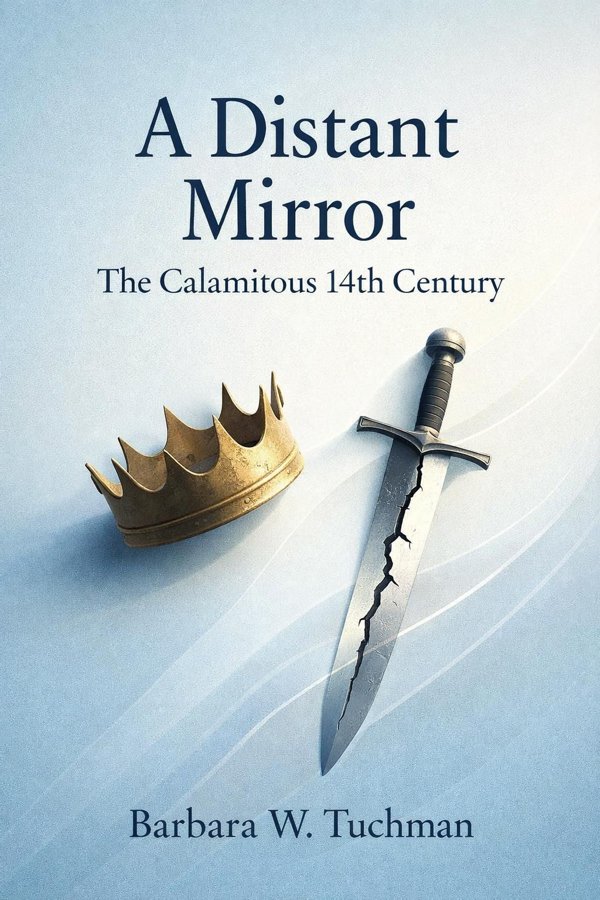
A Distant Mirror: The Calamitous 14th Century: Summary & Key Insights
 10 min10 chaptersAudio available
Key Takeaways from A Distant Mirror: The Calamitous 14th Century
A society does not begin with ideas; it begins with the structure of obligation.
Wars are often remembered as dates and battles, but Tuchman reveals them as long processes that reshape society from the ground up.
Nothing strips away illusions of control faster than plague.
Institutions often appear strongest just before they reveal their deepest weakness.
Cultures often cling to ideals long after reality has moved on.
What Is A Distant Mirror: The Calamitous 14th Century About?
A Distant Mirror: The Calamitous 14th Century by Barbara W. Tuchman is a world_history book spanning 11 pages. Barbara W. Tuchman’s A Distant Mirror: The Calamitous 14th Century is far more than a history of medieval Europe. It is a sweeping portrait of a civilization under pressure, an age marked by war, plague, religious fracture, social unrest, and political instability. Using the life of the French nobleman Enguerrand VII de Coucy as her narrative thread, Tuchman turns a remote century into a vivid human drama populated by kings, peasants, mercenaries, popes, and rebels. Through Coucy’s world, she examines the Hundred Years’ War, the Black Death, the Papal Schism, the fading ideals of chivalry, and the deep transformations that reshaped European society. What makes this book endure is its unsettling relevance. Tuchman does not treat the 14th century as a dead past; she presents it as a mirror reflecting recurring patterns of fear, violence, institutional failure, and human resilience. Her authority comes from masterful research paired with rare narrative skill: she explains complex structures without losing sight of individual lives. For readers of history, politics, or culture, this book offers both a gripping story and a sobering reminder that crisis is often the condition through which societies reveal their true character.
This FizzRead summary covers all 10 key chapters of A Distant Mirror: The Calamitous 14th Century in approximately 10 minutes, distilling the most important ideas, arguments, and takeaways from Barbara W. Tuchman's work. Also available as an audio summary and Key Quotes Podcast.
A Distant Mirror: The Calamitous 14th Century
Barbara W. Tuchman’s A Distant Mirror: The Calamitous 14th Century is far more than a history of medieval Europe. It is a sweeping portrait of a civilization under pressure, an age marked by war, plague, religious fracture, social unrest, and political instability. Using the life of the French nobleman Enguerrand VII de Coucy as her narrative thread, Tuchman turns a remote century into a vivid human drama populated by kings, peasants, mercenaries, popes, and rebels. Through Coucy’s world, she examines the Hundred Years’ War, the Black Death, the Papal Schism, the fading ideals of chivalry, and the deep transformations that reshaped European society.
What makes this book endure is its unsettling relevance. Tuchman does not treat the 14th century as a dead past; she presents it as a mirror reflecting recurring patterns of fear, violence, institutional failure, and human resilience. Her authority comes from masterful research paired with rare narrative skill: she explains complex structures without losing sight of individual lives. For readers of history, politics, or culture, this book offers both a gripping story and a sobering reminder that crisis is often the condition through which societies reveal their true character.
Who Should Read A Distant Mirror: The Calamitous 14th Century?
This book is perfect for anyone interested in world_history and looking to gain actionable insights in a short read. Whether you're a student, professional, or lifelong learner, the key ideas from A Distant Mirror: The Calamitous 14th Century by Barbara W. Tuchman will help you think differently.
- ✓Readers who enjoy world_history and want practical takeaways
- ✓Professionals looking to apply new ideas to their work and life
- ✓Anyone who wants the core insights of A Distant Mirror: The Calamitous 14th Century in just 10 minutes
Want the full summary?
Get instant access to this book summary and 100K+ more with Fizz Moment.
Get Free SummaryAvailable on App Store • Free to download
Key Chapters
A society does not begin with ideas; it begins with the structure of obligation. Tuchman shows that to understand the 14th century, we must first understand feudalism not as a simple hierarchy, but as a lived system of dependence. Power flowed through personal bonds rather than impersonal institutions. Lords offered protection, land, and status; vassals returned military service and loyalty; peasants worked the land in exchange for subsistence and security. Law existed, but custom and force often mattered more.
This system gave medieval society coherence, yet it also made it fragile. Because so much depended on individual relationships, betrayal, inheritance disputes, and weak leadership could destabilize entire regions. Feudal ties could produce solidarity in one moment and violent fragmentation in the next. Tuchman uses the Coucy lineage to illustrate how noble families sat at the center of this web, connecting local estates, military obligations, royal politics, and dynastic ambitions.
A modern reader can see echoes in any organization where personal loyalty outweighs transparent systems. Family businesses, political machines, and informal networks often operate more like feudal structures than modern bureaucracies. They can be flexible and deeply committed, but they are also vulnerable to favoritism, succession crises, and the concentration of power.
Tuchman’s deeper insight is that social order rests not only on formal rules but on accepted expectations. When those expectations weaken, disorder follows. Actionable takeaway: when evaluating any institution, look beyond official charts and titles to the real networks of loyalty, obligation, and dependency that determine how power actually works.
Wars are often remembered as dates and battles, but Tuchman reveals them as long processes that reshape society from the ground up. The Hundred Years’ War was not a single continuous conflict. It was a rolling sequence of invasions, raids, truces, dynastic claims, and resumed hostilities between England and France. Its roots lay in royal inheritance disputes and territorial ambition, yet its effects reached villages, markets, churches, and households across generations.
Tuchman emphasizes that medieval warfare was brutal not only on battlefields but in the countryside. Armies lived off the land, mercenary bands pillaged civilians, and scorched-earth tactics devastated agricultural life. Knights sought glory, kings pursued legitimacy, but ordinary people bore the costs through famine, taxation, displacement, and fear. The war also accelerated changes in political identity. As rulers demanded taxes and loyalty on a larger scale, more centralized forms of monarchy began to emerge.
This matters because prolonged conflict changes what people consider normal. Violence becomes routinized, institutions adapt to emergency, and populations accept burdens they might once have resisted. We see modern parallels in states shaped by endless war, where military spending, propaganda, and insecurity gradually transform public life.
Tuchman also complicates romantic images of medieval combat. Heroic ideals persisted, but strategy, finance, and logistics increasingly determined outcomes. Actionable takeaway: when judging a conflict, do not focus only on leaders and battles; ask how long-term warfare alters taxation, legitimacy, daily life, and the moral imagination of an entire society.
Nothing strips away illusions of control faster than plague. In one of the book’s most unforgettable sections, Tuchman presents the Black Death not simply as a medical catastrophe but as a civilizational rupture. Arriving in Europe in the mid-14th century, the plague killed on a scale that shattered assumptions about order, justice, and divine protection. Families collapsed, labor vanished, burial customs broke down, and fear spread as quickly as disease.
Tuchman’s power lies in showing how people interpreted disaster with the tools available to them. Some saw the plague as God’s punishment; others blamed strangers, minorities, or moral decay. Clergy died in great numbers, yet religion remained central as people sought meaning amid chaos. At the same time, labor shortages altered the balance between workers and landowners, weakening old structures and opening new economic possibilities.
The lesson is not only historical. Epidemics reveal the strengths and weaknesses of a society all at once: trust in authority, public health capacity, inequality, superstition, and collective discipline. Recent global experience makes Tuchman’s account feel startlingly contemporary. Panic, denial, scapegoating, and institutional overload are not modern inventions.
Her treatment of the plague reminds us that demographic shock can reorder society for decades. Labor gains, social mobility, and political unrest often follow mass mortality. Catastrophe destroys, but it also rearranges power. Actionable takeaway: in any crisis, pay attention not just to immediate suffering but to the secondary effects on labor, belief, social trust, and the legitimacy of institutions.
Cultures often cling to ideals long after reality has moved on. Tuchman treats chivalry not as a fairy-tale code but as a social ethic that organized noble identity. Courage, honor, loyalty, courtly behavior, martial prowess, and the defense of status all belonged to the chivalric world. It gave meaning to aristocratic life and shaped education, ceremony, and warfare. Yet by the 14th century, the code had become increasingly disconnected from actual conditions.
Battles were no longer decided solely by noble valor. Archers, infantry, mercenaries, gunpowder, and logistics mattered more. Knights still pursued glory, ransom, and prestige, but war had become harsher, less ritualized, and more commercially driven. Tuchman shows how the noble class kept celebrating heroic conduct even as military effectiveness and political realities undermined its assumptions.
This tension between ideal and function has broad relevance. Every profession develops myths about itself. Companies praise innovation while rewarding caution; political systems celebrate service while incentivizing self-interest; elite institutions speak of merit while preserving privilege. Chivalry’s decline is a case study in how prestige systems persist beyond their practical value.
Tuchman does not dismiss ideals entirely. Codes of honor can restrain behavior, inspire discipline, and create meaning. The problem comes when a code becomes a mask for cruelty, vanity, or denial. Actionable takeaway: examine the guiding ideals of any group and ask whether they still serve real needs, or whether they have become ceremonial language protecting obsolete privilege.
History becomes understandable when a single life gathers the tensions of an era. Tuchman uses Enguerrand VII de Coucy not because he alone changed Europe, but because his career illuminates the world around him. A great French nobleman with English royal ties through marriage, Coucy moved through courts, campaigns, diplomatic entanglements, and noble obligations that crossed emerging national lines. In him, Tuchman finds both a participant in history and a lens through which broad forces become concrete.
Coucy represents the privileges of high aristocracy, yet his life also reveals the limits of noble agency. He could command men, negotiate alliances, and pursue honor, but he could not control plague, dynastic chaos, the shifting ethics of war, or the decline of the social order that sustained his class. His world demanded loyalty, but loyalties increasingly conflicted. It prized chivalry, but practiced brutality. It preserved lineage, yet remained hostage to contingency.
This biographical method makes the book unusually powerful. Rather than reducing history to abstractions, Tuchman lets the reader experience structure through character. The same approach can help modern readers think clearly about their own time. Broad trends like globalization, institutional distrust, and economic precarity become more intelligible when seen through specific lives.
Coucy’s story also warns against overestimating elite control. Even the powerful are shaped by systems they did not create. Actionable takeaway: to understand any historical period or present-day crisis, study one representative life deeply enough to see how large forces operate through personal decisions, constraints, and contradictions.
When societies are unstable at home, they often seek meaning, wealth, or prestige abroad. Tuchman explores how crusading ideals and foreign campaigns persisted in the 14th century even as Europe itself was wracked by war, plague, and schism. Nobles still pursued military adventure in Spain, the eastern Mediterranean, North Africa, and beyond, motivated by piety, ambition, debt, honor, and the lure of plunder. These expeditions reflected continuity with earlier crusading traditions, but they also revealed how fragmented and self-interested the age had become.
Foreign campaigns could redirect restless warriors and provide symbolic unity, yet they rarely solved underlying domestic problems. Instead, they often drained resources, deepened rivalries, and exposed the mismatch between inherited ideals and strategic reality. Tuchman’s account shows crusading in transition: still powerful as language and identity, increasingly compromised in practice.
This pattern remains familiar. Nations facing internal anxiety sometimes project confidence through external missions, interventions, or moralized rhetoric. Leaders frame distant conflict as noble necessity, while unresolved structural issues at home continue to fester. The appeal lies partly in simplification: foreign campaigns can offer a story of purpose where domestic life feels chaotic.
Tuchman’s treatment encourages skepticism toward ventures justified by inherited prestige or moral grandeur alone. Intentions matter, but outcomes matter more. Actionable takeaway: whenever a society turns outward in the name of honor, faith, or destiny, ask what internal tensions the campaign may be masking and whether the stated ideals match practical capacities.
Out of chaos, states often become more organized. One of Tuchman’s most important insights is that the disasters of the 14th century did not merely destroy; they also accelerated political transformation. Feudal fragmentation, private warfare, tax demands, urban growth, and prolonged conflict pushed rulers toward stronger administrative control. Kings increasingly needed revenue, record-keeping, legal reach, and more direct claims on subjects. The age of local noble autonomy did not vanish overnight, but its supremacy was under pressure.
Tuchman traces how monarchy became more national in character, especially under the pressures of war with England and France. The need to raise armies and taxes encouraged broader political identities. At the same time, elites resisted centralization, and the process remained uneven and conflict-ridden. What emerged was not a clean victory of modernity over medievalism, but a messy overlap of old and new forms.
This is a valuable reminder that states often gain strength during periods of insecurity. Emergency powers, fiscal innovations, and centralized narratives can become permanent. Crises justify institutional expansion, and populations may accept it in exchange for order.
For modern readers, the lesson is double-edged. Stronger states can provide stability, but they can also concentrate coercion. Tuchman’s historical narrative helps us see that political development is usually born not from theory but from repeated pressure. Actionable takeaway: in times of disorder, observe which institutions gain lasting power and ask whether they are solving immediate problems only, or quietly redefining the political balance for generations.
A dark age in one sense can be a fertile age in another. Tuchman refuses to portray the 14th century as nothing but misery. Even amid plague, war, and schism, Europe produced literature, religious devotion, artistic expression, pageantry, and intellectual life of striking richness. Courtly culture flourished alongside brutality; chroniclers recorded events with vivid immediacy; architecture, ceremony, and scholarship continued to shape meaning in a wounded world.
This coexistence matters. Societies do not suspend imagination during crisis. In fact, uncertainty often intensifies the need for story, symbolism, ritual, and beauty. Cultural production helps people absorb trauma, assert continuity, and imagine order where reality offers little. Tuchman’s narrative itself models this principle by showing how aesthetic forms and moral aspiration survive inside violent structures.
There is a practical insight here for modern life. During periods of political polarization, economic instability, or public grief, art and thought can seem secondary. Yet they are often part of how societies remain human. Songs, memorials, shared language, humor, and ritual help communities preserve memory and resist despair.
Tuchman also reminds us that culture is never detached from power. Patronage, class, religion, and prestige shape what survives and what gets celebrated. Still, the persistence of creativity under pressure is one of the book’s most hopeful themes. Actionable takeaway: when evaluating a troubled era, do not measure it only by its failures; look also at the forms of meaning, beauty, and memory people create to endure it.
All Chapters in A Distant Mirror: The Calamitous 14th Century
About the Author
Barbara Wertheim Tuchman (1912–1989) was an American historian celebrated for bringing major historical events to life with clarity, drama, and literary elegance. She wrote for general readers without sacrificing seriousness, making complex subjects accessible through vivid scenes, sharp characterization, and careful synthesis of sources. Tuchman won the Pulitzer Prize twice, first for The Guns of August, her influential account of the opening of World War I, and later for Stilwell and the American Experience in China. Her other notable works include The Proud Tower and A Distant Mirror. Though not a conventional academic historian, she earned enormous respect for her ability to connect past and present through narrative history. Her books remain widely read for their insight into power, conflict, leadership, and the recurring patterns of human behavior.
Get This Summary in Your Preferred Format
Read or listen to the A Distant Mirror: The Calamitous 14th Century summary by Barbara W. Tuchman anytime, anywhere. FizzRead offers multiple formats so you can learn on your terms — all free.
Available formats: App · Audio · PDF · EPUB — All included free with FizzRead
Download A Distant Mirror: The Calamitous 14th Century PDF and EPUB Summary
Key Quotes from A Distant Mirror: The Calamitous 14th Century
“A society does not begin with ideas; it begins with the structure of obligation.”
“Wars are often remembered as dates and battles, but Tuchman reveals them as long processes that reshape society from the ground up.”
“Nothing strips away illusions of control faster than plague.”
“Institutions often appear strongest just before they reveal their deepest weakness.”
“Cultures often cling to ideals long after reality has moved on.”
Frequently Asked Questions about A Distant Mirror: The Calamitous 14th Century
A Distant Mirror: The Calamitous 14th Century by Barbara W. Tuchman is a world_history book that explores key ideas across 10 chapters. Barbara W. Tuchman’s A Distant Mirror: The Calamitous 14th Century is far more than a history of medieval Europe. It is a sweeping portrait of a civilization under pressure, an age marked by war, plague, religious fracture, social unrest, and political instability. Using the life of the French nobleman Enguerrand VII de Coucy as her narrative thread, Tuchman turns a remote century into a vivid human drama populated by kings, peasants, mercenaries, popes, and rebels. Through Coucy’s world, she examines the Hundred Years’ War, the Black Death, the Papal Schism, the fading ideals of chivalry, and the deep transformations that reshaped European society. What makes this book endure is its unsettling relevance. Tuchman does not treat the 14th century as a dead past; she presents it as a mirror reflecting recurring patterns of fear, violence, institutional failure, and human resilience. Her authority comes from masterful research paired with rare narrative skill: she explains complex structures without losing sight of individual lives. For readers of history, politics, or culture, this book offers both a gripping story and a sobering reminder that crisis is often the condition through which societies reveal their true character.
More by Barbara W. Tuchman
You Might Also Like
The Age of Capital
Eric Hobsbawm
10 min
The Gulag Archipelago
Aleksandr Solzhenitsyn
10 min
Jerusalem: The Biography
Simon Sebag Montefiore
10 min
The Anglo-Saxons
James Campbell
10 min
The Boer War
Thomas Pakenham
10 min
The Industrial Revolutionaries: The Making of the Modern World 1776–1914
Gavin Weightman
10 minFeatured In
Browse by Category
Ready to read A Distant Mirror: The Calamitous 14th Century?
Get the full summary and 100K+ more books with Fizz Moment.