
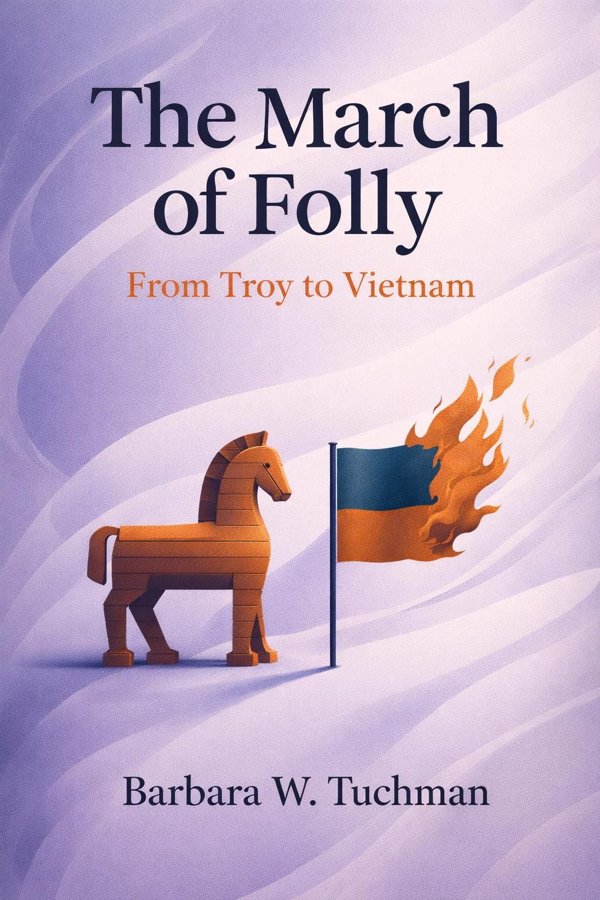
The March of Folly: From Troy to Vietnam: Summary & Key Insights
 10 min9 chaptersAudio available
Key Takeaways from The March of Folly: From Troy to Vietnam
This definition matters because it separates ordinary error from a deeper civic disease.
The Trojan horse endures because it captures a timeless truth: people often help destroy themselves by welcoming what flatters their hopes.
Institutions rarely collapse because they lack power; more often, they are damaged by the arrogant misuse of power.
Empires often fail not because they lack strength, but because they mistake coercion for control.
Tuchman portrays Vietnam as a case of policy sustained by bureaucracy, prestige, and fear of losing face rather than by realistic assessment of national interest.
What Is The March of Folly: From Troy to Vietnam About?
The March of Folly: From Troy to Vietnam by Barbara W. Tuchman is a world_history book spanning 5 pages. Why do leaders keep making disastrous choices even when warning signs are obvious? In The March of Folly: From Troy to Vietnam, Barbara W. Tuchman tackles that unsettling question with the clarity of a historian and the urgency of a political critic. Rather than treating failure as mere accident, she studies a more troubling pattern: governments repeatedly pursuing policies that work against their own interests, despite having alternatives and despite being warned of the consequences. Through four vivid case studies—the Trojans, the Renaissance papacy, Britain’s treatment of the American colonies, and the United States in Vietnam—Tuchman shows how arrogance, inertia, wishful thinking, and the hunger for prestige can overpower reason. The book matters because it turns history into a mirror. It suggests that folly is not confined to ancient myths or distant empires; it is a recurring habit of power. Tuchman, a two-time Pulitzer Prize-winning historian celebrated for The Guns of August and Stilwell and the American Experience in China, brings narrative force and analytical discipline to a subject that remains painfully relevant in every age of government, war, and public policy.
This FizzRead summary covers all 9 key chapters of The March of Folly: From Troy to Vietnam in approximately 10 minutes, distilling the most important ideas, arguments, and takeaways from Barbara W. Tuchman's work. Also available as an audio summary and Key Quotes Podcast.
The March of Folly: From Troy to Vietnam
Why do leaders keep making disastrous choices even when warning signs are obvious? In The March of Folly: From Troy to Vietnam, Barbara W. Tuchman tackles that unsettling question with the clarity of a historian and the urgency of a political critic. Rather than treating failure as mere accident, she studies a more troubling pattern: governments repeatedly pursuing policies that work against their own interests, despite having alternatives and despite being warned of the consequences. Through four vivid case studies—the Trojans, the Renaissance papacy, Britain’s treatment of the American colonies, and the United States in Vietnam—Tuchman shows how arrogance, inertia, wishful thinking, and the hunger for prestige can overpower reason. The book matters because it turns history into a mirror. It suggests that folly is not confined to ancient myths or distant empires; it is a recurring habit of power. Tuchman, a two-time Pulitzer Prize-winning historian celebrated for The Guns of August and Stilwell and the American Experience in China, brings narrative force and analytical discipline to a subject that remains painfully relevant in every age of government, war, and public policy.
Who Should Read The March of Folly: From Troy to Vietnam?
This book is perfect for anyone interested in world_history and looking to gain actionable insights in a short read. Whether you're a student, professional, or lifelong learner, the key ideas from The March of Folly: From Troy to Vietnam by Barbara W. Tuchman will help you think differently.
- ✓Readers who enjoy world_history and want practical takeaways
- ✓Professionals looking to apply new ideas to their work and life
- ✓Anyone who wants the core insights of The March of Folly: From Troy to Vietnam in just 10 minutes
Want the full summary?
Get instant access to this book summary and 100K+ more with Fizz Moment.
Get Free SummaryAvailable on App Store • Free to download
Key Chapters
The most disturbing failures in history are not always the result of ignorance, bad luck, or overwhelming external force; often, they happen when leaders knowingly continue down a harmful path. Tuchman defines political folly as the pursuit of policy contrary to a government’s own self-interest, carried on despite the availability of feasible alternatives and despite contemporary warnings. This definition matters because it separates ordinary error from a deeper civic disease. Folly is not just being wrong. It is persisting in being wrong.
Throughout the book, Tuchman argues that this pattern recurs across centuries because institutions develop habits of self-protection that are stronger than their commitment to truth. Leaders become invested in appearances, ideological consistency, or personal prestige. Advisors who challenge the dominant line are ignored, marginalized, or punished. Public evidence that should provoke correction instead triggers denial. In that sense, folly is a political system’s inability to revise itself when reality changes.
This framework is useful far beyond the historical episodes Tuchman studies. Businesses double down on failed strategies because executives fear admitting losses. Universities cling to ineffective structures because reform threatens internal power balances. Even individuals keep making destructive personal choices because changing course feels like confessing failure. The same logic appears at every scale: ego and institutional momentum overpower judgment.
Tuchman’s great contribution is to show that folly is not mysterious. It has recognizable signals: contempt for dissent, refusal to learn, inflated confidence, and decisions shaped more by image than outcome. Once we understand those signals, history becomes diagnostic rather than decorative.
Actionable takeaway: When evaluating any policy, ask three questions: Is there evidence it is failing, were warnings raised at the time, and are realistic alternatives available? If the answer to all three is yes, you may be watching folly in motion.
The Trojan horse endures because it captures a timeless truth: people often help destroy themselves by welcoming what flatters their hopes. In Tuchman’s telling, Troy serves as the archetype of folly, whether one treats the episode as myth, legend, or political symbol. After ten years of war, the Trojans longed for closure. The Greeks appeared to have retreated, leaving behind a magnificent wooden horse. It looked like a victory token, a sacred object, perhaps even proof that suffering had ended. Warnings existed—most famously from Laocoön and Cassandra—but desire overwhelmed judgment.
The significance of the story lies less in trickery than in self-deception. The Trojans did not merely fail to detect danger; they preferred a comforting interpretation to a prudent one. The horse represented everything exhausted societies want to believe: that conflict is over, that the enemy has conceded, that destiny is finally turning in their favor. In such moments, skepticism feels unpatriotic or joyless, and warning voices seem like spoilers of collective relief.
This dynamic remains familiar. Investors chase obvious bubbles because they want to believe the boom is permanent. Governments accept fragile peace arrangements without verifying incentives and enforcement. Organizations embrace glamorous solutions—a merger, a rebrand, a flashy technology—because symbolism substitutes for scrutiny. The horse changes shape, but the temptation is the same.
Tuchman uses Troy to illustrate that folly often begins with emotional need. People do not adopt dangerous illusions only because they are fooled; they adopt them because they are tired, hopeful, vain, or eager for confirmation. Rational analysis loses to psychological craving.
Actionable takeaway: When a solution seems especially gratifying, symbolic, or convenient, slow down and ask what trusted skeptics are saying. The stronger the emotional appeal, the more rigorous the scrutiny should be.
Institutions rarely collapse because they lack power; more often, they are damaged by the arrogant misuse of power. Tuchman’s examination of the Renaissance papacy shows how an institution at the height of prestige can undermine itself through corruption, vanity, and indifference to reform. The popes of the 15th and early 16th centuries—figures such as Sixtus IV, Alexander VI, Julius II, and Leo X—were not simply flawed individuals. Together they embodied a system more devoted to dynastic politics, art patronage, territorial ambition, and luxury than to spiritual leadership.
Tuchman’s argument is not that beauty, patronage, or political skill were inherently disastrous. The problem was proportion and blindness. At the very moment when calls for reform were intensifying, the papacy continued practices that scandalized believers: nepotism, absenteeism, simony, the sale of indulgences, and extravagant spending. Instead of asking how to restore moral authority, papal leadership behaved as if criticism could be managed through force, ceremony, or dismissal. By treating discontent as irritation rather than warning, the Church helped prepare the ground for the Protestant Reformation.
This case matters because it demonstrates how institutions often confuse durability with invulnerability. Long success breeds the assumption that critics will adjust, followers will remain loyal, and legitimacy can survive almost any abuse. Yet legitimacy is not a static asset. It must be renewed through conduct. Once a gap widens between professed values and actual behavior, outrage accumulates faster than elites expect.
Modern parallels are easy to find: corporations that preach ethics while concealing misconduct, political parties that ignore internal corruption because they believe supporters have nowhere else to go, and nonprofits that lose public trust by treating mission as branding rather than discipline.
Actionable takeaway: If an institution’s public ideals and internal behavior are drifting apart, reform cannot wait. Audit where prestige, money, and power are distracting from core purpose before critics turn into defectors.
Empires often fail not because they lack strength, but because they mistake coercion for control. In Tuchman’s account of Britain and the American colonies, folly lay in a stubborn refusal to understand political reality. After the Seven Years’ War, British leaders sought tighter imperial administration and new revenue from the colonies. From London’s perspective, taxes and regulations seemed justified. But from the colonial perspective, measures such as the Stamp Act, Townshend duties, and coercive enforcement represented a direct challenge to rights, self-government, and dignity.
The deeper problem was not any single tax. It was Britain’s inability to grasp that colonial resistance was rooted in principle and identity, not merely in cost. Repeated warnings came from statesmen who understood the danger of governing free communities without representation or consent. Yet Parliament and the Crown persisted, alternating between punishment and half-measures. Each act of pressure hardened colonial unity and made reconciliation less likely. Britain did not merely provoke resistance; it educated the colonies into revolution.
Tuchman shows how ruling powers often interpret opposition as ingratitude, immaturity, or manipulation by agitators. That misreading becomes fatal. When leaders assume critics are merely unruly subjects rather than political actors with real grievances, they design responses that intensify the problem. The result is a cycle of indignation: protest prompts discipline, discipline deepens resentment, and resentment creates the very separatism or rebellion authorities feared.
The lesson applies to workplaces, governments, and families alike. People do not accept decisions simply because authority believes itself justified. Legitimacy depends on voice, fairness, and respect. Where those are absent, compliance erodes even if rules appear technically reasonable.
Actionable takeaway: When resistance grows, do not ask only whether your policy is lawful or efficient. Ask whether the people affected feel heard, represented, and respected. Ignored dignity can become organized opposition.
Few modern examples better illustrate folly than the American war in Vietnam, where vast resources, immense data, and repeated internal doubts still failed to produce strategic clarity. Tuchman portrays Vietnam as a case of policy sustained by bureaucracy, prestige, and fear of losing face rather than by realistic assessment of national interest. Successive administrations inherited assumptions they were reluctant to challenge: that American credibility depended on staying the course, that communist expansion had to be resisted in Vietnam to protect broader global stability, and that military pressure could compel political outcomes in a deeply nationalist conflict.
Warnings existed at every level. Diplomats questioned the legitimacy of the South Vietnamese regime. Military observers noted the limits of conventional force in guerrilla conditions. Analysts challenged optimistic metrics. Yet the machinery of policy favored escalation. Each setback generated a demand for more effort rather than reconsideration. Leaders feared the domestic and international cost of withdrawal more than the cumulative cost of continuing. In this environment, statistics became instruments of reassurance, and ambiguity was treated as evidence that one more increment might work.
Tuchman’s treatment remains powerful because it shows that modern systems are not immune to folly simply because they possess expertise. In fact, bureaucracies can become especially vulnerable when specialized knowledge is fragmented and no one is rewarded for asking the most basic question: Is the underlying objective achievable at acceptable cost? Information overload can mask strategic emptiness.
Today, organizations repeat similar mistakes when they measure activity instead of results, fund failing initiatives to avoid embarrassment, or confuse commitment with wisdom. More planning does not guarantee better judgment if institutions are designed to defend prior decisions.
Actionable takeaway: Build regular decision points into major projects where leaders must justify continuation from first principles. If the rationale depends mainly on sunk costs, reputation, or fear of reversal, reconsider immediately.
History is full of warnings that were not merely overlooked but actively discounted. Tuchman shows that one of folly’s central features is the systematic silencing of inconvenient truth. Advice is available, evidence is accumulating, alternatives exist—yet leaders treat criticism as disloyalty, naivete, or obstruction. This happens because warnings threaten not only policy but identity. To admit error is to risk prestige, authority, and the narrative leaders tell themselves about competence.
Several forces reinforce this blindness. First is group loyalty: advisors who depend on access often soften criticism to remain influential. Second is ideological commitment: evidence that contradicts a guiding belief is reinterpreted rather than accepted. Third is administrative momentum: large systems reward execution, not reconsideration. Finally, there is emotional fatigue. When institutions are deeply invested in a course of action, changing direction feels exhausting, humiliating, or destabilizing.
Tuchman’s historical episodes reveal that warnings are rarely absent. In Troy, skepticism existed. In the late medieval Church, reformers and moral critics spoke loudly. In the imperial crisis, British politicians urged conciliation. In Vietnam, officials produced memoranda and testimony filled with doubt. The issue was not ignorance but the political cost of listening.
This pattern is visible in everyday life. Teams ignore frontline employees until customers leave. Cities neglect infrastructure warnings until disaster strikes. Families postpone difficult conversations because peace in the present seems easier than honesty. In each case, warnings are inconvenient because they demand change before collapse makes it unavoidable.
Actionable takeaway: Create a formal role for dissent in any important decision. Ask someone to assemble the strongest case against the current plan, and reward candor rather than punishing it. Institutions that normalize dissent are less likely to confuse silence with agreement.
One of Tuchman’s sharpest insights is that governments often act less to achieve concrete success than to preserve image. Prestige, honor, credibility, grandeur—these abstractions repeatedly outweigh practical interest. Leaders fear appearing weak, inconsistent, or reversible, so they persist in policies that are visibly damaging. In this sense, folly is often theater performed at enormous cost.
Prestige can be politically intoxicating because it transforms policy into a test of status. Once a decision is framed as a measure of strength, retreat becomes psychologically and symbolically difficult. Britain feared that yielding to colonial protest would diminish parliamentary sovereignty. The papacy feared that reform under pressure would signal weakness. American leaders in Vietnam worried that withdrawal would damage credibility around the world. In each case, symbolic concerns eclipsed strategic recalculation.
The danger is that prestige is always relational and never finally secure. Attempts to defend it through stubbornness can backfire, producing exactly the humiliation leaders sought to avoid. Britain lost the colonies. The papacy fractured Christendom. The United States suffered prolonged division and reputational damage. By trying to avoid the appearance of weakness, these powers invited larger failures.
This lesson applies in modern organizations whenever executives insist on defending a public commitment after facts change, or when politicians cling to slogans because changing course would look embarrassing. The pursuit of face-saving can become costlier than the original mistake. Mature leadership distinguishes between principled consistency and vanity.
Actionable takeaway: Before defending a policy on grounds of credibility or prestige, specify the tangible objective it serves. If the main benefit is avoiding embarrassment, the policy may be serving ego more than interest.
A painful theme running through The March of Folly is that institutions do not automatically learn from experience. We often speak as though history teaches lessons, but Tuchman suggests that lessons are only useful when leaders are willing to hear them. Power structures, traditions, and internal incentives can make organizations remarkably resistant to self-correction, even after repeated setbacks. Failure alone does not produce wisdom; sometimes it produces defensiveness.
Why is institutional learning so hard? First, accountability is diffuse. The people who make poor decisions are often shielded by hierarchy, complexity, or turnover. Second, organizations preserve themselves through narrative. They explain failure as temporary, external, or caused by insufficient commitment rather than flawed design. Third, memory is selective. Administrations change, records are compartmentalized, and uncomfortable episodes are reframed to protect legitimacy.
Tuchman’s examples show different versions of this problem. The Renaissance papacy ignored accumulating moral damage. Britain misread growing colonial resistance until reconciliation was no longer plausible. In Vietnam, each stage of escalation was justified as a correction to prior shortcomings rather than a challenge to the entire enterprise. These institutions did not lack information; they lacked mechanisms and incentives for genuine revision.
The practical relevance is immense. Schools repeat ineffective policies because no one tracks outcomes honestly. Companies run postmortems that avoid naming leadership errors. Governments launch commissions whose recommendations vanish because implementation threatens entrenched interests. Learning requires more than analysis; it requires structures that connect truth to consequence.
Actionable takeaway: After any major failure, conduct a review that asks not only what went wrong, but what incentives discouraged people from recognizing it sooner. Unless the system changes, the same mistake will return in a new form.
The deepest lesson of Tuchman’s book is not cynicism but humility. Folly thrives where leaders assume their position exempts them from ordinary limits of judgment. Power creates insulation. It narrows the flow of honest information, encourages flattery, and rewards confidence over reflection. Tuchman’s case studies reveal that leaders who appear formidable from the outside are often trapped inside closed systems of belief, ceremony, and pride.
Humility in this context does not mean weakness or indecision. It means a disciplined awareness that authority can distort perception. It means recognizing that institutions are prone to self-justification, that expertise can coexist with blindness, and that moral legitimacy is easier to lose than to regain. Tuchman does not offer a mechanical formula for avoiding folly, but she does imply certain virtues: attentiveness to dissent, willingness to revise, skepticism toward prestige, and respect for the intelligence of those being governed.
This is why the book remains relevant. Democracies, corporations, media organizations, and international bodies all face temptations similar to those Tuchman chronicles. Leaders still confuse persistence with strength, criticism with betrayal, and symbolic victory with practical success. The names and technologies change, but human governance remains vulnerable to old defects.
For readers, the book also offers a personal challenge. It is easy to diagnose folly in ancient Trojans, corrupt popes, imperial ministers, or war planners. It is harder to ask where we ourselves cling to failing assumptions because they flatter our identity. The history of folly is also a guide to self-examination.
Actionable takeaway: Practice humility as a decision tool. Before committing to a major course of action, ask what evidence would convince you to change your mind. If you cannot answer clearly, you may be defending a position rather than seeking the truth.
All Chapters in The March of Folly: From Troy to Vietnam
About the Author
Barbara Wertheim Tuchman (1912–1989) was a distinguished American historian and author celebrated for bringing history to life through elegant prose, narrative momentum, and sharp political insight. Though not trained in a conventional academic career path, she became one of the most widely respected popular historians of the twentieth century. Tuchman won two Pulitzer Prizes: one for The Guns of August, her acclaimed account of the opening of World War I, and another for Stilwell and the American Experience in China. Her books often explored war, diplomacy, leadership, and the unintended consequences of political decisions. In The March of Folly, she turned her attention to a recurring problem in governance: why rulers and institutions persist in self-destructive policies. Her work remains admired for its readability, intelligence, and lasting relevance.
Get This Summary in Your Preferred Format
Read or listen to the The March of Folly: From Troy to Vietnam summary by Barbara W. Tuchman anytime, anywhere. FizzRead offers multiple formats so you can learn on your terms — all free.
Available formats: App · Audio · PDF · EPUB — All included free with FizzRead
Download The March of Folly: From Troy to Vietnam PDF and EPUB Summary
Key Quotes from The March of Folly: From Troy to Vietnam
“The most disturbing failures in history are not always the result of ignorance, bad luck, or overwhelming external force; often, they happen when leaders knowingly continue down a harmful path.”
“The Trojan horse endures because it captures a timeless truth: people often help destroy themselves by welcoming what flatters their hopes.”
“Institutions rarely collapse because they lack power; more often, they are damaged by the arrogant misuse of power.”
“Empires often fail not because they lack strength, but because they mistake coercion for control.”
“Few modern examples better illustrate folly than the American war in Vietnam, where vast resources, immense data, and repeated internal doubts still failed to produce strategic clarity.”
Frequently Asked Questions about The March of Folly: From Troy to Vietnam
The March of Folly: From Troy to Vietnam by Barbara W. Tuchman is a world_history book that explores key ideas across 9 chapters. Why do leaders keep making disastrous choices even when warning signs are obvious? In The March of Folly: From Troy to Vietnam, Barbara W. Tuchman tackles that unsettling question with the clarity of a historian and the urgency of a political critic. Rather than treating failure as mere accident, she studies a more troubling pattern: governments repeatedly pursuing policies that work against their own interests, despite having alternatives and despite being warned of the consequences. Through four vivid case studies—the Trojans, the Renaissance papacy, Britain’s treatment of the American colonies, and the United States in Vietnam—Tuchman shows how arrogance, inertia, wishful thinking, and the hunger for prestige can overpower reason. The book matters because it turns history into a mirror. It suggests that folly is not confined to ancient myths or distant empires; it is a recurring habit of power. Tuchman, a two-time Pulitzer Prize-winning historian celebrated for The Guns of August and Stilwell and the American Experience in China, brings narrative force and analytical discipline to a subject that remains painfully relevant in every age of government, war, and public policy.
More by Barbara W. Tuchman
You Might Also Like
The Age of Capital
Eric Hobsbawm
10 min
The Gulag Archipelago
Aleksandr Solzhenitsyn
10 min
Jerusalem: The Biography
Simon Sebag Montefiore
10 min
The Anglo-Saxons
James Campbell
10 min
The Boer War
Thomas Pakenham
10 min
The Industrial Revolutionaries: The Making of the Modern World 1776–1914
Gavin Weightman
10 minBrowse by Category
Ready to read The March of Folly: From Troy to Vietnam?
Get the full summary and 100K+ more books with Fizz Moment.