
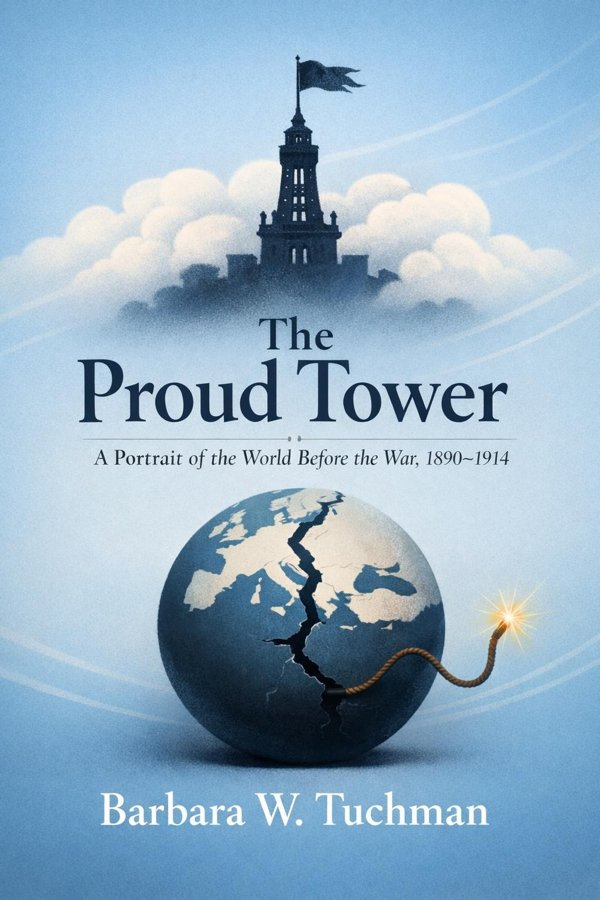
The Proud Tower: A Portrait of the World Before the War, 1890–1914: Summary & Key Insights
 10 min10 chaptersAudio available
Key Takeaways from The Proud Tower: A Portrait of the World Before the War, 1890–1914
A society can look most secure precisely when it is closest to losing its foundations.
Violence often begins as a moral argument that convinces itself it has no other path.
Ideas become historically powerful when they stop being theories and start organizing ordinary people.
A single injustice can reveal the hidden structure of an entire society.
A rising power often experiences itself as both triumphant and unstable.
What Is The Proud Tower: A Portrait of the World Before the War, 1890–1914 About?
The Proud Tower: A Portrait of the World Before the War, 1890–1914 by Barbara W. Tuchman is a world_history book spanning 10 pages. Barbara W. Tuchman’s The Proud Tower is a sweeping portrait of the Western world in the final decades before World War I, when confidence, wealth, and progress seemed to define modern civilization even as deep political and social fractures were widening beneath the surface. Rather than telling a straight diplomatic history, Tuchman examines the people, classes, movements, and institutions that shaped the age: aristocrats preserving prestige, anarchists trying to destroy the old order, socialists building mass politics, parliamentarians battling constitutional crises, and nations competing for imperial power and military advantage. The result is not just a prewar chronicle but an anatomy of a civilization at its glittering peak and hidden breaking point. The book matters because it shows how catastrophe rarely appears inevitable to those living through the years that precede it. Tuchman, one of the twentieth century’s most admired narrative historians and a two-time Pulitzer Prize winner, combines rigorous research with vivid storytelling. Her authority lies not only in command of sources but in her gift for revealing how ideas, ambitions, blind spots, and institutions interact to produce history’s turning points.
This FizzRead summary covers all 10 key chapters of The Proud Tower: A Portrait of the World Before the War, 1890–1914 in approximately 10 minutes, distilling the most important ideas, arguments, and takeaways from Barbara W. Tuchman's work. Also available as an audio summary and Key Quotes Podcast.
The Proud Tower: A Portrait of the World Before the War, 1890–1914
Barbara W. Tuchman’s The Proud Tower is a sweeping portrait of the Western world in the final decades before World War I, when confidence, wealth, and progress seemed to define modern civilization even as deep political and social fractures were widening beneath the surface. Rather than telling a straight diplomatic history, Tuchman examines the people, classes, movements, and institutions that shaped the age: aristocrats preserving prestige, anarchists trying to destroy the old order, socialists building mass politics, parliamentarians battling constitutional crises, and nations competing for imperial power and military advantage. The result is not just a prewar chronicle but an anatomy of a civilization at its glittering peak and hidden breaking point. The book matters because it shows how catastrophe rarely appears inevitable to those living through the years that precede it. Tuchman, one of the twentieth century’s most admired narrative historians and a two-time Pulitzer Prize winner, combines rigorous research with vivid storytelling. Her authority lies not only in command of sources but in her gift for revealing how ideas, ambitions, blind spots, and institutions interact to produce history’s turning points.
Who Should Read The Proud Tower: A Portrait of the World Before the War, 1890–1914?
This book is perfect for anyone interested in world_history and looking to gain actionable insights in a short read. Whether you're a student, professional, or lifelong learner, the key ideas from The Proud Tower: A Portrait of the World Before the War, 1890–1914 by Barbara W. Tuchman will help you think differently.
- ✓Readers who enjoy world_history and want practical takeaways
- ✓Professionals looking to apply new ideas to their work and life
- ✓Anyone who wants the core insights of The Proud Tower: A Portrait of the World Before the War, 1890–1914 in just 10 minutes
Want the full summary?
Get instant access to this book summary and 100K+ more with Fizz Moment.
Get Free SummaryAvailable on App Store • Free to download
Key Chapters
A society can look most secure precisely when it is closest to losing its foundations. Tuchman opens with the late nineteenth-century aristocracy because Europe’s old ruling class still seemed unshakable: wealthy, ceremonially magnificent, politically connected, and culturally dominant. Nobles filled military commands, diplomatic posts, court circles, and elite salons. Their codes of honor, leisure, dress, and breeding shaped what much of Europe considered civilization itself. Yet their grandeur disguised a growing mismatch between inherited privilege and the demands of mass industrial society.
Tuchman shows that aristocratic life was not just decorative; it was institutional. The old elite still influenced legislation, foreign policy, and military culture. But while they mastered etiquette and patronage, they often failed to grasp the force of democratic politics, labor unrest, modern media, and nationalist mobilization. Their confidence in hierarchy made them slow to see that public opinion and organized mass movements were beginning to rival lineage as sources of power.
This pattern has a modern application. Established elites in any era can mistake visibility for legitimacy and tradition for permanence. A corporate board, political dynasty, or cultural establishment may still control key institutions while losing emotional authority among the broader public. When leaders live inside insulated networks, they often underestimate how quickly resentment can accumulate outside them.
Tuchman’s portrait of the aristocracy is therefore less nostalgia than warning. It reminds us that social order depends not only on ceremony and prestige but on adaptability. If you want to understand a system’s future, don’t just look at who rules—look at whether they still understand the world changing beneath them. Actionable takeaway: examine the institutions you trust most and ask whether they are evolving with society or merely preserving appearances.
Violence often begins as a moral argument that convinces itself it has no other path. Tuchman’s chapter on anarchism explores one of the era’s most radical assaults on established order. To anarchists, monarchy, parliament, police, church, and property were not stabilizing institutions but machinery of oppression. Their aim was not random chaos in theory; it was liberation from coercive authority. Yet in practice, factions within the movement embraced bombings and assassinations as dramatic acts of revolutionary truth.
Tuchman traces how anarchism fed on inequality, repression, and disillusionment with gradual reform. In countries where legal channels seemed closed or corrupt, direct action acquired an emotional and political appeal. Assassinations of heads of state and public officials did more than spread fear; they symbolized a world in which old authority could be struck anywhere. At the same time, the movement exposed the limits of politics based only on negation. Destroying institutions proved far easier than building legitimate alternatives.
The relevance extends beyond nineteenth-century radicals. Whenever groups conclude that all existing systems are irredeemable, the temptation arises to treat spectacle as strategy. Social media extremism, political nihilism, and anti-system movements today often share this dynamic: moral outrage fuses with impatience, and destruction is mistaken for transformation.
Tuchman does not excuse anarchist violence, but she helps explain the conditions that made it resonate. That matters because dismissing extremism as madness alone prevents societies from addressing the grievances that fuel it. Actionable takeaway: when confronted with radical anti-system anger, respond in two directions at once—protect institutions against violence, but also repair the injustices and exclusions that make destructive ideologies attractive.
A single injustice can reveal the hidden structure of an entire society. The Dreyfus Affair, one of the defining political crises of fin-de-siècle France, began with the wrongful conviction of Alfred Dreyfus, a Jewish French army officer accused of treason. But as Tuchman shows, it became far more than a legal scandal. It exposed divisions over nationalism, anti-Semitism, military authority, the press, the judiciary, and the meaning of the republic itself.
The significance of the affair lay in the refusal of institutions to admit error. When evidence emerged that Dreyfus had been falsely convicted, key elements within the military and conservative establishment defended the original verdict to protect prestige and cohesion. In doing so, they transformed a miscarriage of justice into a national moral crisis. Intellectuals, journalists, republicans, nationalists, clericals, and anti-Semites all took sides. Émile Zola’s famous intervention symbolized a new public role for writers as defenders of truth against official falsehood.
Tuchman uses the affair to show how modern politics can become a battle over reality itself. Institutions under pressure may prioritize self-protection over truth, while identity, fear, and ideology shape what evidence people are willing to accept. That lesson remains urgent in any age of polarized media, conspiracy, and “post-truth” rhetoric.
Practically, the Dreyfus Affair teaches that due process and transparency are not procedural luxuries. They are defenses against collective self-deception. Once loyalty to tribe or institution becomes more important than factual correction, public trust begins to erode.
Actionable takeaway: whenever a public controversy centers on evidence, ask who benefits from preserving the original story and whether institutional pride is being placed above justice. Truth requires not only facts but the courage to revise beliefs when facts change.
A rising power often experiences itself as both triumphant and unstable. Tuchman’s treatment of the United States captures a nation bursting with industrial strength, wealth creation, immigration, urban growth, and confidence, yet struggling with corruption, labor conflict, inequality, and social fragmentation. America represented modernity in motion: railroads, giant corporations, newspaper empires, machine politics, and a restless faith in expansion.
What interested Tuchman was not simply American success but the contradictions embedded within it. The United States projected optimism and dynamism, but its political and economic systems were increasingly shaped by concentrated power. Industrial magnates accumulated extraordinary influence, while urban workers, immigrants, and the poor navigated dangerous conditions with limited protections. Reform movements emerged in response, signaling that modernization was not self-correcting. Progress created problems that required new forms of governance.
This makes the American chapter especially relevant today. Rapid growth in any country or industry can generate a celebratory narrative that conceals social costs. Technological progress may coexist with labor precarity; national wealth may rise alongside distrust in institutions. Tuchman’s portrait suggests that a society should be judged not only by its productive energy but by its capacity to govern the consequences of that energy fairly.
Her account also helps explain America’s future global role. The country’s confidence, scale, and improvisational politics positioned it to become central to the twentieth century. Yet even before that ascent was complete, the tensions of democracy, capitalism, and reform were already visible.
Actionable takeaway: when assessing a booming system—whether a nation, company, or sector—look beyond headline growth. Ask who is benefiting, what strains are emerging, and whether institutions are adapting fast enough to keep prosperity from turning into backlash.
Stable institutions are tested not when everyone agrees on the rules, but when power shifts and old rules become obstacles. Tuchman’s examination of the British Parliament focuses on a nation often admired for orderly constitutional evolution, yet deeply strained in the years before the war. The conflict between the House of Lords and the elected Commons, along with battles over taxation, Irish Home Rule, and social reform, showed that even Britain’s celebrated political system was not immune to crisis.
The constitutional struggle mattered because it forced a basic question: who truly governs in a modern society—the hereditary guardians of tradition or representatives of an expanding electorate? The Lords’ resistance to Liberal reforms, including redistributive taxation and welfare measures, transformed parliamentary procedure into a conflict over legitimacy itself. Britain avoided revolution, but only through intense confrontation and eventual limitation of aristocratic veto power.
Tuchman’s broader point is that constitutional systems can appear durable while carrying unresolved tensions. Formal continuity does not guarantee substantive legitimacy. In any democracy, institutions designed for one social order may become unstable when new classes, regions, or movements demand recognition. If those demands are blocked too long, technical disputes over procedure can become existential struggles over representation.
Modern parallels are easy to find: fights over judicial power, voting rules, upper chambers, executive authority, or federal-state relations often look procedural on the surface but reflect deeper conflicts over whose voice counts.
Tuchman’s chapter shows that reforming institutions is not a sign of weakness; refusing reform can be far more dangerous. Actionable takeaway: when political debate seems consumed by constitutional mechanics, look beneath the procedure to identify the social change driving it. Durable systems survive by adjusting rules before frustration turns into rupture.
Nations often talk most earnestly about peace when they are least willing to surrender the means of war. Tuchman’s discussion of the Hague Conferences reveals one of the central paradoxes of the pre-1914 world: the same powers that convened to regulate conflict, promote arbitration, and affirm civilized norms continued to expand armaments and strategic rivalries. The language of international cooperation flourished, but national interests remained sovereign.
The Hague meetings were not meaningless. They reflected genuine hopes that law, diplomacy, and shared procedure might restrain violence among states. These conferences helped advance ideas of arbitration, codified some rules of war, and nourished the vision of an international order based on institutions rather than force alone. Yet Tuchman shows that these aspirations ran up against the hard realities of prestige, military planning, alliance commitments, and imperial competition. States wanted peace, but peace on terms that preserved advantage.
This is one of the book’s most enduring lessons. International norms matter, but they cannot substitute for political will. Declarations, treaties, and summits are strongest when they align with incentives, domestic support, and credible enforcement. Otherwise, they risk becoming ceremonies of good intention masking preparations for conflict.
For modern readers, the chapter offers a sober framework for understanding global diplomacy. Climate agreements, arms control talks, and multilateral institutions can be important achievements, but they should be judged by implementation, not rhetoric alone. Hope is necessary, but realism is indispensable.
Actionable takeaway: whenever leaders celebrate a grand international agreement, ask three questions: what interests are actually being restrained, what mechanisms enforce compliance, and what behavior continues unchanged beneath the diplomatic language.
Brilliant art does not guarantee a healthy civilization; sometimes it accompanies a society’s deepest unease. Tuchman’s exploration of the arts and intellectual life before World War I captures a period of extraordinary creativity. Literature, music, painting, theater, and philosophy were all being transformed by modernist experimentation, scientific change, urban experience, and psychological introspection. The age was intellectually alive, self-conscious, and daring.
Yet Tuchman does not present culture as separate from politics. The same world that produced refined salons, aesthetic innovation, and new schools of thought also generated insecurity about religion, morality, social order, and the future of Europe. Artists and thinkers were responding to acceleration, alienation, class tension, and the weakening of inherited certainties. Cultural brilliance, in this sense, was not proof of civilizational stability but evidence of intense adaptation.
This insight helps modern readers resist a common mistake: assuming that cultural vibrancy means political resilience. A city may lead the world in art, fashion, research, and design while also suffering from institutional fragility, inequality, or deep polarization. Creativity often thrives in moments of disruption because old forms no longer suffice.
Tuchman’s treatment of intellectual life also shows why elite confidence can be misleading. An age may appear sophisticated and humane while harboring destructive passions that culture alone cannot disarm. The prewar world was educated, articulate, and artistically rich; it still moved toward catastrophe.
Actionable takeaway: when evaluating the health of a society, appreciate its cultural achievements but do not confuse them with political security. Ask what anxieties its art is expressing, what assumptions are breaking down, and whether institutions are keeping pace with changes in consciousness and social life.
A nation’s pride becomes dangerous when it requires other nations to accept a lesser place. Tuchman shows that nationalism and imperialism were not side themes of the prewar era; they were among its principal engines. European powers competed for colonies, markets, prestige, and strategic position while cultivating powerful national myths at home. Citizens were taught to think of greatness in comparative, often zero-sum terms. Expansion abroad and solidarity at home reinforced each other.
Imperial rivalry intensified tensions among the major powers, but nationalism also destabilized multiethnic empires from within. Peoples under imperial rule increasingly demanded autonomy, recognition, or independence. This made Europe and its peripheries doubly volatile: strong states sought external advantage even as internal identities strained their cohesion. The result was a political climate in which compromise could be portrayed as weakness and concession as humiliation.
Tuchman’s analysis remains deeply relevant because nationalism still carries a dual character. It can inspire legitimate self-determination, civic belonging, and democratic energy. But when fused with grievance, racial superiority, or imperial nostalgia, it becomes combustible. Leaders may exploit perceived insults, border disputes, or historical wounds to mobilize support and narrow the space for diplomacy.
The practical lesson is that rhetoric matters. When states repeatedly frame international life as a contest for honor and rank, they train publics to interpret restraint as defeat. That dynamic can make crises harder to manage, because leaders fear domestic backlash if they step back.
Actionable takeaway: pay close attention to how political leaders define national greatness. If pride depends on domination, humiliation narratives, or constant external enemies, the groundwork for conflict is already being laid, even before any shot is fired.
History’s greatest disasters often arise not from a single decision but from a chain of normal decisions made inside a flawed system. In Tuchman’s final movement toward 1914, the reader sees how Europe approached war through accumulating tensions rather than universal desire for apocalypse. Alliances hardened, military timetables accelerated, diplomatic flexibility narrowed, and leaders grew accustomed to managing repeated crises without fundamental change. Success in avoiding war during earlier confrontations bred confidence that the next crisis could also be contained.
This is one of Tuchman’s most important contributions. She rejects simplistic fatalism. The war was not foreordained in some mystical sense, nor was it caused by one villain alone. It emerged from a structure in which nationalism, imperial rivalry, military planning, elite misjudgment, and institutional rigidity interacted. Statesmen believed they were defending security and prestige, but the system they inhabited magnified risk and punished hesitation.
That framework is useful far beyond 1914. Organizations, markets, and governments frequently normalize dangerous patterns because each step appears manageable in isolation. A company can drift toward scandal, a democracy toward authoritarianism, or a region toward armed conflict through incremental decisions that no participant experiences as the final crossing of a line.
Tuchman’s prelude to war teaches vigilance against cumulative danger. The central question is not only whether a crisis seems survivable, but whether the surrounding system is becoming less forgiving of error.
Actionable takeaway: when a political or organizational environment is marked by recurring crises, rigid commitments, and shrinking room for compromise, do not take temporary escapes as proof of safety. Treat repeated near-misses as signals that the structure itself requires reform.
All Chapters in The Proud Tower: A Portrait of the World Before the War, 1890–1914
About the Author
Barbara W. Tuchman (1912–1989) was an American historian celebrated for bringing major historical subjects to life through elegant prose, vivid scenes, and meticulous research. Though not trained in the conventional academic mold, she became one of the twentieth century’s most widely read historians. Her work combined literary skill with a sharp eye for political character, institutional failure, and historical irony. Tuchman won two Pulitzer Prizes, first for The Guns of August and later for Stilwell and the American Experience in China. Other notable books include A Distant Mirror and The March of Folly. In The Proud Tower, she applies her signature narrative approach to the decades before World War I, revealing a world of brilliance, tension, and approaching crisis.
Get This Summary in Your Preferred Format
Read or listen to the The Proud Tower: A Portrait of the World Before the War, 1890–1914 summary by Barbara W. Tuchman anytime, anywhere. FizzRead offers multiple formats so you can learn on your terms — all free.
Available formats: App · Audio · PDF · EPUB — All included free with FizzRead
Download The Proud Tower: A Portrait of the World Before the War, 1890–1914 PDF and EPUB Summary
Key Quotes from The Proud Tower: A Portrait of the World Before the War, 1890–1914
“A society can look most secure precisely when it is closest to losing its foundations.”
“Violence often begins as a moral argument that convinces itself it has no other path.”
“Ideas become historically powerful when they stop being theories and start organizing ordinary people.”
“A single injustice can reveal the hidden structure of an entire society.”
“A rising power often experiences itself as both triumphant and unstable.”
Frequently Asked Questions about The Proud Tower: A Portrait of the World Before the War, 1890–1914
The Proud Tower: A Portrait of the World Before the War, 1890–1914 by Barbara W. Tuchman is a world_history book that explores key ideas across 10 chapters. Barbara W. Tuchman’s The Proud Tower is a sweeping portrait of the Western world in the final decades before World War I, when confidence, wealth, and progress seemed to define modern civilization even as deep political and social fractures were widening beneath the surface. Rather than telling a straight diplomatic history, Tuchman examines the people, classes, movements, and institutions that shaped the age: aristocrats preserving prestige, anarchists trying to destroy the old order, socialists building mass politics, parliamentarians battling constitutional crises, and nations competing for imperial power and military advantage. The result is not just a prewar chronicle but an anatomy of a civilization at its glittering peak and hidden breaking point. The book matters because it shows how catastrophe rarely appears inevitable to those living through the years that precede it. Tuchman, one of the twentieth century’s most admired narrative historians and a two-time Pulitzer Prize winner, combines rigorous research with vivid storytelling. Her authority lies not only in command of sources but in her gift for revealing how ideas, ambitions, blind spots, and institutions interact to produce history’s turning points.
More by Barbara W. Tuchman
You Might Also Like
The Age of Capital
Eric Hobsbawm
10 min
The Gulag Archipelago
Aleksandr Solzhenitsyn
10 min
Jerusalem: The Biography
Simon Sebag Montefiore
10 min
The Anglo-Saxons
James Campbell
10 min
The Boer War
Thomas Pakenham
10 min
The Industrial Revolutionaries: The Making of the Modern World 1776–1914
Gavin Weightman
10 minBrowse by Category
Ready to read The Proud Tower: A Portrait of the World Before the War, 1890–1914?
Get the full summary and 100K+ more books with Fizz Moment.