
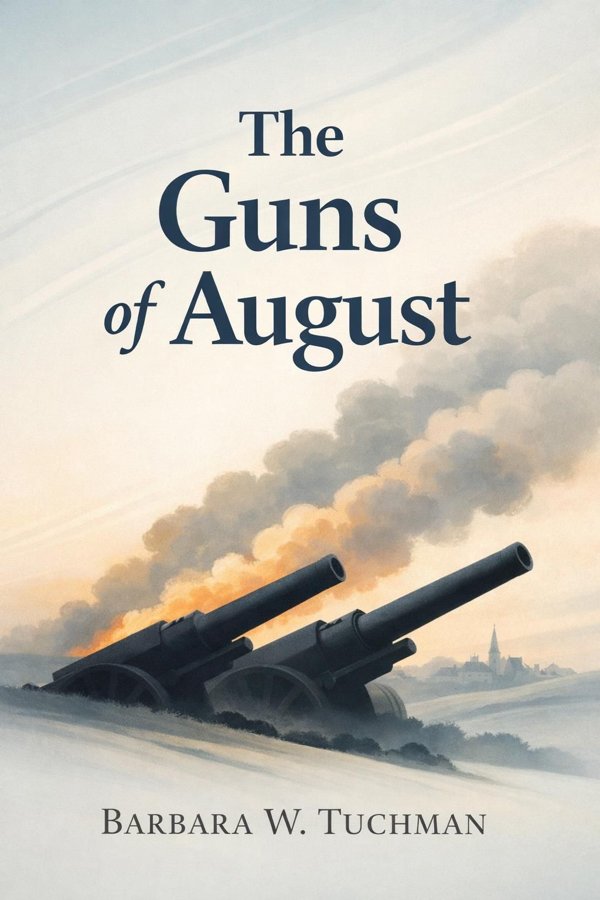
The Guns of August: Summary & Key Insights
 10 min10 chaptersAudio available
Key Takeaways from The Guns of August
History often turns not when societies expect disaster, but when they feel most confident in their own stability.
Systems built to prevent conflict can sometimes make conflict harder to stop.
A brilliant plan can become dangerous when people begin serving it instead of reality.
Assassinations make headlines, but they only trigger great crises when deeper structures are ready to burn.
Sometimes the most dangerous decision is creating a system that cannot pause.
What Is The Guns of August About?
The Guns of August by Barbara W. Tuchman is a war_military book spanning 11 pages. Barbara W. Tuchman’s The Guns of August is a gripping history of how Europe stumbled into catastrophe in the summer of 1914. Rather than treating World War I as an inevitable explosion, Tuchman reconstructs the first month of the war as a chain of decisions made by proud governments, rigid military systems, and fallible leaders who did not fully understand the forces they had unleashed. The book moves from the glittering funeral of King Edward VII to the German invasion of Belgium, the French offensives, the Russian advance in the east, and the climactic Battle of the Marne that halted Germany’s initial drive. What makes the book endure is not only its command of events but its human drama. Tuchman shows how ambition, fear, vanity, doctrine, and miscommunication shaped outcomes as much as numbers and weapons did. Her gift lies in turning dense diplomatic and military history into vivid narrative without sacrificing seriousness. A Pulitzer Prize winner and one of the 20th century’s most admired popular historians, Tuchman writes with authority, clarity, and narrative power. The result is a classic account of how modern war begins: suddenly, irrationally, and at immense human cost.
This FizzRead summary covers all 10 key chapters of The Guns of August in approximately 10 minutes, distilling the most important ideas, arguments, and takeaways from Barbara W. Tuchman's work. Also available as an audio summary and Key Quotes Podcast.
The Guns of August
Barbara W. Tuchman’s The Guns of August is a gripping history of how Europe stumbled into catastrophe in the summer of 1914. Rather than treating World War I as an inevitable explosion, Tuchman reconstructs the first month of the war as a chain of decisions made by proud governments, rigid military systems, and fallible leaders who did not fully understand the forces they had unleashed. The book moves from the glittering funeral of King Edward VII to the German invasion of Belgium, the French offensives, the Russian advance in the east, and the climactic Battle of the Marne that halted Germany’s initial drive.
What makes the book endure is not only its command of events but its human drama. Tuchman shows how ambition, fear, vanity, doctrine, and miscommunication shaped outcomes as much as numbers and weapons did. Her gift lies in turning dense diplomatic and military history into vivid narrative without sacrificing seriousness. A Pulitzer Prize winner and one of the 20th century’s most admired popular historians, Tuchman writes with authority, clarity, and narrative power. The result is a classic account of how modern war begins: suddenly, irrationally, and at immense human cost.
Who Should Read The Guns of August?
This book is perfect for anyone interested in war_military and looking to gain actionable insights in a short read. Whether you're a student, professional, or lifelong learner, the key ideas from The Guns of August by Barbara W. Tuchman will help you think differently.
- ✓Readers who enjoy war_military and want practical takeaways
- ✓Professionals looking to apply new ideas to their work and life
- ✓Anyone who wants the core insights of The Guns of August in just 10 minutes
Want the full summary?
Get instant access to this book summary and 100K+ more with Fizz Moment.
Get Free SummaryAvailable on App Store • Free to download
Key Chapters
History often turns not when societies expect disaster, but when they feel most confident in their own stability. Tuchman opens with the funeral of King Edward VII, where Europe’s monarchs assemble in dazzling ceremonial unity. The scene is more than pageantry. It reveals a continent tied together by bloodlines, diplomacy, and habit, yet quietly fractured by nationalism, rivalry, and military preparation. The old order appears strong, even magnificent, but it is already brittle.
This opening matters because it destroys the comforting idea that great crises always announce themselves clearly. Europe in 1914 was prosperous, cultured, and interconnected. Trade was thriving, capitals glittered, and many elites assumed civilization itself would restrain any major conflict. Yet beneath that polish lay mutual suspicion, colonial competition, arms races, and strategic plans that reduced politics to timetables.
Tuchman uses this contrast to show how complacency and ritual can disguise structural danger. The rulers at the funeral embodied continuity, but they did not control the forces gathering around them. Institutions were already preparing for war on a scale their social world could barely imagine.
The lesson extends far beyond 1914. Modern organizations, states, and even businesses often mistake surface order for deep resilience. A polished leadership summit, a strong market, or a period of peace can conceal unresolved tensions. Healthy systems require more than appearance; they require flexibility, honest assessment, and mechanisms for de-escalation.
Actionable takeaway: When things look stable, ask what hidden assumptions hold that stability together—and what might happen if they fail all at once.
Systems built to prevent conflict can sometimes make conflict harder to stop. Before 1914, Europe’s alliance structure was meant to preserve balance. Germany, Austria-Hungary, and Italy formed the Triple Alliance, while France, Russia, and Britain moved toward the Triple Entente. In theory, these arrangements deterred aggression by ensuring that any attack would trigger a wider response. In practice, they created a chain reaction machine.
Tuchman shows that alliances did not operate like calm legal agreements. They worked through fear, reputation, and worst-case thinking. Leaders worried constantly that hesitation would look like weakness, that support for an ally would be judged insufficient, or that mobilization by one power would leave another fatally behind. As a result, local disputes became continental emergencies. Austria-Hungary’s conflict with Serbia could no longer remain regional once Russia felt compelled to support Serbia, Germany to support Austria-Hungary, and France and Britain to weigh their own obligations and strategic interests.
The power of Tuchman’s analysis is that she reveals how leaders became servants of systems they believed they controlled. Alliances narrowed options, hardened expectations, and made compromise seem dangerous. Instead of buying time, they compressed it.
This dynamic has modern parallels in corporate partnerships, political coalitions, and international blocs. When commitments are vague in public but rigid in private, actors may escalate to preserve credibility rather than solve the underlying problem. Teams can also become trapped by informal loyalties that prevent fresh thinking.
Actionable takeaway: Build alliances and commitments with clear exit paths, clear communication, and room for discretion, or they may transform support into automatic escalation.
A brilliant plan can become dangerous when people begin serving it instead of reality. One of Tuchman’s central themes is the dominance of Germany’s Schlieffen Plan, the strategy for a rapid knockout blow against France before turning east against Russia. The plan was admired for its logic, scale, and precision. It promised to solve Germany’s nightmare of a two-front war through speed, concentration, and strict timing. But in Tuchman’s telling, that logic came at the cost of humanity, diplomacy, and adaptability.
Because the plan depended on exact movement by rail and road, any delay or political hesitation threatened the whole structure. Germany’s leaders therefore treated mobilization not as one option among many but as a point of no return. Neutral Belgium became a route on a map rather than a sovereign state. Civilian consequences became secondary to military geometry. Even when events changed, commanders remained prisoners of assumptions built into the plan.
Tuchman does not argue that strategy is unimportant. She shows that strategy becomes destructive when it leaves no space for surprise, friction, or moral judgment. The Schlieffen Plan was not simply a military design; it was a mindset that converted uncertainty into rigid action. Once activated, it drove Germany into choices that widened the war and strengthened its enemies.
In contemporary life, organizations often create their own Schlieffen Plans: expansion models, crisis protocols, or product rollouts so rigid that they cannot absorb new facts. When success depends on the environment behaving exactly as expected, failure can escalate quickly.
Actionable takeaway: Treat every major plan as a guide, not a master—stress-test it against political, ethical, and human realities before execution becomes irreversible.
Assassinations make headlines, but they only trigger great crises when deeper structures are ready to burn. Tuchman presents the murder of Archduke Franz Ferdinand in Sarajevo as the spark that ignited the war, not the full explanation for it. The event was dramatic and consequential, yet what followed mattered more: the diplomatic choices, ultimatums, calculations, and assumptions that turned a Balkan incident into a European war.
Austria-Hungary saw the assassination as a chance to crush Serbian nationalism and reassert imperial authority. Germany offered support, effectively encouraging a hard line. Russia saw itself as protector of Serbia and feared losing influence if it backed down. France encouraged Russian firmness. Britain hesitated, hoping the crisis might still be contained. At each stage, leaders interpreted events through their own anxieties and ambitions.
Tuchman’s achievement is to show that crises rarely have single causes. They arise from the interaction between immediate events and long-standing tensions. That is why simple explanations are so often misleading. A trigger can be visible, but the tinder has usually been accumulating for years.
This insight applies to modern conflict, whether geopolitical or organizational. A public argument may seem to cause a breakup, a resignation, or a policy failure, but usually the real causes are accumulated grievances, poor incentives, and unresolved distrust. Focusing only on the trigger prevents learning.
Actionable takeaway: When a crisis erupts, resist blaming only the latest event; map the deeper pressures, prior decisions, and hidden incentives that made the explosion possible.
Sometimes the most dangerous decision is creating a system that cannot pause. In The Guns of August, mobilization is not a technical background detail but one of the engines of disaster. Rail schedules, troop call-ups, deployment timetables, and reserve systems gave states the power to wage industrial war quickly. Yet these same systems also reduced political flexibility. Once mobilization began, leaders felt they could not stop without risking strategic ruin.
Tuchman shows how military preparedness was treated as neutral efficiency, even prudence. But because each power feared being slower than its rivals, mobilization became psychologically indistinguishable from war itself. Diplomacy no longer set the pace; logistics did. Civilian leaders found themselves pressured by generals insisting that delay meant defeat. The machine had its own momentum.
This is one of Tuchman’s sharpest warnings: procedures designed for emergency can begin dictating policy. When tools become too large, expensive, or automatic, people hesitate to question them. Germany and Russia in particular were trapped by the belief that the first side to move decisively would gain the decisive advantage. That belief narrowed every diplomatic opening.
The modern relevance is striking. In institutions today, automated systems, legal triggers, bureaucratic workflows, and algorithmic alerts can create forms of mobilization that outpace judgment. A company can launch a harmful response because its escalation protocol was activated. A government can harden a position because a sequence has already begun.
Actionable takeaway: Build stop mechanisms into high-stakes systems—moments where leaders must actively reassess before procedure turns preparation into irreversible action.
Violating a small neutral state can transform a strategic calculation into a moral and political disaster. Germany’s invasion of Belgium was, in narrow military terms, part of the shortest route toward France. In wider historical terms, it reshaped the war. Tuchman shows that Belgium’s resistance, though militarily limited compared with Germany’s power, had enormous political significance. It delayed German movement, rallied international opinion, and provided Britain with both legal and moral grounds to enter the war.
The episode demonstrates that small actors are not irrelevant in great-power struggles. Belgium’s forts, army, and national resolve disrupted assumptions of an easy passage. More importantly, the invasion exposed the gulf between abstract staff planning and lived political consequences. What German planners saw as operational necessity looked to others like ruthless aggression.
Tuchman is especially strong in showing how actions generate narratives, and narratives generate coalitions. Germany may have viewed Britain’s entry as unfortunate but manageable. Instead, Belgian neutrality became a symbol around which British public opinion and state policy could rally. The image of a treaty violated and a weaker country overrun carried immense force.
This lesson matters beyond military history. In business, politics, and personal leadership, a move that seems efficient from inside an organization may appear predatory or illegitimate from outside. Stakeholders respond not only to what you do, but to what your actions come to represent.
Actionable takeaway: Before taking a hard strategic step, ask how it will be perceived by neutral observers—because legitimacy can be as decisive as raw power.
Belief can become deadly when leaders confuse courage with immunity to facts. Tuchman’s account of France’s Plan XVII and the Battle of the Frontiers shows how military doctrine shaped behavior even when evidence pointed in the opposite direction. French commanders embraced the offensive spirit with near-religious fervor. They believed elan, morale, and aggressive action could overcome material disadvantages. The result was repeated assaults against prepared German positions with catastrophic losses.
Tuchman does not mock bravery. She honors it while exposing the leadership failures that wasted it. The French army entered the war with striking uniforms, patriotic confidence, and an attack-first mindset that underestimated modern firepower. Machine guns, artillery, and entrenched defenders shattered theories built on valor alone. Soldiers paid with their lives for assumptions their superiors had not adequately tested.
Germany, too, suffered from offensive overreach, but the French example is especially revealing because it shows the power of institutional culture. Once an army builds identity around aggression, caution can appear dishonorable. Data that challenge doctrine may be ignored because they threaten prestige.
The pattern is familiar in nonmilitary settings. Companies cling to growth-at-all-costs strategies long after markets change. Political movements double down on slogans that energize supporters but fail in practice. Teams reward confidence while sidelining dissent. In each case, morale becomes a substitute for adaptation.
Actionable takeaway: Encourage cultures where commitment is matched by evidence—where people can question doctrine without being treated as weak, disloyal, or lacking spirit.
Early success often creates the most dangerous kind of illusion: the belief that events are following a controllable pattern. Tuchman’s treatment of the Eastern Front, especially Germany’s dramatic victories against Russia at Tannenberg and the Masurian Lakes, illustrates this paradox. These operations showcased German operational skill, intelligence use, and command effectiveness. They also produced heroes and reassured a public hungry for triumph. Yet success in the east did not solve Germany’s deeper strategic dilemma.
The war’s central problem remained the western offensive. Troops, attention, and confidence were all strained by the demands of fighting on multiple fronts. Victories against Russia could not erase the overextension built into Germany’s wider war plan. Tuchman highlights how commanders and politicians can misread local victories as proof that the whole system is sound.
This matters because it shows that results must be interpreted in context. A strong quarter does not mean a company’s business model is secure. A successful campaign does not mean a nation’s grand strategy is coherent. One team’s excellence may conceal broader organizational fragility. Tuchman repeatedly reminds readers that war is not a set of isolated battles but an interaction of fronts, resources, morale, and time.
Her broader point is strategic humility. Leaders must ask not only, “Did we win here?” but also, “What did this victory cost, and did it advance our real objective?” Without that second question, wins can become distractions.
Actionable takeaway: Evaluate success at the system level, not just the local level—because a tactical win that weakens your larger position may be a disguised setback.
Leadership is tested most severely when events move faster than the mind can organize them. Tuchman’s narrative is filled with commanders struggling to understand fluid fronts, broken communications, exhausted troops, and contradictory reports. The opening month of World War I exposed not only the limitations of plans but the limitations of command itself. Armies had grown enormous, battlefields had expanded, and the tempo of modern mobilization outpaced the ability of leaders to see clearly.
German commanders drove their men forward on punishing schedules and drifted apart from one another as the advance deepened. French leaders clung to offensive assumptions while trying to recover from disaster. British commanders had to adapt quickly in coalition warfare under extreme pressure. Everywhere, communication lagged behind movement. Headquarters often acted on stale information, while frontline conditions changed by the hour.
Tuchman’s point is not simply that some generals were flawed, though many were. It is that modern complexity magnifies human weakness. Pride, fatigue, rivalry, and confusion become more damaging when systems are large and margins are narrow. A capable leader in a simple environment may fail in a complex one if they cannot delegate, revise, and absorb uncertainty.
This lesson applies directly to management and statecraft. During fast-moving crises, leaders may overcentralize, deny bad news, or stick to outdated assumptions because admitting confusion feels like weakness. In fact, adaptability is often the real strength.
Actionable takeaway: In any high-pressure system, create channels for honest feedback, decentralized adjustment, and rapid revision—because control without clarity is only an illusion.
Even in the midst of cascading failure, history can still turn on timely adaptation. The Battle of the Marne is the climax of Tuchman’s story and the clearest rebuttal to fatalism. Germany’s armies had swept through Belgium and deep into France. Paris seemed threatened, and the logic of the opening campaign suggested a German victory in the west. Yet a combination of overextension, command strain, exposed flanks, French resilience, British cooperation, and decisive action by General Joffre and others created an opening.
Tuchman shows that the Marne was not a miracle detached from prior events. It emerged because German momentum had stretched beyond sustainable limits and because Allied leaders, after earlier blunders, adjusted in time. The famous use of Paris taxis is memorable, but the real significance lies in strategic recovery. The Allies recognized vulnerability in the German line and acted before the chance vanished.
The battle halted the immediate German drive and set the stage for trench warfare. More broadly, it reveals one of Tuchman’s deepest themes: systems may push toward catastrophe, but outcomes are never wholly mechanical. Human judgment still matters. Poor decisions had helped create the crisis, and better decisions, even if imperfect, helped prevent complete collapse.
For modern readers, the Marne offers a disciplined form of hope. In crises, recovery rarely comes from wishful thinking. It comes from reassessment, coordination, and the courage to change course while there is still time.
Actionable takeaway: When a situation appears to be sliding out of control, look for where momentum has created vulnerability—and act decisively before temporary openings close.
All Chapters in The Guns of August
About the Author
Barbara W. Tuchman (1912–1989) was an American historian and bestselling author celebrated for transforming complex history into vivid, accessible narrative. Born in New York City, she began her career in journalism before turning to historical writing, a shift that helped shape her clear, dramatic style. Tuchman became one of the most admired popular historians of the 20th century, winning the Pulitzer Prize twice: first for The Guns of August in 1963 and later for Stilwell and the American Experience in China. Her work often explored war, diplomacy, political leadership, and the unintended consequences of human decisions. Though writing for a broad audience, she was respected for the depth of her research and the force of her historical imagination. Her books remain enduring classics of narrative history.
Get This Summary in Your Preferred Format
Read or listen to the The Guns of August summary by Barbara W. Tuchman anytime, anywhere. FizzRead offers multiple formats so you can learn on your terms — all free.
Available formats: App · Audio · PDF · EPUB — All included free with FizzRead
Download The Guns of August PDF and EPUB Summary
Key Quotes from The Guns of August
“History often turns not when societies expect disaster, but when they feel most confident in their own stability.”
“Systems built to prevent conflict can sometimes make conflict harder to stop.”
“A brilliant plan can become dangerous when people begin serving it instead of reality.”
“Assassinations make headlines, but they only trigger great crises when deeper structures are ready to burn.”
“Sometimes the most dangerous decision is creating a system that cannot pause.”
Frequently Asked Questions about The Guns of August
The Guns of August by Barbara W. Tuchman is a war_military book that explores key ideas across 10 chapters. Barbara W. Tuchman’s The Guns of August is a gripping history of how Europe stumbled into catastrophe in the summer of 1914. Rather than treating World War I as an inevitable explosion, Tuchman reconstructs the first month of the war as a chain of decisions made by proud governments, rigid military systems, and fallible leaders who did not fully understand the forces they had unleashed. The book moves from the glittering funeral of King Edward VII to the German invasion of Belgium, the French offensives, the Russian advance in the east, and the climactic Battle of the Marne that halted Germany’s initial drive. What makes the book endure is not only its command of events but its human drama. Tuchman shows how ambition, fear, vanity, doctrine, and miscommunication shaped outcomes as much as numbers and weapons did. Her gift lies in turning dense diplomatic and military history into vivid narrative without sacrificing seriousness. A Pulitzer Prize winner and one of the 20th century’s most admired popular historians, Tuchman writes with authority, clarity, and narrative power. The result is a classic account of how modern war begins: suddenly, irrationally, and at immense human cost.
More by Barbara W. Tuchman
You Might Also Like
Patriot
Andrew Britton
10 min
War
John Hersey
10 min
An Army at Dawn: The War in North Africa, 1942–1943
Rick Atkinson
10 min
Brave New War: The Next Stage of Terrorism and the End of Globalization
John Robb
10 min
Catch-22
Joseph Heller
10 min
Command and Control: Nuclear Weapons, the Damascus Accident, and the Illusion of Safety
Eric Schlosser
10 minBrowse by Category
Ready to read The Guns of August?
Get the full summary and 100K+ more books with Fizz Moment.