
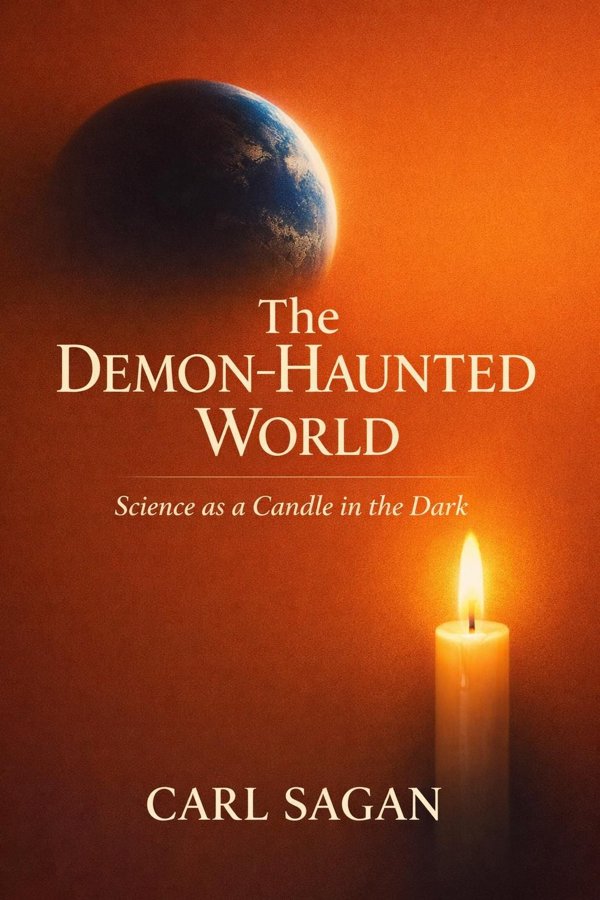
The Demon-Haunted World: Summary & Key Insights
by Carl Sagan
 10 min9 chaptersAudio available
Key Takeaways from The Demon-Haunted World
The deepest strength of science is not certainty but organized skepticism.
Bad ideas often sound persuasive because they appeal to emotion, authority, or wishful thinking rather than evidence.
False beliefs often succeed not because they are well supported, but because they are psychologically satisfying.
A society can be technologically advanced and still intellectually fragile if its citizens are not trained to reason well.
Democracy cannot function well if citizens are unable to distinguish evidence from propaganda.
What Is The Demon-Haunted World About?
The Demon-Haunted World by Carl Sagan is a science book published in 1995 spanning 6 pages. Carl Sagan’s The Demon-Haunted World: Science as a Candle in the Dark is both a defense of science and a warning about what happens when societies lose their grip on critical thinking. Written in 1995 but startlingly relevant today, the book examines why people are drawn to superstition, pseudoscience, conspiracy theories, and magical thinking—even in technologically advanced cultures. Sagan argues that science is not merely a body of facts but a disciplined way of testing ideas, questioning assumptions, and protecting ourselves from deception. He explores UFO claims, alien abductions, faith healing, witch hunts, and media-driven misinformation to show how easily human beings can be misled when skepticism is weak. What makes the book powerful is Sagan’s rare combination of scientific authority and human warmth. As an astronomer, educator, and one of the world’s great science communicators, he understood both the grandeur of discovery and the fragility of reason. This book matters because it teaches readers how to think, not what to think—and in an age of viral falsehoods, that skill is indispensable.
This FizzRead summary covers all 9 key chapters of The Demon-Haunted World in approximately 10 minutes, distilling the most important ideas, arguments, and takeaways from Carl Sagan's work. Also available as an audio summary and Key Quotes Podcast.
The Demon-Haunted World
Carl Sagan’s The Demon-Haunted World: Science as a Candle in the Dark is both a defense of science and a warning about what happens when societies lose their grip on critical thinking. Written in 1995 but startlingly relevant today, the book examines why people are drawn to superstition, pseudoscience, conspiracy theories, and magical thinking—even in technologically advanced cultures. Sagan argues that science is not merely a body of facts but a disciplined way of testing ideas, questioning assumptions, and protecting ourselves from deception. He explores UFO claims, alien abductions, faith healing, witch hunts, and media-driven misinformation to show how easily human beings can be misled when skepticism is weak. What makes the book powerful is Sagan’s rare combination of scientific authority and human warmth. As an astronomer, educator, and one of the world’s great science communicators, he understood both the grandeur of discovery and the fragility of reason. This book matters because it teaches readers how to think, not what to think—and in an age of viral falsehoods, that skill is indispensable.
Who Should Read The Demon-Haunted World?
This book is perfect for anyone interested in science and looking to gain actionable insights in a short read. Whether you're a student, professional, or lifelong learner, the key ideas from The Demon-Haunted World by Carl Sagan will help you think differently.
- ✓Readers who enjoy science and want practical takeaways
- ✓Professionals looking to apply new ideas to their work and life
- ✓Anyone who wants the core insights of The Demon-Haunted World in just 10 minutes
Want the full summary?
Get instant access to this book summary and 100K+ more with Fizz Moment.
Get Free SummaryAvailable on App Store • Free to download
Key Chapters
The deepest strength of science is not certainty but organized skepticism. Many people imagine that science is a system for producing final answers, yet Carl Sagan insists that its real power lies in its willingness to question itself. Scientific knowledge is always provisional: ideas must survive testing, criticism, replication, and the possibility of being replaced by better explanations. This does not make science weak. It makes it trustworthy.
Sagan contrasts scientific thinking with dogmatic belief. Dogma begins by declaring itself true and treating disagreement as a threat. Science begins with doubt and treats disagreement as useful. A good scientist asks: What is the evidence? Could I be mistaken? What else might explain this result? In that sense, science is a humbling discipline. It asks us to hold beliefs in proportion to the evidence, not in proportion to our desires.
This mindset is valuable far beyond laboratories. If a headline claims a miracle cure, informed doubt asks whether the study was controlled, whether the sample size was large enough, and whether other researchers reached the same conclusion. If someone makes a dramatic historical claim online, skepticism asks for sources, context, and verification. Even in personal life, informed doubt helps us pause before assuming motives, spreading rumors, or trusting first impressions.
Sagan’s point is not that we should doubt everything endlessly. Rather, we should calibrate confidence carefully. Some claims are strongly supported, others remain tentative, and extraordinary claims require extraordinary evidence. Science moves forward not by pretending to know everything, but by refusing to confuse confidence with truth.
Actionable takeaway: When you encounter any strong claim, ask three questions before accepting it: What is the evidence, how was it tested, and what would count as proof that it is wrong?
Bad ideas often sound persuasive because they appeal to emotion, authority, or wishful thinking rather than evidence. To help ordinary people protect themselves, Sagan offers what he famously calls the “Baloney Detection Kit,” a practical toolbox for spotting weak reasoning and manipulation. It is one of the book’s most enduring contributions because it turns skepticism into a learnable everyday skill.
The kit includes several core principles: seek independent confirmation of facts; encourage substantive debate from informed people with different viewpoints; do not rely only on authority; consider multiple hypotheses; and avoid becoming emotionally attached to the idea you are testing. Sagan also lists common logical fallacies, such as ad hominem attacks, appeals to ignorance, false dilemmas, circular reasoning, and confusing correlation with causation. These errors are not rare mistakes made by a few cranks. They are ordinary habits of mind that affect all of us.
The practical usefulness of this toolkit is enormous. Consider health misinformation on social media. A charismatic influencer may claim that a supplement “changed everything,” but anecdote is not proof. Independent trials, placebo controls, and peer review matter more than confidence and testimonials. In politics, a sensational accusation may spread rapidly, but the Baloney Detection Kit reminds us to separate evidence from rhetoric. In business, it can protect consumers from miracle products, exaggerated investment claims, and manipulative advertising.
Sagan’s larger message is empowering: critical thinking is not elitist. It is a form of self-defense. You do not need a PhD to ask good questions, notice weak arguments, and resist being fooled. In a noisy information environment, these habits are as essential as literacy.
Actionable takeaway: Make a simple checklist for important claims—source, evidence, alternative explanations, independent confirmation, and logical consistency—and use it before sharing or believing them.
False beliefs often succeed not because they are well supported, but because they are psychologically satisfying. Sagan shows that pseudoscience and superstition persist by speaking to deep human needs: the need for certainty, wonder, control, identity, and belonging. A claim about psychic powers, alien visitors, or supernatural healing can feel more exciting and emotionally rewarding than a cautious scientific explanation. That emotional appeal gives pseudoscience its grip.
Sagan does not dismiss believers as foolish. Instead, he examines the conditions that make people vulnerable to unsupported ideas. Memory is unreliable. Pattern-seeking is natural. Coincidences feel meaningful. Personal experiences can be vivid while still misleading. A person who dreams of an event and later notices something similar may sincerely believe in precognition. Someone who recovers after trying an alternative therapy may attribute the recovery to the treatment, even if the real causes were time, placebo effects, or standard medicine.
Pseudoscience also borrows the language of science while rejecting its discipline. It uses technical-sounding terms, selective evidence, and dramatic claims without controlled testing. It often avoids disproof by shifting goalposts: if evidence fails to appear, believers claim the phenomenon is too mysterious for ordinary measurement. That makes pseudoscience resilient, because it protects itself against correction.
This pattern appears everywhere today: anti-vaccine myths, astrology apps treated as personality science, detox fads, conspiracy videos, and fake experts offering certainty in uncertain times. The lesson is not to suppress wonder but to separate wonder from gullibility. Reality is astonishing enough without requiring fabrication.
Actionable takeaway: Whenever a claim seems compelling because it is exciting, comforting, or personally meaningful, pause and ask whether the evidence is strong—or whether the feeling of meaning is doing the persuasive work.
A society can be technologically advanced and still intellectually fragile if its citizens are not trained to reason well. Sagan worries that many people know how to use the products of science without understanding the method behind them. This creates a dangerous imbalance: we become dependent on complex systems while lacking the intellectual tools needed to evaluate claims about medicine, technology, policy, and risk.
For Sagan, real education is not memorizing facts. It is learning how to ask questions, weigh evidence, detect bias, and tolerate uncertainty. Students should understand why controlled experiments matter, why peer review matters, why anecdote is limited, and why changing one’s mind in light of new evidence is a strength rather than a weakness. Without that foundation, people become easy prey for demagogues, charlatans, and media sensationalism.
This idea has urgent practical applications. In classrooms, science should be taught as a process of inquiry, not as a frozen list of conclusions. In families, children should be encouraged to ask “How do we know?” rather than merely repeat accepted answers. In public life, citizens need enough scientific literacy to assess claims about climate change, public health, artificial intelligence, and environmental risk. The issue is not whether everyone becomes a scientist. It is whether enough people can think clearly in a world shaped by science.
Sagan also reminds us that curiosity is natural. Good education protects it instead of punishing it. When children are shamed for asking difficult questions, they may either retreat into passivity or seek certainty from simplistic ideologies. Education should build resilient minds, not compliant ones.
Actionable takeaway: Practice turning every important topic into inquiry by asking: What is the evidence, who tested it, what are the limits, and what questions remain unanswered?
Democracy cannot function well if citizens are unable to distinguish evidence from propaganda. Sagan argues that scientific habits of mind—skepticism, open debate, transparency, and willingness to revise conclusions—are not only useful in research; they are essential to free societies. When people lose these habits, public life becomes vulnerable to manipulation by authorities who reward loyalty over truth.
Science and democracy share a moral structure. Both depend on criticism, distributed scrutiny, and correction of error. In science, no idea should be immune from examination. In democracy, no leader should be beyond accountability. Both systems work imperfectly, but they are stronger than systems built on unquestionable authority. When evidence matters less than tribal identity, both science and democracy deteriorate.
Sagan was especially concerned about a future in which citizens consume advanced technology while becoming politically passive and intellectually dependent. In such a world, a small expert class understands the systems everyone relies on, while the broader public becomes easy to mislead. That imbalance invites fear, resentment, and anti-intellectualism. A democracy needs citizens capable of evaluating statistical claims, recognizing rhetorical tricks, and resisting the seduction of simplistic answers.
We can see this clearly in debates over elections, public health, economic policy, and environmental regulation. Misleading graphs, out-of-context numbers, fabricated experts, and emotionally charged misinformation can reshape public opinion rapidly. Scientific thinking cannot solve political disagreement, but it can improve the quality of the disagreement by grounding it in reality.
Actionable takeaway: Treat civic participation like an evidence-based discipline—check original sources, compare competing arguments fairly, and refuse to outsource your judgment to slogans, personalities, or viral outrage.
Many people fear that skepticism destroys mystery, but Sagan argues the opposite: disciplined inquiry makes reality more awe-inspiring, not less. False wonders are fragile because they depend on exaggeration, fraud, or misunderstanding. Genuine scientific discovery expands our sense of the universe in ways far stranger and grander than superstition ever could. The age of stars, the evolution of life, the scale of galaxies, and the complexity of the human brain are not dry facts. They are sources of profound wonder.
This idea is central to Sagan’s style as a writer. He refuses the false choice between rationality and enchantment. A rainbow does not become less beautiful because we understand refraction. A solar eclipse does not lose majesty because celestial mechanics can predict it. Knowledge does not flatten experience; it deepens it. The more accurately we see the world, the more astonishing it becomes.
This matters because pseudoscience often markets itself as a defense of mystery. It says, in effect, “Science is cold, but our story is magical.” Sagan responds by showing that reality itself is magical enough—if by magic we mean astonishing, intricate, and humbling. The problem with many supernatural claims is not that they are too wondrous, but that they are too small. They reduce the vastness of reality to human-centered fantasies.
In everyday life, this perspective can renew curiosity. Looking at the night sky, studying fossils, learning about ecosystems, or even understanding how vaccines work can become moments of intellectual wonder. Skepticism need not be cynical. It can be reverent toward truth.
Actionable takeaway: Replace one comforting but unsupported belief with a real scientific question, then explore the evidence until reality itself becomes the source of your amazement.
Not all claims deserve equal confidence. Sagan’s famous principle—extraordinary claims require extraordinary evidence—captures a basic rule of rational judgment. If someone says it will rain tomorrow, modest evidence may be enough. If someone says aliens are secretly abducting thousands of people, the evidentiary bar must be much higher. The more a claim contradicts established knowledge or demands major revisions to our understanding of reality, the stronger and more rigorous the supporting evidence must be.
This principle protects us from two opposite errors: gullibility and closed-mindedness. It does not say extraordinary claims are impossible. It says we should not accept them casually. If a revolutionary medical treatment appears to cure a previously untreatable disease, that would be extraordinary—and deeply exciting. But excitement is not proof. We would need careful trials, replication, mechanism, and independent verification.
Sagan uses examples such as UFO reports, alien abduction stories, and psychic phenomena to show how weak evidence often gets inflated into certainty. Eyewitness testimony, sincere conviction, and unexplained experiences are not enough on their own. Human perception is limited, memory is reconstructive, and emotionally intense experiences can still be mistaken. Scientific standards exist precisely because our intuitions are unreliable.
This principle is especially useful in digital culture, where sensational claims spread faster than cautious corrections. The more dramatic the headline—hidden cure, vast cover-up, supernatural proof—the more carefully it should be examined. Extraordinary stories are profitable, memorable, and socially contagious.
Actionable takeaway: Match your confidence to the size of the claim: the more startling, worldview-shifting, or emotionally charged the assertion, the more demanding you should be about evidence and independent replication.
One of Sagan’s most important insights is that the greatest source of deception is often not malicious outsiders but our own minds. Human beings are meaning-making creatures. We infer patterns from randomness, remember the hits and forget the misses, and interpret events in self-serving ways. These tendencies were useful in many ancestral contexts, but they can badly distort our understanding of evidence.
Sagan highlights memory errors, suggestibility, confirmation bias, and the emotional power of narrative. If people are repeatedly exposed to leading questions or culturally shared stories, they may come to remember events that never occurred. This helps explain phenomena such as recovered memories under questionable therapeutic practices, panics about occult conspiracies, and vivid testimonies that feel persuasive but are psychologically constructed. The point is not that people are lying. It is that sincerity and accuracy are not the same thing.
Modern life amplifies these vulnerabilities. Algorithms feed us information that confirms existing beliefs. Online communities reward certainty and identity signaling. Emotional stories spread more widely than statistical truths. Once a belief becomes part of someone’s tribe or self-image, evidence alone may no longer be enough to change it.
Recognizing mental bias should make us more careful and more compassionate. We all have blind spots. The antidote is not self-hatred but method: external checks, documented evidence, controlled tests, and intellectual humility. Good reasoning depends on building systems that compensate for human weakness.
Actionable takeaway: Keep a habit of asking, “What evidence would make me change my mind?” If you cannot name any, you may be protecting an identity rather than evaluating a claim.
Ignorance is never merely private when it shapes public decisions. Sagan warns that scientific illiteracy carries social costs that extend far beyond embarrassment or confusion. A population that cannot evaluate evidence becomes vulnerable to exploitative industries, bad policy, public health disasters, and authoritarian manipulation. The issue is not whether everyone can explain quantum mechanics. It is whether enough citizens can think clearly about evidence, risk, probability, and causation.
Scientific illiteracy often appears in ordinary forms: misunderstanding vaccines, misreading statistics, falling for miracle cures, confusing weather with climate, or trusting anecdotes over large-scale evidence. These errors seem small until they accumulate. A parent refusing effective medicine because of misinformation can harm a child. A voter misled by false claims about energy or disease can support destructive policy. A public unable to understand probability may panic over tiny risks while ignoring larger systemic dangers.
Sagan’s warning has become even sharper in the age of information abundance. Access to data does not guarantee understanding. In fact, misinformation often thrives where people feel overwhelmed and seek simple narratives. Scientific literacy therefore includes not only knowledge of facts but comfort with complexity, uncertainty, and delayed conclusions.
The hopeful side of Sagan’s argument is that these skills can be cultivated. Communities can build healthier information habits. Schools can teach media literacy alongside science. Journalists can explain uncertainty responsibly. Individuals can become more careful consumers of claims.
Actionable takeaway: Choose one area of public importance—health, climate, technology, or economics—and build basic literacy in how evidence works there, so you are less dependent on slogans and more capable of informed judgment.
All Chapters in The Demon-Haunted World
About the Author
Carl Sagan (1934–1996) was an American astronomer, astrophysicist, professor, and bestselling author who transformed public understanding of science. A longtime faculty member at Cornell University, he conducted important research on planetary atmospheres, the greenhouse effect, and the possibility of extraterrestrial life. Sagan became one of the world’s most influential science communicators through his landmark television series Cosmos: A Personal Voyage and through books that combined scientific rigor with literary elegance. He had a rare gift for making complex ideas feel accessible, urgent, and deeply human. Throughout his career, Sagan championed skepticism, curiosity, and the ethical responsibility to think clearly in a technological age. His work continues to inspire readers to approach the universe with both wonder and reason.
Get This Summary in Your Preferred Format
Read or listen to the The Demon-Haunted World summary by Carl Sagan anytime, anywhere. FizzRead offers multiple formats so you can learn on your terms — all free.
Available formats: App · Audio · PDF · EPUB — All included free with FizzRead
Download The Demon-Haunted World PDF and EPUB Summary
Key Quotes from The Demon-Haunted World
“The deepest strength of science is not certainty but organized skepticism.”
“Bad ideas often sound persuasive because they appeal to emotion, authority, or wishful thinking rather than evidence.”
“False beliefs often succeed not because they are well supported, but because they are psychologically satisfying.”
“A society can be technologically advanced and still intellectually fragile if its citizens are not trained to reason well.”
“Democracy cannot function well if citizens are unable to distinguish evidence from propaganda.”
Frequently Asked Questions about The Demon-Haunted World
The Demon-Haunted World by Carl Sagan is a science book that explores key ideas across 9 chapters. Carl Sagan’s The Demon-Haunted World: Science as a Candle in the Dark is both a defense of science and a warning about what happens when societies lose their grip on critical thinking. Written in 1995 but startlingly relevant today, the book examines why people are drawn to superstition, pseudoscience, conspiracy theories, and magical thinking—even in technologically advanced cultures. Sagan argues that science is not merely a body of facts but a disciplined way of testing ideas, questioning assumptions, and protecting ourselves from deception. He explores UFO claims, alien abductions, faith healing, witch hunts, and media-driven misinformation to show how easily human beings can be misled when skepticism is weak. What makes the book powerful is Sagan’s rare combination of scientific authority and human warmth. As an astronomer, educator, and one of the world’s great science communicators, he understood both the grandeur of discovery and the fragility of reason. This book matters because it teaches readers how to think, not what to think—and in an age of viral falsehoods, that skill is indispensable.
More by Carl Sagan
You Might Also Like
Featured In
Browse by Category
Ready to read The Demon-Haunted World?
Get the full summary and 100K+ more books with Fizz Moment.