
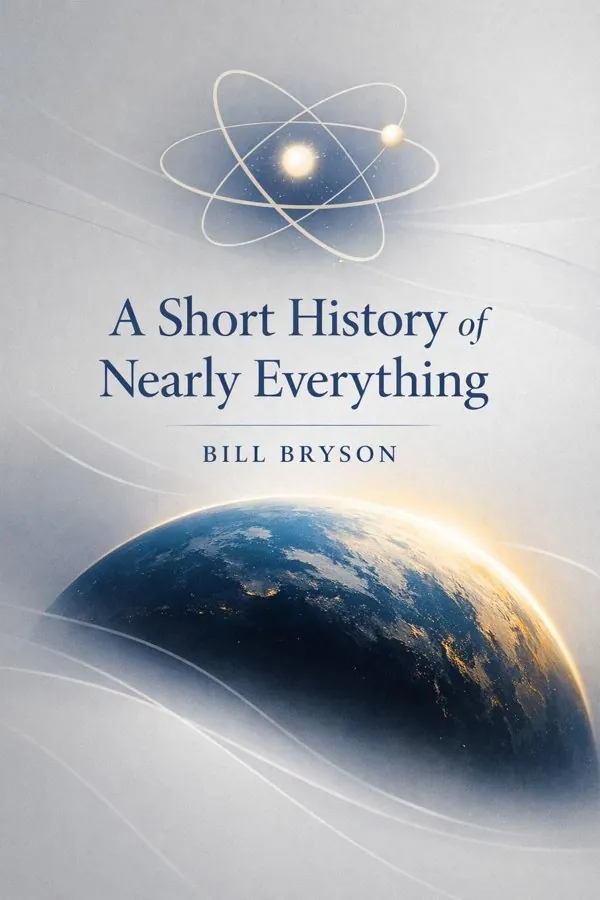
A Short History of Nearly Everything: Summary & Key Insights
by Bill Bryson
 10 min10 chaptersAudio available
Key Takeaways from A Short History of Nearly Everything
Everything you know—every star, atom, ocean, and memory—began in an event so extreme that ordinary language barely helps us describe it.
The ground beneath your feet feels permanent, but Earth’s existence is the result of chaos, collision, and extraordinary luck.
One of science’s most revolutionary discoveries is not a machine or a formula, but a timescale.
The solid world seems straightforward until science reveals that matter is mostly emptiness structured by forces we cannot see.
The universe may seem messy, but science advances because nature is surprisingly orderly.
What Is A Short History of Nearly Everything About?
A Short History of Nearly Everything by Bill Bryson is a science book published in 2003 spanning 12 pages. A Short History of Nearly Everything is Bill Bryson’s ambitious attempt to answer some of humanity’s biggest questions: How did the universe begin? How did Earth form? How did life emerge, evolve, and eventually produce us? Rather than writing a dry scientific survey, Bryson turns these immense topics into a vivid, highly readable journey through cosmology, geology, chemistry, physics, biology, and human evolution. He is especially interested in how we know what we know, so the book does not just present facts—it tells the stories of the curious, stubborn, brilliant, and often eccentric people who discovered them. What makes the book matter is its rare combination of scope, clarity, and humility. Bryson reminds readers that modern science is one of humanity’s greatest achievements, yet much of reality remains astonishingly mysterious. He also shows how fragile life is and how improbable our existence may be. Though Bryson is not a scientist by training, that is part of his strength: he writes as an intelligent outsider asking the questions many readers themselves would ask. The result is one of the most engaging introductions to scientific thought ever written for general readers.
This FizzRead summary covers all 10 key chapters of A Short History of Nearly Everything in approximately 10 minutes, distilling the most important ideas, arguments, and takeaways from Bill Bryson's work. Also available as an audio summary and Key Quotes Podcast.
A Short History of Nearly Everything
A Short History of Nearly Everything is Bill Bryson’s ambitious attempt to answer some of humanity’s biggest questions: How did the universe begin? How did Earth form? How did life emerge, evolve, and eventually produce us? Rather than writing a dry scientific survey, Bryson turns these immense topics into a vivid, highly readable journey through cosmology, geology, chemistry, physics, biology, and human evolution. He is especially interested in how we know what we know, so the book does not just present facts—it tells the stories of the curious, stubborn, brilliant, and often eccentric people who discovered them.
What makes the book matter is its rare combination of scope, clarity, and humility. Bryson reminds readers that modern science is one of humanity’s greatest achievements, yet much of reality remains astonishingly mysterious. He also shows how fragile life is and how improbable our existence may be. Though Bryson is not a scientist by training, that is part of his strength: he writes as an intelligent outsider asking the questions many readers themselves would ask. The result is one of the most engaging introductions to scientific thought ever written for general readers.
Who Should Read A Short History of Nearly Everything?
This book is perfect for anyone interested in science and looking to gain actionable insights in a short read. Whether you're a student, professional, or lifelong learner, the key ideas from A Short History of Nearly Everything by Bill Bryson will help you think differently.
- ✓Readers who enjoy science and want practical takeaways
- ✓Professionals looking to apply new ideas to their work and life
- ✓Anyone who wants the core insights of A Short History of Nearly Everything in just 10 minutes
Want the full summary?
Get instant access to this book summary and 100K+ more with Fizz Moment.
Get Free SummaryAvailable on App Store • Free to download
Key Chapters
Everything you know—every star, atom, ocean, and memory—began in an event so extreme that ordinary language barely helps us describe it. Bryson opens with the Big Bang not merely as a scientific theory, but as the starting point for all meaningful history. From an unimaginably dense and hot beginning, the universe expanded, cooled, and gradually formed the basic ingredients of matter. Out of this process came stars, galaxies, and eventually the chemical elements necessary for planets and life.
What makes this chapter powerful is Bryson’s emphasis on scale. Cosmology forces us to think in billions of years and distances so vast that even light, the fastest thing in the universe, needs ages to cross them. This can feel abstract, but Bryson grounds it in a simple insight: science has managed to reconstruct a plausible story of cosmic origins from tiny clues available on one small planet. Observing background radiation, measuring redshift, and studying particle behavior allowed scientists to infer events no human witnessed.
In practical terms, this idea changes how we think about everyday concerns. It reminds us that our personal timelines are microscopic compared with cosmic history, which can be strangely comforting. It also teaches intellectual humility: the universe is not built to fit human intuition. Whether you are reading the news about space telescopes, thinking about scientific uncertainty, or trying to inspire wonder in a child, this perspective matters.
Actionable takeaway: when faced with a complex problem, imitate cosmology—start with the evidence you have, think across long timescales, and accept that big truths often emerge from small clues.
The ground beneath your feet feels permanent, but Earth’s existence is the result of chaos, collision, and extraordinary luck. Bryson describes how our planet formed about 4.5 billion years ago from dust and debris orbiting the young Sun. Through endless impacts, matter clumped together, heated up, melted, and separated into layers. Heavy materials sank inward to form the core, while lighter materials rose to create the crust. At some point, a colossal collision likely helped form the Moon, which in turn stabilized Earth’s wobble and influenced tides.
Bryson highlights that Earth was not designed for life. It became habitable through a long series of contingent events: the right distance from the Sun, enough gravity to hold an atmosphere, geological activity to recycle materials, and liquid water persisting over immense spans of time. Even then, the early planet was hostile—bombarded by asteroids, covered in volcanoes, and prone to conditions that would instantly kill most modern organisms.
This matters because it reframes the planet as both resilient and precarious. We often imagine Earth as a static home, but it is really a dynamic system held within narrow boundaries. In everyday life, that insight can deepen appreciation for climate balance, water systems, and the rare conditions that support civilization. It also helps explain why planetary science and environmental stewardship are not niche interests but survival issues.
Actionable takeaway: treat Earth’s habitability as a rare inheritance, not a guarantee—support habits and policies that protect air, water, and long-term ecological stability.
One of science’s most revolutionary discoveries is not a machine or a formula, but a timescale. Bryson shows how difficult it was for humans to grasp that Earth is not thousands but billions of years old. Before geology matured, many people assumed the planet’s history was short, simple, and largely knowable from tradition. The realization of deep time shattered that assumption. Mountains, canyons, fossils, and sedimentary layers all pointed to a world shaped by processes operating over spans almost beyond imagination.
Bryson makes the concept vivid by showing how scientists slowly pieced together Earth’s age through stratigraphy, radiometric dating, and fossil records. These methods did more than settle a number; they transformed how we understand change itself. Evolution needs vast stretches of time. Continents move slowly but relentlessly. Climate shifts, seas rise and vanish, and species emerge and disappear on scales far greater than human memory.
The practical value of deep time is that it trains patience and proportional thinking. In modern life, we are biased toward the immediate—quarterly results, daily headlines, instant feedback. Geology reminds us that some causes are gradual and some consequences unfold over centuries or millennia. This perspective is essential for understanding climate change, biodiversity loss, and even personal development, where meaningful transformation is often incremental rather than dramatic.
Actionable takeaway: regularly ask whether the issue you are evaluating belongs to a daily, yearly, or geological timescale; better decisions begin when you match your expectations to the pace of reality.
The solid world seems straightforward until science reveals that matter is mostly emptiness structured by forces we cannot see. Bryson explores the discovery of atoms, subatomic particles, and the hidden architecture of physical reality. For centuries, people debated what matter was made of, often with little evidence. Then experimental science began uncovering a universe at scales too small for direct perception, populated by electrons, protons, neutrons, quarks, and other entities whose behavior defies common sense.
A major strength of Bryson’s treatment is that he pairs conceptual explanation with the human drama of discovery. Scientists made astonishing progress not by possessing certainty, but by asking precise questions, building instruments, and revising assumptions. The atom turned out not to be indivisible; particles turned out to behave in probabilistic ways; and the ordinary objects around us turned out to be expressions of unseen interactions.
This idea is useful far beyond physics. It reminds us that reality often differs sharply from appearance. Air feels empty but contains molecules, moisture, pollutants, and energy exchanges. A metal spoon looks inert but is full of atomic motion. In practical terms, this mindset encourages skepticism toward surface impressions. It is relevant in medicine, technology, economics, and everyday reasoning: what looks simple usually sits atop hidden systems.
Actionable takeaway: whenever something appears obvious, pause and ask what invisible structure or process makes it possible; better understanding starts by looking beyond surfaces.
The universe may seem messy, but science advances because nature is surprisingly orderly. Bryson explains how physics uncovered laws that govern motion, energy, gravity, heat, light, and matter. These laws do not remove mystery; they show that beneath countless events lies a framework of regularity. From Newton’s insights into motion and gravitation to later breakthroughs in relativity and quantum theory, scientists learned that the cosmos is both intelligible and profoundly unintuitive.
Bryson is especially good at showing that scientific progress is cumulative but never final. Newton explained more than anyone before him, yet Einstein later showed the limits of Newtonian thinking. Quantum mechanics opened a new realm of understanding while also introducing new puzzles. In other words, science does not march from ignorance to permanent certainty. It refines models, expands accuracy, and accepts that deeper layers of reality may overturn older assumptions.
This is practical because many people misunderstand science as a collection of fixed facts. Bryson presents it instead as a disciplined method for finding patterns in complexity. That lesson applies to work, education, and decision-making. Good analysis means identifying underlying rules, testing claims, and staying open to revision. Engineers use this approach to build bridges, doctors to interpret symptoms, and ordinary people to evaluate risk.
Actionable takeaway: adopt a scientific mindset in daily life—look for patterns, test your assumptions, and update your conclusions when stronger evidence appears.
What looks like a stable planet is actually a restless engine of motion. Bryson’s discussion of geology reveals that Earth’s crust is broken into moving plates, its interior remains intensely hot, and its surface is continuously reshaped by uplift, erosion, earthquakes, and volcanoes. Continents drift, oceans open and close, and mountain ranges rise only to be worn down. The world map feels fixed to us only because our lifespans are too short to notice the movement.
This dynamic Earth explains many otherwise puzzling features of the planet: why fossils of similar organisms appear on distant continents, why earthquakes cluster along fault lines, and why volcanic activity occurs in specific regions. Plate tectonics, one of the great unifying ideas in science, tied together a wide range of evidence that had long seemed disconnected. Bryson also reminds readers that catastrophic events are part of Earth’s history, not exceptions to it.
The practical implication is sobering. Human civilization is built on a geologically active planet, and many of our cities, ports, and settlements exist in vulnerable zones. Understanding the dynamic Earth matters for disaster planning, construction, insurance, infrastructure, and public policy. Even on a personal level, it teaches that apparent stability can conceal powerful underlying forces.
Actionable takeaway: learn the geological risks of where you live—earthquake, flood, volcano, erosion, or storm surge—and use that knowledge to make smarter choices about preparedness and resilience.
The most astonishing fact about life may be that it began at all. Bryson traces the history of life from simple microbial origins to the immense diversity of organisms that later populated Earth. For most of our planet’s history, life was microscopic. Complex multicellular organisms appeared relatively late, and even then the path of evolution was anything but smooth. Extinctions repeatedly erased dominant forms, opening space for new ones to emerge.
Bryson emphasizes that evolution is not a march toward perfection. It is an improvisational process shaped by mutation, selection, environment, chance, and time. Species survive not because they are ideal in any absolute sense, but because they fit current conditions well enough. This insight helps explain both the elegance and the awkwardness of biology: wings, eyes, and nervous systems are extraordinary, yet many organisms also bear the marks of compromise and historical accident.
This chapter has practical power because evolutionary thinking sharpens how we understand health, ecology, and behavior. Antibiotic resistance, crop adaptation, viral mutation, and ecosystem fragility all make more sense when viewed through evolution. It also changes how we see ourselves—not as separate from nature, but as one recent branch on a very old tree of life.
Actionable takeaway: use evolutionary thinking in real life by asking how a trait, problem, or system was shaped by past pressures; understanding origins often clarifies present behavior.
For a species that often behaves as if it owns the planet, humanity arrived remarkably late. Bryson’s account of human evolution places us within the broader story of life, showing that Homo sapiens are one recent outcome of a long, branching, uncertain process. Numerous hominin species existed before us, and our survival was never inevitable. Intelligence, language, tool use, and cooperation gradually gave humans extraordinary power, but they did not exempt us from biological contingency.
Bryson is particularly effective at puncturing human self-importance. Modern humans emerged only in the last sliver of Earth’s history, and civilization occupies an even tinier span. Much of what we take for granted—agriculture, cities, writing, industry—is astonishingly new. This perspective helps explain both our capabilities and our vulnerabilities. We are inventive, but still dependent on stable climate, functioning ecosystems, and a narrow range of physical conditions.
In practice, this idea encourages humility and responsibility. If our species is neither central nor guaranteed, then preserving the conditions that support human flourishing becomes a serious moral task. It also offers a healthier identity: we are not separate from natural history but participants in it.
Actionable takeaway: let human evolution reshape your priorities—replace arrogance with stewardship, and judge progress by whether it strengthens the long-term conditions that allow people and other life forms to thrive.
Science is one of humanity’s greatest triumphs precisely because it advances in the presence of uncertainty. Bryson closes many of his themes with a dual message: we have learned an extraordinary amount about the universe, Earth, and life, yet vast areas remain unresolved. There are still open questions about cosmic structure, consciousness, extinction events, Earth systems, and the full complexity of biology. This does not diminish science; it defines its vitality.
Bryson also stresses the human side of discovery. Scientific understanding did not appear automatically. It emerged through mistakes, rivalries, patient observation, failed experiments, institutional resistance, and occasional flashes of genius. The story of science is therefore not just about knowledge, but about character—persistence, skepticism, imagination, and the willingness to admit error.
This perspective has immediate value in a world flooded with certainty, hot takes, and oversimplified claims. Bryson teaches readers to respect expertise without treating experts as infallible, to appreciate facts without losing wonder, and to remain curious even when answers are incomplete. The limit of knowledge is not a dead end; it is an invitation.
Actionable takeaway: cultivate informed curiosity—read widely, ask better questions, and become comfortable saying “I don’t know yet,” because genuine understanding begins where false certainty ends.
All Chapters in A Short History of Nearly Everything
About the Author
Bill Bryson is an American-British author celebrated for making complex subjects entertaining and accessible to general readers. Born in Des Moines, Iowa, he later spent many years in Britain, a cross-cultural background that shaped his distinctive voice: observant, witty, curious, and deeply readable. Bryson first gained fame through travel books, but he went on to write acclaimed works on language, science, history, and domestic life. His gift lies in turning research-heavy material into lively narrative without losing intellectual substance. A Short History of Nearly Everything became one of his most influential books because it introduced millions of readers to science through story rather than jargon. Other notable works include Notes from a Small Island, At Home, One Summer, and The Body: A Guide for Occupants.
Get This Summary in Your Preferred Format
Read or listen to the A Short History of Nearly Everything summary by Bill Bryson anytime, anywhere. FizzRead offers multiple formats so you can learn on your terms — all free.
Available formats: App · Audio · PDF · EPUB — All included free with FizzRead
Download A Short History of Nearly Everything PDF and EPUB Summary
Key Quotes from A Short History of Nearly Everything
“Everything you know—every star, atom, ocean, and memory—began in an event so extreme that ordinary language barely helps us describe it.”
“The ground beneath your feet feels permanent, but Earth’s existence is the result of chaos, collision, and extraordinary luck.”
“One of science’s most revolutionary discoveries is not a machine or a formula, but a timescale.”
“The solid world seems straightforward until science reveals that matter is mostly emptiness structured by forces we cannot see.”
“The universe may seem messy, but science advances because nature is surprisingly orderly.”
Frequently Asked Questions about A Short History of Nearly Everything
A Short History of Nearly Everything by Bill Bryson is a science book that explores key ideas across 10 chapters. A Short History of Nearly Everything is Bill Bryson’s ambitious attempt to answer some of humanity’s biggest questions: How did the universe begin? How did Earth form? How did life emerge, evolve, and eventually produce us? Rather than writing a dry scientific survey, Bryson turns these immense topics into a vivid, highly readable journey through cosmology, geology, chemistry, physics, biology, and human evolution. He is especially interested in how we know what we know, so the book does not just present facts—it tells the stories of the curious, stubborn, brilliant, and often eccentric people who discovered them. What makes the book matter is its rare combination of scope, clarity, and humility. Bryson reminds readers that modern science is one of humanity’s greatest achievements, yet much of reality remains astonishingly mysterious. He also shows how fragile life is and how improbable our existence may be. Though Bryson is not a scientist by training, that is part of his strength: he writes as an intelligent outsider asking the questions many readers themselves would ask. The result is one of the most engaging introductions to scientific thought ever written for general readers.
More by Bill Bryson


You Might Also Like
Featured In
Browse by Category
Ready to read A Short History of Nearly Everything?
Get the full summary and 100K+ more books with Fizz Moment.