
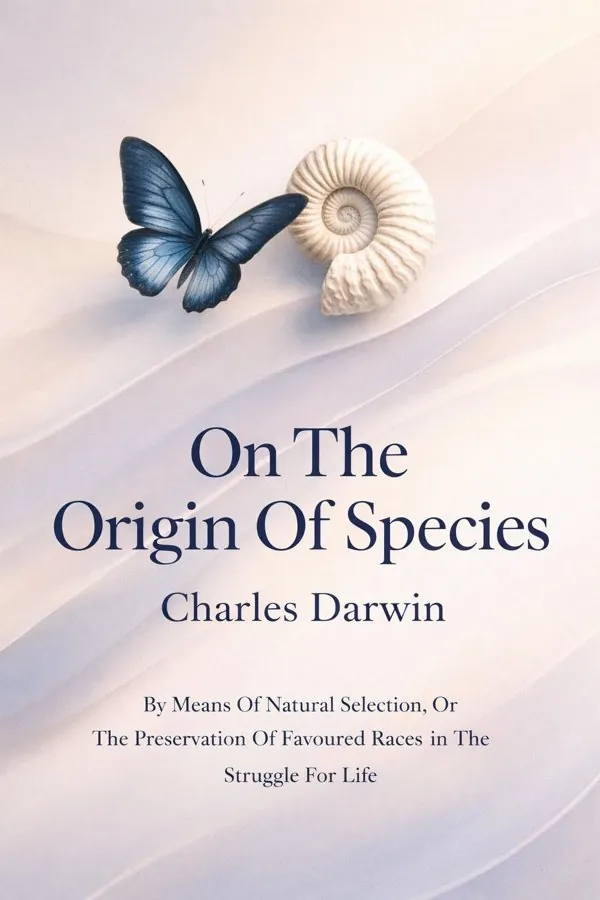
The Origin of Species: Summary & Key Insights
 10 min13 chaptersAudio available
What Is The Origin of Species About?
The Origin of Species by Charles Darwin is a science book published in 2006 spanning 13 pages. On the Origin of Species is Charles Darwin’s groundbreaking 1859 work that introduced the theory of evolution by natural selection. In this seminal text, Darwin presents evidence that species evolve over time from common ancestors, driven by the process of natural selection. The book transformed biology and reshaped humanity’s understanding of its place in the natural world, establishing a scientific foundation for evolutionary theory.
This FizzRead summary covers all 13 key chapters of The Origin of Species in approximately 10 minutes, distilling the most important ideas, arguments, and takeaways from Charles Darwin's work. Also available as an audio summary and Key Quotes Podcast.
On The Origin Of Species: By Means Of Natural Selection, Or The Preservation Of Favoured Races In The Struggle For Life
On the Origin of Species is Charles Darwin’s groundbreaking 1859 work that introduced the theory of evolution by natural selection. In this seminal text, Darwin presents evidence that species evolve over time from common ancestors, driven by the process of natural selection. The book transformed biology and reshaped humanity’s understanding of its place in the natural world, establishing a scientific foundation for evolutionary theory.
Who Should Read The Origin of Species?
This book is perfect for anyone interested in science and looking to gain actionable insights in a short read. Whether you're a student, professional, or lifelong learner, the key ideas from The Origin of Species by Charles Darwin will help you think differently.
- ✓Readers who enjoy science and want practical takeaways
- ✓Professionals looking to apply new ideas to their work and life
- ✓Anyone who wants the core insights of The Origin of Species in just 10 minutes
Want the full summary?
Get instant access to this book summary and 100K+ more with Fizz Moment.
Get Free SummaryAvailable on App Store • Free to download
Key Chapters
Let us first consider the domain where variation is most apparent—the world of domesticated plants and animals. Breeders, whether of pigeons, dogs, or cabbages, have long known that within every stock there are minor differences. Through selective breeding, by choosing individuals with desirable traits, they can shape lineages within a few generations. Out of a single wild species, the patient hand of man has created a family of forms as distinct as the tumbling pigeon and the carrier pigeon.
The principle at work here is clear: if selection favors certain variations, they accumulate, leading to profound transformation. It is not imagination, but direct observation, that reveals how pliable species can be under careful selection. I learned much from pigeon fanciers who, without formal knowledge, have produced striking varieties. What nature does slowly and unconsciously, humans do consciously but on a smaller timescale. The results under domestication are thus a demonstration, almost an experiment, in how small inherited variations can yield major differences in structure and function.
In these examples lies a powerful analogy. If artificial selection can change a species in a few centuries, then what might the ceaseless pressures of nature accomplish over countless ages? This forms the first foundation of my argument: variation exists everywhere, it is heritable, and even limited selection can produce remarkable transformation.
When we turn from the barnyard to the wilderness, variation does not disappear—it flourishes. Within every natural population, no two individuals are quite alike. These innumerable small differences, whether in color, form, or instinct, give nature her raw material for change. I found that such variations occur freely, as readily in the wild as under domestication, though without the guidance of human choice.
To many naturalists of my time, species appeared fixed and immutable. Yet the boundaries between species and varieties often blur. The so-called 'doubtful species' that one expert divides and another unites are, I believe, simply evidence that we are observing lineages in motion. Nature, unlike the classifier’s cabinet, admits no sharp limits.
This imperceptible gradation between forms reveals a living continuum. Varieties are to species what species are to genera—successive steps in the long procession of life. When we appreciate this continuity, the concept of invariability vanishes, replaced by the fluid image of life unfolding over time.
+ 11 more chapters — available in the FizzRead app
All Chapters in The Origin of Species
About the Author
Charles Darwin (1809–1882) was a British naturalist whose research on evolution and natural selection revolutionized modern biology. His voyage aboard the HMS Beagle and his observations of species diversity led him to formulate the theory of evolution, which he presented in his most influential work, On the Origin of Species.
Get This Summary in Your Preferred Format
Read or listen to the The Origin of Species summary by Charles Darwin anytime, anywhere. FizzRead offers multiple formats so you can learn on your terms — all free.
Available formats: App · Audio · PDF · EPUB — All included free with FizzRead
Download The Origin of Species PDF and EPUB Summary
Key Quotes from The Origin of Species
“Let us first consider the domain where variation is most apparent—the world of domesticated plants and animals.”
“When we turn from the barnyard to the wilderness, variation does not disappear—it flourishes.”
Frequently Asked Questions about The Origin of Species
The Origin of Species by Charles Darwin is a science book that explores key ideas across 13 chapters. On the Origin of Species is Charles Darwin’s groundbreaking 1859 work that introduced the theory of evolution by natural selection. In this seminal text, Darwin presents evidence that species evolve over time from common ancestors, driven by the process of natural selection. The book transformed biology and reshaped humanity’s understanding of its place in the natural world, establishing a scientific foundation for evolutionary theory.
You Might Also Like

Browse by Category
Ready to read The Origin of Species?
Get the full summary and 100K+ more books with Fizz Moment.