
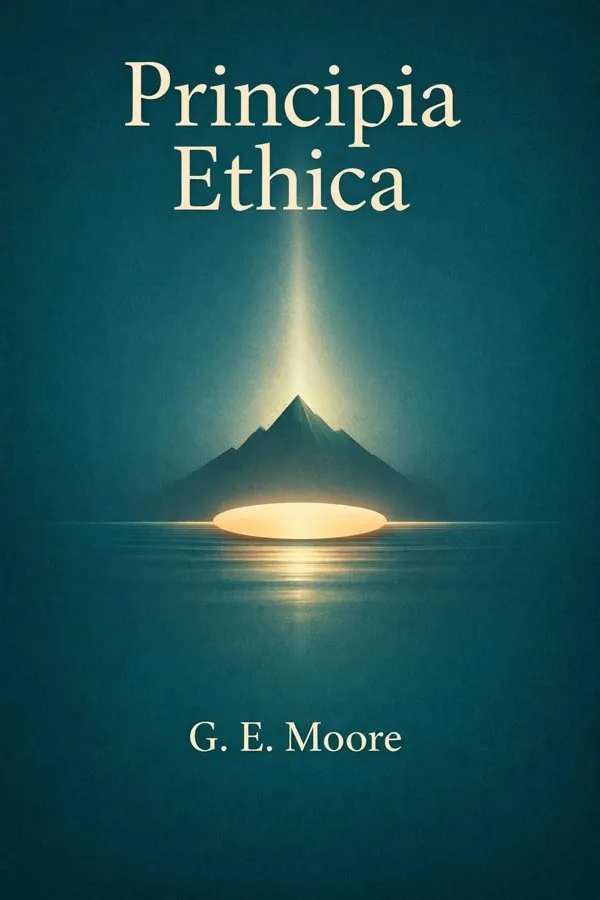
Principia: Summary & Key Insights
by Isaac Newton
 10 min8 chapters
What Is Principia About?
Principia by Isaac Newton is a science book published in 1903 spanning 8 pages. Principia Ethica, first published in 1903, is a landmark in analytic moral philosophy. In this work, G. E. Moore critiques ethical naturalism and introduces the 'open question argument' to demonstrate that 'good' is a simple, indefinable quality. The book emphasizes intrinsic value and the distinction between means and ends, profoundly influencing later thinkers such as Bertrand Russell and members of the Bloomsbury Group.
This FizzRead summary covers all 8 key chapters of Principia in approximately 10 minutes, distilling the most important ideas, arguments, and takeaways from Isaac Newton's work.
Principia Ethica
Principia Ethica, first published in 1903, is a landmark in analytic moral philosophy. In this work, G. E. Moore critiques ethical naturalism and introduces the 'open question argument' to demonstrate that 'good' is a simple, indefinable quality. The book emphasizes intrinsic value and the distinction between means and ends, profoundly influencing later thinkers such as Bertrand Russell and members of the Bloomsbury Group.
Who Should Read Principia?
This book is perfect for anyone interested in science and looking to gain actionable insights in a short read. Whether you're a student, professional, or lifelong learner, the key ideas from Principia by Isaac Newton will help you think differently.
- ✓Readers who enjoy science and want practical takeaways
- ✓Professionals looking to apply new ideas to their work and life
- ✓Anyone who wants the core insights of Principia in just 10 minutes
Want the full summary?
Get instant access to this book summary and 100K+ more with Fizz Moment.
Get Free SummaryAvailable on App Store • Free to download
Key Chapters
I begin my argument by questioning what philosophers have long taken for granted—that goodness can be defined in terms of some natural property. Utilitarians claimed good to mean pleasure; evolutionists defined it as survival; others equated it with desire or social approval. All these attempts share one fatal error: they commit the naturalistic fallacy.
The core of the fallacy is the confusion between what is and what ought to be. To say that something is pleasant is to state a fact about human sensation. To say that something is good is to make a moral claim whose meaning lies beyond any empirical observation. If you identify 'good' with 'pleasant', you are reducing a moral concept to a psychological description. But the moment you do so, you lose the unique moral quality that goodness expresses. You cannot capture an evaluative judgment simply by pointing to a natural fact.
Through examples I show that natural definitions of good are always vulnerable to the same test: imagine that pleasure is good. One can still ask meaningfully, 'Is pleasure itself good?' This question remains open, and so your definition must be wrong. If the meaning of 'good' were truly identical to 'pleasant,' the question would be nonsensical—like asking whether a bachelor is unmarried. Yet it remains sensible, proving the definitions fail.
My critique of ethical naturalism is not merely semantic; it has practical consequences. For if we mistake goodness for some natural property, we will invariably confuse ends with means. We will chase after pleasure or utility, believing them to be ultimate goods, when in fact their moral worth depends on whether they relate to intrinsic values. The failure of naturalism thus distorts the entire moral enterprise. Only by recognizing good as irreducible can we build an ethics that respects the true nature of value.
Having shown that attempts to define good in naturalistic terms fail, I advance the claim that 'good' is simple and indefinable. By simplicity I mean that good is not composed of smaller parts or reducible to anything more fundamental. Colors provide an analogy: 'yellow' cannot be defined except by pointing to examples. Similarly, one grasping the meaning of 'good' must rely upon direct intuition.
The notorious open question argument supports this claim. Take any proposed definition—for instance, 'good means pleasant.' Ask yourself sincerely whether it is true that pleasure is good. If the question remains meaningful, the definition fails, since a genuine synonym would render the question nonsensical. This logical openness proves that 'good' designates a unique, non-natural property.
My insistence on indefinability is not meant to frustrate ethical progress but to free it. Once we admit that good is irreducible, we can focus on discovering which things embody it intrinsically. The philosopher’s first task is therefore analytic—to clarify meaning so moral inquiry proceeds on solid ground. Through self-reflection and experience we perceive goodness directly, not through descriptive science but through intuitive apprehension. The denial of naturalistic reduction does not make goodness mystical; it merely respects the limits of definition. To try to define it would be to misunderstand what kind of concept it is.
+ 6 more chapters — available in the FizzRead app
All Chapters in Principia
About the Author
George Edward Moore (1873–1958) was a British philosopher and a founding figure of analytic philosophy. Renowned for his contributions to ethics, epistemology, and common-sense realism, Moore taught at the University of Cambridge and edited the journal Mind. His rigorous argumentation and defense of moral intuitionism shaped twentieth-century philosophical thought.
Get This Summary in Your Preferred Format
Read or listen to the Principia summary by Isaac Newton anytime, anywhere. FizzRead offers multiple formats so you can learn on your terms — all free.
Available formats: App · Audio · PDF · EPUB — All included free with FizzRead
Download Principia PDF and EPUB Summary
Key Quotes from Principia
“I begin my argument by questioning what philosophers have long taken for granted—that goodness can be defined in terms of some natural property.”
“Having shown that attempts to define good in naturalistic terms fail, I advance the claim that 'good' is simple and indefinable.”
Frequently Asked Questions about Principia
Principia by Isaac Newton is a science book that explores key ideas across 8 chapters. Principia Ethica, first published in 1903, is a landmark in analytic moral philosophy. In this work, G. E. Moore critiques ethical naturalism and introduces the 'open question argument' to demonstrate that 'good' is a simple, indefinable quality. The book emphasizes intrinsic value and the distinction between means and ends, profoundly influencing later thinkers such as Bertrand Russell and members of the Bloomsbury Group.
You Might Also Like

Browse by Category
Ready to read Principia?
Get the full summary and 100K+ more books with Fizz Moment.