
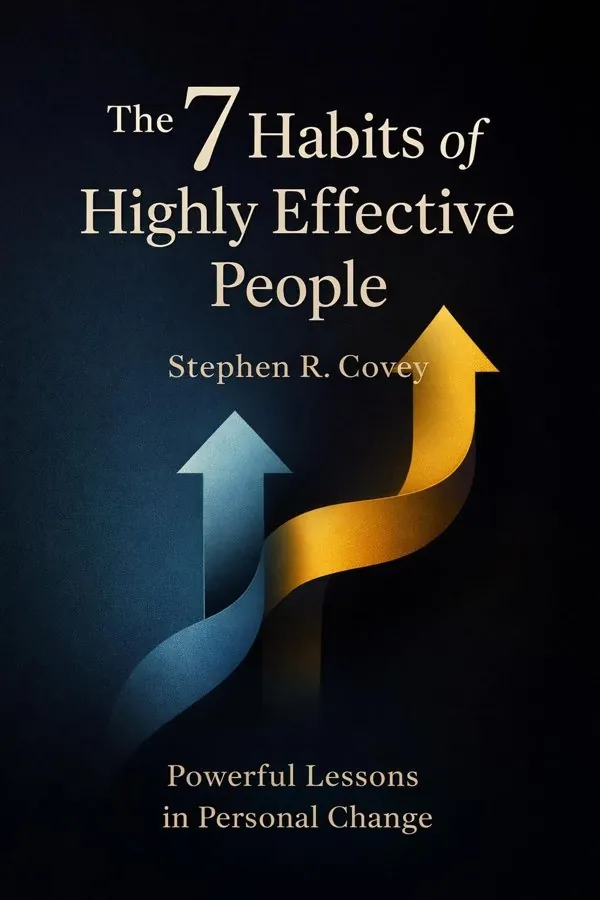
The 7 Habits of Highly Effective People: Summary & Key Insights
 10 min8 chaptersAudio available
Key Takeaways from The 7 Habits of Highly Effective People
Many people spend years searching for better results while ignoring the beliefs and habits that produce those results in the first place.
The space between what happens to you and how you respond is where your freedom lives.
It is easy to climb the ladder of success only to discover it was leaning against the wrong wall.
Most people do not fail because they lack goals; they fail because urgent demands crowd out important ones.
In many environments, people are trained to believe that one person’s success requires another person’s loss.
What Is The 7 Habits of Highly Effective People About?
The 7 Habits of Highly Effective People by Stephen R. Covey is a self-help book. What if lasting success has less to do with techniques and more to do with character? In The 7 Habits of Highly Effective People, Stephen R. Covey argues that real effectiveness begins inside out. Instead of offering quick fixes, motivational slogans, or productivity hacks, Covey presents a principle-centered approach to personal and professional growth. He explains that many people chase external success while neglecting the deeper habits of responsibility, integrity, discipline, empathy, and renewal that make success sustainable. First published in 1989, the book became one of the most influential self-help and leadership titles ever written because it speaks to a universal challenge: how to live with purpose while working well with others. Covey, a respected educator, leadership expert, and organizational consultant, draws on psychology, philosophy, and practical experience to show how enduring effectiveness comes from aligning behavior with timeless principles. His seven habits move from personal mastery to interpersonal effectiveness and finally to continuous self-renewal. The result is a framework that helps readers lead themselves better, improve relationships, make wiser decisions, and build a life guided by values rather than circumstance.
This FizzRead summary covers all 8 key chapters of The 7 Habits of Highly Effective People in approximately 10 minutes, distilling the most important ideas, arguments, and takeaways from Stephen R. Covey's work. Also available as an audio summary and Key Quotes Podcast.
The 7 Habits of Highly Effective People
What if lasting success has less to do with techniques and more to do with character? In The 7 Habits of Highly Effective People, Stephen R. Covey argues that real effectiveness begins inside out. Instead of offering quick fixes, motivational slogans, or productivity hacks, Covey presents a principle-centered approach to personal and professional growth. He explains that many people chase external success while neglecting the deeper habits of responsibility, integrity, discipline, empathy, and renewal that make success sustainable.
First published in 1989, the book became one of the most influential self-help and leadership titles ever written because it speaks to a universal challenge: how to live with purpose while working well with others. Covey, a respected educator, leadership expert, and organizational consultant, draws on psychology, philosophy, and practical experience to show how enduring effectiveness comes from aligning behavior with timeless principles. His seven habits move from personal mastery to interpersonal effectiveness and finally to continuous self-renewal. The result is a framework that helps readers lead themselves better, improve relationships, make wiser decisions, and build a life guided by values rather than circumstance.
Who Should Read The 7 Habits of Highly Effective People?
This book is perfect for anyone interested in self-help and looking to gain actionable insights in a short read. Whether you're a student, professional, or lifelong learner, the key ideas from The 7 Habits of Highly Effective People by Stephen R. Covey will help you think differently.
- ✓Readers who enjoy self-help and want practical takeaways
- ✓Professionals looking to apply new ideas to their work and life
- ✓Anyone who wants the core insights of The 7 Habits of Highly Effective People in just 10 minutes
Want the full summary?
Get instant access to this book summary and 100K+ more with Fizz Moment.
Get Free SummaryAvailable on App Store • Free to download
Key Chapters
Many people spend years searching for better results while ignoring the beliefs and habits that produce those results in the first place. Covey’s central insight is that effectiveness is not built on image, charm, or short-term techniques. It grows out of character. He calls this the difference between the personality ethic and the character ethic. The personality ethic focuses on appearance, influence, communication tricks, and public impression. The character ethic focuses on integrity, humility, courage, fidelity, patience, and service.
Covey argues that lasting success cannot be separated from the principles that sustain it. You might use clever tactics to impress a boss, win an argument, or persuade a client, but if trust is weak underneath, results will eventually erode. In contrast, when your actions are rooted in reliable values, you build credibility that compounds over time. This idea is why the book still matters: it challenges readers to stop asking only, “How can I get what I want?” and start asking, “Who am I becoming?”
In practical life, this means looking beneath visible problems. If a team struggles with communication, the real issue may be low trust. If a family seems chaotic, the deeper issue may be a lack of shared priorities. If work feels meaningless, the issue may be a gap between your values and your daily choices. Covey invites readers to work from the inside out by examining assumptions, motives, and principles before trying to fix outcomes.
Actionable takeaway: Before trying a new productivity method or relationship tactic, identify one recurring problem in your life and ask what character quality it is calling you to strengthen, such as discipline, honesty, patience, or responsibility.
The space between what happens to you and how you respond is where your freedom lives. That is the foundation of Habit 1: Be Proactive. Covey does not mean merely taking initiative or staying busy. He means recognizing that while we cannot control every circumstance, we can control our response. Proactive people act from values. Reactive people act from mood, pressure, or environment.
Covey explains that highly effective people focus their energy on what he calls the circle of influence rather than endlessly worrying about the circle of concern. The circle of concern contains everything that troubles us: the economy, other people’s opinions, office politics, traffic, and world events. The circle of influence includes what we can actually affect: our behavior, preparation, words, attitude, decisions, and commitments. When people keep investing in their influence, that circle tends to grow. When they stay stuck in complaint and blame, it shrinks.
This habit is especially powerful in ordinary situations. If a colleague is difficult, a reactive approach is to gossip or complain. A proactive approach is to prepare for the conversation, clarify expectations, and communicate calmly. If you feel overwhelmed, a reactive response is to blame your schedule. A proactive response is to review your commitments and renegotiate them. Covey also stresses language. Reactive language sounds like “I have to,” “They make me,” or “That’s just how I am.” Proactive language sounds like “I choose,” “I can,” and “I will.”
Actionable takeaway: For one week, notice moments when you feel frustrated or powerless. Replace one reactive phrase with a proactive one and choose a specific action that lies within your control.
It is easy to climb the ladder of success only to discover it was leaning against the wrong wall. Habit 2 asks readers to live from vision rather than drift. To begin with the end in mind means to define what truly matters before daily demands consume your attention. Covey encourages readers to imagine their own funeral and consider what they would want family, friends, colleagues, and community members to say about how they lived. This is not a morbid exercise. It is a clarifying one.
The habit is about personal leadership. Every creation happens twice: first mentally, then physically. A building exists as a blueprint before construction begins. In the same way, a meaningful life must be designed in thought before it is expressed in action. Without that design, people often inherit scripts from parents, culture, ambition, fear, or social comparison. They become successful by external standards while feeling internally unfulfilled.
Covey’s practical tool here is the personal mission statement, a written expression of your values, priorities, and desired contributions. It can include who you want to be, what relationships you want to build, what principles guide your decisions, and what kind of work feels meaningful. This statement becomes a reference point during difficult decisions. For example, if your mission emphasizes being a present parent, that may influence how you set boundaries around work. If it emphasizes service and growth, it may shape how you choose opportunities.
Actionable takeaway: Write a short personal mission statement using three prompts: the kind of person you want to be, the relationships you want to nurture, and the contribution you want your life to make.
Most people do not fail because they lack goals; they fail because urgent demands crowd out important ones. Habit 3 turns vision into disciplined action. Once you know your values and long-term priorities, you must organize your time around them. Covey’s time management framework is one of the book’s most enduring contributions. He divides activities into four quadrants based on urgency and importance. Quadrant I is urgent and important, such as crises and deadlines. Quadrant II is important but not urgent, such as planning, relationship building, exercise, prevention, learning, and strategic thinking. Quadrant III is urgent but not important, like many interruptions and low-value requests. Quadrant IV is neither urgent nor important, like trivial busywork or mindless distraction.
Covey argues that effective people invest heavily in Quadrant II. This is where quality improves, trust deepens, and future crises are prevented. Yet Quadrant II is often neglected because it does not shout for attention. Exercise can wait. Preparation can wait. Honest conversations can wait. Reflection can wait. Until the consequences arrive.
Putting first things first means scheduling priorities instead of merely prioritizing your schedule. It also requires courage to say no to things that appear urgent but do not align with your mission. In practice, this can mean setting aside weekly planning time, blocking focused work sessions, scheduling family commitments first, and protecting space for renewal. It may also mean reducing commitments that create noise without value.
Actionable takeaway: Review your calendar for the next seven days and deliberately schedule one important but non-urgent activity in health, relationships, or personal growth before filling the rest of your time.
In many environments, people are trained to believe that one person’s success requires another person’s loss. Covey challenges that scarcity mindset with Habit 4: Think Win-Win. This habit is not naive optimism or endless compromise. It is the belief that in many human interactions, better solutions emerge when both sides seek mutual benefit rather than domination, submission, or avoidance.
Covey outlines several common relationship patterns: win-lose, where one side tries to prevail; lose-win, where one side gives in to keep peace; lose-lose, where conflict becomes destructive; win, where people care only about themselves; and win-win, where both sides pursue a fair, principled, mutually beneficial result. Win-win requires maturity, courage, and consideration. Courage allows you to express your needs honestly. Consideration allows you to respect the needs of others.
This habit matters in business, marriage, parenting, and leadership. A manager using win-lose may rely on pressure and control, damaging morale. Someone stuck in lose-win may overcommit, suppress resentment, and burn out. A win-win approach would involve clear expectations, shared goals, and transparent agreements. In family life, win-win might mean involving children in problem-solving instead of imposing every rule without discussion. In negotiation, it means asking what solution preserves trust while meeting legitimate interests.
Covey also notes that win-win rests on an abundance mentality, the belief that there is enough recognition, opportunity, and success to go around. Without that mindset, collaboration becomes difficult because every interaction feels threatening.
Actionable takeaway: In one ongoing conflict, stop asking how to win the argument and instead write down what a genuinely good outcome would look like for both you and the other person.
Most people listen with the intention to reply, not to understand. Habit 5 is one of Covey’s most transformative ideas because it addresses the root of many relationship breakdowns. He argues that deep communication begins with empathic listening. Before offering advice, defending your position, or explaining yourself, you must understand the other person’s perspective in a way that they themselves feel understood.
This is harder than it sounds because people tend to filter conversations through autobiography. We compare, judge, interpret, diagnose, or prepare our response while the other person is still speaking. Covey suggests that this habit requires patience and discipline. Empathic listening means hearing not just words, but emotions, assumptions, and unmet needs. It communicates respect and builds trust.
The practical power of this habit is immense. In marriage, many conflicts escalate because each partner argues from pain without truly hearing the other. At work, employees often resist decisions less because of the decision itself and more because they feel ignored. In leadership, people become far more open to direction when they believe their concerns have been honestly heard. Covey points out that being understood is a deep human need, but paradoxically the path to influence begins by granting that need to others first.
Once understanding is established, then you can seek to be understood. Your message lands more effectively because the conversation is no longer adversarial. Even when disagreement remains, empathy lowers defensiveness and makes solution-finding possible.
Actionable takeaway: In your next important conversation, spend at least five uninterrupted minutes asking clarifying questions and reflecting back what you heard before sharing your own opinion or solution.
When people stop treating differences as threats, they can turn them into creative advantage. That is the essence of Habit 6: Synergize. Covey describes synergy as the outcome produced when people value differences deeply enough to create something better together than either could create alone. It is not simple compromise, where each side gives up part of what it wants. It is a third alternative that emerges through trust, openness, and collaboration.
Synergy depends on the earlier habits. Without personal security, people become defensive. Without win-win thinking, they compete instead of collaborate. Without empathic listening, they misunderstand each other. But when those foundations are present, differences in background, temperament, expertise, and perspective become resources rather than obstacles.
In practical terms, synergy appears in teams that solve problems creatively because members challenge each other constructively. It appears in partnerships where one person is visionary and another is analytical. It appears in families where differing personalities are respected instead of forced into sameness. Covey invites readers to welcome diversity not merely as a moral value but as a practical advantage. A homogeneous group may feel comfortable, but it often misses blind spots and settles for weaker solutions.
This habit also calls for humility. You must be willing to admit that your current answer may not be the best answer. In conflict, synergy asks not, “Whose idea wins?” but, “What better idea can emerge if we think together?” That question can transform problem-solving from a power struggle into a creative process.
Actionable takeaway: In the next group decision you face, intentionally seek input from someone who sees the issue differently from you and ask what possibility your current thinking might be overlooking.
Productivity without renewal eventually becomes exhaustion in disguise. Covey closes with Habit 7: Sharpen the Saw, the practice of continuous self-renewal in four dimensions of life: physical, mental, social-emotional, and spiritual. The metaphor comes from a person trying to cut wood with a dull saw while insisting they are too busy to stop and sharpen it. Many people live this way, pushing harder while becoming less effective.
Physical renewal includes exercise, sleep, nutrition, and stress management. Mental renewal includes reading, learning, writing, and disciplined thinking. Social-emotional renewal includes service, relationships, empathy, and emotional connection. Spiritual renewal includes reflection, prayer, meditation, time in nature, values clarification, and activities that reconnect you with meaning. Covey does not present renewal as indulgence. He presents it as maintenance for effectiveness.
This habit is especially relevant in a culture that rewards constant output. People often treat rest, reflection, and development as optional extras to be squeezed in after work is done. Covey reverses that logic. Renewal is what makes sustained contribution possible. A leader who never reflects becomes reactive. A parent who never restores energy becomes irritable. A professional who never learns becomes outdated. A person who ignores health eventually loses capacity.
The deeper value of this habit is balance. Covey’s model does not ask readers to optimize one area at the expense of all others. It asks them to cultivate the whole person. Effectiveness is not just about achievement. It is about maintaining the inner resources required to live well over time.
Actionable takeaway: Choose one small weekly renewal ritual in each of the four areas, such as a walk, a chapter of reading, a meaningful conversation, and ten minutes of reflection, and protect them like important appointments.
All Chapters in The 7 Habits of Highly Effective People
About the Author
Stephen R. Covey was an American author, educator, and leadership consultant whose work reshaped modern thinking about effectiveness, character, and leadership. Born in 1932, he became internationally known through The 7 Habits of Highly Effective People, a landmark book that sold millions of copies and influenced readers across business, education, government, and personal development. Covey held an MBA from Harvard and a doctorate from Brigham Young University, where he also taught organizational behavior and business management. He later co-founded FranklinCovey, a global company focused on leadership training and performance improvement. Unlike many self-help writers, Covey grounded his ideas in timeless principles, ethical responsibility, and long-term growth. His work continues to be widely read because it combines practical tools with a strong moral and philosophical foundation.
Get This Summary in Your Preferred Format
Read or listen to the The 7 Habits of Highly Effective People summary by Stephen R. Covey anytime, anywhere. FizzRead offers multiple formats so you can learn on your terms — all free.
Available formats: App · Audio · PDF · EPUB — All included free with FizzRead
Download The 7 Habits of Highly Effective People PDF and EPUB Summary
Key Quotes from The 7 Habits of Highly Effective People
“Many people spend years searching for better results while ignoring the beliefs and habits that produce those results in the first place.”
“The space between what happens to you and how you respond is where your freedom lives.”
“It is easy to climb the ladder of success only to discover it was leaning against the wrong wall.”
“Most people do not fail because they lack goals; they fail because urgent demands crowd out important ones.”
“In many environments, people are trained to believe that one person’s success requires another person’s loss.”
Frequently Asked Questions about The 7 Habits of Highly Effective People
The 7 Habits of Highly Effective People by Stephen R. Covey is a self-help book that explores key ideas across 8 chapters. What if lasting success has less to do with techniques and more to do with character? In The 7 Habits of Highly Effective People, Stephen R. Covey argues that real effectiveness begins inside out. Instead of offering quick fixes, motivational slogans, or productivity hacks, Covey presents a principle-centered approach to personal and professional growth. He explains that many people chase external success while neglecting the deeper habits of responsibility, integrity, discipline, empathy, and renewal that make success sustainable. First published in 1989, the book became one of the most influential self-help and leadership titles ever written because it speaks to a universal challenge: how to live with purpose while working well with others. Covey, a respected educator, leadership expert, and organizational consultant, draws on psychology, philosophy, and practical experience to show how enduring effectiveness comes from aligning behavior with timeless principles. His seven habits move from personal mastery to interpersonal effectiveness and finally to continuous self-renewal. The result is a framework that helps readers lead themselves better, improve relationships, make wiser decisions, and build a life guided by values rather than circumstance.
Compare The 7 Habits of Highly Effective People
More by Stephen R. Covey

The 7 Habits of Highly Effective Families
Stephen R. Covey
10 min
Primary Greatness: The 12 Levers of Success
Stephen R. Covey
10 min
Live Life in Crescendo: Your Most Important Work Is Always Ahead of You
Stephen R. Covey, Cynthia Covey Haller
10 min
The 8th Habit: From Effectiveness to Greatness
Stephen R. Covey
10 minYou Might Also Like




Featured In
Curated's Book Picks
Best Self-Help Books of All Time — Transform Your Life
Curated's Book Picks
Books Everyone Should Read — Universal Essentials
Curated's Book Picks
Best Audiobooks of All Time — Listen to the Greatest Books
Psychology's Book Picks
Inside Your Mind: Psychology Books That Change Everything
Browse by Category
Ready to read The 7 Habits of Highly Effective People?
Get the full summary and 100K+ more books with Fizz Moment.