
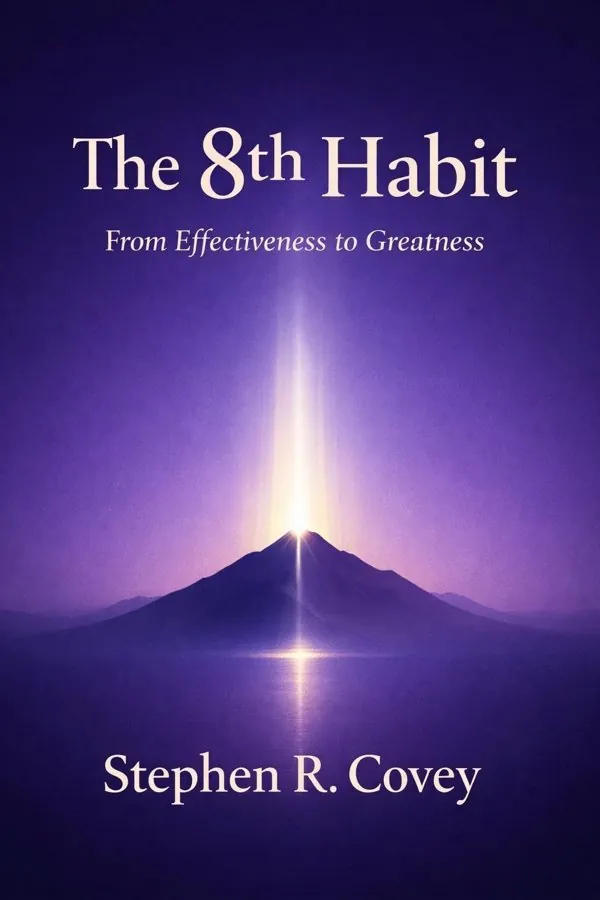
The 8th Habit: From Effectiveness to Greatness: Summary & Key Insights
 10 min9 chaptersAudio available
Key Takeaways from The 8th Habit: From Effectiveness to Greatness
One of the deepest frustrations of modern work is that people can be surrounded by opportunity and still feel invisible.
The biggest organizational problem is rarely a lack of talent; it is the failure to unlock it.
Greatness begins when a person stops asking only how to succeed and starts asking what they are uniquely here to contribute.
People do not leave their humanity at the office door, even if many systems act as though they should.
Real leadership is not about controlling people more efficiently; it is about helping them see and express their worth.
What Is The 8th Habit: From Effectiveness to Greatness About?
The 8th Habit: From Effectiveness to Greatness by Stephen R. Covey is a leadership book spanning 10 pages. The 8th Habit: From Effectiveness to Greatness is Stephen R. Covey’s answer to a question left open by The 7 Habits of Highly Effective People: once people become effective, what comes next? Covey argues that in today’s knowledge-worker world, effectiveness is no longer enough. Organizations are full of intelligent, capable people who feel underused, disconnected, and unseen. The real challenge is not just getting things done, but discovering meaning, contribution, and the ability to inspire others to do the same. That is where the “8th habit” begins. Covey’s central idea is simple but powerful: greatness comes from finding your voice—the unique intersection of your talent, passion, conscience, and the world’s needs—and then helping others find theirs. Drawing on leadership theory, organizational behavior, and decades of consulting experience, he critiques outdated Industrial Age management and replaces it with a more human, principle-centered model. This book matters because it speaks to a widespread modern problem: people may be technically connected and professionally busy, yet still feel spiritually and emotionally disengaged. Covey offers a framework for personal leadership, cultural transformation, and lasting significance.
This FizzRead summary covers all 9 key chapters of The 8th Habit: From Effectiveness to Greatness in approximately 10 minutes, distilling the most important ideas, arguments, and takeaways from Stephen R. Covey's work. Also available as an audio summary and Key Quotes Podcast.
The 8th Habit: From Effectiveness to Greatness
The 8th Habit: From Effectiveness to Greatness is Stephen R. Covey’s answer to a question left open by The 7 Habits of Highly Effective People: once people become effective, what comes next? Covey argues that in today’s knowledge-worker world, effectiveness is no longer enough. Organizations are full of intelligent, capable people who feel underused, disconnected, and unseen. The real challenge is not just getting things done, but discovering meaning, contribution, and the ability to inspire others to do the same. That is where the “8th habit” begins.
Covey’s central idea is simple but powerful: greatness comes from finding your voice—the unique intersection of your talent, passion, conscience, and the world’s needs—and then helping others find theirs. Drawing on leadership theory, organizational behavior, and decades of consulting experience, he critiques outdated Industrial Age management and replaces it with a more human, principle-centered model. This book matters because it speaks to a widespread modern problem: people may be technically connected and professionally busy, yet still feel spiritually and emotionally disengaged. Covey offers a framework for personal leadership, cultural transformation, and lasting significance.
Who Should Read The 8th Habit: From Effectiveness to Greatness?
This book is perfect for anyone interested in leadership and looking to gain actionable insights in a short read. Whether you're a student, professional, or lifelong learner, the key ideas from The 8th Habit: From Effectiveness to Greatness by Stephen R. Covey will help you think differently.
- ✓Readers who enjoy leadership and want practical takeaways
- ✓Professionals looking to apply new ideas to their work and life
- ✓Anyone who wants the core insights of The 8th Habit: From Effectiveness to Greatness in just 10 minutes
Want the full summary?
Get instant access to this book summary and 100K+ more with Fizz Moment.
Get Free SummaryAvailable on App Store • Free to download
Key Chapters
One of the deepest frustrations of modern work is that people can be surrounded by opportunity and still feel invisible. Covey begins by identifying a widespread form of pain: talented individuals are often trapped inside systems designed for another era. In the Industrial Age, efficiency depended on standardization, control, hierarchy, and compliance. People were treated as costs, positions, or replaceable labor. That model worked reasonably well when the main challenge was managing manual production. But in the knowledge-worker age, value comes from judgment, creativity, initiative, relationships, and innovation. When organizations continue treating people like things, they create disengagement, distrust, and underperformance.
Covey argues that this pain is not limited to offices and corporations. It shows up in families, schools, communities, and public institutions whenever human beings are managed through rules and fear rather than inspired by purpose and contribution. A person may have skills, education, and technology, but still feel powerless because no one asks for their ideas or trusts their capacity. The result is not just inefficiency; it is wasted human potential.
Consider a customer service team where employees follow rigid scripts and are punished for deviation. They may solve basic issues, but they cannot adapt, empathize, or improve the process. By contrast, when leaders trust people to think, solve, and contribute, service quality and morale both rise.
The takeaway is clear: if you feel drained by systems that reduce people to roles, start naming the pain honestly. Recognizing that outdated models are the problem is the first step toward building a culture where people can contribute their full intelligence and humanity.
The biggest organizational problem is rarely a lack of talent; it is the failure to unlock it. Covey describes a massive gap between what people are capable of and what they actually contribute. Most workplaces contain far more intelligence, creativity, and commitment than daily results suggest. The issue is not human deficiency but leadership deficiency. People often know more than their jobs allow them to express. They have ideas, insights, and energy, yet systems of control, poor communication, and low trust keep that potential dormant.
Covey points to a familiar pattern: leaders ask for better results while relying on methods that suppress ownership. Employees are given goals but not context, responsibilities but not authority, and accountability but not trust. Under these conditions, people do the minimum required because they do not feel seen, needed, or respected. Over time, learned helplessness replaces initiative. Teams stop thinking beyond their immediate tasks, and organizations wonder why innovation stalls.
This gap appears in personal life as well. Someone may possess strong values and ambitions but remain stuck in reactive habits, unclear priorities, or environments that discourage growth. Closing the gap requires more than motivation. It requires aligning systems, relationships, and purpose around the whole person.
For example, a manager who invites employees into planning meetings, shares meaningful metrics, and asks for solutions rather than merely issuing instructions often discovers hidden leadership throughout the team. Contribution expands when ownership expands.
The practical lesson is to look for blocked potential, not just visible performance. Ask: where are people capable of more than the system currently permits? Then remove barriers, increase trust, and create conditions where responsibility and initiative can grow together.
Greatness begins when a person stops asking only how to succeed and starts asking what they are uniquely here to contribute. Covey defines the 8th habit as finding your voice and inspiring others to find theirs. “Voice” is more than self-expression or confidence. It is the meeting point of four elements: talent, passion, conscience, and need. Talent is what you do well. Passion is what energizes you. Conscience is your inner sense of right and responsibility. Need is where your abilities can serve others and solve real problems. When these elements converge, work becomes contribution rather than mere activity.
This idea expands the earlier seven habits. The 7 Habits help people become effective by building character, discipline, and interdependence. The 8th Habit asks what effectiveness is for. Covey’s answer is that effectiveness becomes greatness when it is directed toward meaningful service. A person with voice does not just perform efficiently; they act with authenticity and moral clarity.
Imagine a teacher who is not merely delivering a curriculum but awakening curiosity in students because she sees education as her calling. Or a product designer who uses technical skill to create tools that genuinely improve people’s lives. In both cases, the individual is operating from voice rather than obligation.
Finding voice is not a single moment of discovery. It is a process of reflection, experimentation, listening, and courage. It often requires saying no to what is merely impressive so you can say yes to what is deeply aligned.
Action step: write down your strongest talents, the work that gives you energy, the values you refuse to violate, and the needs around you that matter most. Look for the overlap. That is where your voice starts to become visible.
People do not leave their humanity at the office door, even if many systems act as though they should. One of Covey’s most important contributions is the whole-person paradigm. Human beings are not just economic units or bundles of skills; they have body, mind, heart, and spirit. The body seeks fair compensation, security, and practical well-being. The mind seeks challenge, growth, and learning. The heart seeks relationships, belonging, and appreciation. The spirit seeks meaning, integrity, and contribution. When leadership addresses only one or two of these dimensions, people disengage.
This explains why high salaries alone do not create loyalty, why training without trust does not produce innovation, and why friendly culture without purpose still feels hollow. Whole-person leadership means designing environments where people can survive, learn, connect, and matter. It is a much richer view of motivation than simple rewards and punishments.
Take the example of a company that offers good pay but gives employees no autonomy, little feedback, and no connection to a larger mission. Staff may stay for financial reasons, but creativity and commitment will remain low. In contrast, an organization that combines fair compensation with growth opportunities, mutual respect, and a shared sense of purpose is far more likely to unleash extraordinary effort.
This framework also applies personally. If your life is physically productive but emotionally empty, mentally stagnant, or spiritually misaligned, success will feel thin. Sustainable greatness requires attention to all four dimensions.
The actionable takeaway is to assess your work and leadership through the whole-person lens. Ask: are people’s bodies respected, minds challenged, hearts included, and spirits inspired? Any dimension you ignore will eventually show up as resistance, burnout, or disengagement.
Real leadership is not about controlling people more efficiently; it is about helping them see and express their worth. Covey makes a sharp distinction between formal authority and moral authority. Position can make people comply, but only character and credibility inspire commitment. Leaders in the knowledge age must move beyond command-and-control and become stewards of trust, clarity, and empowerment. Their role is to create conditions where others can contribute at their highest level.
To inspire others to find their voice, leaders must model it first. That means living by principles, keeping promises, listening deeply, and aligning words with actions. People pay less attention to leadership slogans than to leadership behavior. If a leader talks about empowerment but micromanages every decision, the culture learns fear, not responsibility. If a leader admits mistakes, shares information openly, and invites contribution, trust begins to expand.
Covey suggests that people want to be understood, involved, and connected to something meaningful. A team becomes energized when its members know why their work matters and how their strengths contribute. For example, a hospital administrator who regularly shares patient impact stories, asks frontline staff for process improvements, and acts on their suggestions transforms morale. Employees stop seeing themselves as task performers and start seeing themselves as healers in a larger mission.
This kind of leadership requires humility. Inspiring others is not about becoming the hero of the story but helping others become protagonists in their own. It is a shift from ego-centered management to service-centered leadership.
Takeaway: if you lead others, spend less time asking how to get more from people and more time asking how to reveal more within them. Trust, example, and meaningful involvement are the tools that awaken contribution.
Influence is strongest when it flows from credibility rather than pressure. Covey explains that the ability to move people and institutions depends on both character and competence. Character includes integrity, humility, courage, and fidelity to principles. Competence includes knowledge, judgment, skills, and results. When one is present without the other, influence weakens. A well-meaning person without competence is easy to dismiss; a highly capable person without integrity is hard to trust. Lasting influence requires both.
Covey also emphasizes empathic communication as a practical expression of influence. People rarely open themselves to your ideas until they feel you have genuinely understood theirs. In conflict, negotiation, or change management, the instinct is often to argue more forcefully. But influence grows when you listen first, acknowledge concerns, and search for shared principles. This creates emotional trust, which makes rational collaboration possible.
Consider a department leader trying to implement a major technology change. If she pushes the rollout without hearing employee fears, resistance will rise. But if she listens to concerns about training, workload, and customer impact, then addresses those issues transparently, people are far more willing to engage. Influence does not erase disagreement; it creates enough trust to work through it.
Covey’s deeper point is that moral authority scales. Families, teams, and organizations all function better when people believe leadership is credible and aligned. That trust lowers friction, speeds collaboration, and increases resilience under pressure.
Actionable takeaway: strengthen your influence by pairing expertise with trustworthiness. Keep commitments, tell the truth, listen before prescribing, and improve your competence where gaps exist. Influence is earned through consistent alignment between what you know, what you value, and how you treat people.
Freedom without focus creates chaos, but control without trust creates apathy. Covey argues that empowerment works only when it is matched with disciplined execution. Many leaders assume empowerment means stepping back and hoping people take initiative. Others believe execution requires tight oversight and constant correction. Covey offers a better model: establish shared purpose, clear goals, aligned systems, and visible accountability, then give people the authority and support to achieve the desired results.
He emphasizes that organizations often fail not because strategy is wrong but because daily execution is disconnected from core priorities. Teams are busy but misaligned. People work hard on what is urgent rather than what matters most. To solve this, leaders need a scoreboard people can understand, goals that are few and important, and regular accountability around commitments. When individuals see how their work connects to meaningful outcomes, they are more likely to take ownership.
For example, a sales team may be told to “improve customer retention,” but without a clear definition, measurement system, or ownership structure, the goal remains abstract. If leadership instead identifies two key retention metrics, reviews them weekly, and empowers frontline staff to propose solutions, performance becomes both measurable and participatory.
Empowerment also requires removing structural contradictions. If leaders preach initiative but punish every mistake, no one will take responsible risks. If they ask for collaboration but reward only individual results, silos will persist. Systems must reinforce the behavior culture claims to value.
The practical lesson is simple: empowerment is not the absence of management; it is high-trust management with clear expectations. Choose a small number of vital priorities, define success visibly, and create regular rhythms of accountability that support ownership instead of fear.
The most fulfilling work often emerges where personal calling meets meaningful service. Covey describes greatness as living in the “sweet spot,” the place where your natural gifts, deep passion, moral conscience, and the world’s needs intersect. This idea expands beyond career planning. It is a framework for deciding how to invest your life. Many people spend years pursuing what they are good at but not what they care about, or what excites them but does not truly serve others. The sweet spot integrates ability, energy, ethics, and usefulness.
Covey’s concept is powerful because it resists shallow definitions of success. Achievement alone is not greatness. Someone can accumulate status, money, or recognition while feeling internally fragmented. Greatness, in Covey’s view, has both performance and purpose. It is not about grandiosity but alignment. A parent, nurse, entrepreneur, craftsman, or community organizer can live greatly if their work expresses who they are in ways that genuinely help others.
A practical example might be an engineer who realizes her deepest interest is sustainable design. Instead of using her skills only for technical efficiency, she shifts toward projects that reduce waste and improve community resilience. Her talent remains the same, but the integration of passion, conscience, and need transforms her work into vocation.
The sweet spot is not static. Life stages, responsibilities, and opportunities change. What matters is the ongoing discipline of listening inwardly and responding outwardly. Reflection, feedback, service, and experimentation all help reveal the right direction.
Action step: review your current commitments and ask four questions: What am I good at? What energizes me? What feels right? What need am I meeting? Where the answers overlap, invest more deeply. Where they do not, consider what needs to change.
In the end, the question is not whether you were busy or even effective, but whether your life helped others become more fully themselves. Covey closes with the idea that true greatness leaves a legacy. Legacy is not merely what people remember about you; it is what continues because of how you lived, led, and served. The highest form of success is generative. It multiplies capacity, character, and contribution in others.
This is why the 8th habit is inherently relational. Finding your own voice is incomplete if it stops with personal fulfillment. Great leaders, parents, teachers, and citizens extend their influence by helping others discover courage, purpose, and agency. They do not create dependence on themselves; they build people who can think, choose, and lead. That is the difference between temporary impact and enduring significance.
Legacy also requires principle-centered living. Titles fade, markets shift, and achievements lose their novelty. What remains is trust built, people developed, and values embodied consistently over time. A manager who mentors younger colleagues, a parent who teaches responsibility with love, or a community leader who creates institutions that outlast them all demonstrate this kind of greatness.
Covey’s message is especially relevant in a culture obsessed with visibility and speed. Legacy grows more quietly. It comes from repeated acts of integrity, service, and empowerment. It is built in conversations, systems, and decisions that honor human worth.
The actionable takeaway is to measure your life by contribution, not just accomplishment. Ask regularly: who is stronger, wiser, freer, or more responsible because I was here? Then make choices that transfer confidence, capability, and moral clarity to others. That is how effectiveness becomes greatness.
All Chapters in The 8th Habit: From Effectiveness to Greatness
About the Author
Stephen R. Covey (1932–2012) was an American author, educator, leadership expert, and co-founder of FranklinCovey, one of the world’s best-known leadership development organizations. He rose to international prominence with The 7 Habits of Highly Effective People, a book that helped redefine personal and professional development through principle-centered living. Covey earned degrees from the University of Utah, Harvard Business School, and Brigham Young University, where he also served as a professor. His work focused on character, trust, leadership, and organizational effectiveness, blending ethical reflection with practical application. Over several decades, he advised corporations, governments, schools, and individuals around the world. The 8th Habit represents his later thinking on purpose, empowerment, and leadership in the knowledge-worker age.
Get This Summary in Your Preferred Format
Read or listen to the The 8th Habit: From Effectiveness to Greatness summary by Stephen R. Covey anytime, anywhere. FizzRead offers multiple formats so you can learn on your terms — all free.
Available formats: App · Audio · PDF · EPUB — All included free with FizzRead
Download The 8th Habit: From Effectiveness to Greatness PDF and EPUB Summary
Key Quotes from The 8th Habit: From Effectiveness to Greatness
“One of the deepest frustrations of modern work is that people can be surrounded by opportunity and still feel invisible.”
“The biggest organizational problem is rarely a lack of talent; it is the failure to unlock it.”
“Greatness begins when a person stops asking only how to succeed and starts asking what they are uniquely here to contribute.”
“People do not leave their humanity at the office door, even if many systems act as though they should.”
“Real leadership is not about controlling people more efficiently; it is about helping them see and express their worth.”
Frequently Asked Questions about The 8th Habit: From Effectiveness to Greatness
The 8th Habit: From Effectiveness to Greatness by Stephen R. Covey is a leadership book that explores key ideas across 9 chapters. The 8th Habit: From Effectiveness to Greatness is Stephen R. Covey’s answer to a question left open by The 7 Habits of Highly Effective People: once people become effective, what comes next? Covey argues that in today’s knowledge-worker world, effectiveness is no longer enough. Organizations are full of intelligent, capable people who feel underused, disconnected, and unseen. The real challenge is not just getting things done, but discovering meaning, contribution, and the ability to inspire others to do the same. That is where the “8th habit” begins. Covey’s central idea is simple but powerful: greatness comes from finding your voice—the unique intersection of your talent, passion, conscience, and the world’s needs—and then helping others find theirs. Drawing on leadership theory, organizational behavior, and decades of consulting experience, he critiques outdated Industrial Age management and replaces it with a more human, principle-centered model. This book matters because it speaks to a widespread modern problem: people may be technically connected and professionally busy, yet still feel spiritually and emotionally disengaged. Covey offers a framework for personal leadership, cultural transformation, and lasting significance.
More by Stephen R. Covey
The 7 Habits of Highly Effective People
Stephen R. Covey
10 min
The 7 Habits of Highly Effective Families
Stephen R. Covey
10 min
Primary Greatness: The 12 Levers of Success
Stephen R. Covey
10 min
Live Life in Crescendo: Your Most Important Work Is Always Ahead of You
Stephen R. Covey, Cynthia Covey Haller
10 minYou Might Also Like

Extreme Ownership
Jocko Willink
10 min
Dare to Lead
Brene Brown
10 min
Leaders Eat Last
Simon Sinek
10 min
The 21 Irrefutable Laws of Leadership
John Maxwell
10 min
Start With Why
Simon Sinek
10 min
How to Lead When You're Not in Charge
Clay Scroggins
10 minBrowse by Category
Ready to read The 8th Habit: From Effectiveness to Greatness?
Get the full summary and 100K+ more books with Fizz Moment.