
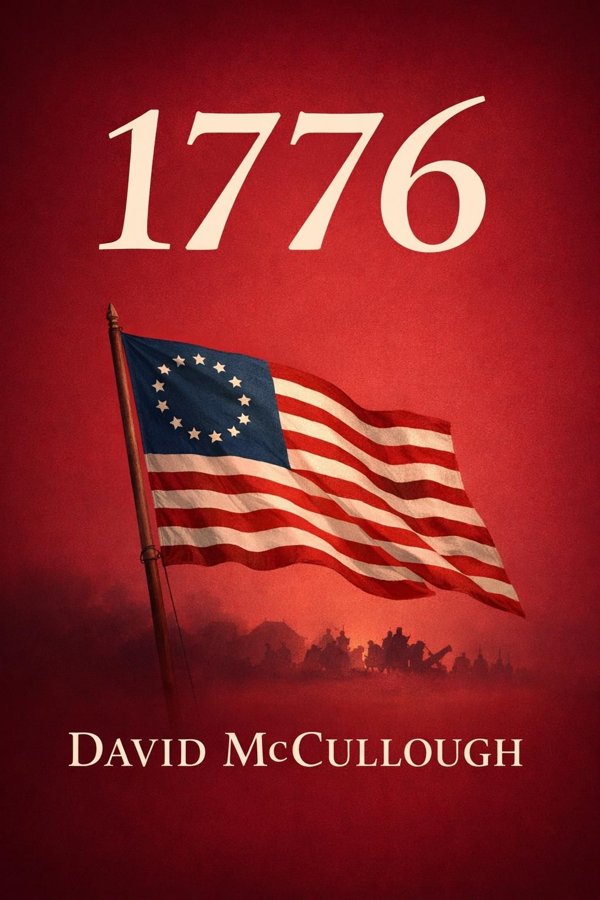
1776: Summary & Key Insights
 10 min10 chaptersAudio available
Key Takeaways from 1776
Revolutions often begin in rhetoric but are decided in grim reality.
Great leaders are not always fully formed when history calls on them.
A declaration can announce a cause, but it cannot defend it.
Important battles are often lost before they begin, in the gap between what leaders hope and what geography allows.
Some of the most consequential moments in history are not victories but escapes.
What Is 1776 About?
1776 by David McCullough is a world_history book spanning 10 pages. David McCullough��s 1776 is a vivid, fast-moving history of the year in which the American Revolution nearly failed before it found its footing. Rather than treating independence as an inevitable triumph, McCullough restores the uncertainty, fear, confusion, and sheer contingency of events. He follows George Washington, the Continental Army, the British high command, Congress, and ordinary soldiers through a year marked by desperation as much as hope. The result is not simply a military chronicle, but a human story about leadership under pressure, endurance in defeat, and the fragile beginnings of a nation. What makes the book so powerful is its insistence that history is made by flawed people operating with incomplete information. Washington appears not as a marble hero, but as a determined commander learning under fire. The soldiers are shown as exhausted, hungry, often frightened men whose perseverance mattered as much as grand political ideals. McCullough, one of America’s most respected historians and a two-time Pulitzer Prize winner, grounds the narrative in letters, diaries, and official records, giving the year extraordinary immediacy. 1776 matters because it reminds us that great turning points are rarely secure while they are happening.
This FizzRead summary covers all 10 key chapters of 1776 in approximately 10 minutes, distilling the most important ideas, arguments, and takeaways from David McCullough's work. Also available as an audio summary and Key Quotes Podcast.
1776
David McCullough��s 1776 is a vivid, fast-moving history of the year in which the American Revolution nearly failed before it found its footing. Rather than treating independence as an inevitable triumph, McCullough restores the uncertainty, fear, confusion, and sheer contingency of events. He follows George Washington, the Continental Army, the British high command, Congress, and ordinary soldiers through a year marked by desperation as much as hope. The result is not simply a military chronicle, but a human story about leadership under pressure, endurance in defeat, and the fragile beginnings of a nation.
What makes the book so powerful is its insistence that history is made by flawed people operating with incomplete information. Washington appears not as a marble hero, but as a determined commander learning under fire. The soldiers are shown as exhausted, hungry, often frightened men whose perseverance mattered as much as grand political ideals. McCullough, one of America’s most respected historians and a two-time Pulitzer Prize winner, grounds the narrative in letters, diaries, and official records, giving the year extraordinary immediacy. 1776 matters because it reminds us that great turning points are rarely secure while they are happening.
Who Should Read 1776?
This book is perfect for anyone interested in world_history and looking to gain actionable insights in a short read. Whether you're a student, professional, or lifelong learner, the key ideas from 1776 by David McCullough will help you think differently.
- ✓Readers who enjoy world_history and want practical takeaways
- ✓Professionals looking to apply new ideas to their work and life
- ✓Anyone who wants the core insights of 1776 in just 10 minutes
Want the full summary?
Get instant access to this book summary and 100K+ more with Fizz Moment.
Get Free SummaryAvailable on App Store • Free to download
Key Chapters
Revolutions often begin in rhetoric but are decided in grim reality. McCullough opens 1776 with Boston under siege, where the Continental Army surrounds British forces entrenched in the city. At first glance, the Americans appear energized by purpose and numbers, yet the closer view is unsettling: powder is scarce, organization is weak, enlistments are temporary, and discipline is inconsistent. George Washington arrives to take command and immediately discovers that enthusiasm is not the same as readiness.
The significance of Boston lies in how quickly it strips away romantic illusions. Washington sees men brave in spirit but undertrained, poorly equipped, and often governed more by local loyalties than national commitment. Across from them stands the world’s most powerful professional army. The British may underestimate colonial resolve, but they possess the advantages of structure, experience, and naval power. The siege therefore becomes a classroom in leadership. Washington must impose order, gather intelligence, improve morale, and cultivate patience while waiting for an opening.
One practical lesson from this episode is that early success in any mission can hide structural weaknesses. A startup may have vision but no systems. A social movement may have passion but no operational discipline. A team may be committed but not coordinated. Washington’s challenge in Boston shows that leaders must diagnose reality before celebrating momentum.
The eventual British evacuation of Boston was an important American victory, but McCullough makes clear that it did not prove the war was won. It proved something subtler: survival required organization as much as courage. Actionable takeaway: when facing a major challenge, assess your capabilities honestly and strengthen the unglamorous basics before assuming passion alone will carry you through.
Great leaders are not always fully formed when history calls on them. One of McCullough’s central achievements is to portray Washington as a commander growing into his responsibilities in real time. He is resolute, dignified, and tireless, but he is also inexperienced at this scale of command. He must manage politics, personalities, logistics, intelligence, morale, and strategy while under intense scrutiny from Congress and the public.
After Boston, Washington confronts a painful truth: holding an army together may be harder than winning a symbolic victory. Soldiers go home as enlistments expire. Supplies remain erratic. Regional rivalries persist. Congress expects results without always providing the means. Washington’s correspondence reveals a man caught between urgency and limitation. He cannot fight effectively without men, money, ammunition, and time, yet he rarely has enough of any of them.
This matters because McCullough challenges the myth of effortless greatness. Washington’s strength was not perfection but steadiness. He learned from setbacks, adapted to circumstances, and understood that his own composure influenced the army’s confidence. In modern terms, this is the difference between charisma and durable leadership. A manager inheriting a troubled organization, for example, may not have ideal resources or complete expertise. What matters first is clarity, discipline, and the ability to keep the group focused through uncertainty.
Washington also understood symbolism. His presence, persistence, and refusal to collapse emotionally under pressure had strategic value. People often continue because someone at the top continues. Actionable takeaway: when responsibility outruns your preparation, do not wait to feel fully ready. Build credibility by staying calm, learning quickly, and consistently aligning people around the next necessary step.
A declaration can announce a cause, but it cannot defend it. In 1776, the Continental Congress adopted the Declaration of Independence, creating one of the most important political documents in modern history. Yet McCullough places this event in a revealing context: while Congress proclaimed universal principles, Washington’s army was struggling simply to survive. The contrast is essential to understanding the book. Political vision and military endurance had to operate together, or the revolution would fail.
McCullough does not diminish the Declaration’s importance. Rather, he restores its fragility. Independence in July was a statement of intent, not a settled fact. The colonies had declared themselves free while facing internal division, uncertain foreign support, and an enemy of overwhelming strength. The ideals were magnificent, but the conditions were unstable. This tension between aspiration and capability runs throughout the narrative.
The broader lesson is that institutions and individuals often mistake announcement for achievement. A company may unveil a bold strategy, a government may pass ambitious reforms, or a person may publicly commit to change. But declaration only matters if it is followed by sustained execution. The Americans needed armies in the field, supply lines, public patience, and leaders who could continue after defeats.
By linking the Declaration to the brutal campaigns of the same year, McCullough shows that principles gain force when people endure for them under extreme stress. The ideals of liberty became more meaningful, not less, because they had to be defended at great cost. Actionable takeaway: treat your most inspiring commitments as beginnings, not conclusions. Pair every declaration of purpose with a realistic plan for what endurance, sacrifice, and follow-through will require.
Important battles are often lost before they begin, in the gap between what leaders hope and what geography allows. McCullough’s account of the British campaign in New York shows how exposed the American position was. New York was commercially vital, politically symbolic, and geographically difficult to defend. It was spread across islands, rivers, and waterways that gave the British navy enormous advantages. Washington understood its importance, but defending it effectively with his inexperienced army was a near-impossible task.
General William Howe and Admiral Richard Howe brought massive force to the theater. Their fleet, troops, and professional coordination dwarfed American capabilities. Washington attempted to hold multiple positions, trying to protect the city and its approaches, but this dispersed his already limited strength. The campaign revealed a recurring problem of leadership: the temptation to defend everything can lead to the loss of almost everything.
McCullough’s treatment of New York is especially valuable because it presents strategic failure as a product of constraints, uncertainty, and imperfect judgment rather than simple incompetence. Washington had to balance military logic against political necessity. Abandoning New York without a fight might have looked cowardly or disastrous. Holding it too long risked annihilation. Leaders in business, government, and personal life face similar dilemmas when symbolic commitments interfere with strategic retreat.
The New York campaign also highlights the importance of matching goals to resources. Ambition without capacity invites collapse. Sometimes preserving core strength matters more than defending prestige. Washington’s eventual decisions, though painful and costly, helped save the army even as the city was lost. Actionable takeaway: when circumstances are stacked against you, distinguish between what is emotionally important and what is strategically defensible, then concentrate your effort where survival and future recovery remain possible.
Some of the most consequential moments in history are not victories but escapes. The Battle of Long Island was a crushing American defeat. British forces outmaneuvered Washington, exploited weaknesses in the American position, and demonstrated the gulf between seasoned professionals and inexperienced troops. By conventional standards, the Continental Army should have been trapped and perhaps destroyed. Yet what followed mattered just as much as the battlefield loss itself: Washington executed a daring nighttime withdrawal across the East River, saving the army from catastrophe.
McCullough uses this episode to show that resilience is often more decisive than brilliance. Washington’s errors in positioning and reconnaissance contributed to the defeat, but his determination to preserve the army prevented the revolution from ending in August 1776. The retreat was conducted with discipline under extraordinary pressure, aided by weather, luck, and the efforts of ordinary men doing difficult work in silence and darkness.
The practical relevance is immediate. In professional life, a failed product launch, a public setback, or a bad strategic bet can feel terminal. But the real question is whether the core organization survives intact. Preserving talent, morale, and optionality after failure may matter more than salvaging appearances. McCullough reminds readers that not every defeat is equal. A lost position can be recovered; a destroyed capacity may not.
Long Island also underscores the value of composure after error. Panic converts setbacks into collapses. Washington did not deny the defeat, but he refused to let it define the war. His army’s survival kept the cause alive. Actionable takeaway: when a major plan fails, shift quickly from embarrassment to preservation. Save your people, protect your remaining strengths, and create room for the next move.
Endurance becomes visible when momentum turns against you. After the defeats around New York, Washington’s army retreated across New Jersey in one of the bleakest stretches of the war. Men deserted. Enlistments neared expiration. Civilians doubted the cause. Congress fled Philadelphia. The British advanced with confidence, and many observers assumed the rebellion was nearing its end. McCullough’s narrative slows us down enough to feel how psychologically corrosive this period was.
The retreat was not merely military movement; it was a test of whether the American cause possessed enough inner conviction to survive humiliation. Washington’s army was exhausted, diminished, and often barefoot. Yet he continued to maneuver, crossing rivers, avoiding destruction, and trying to keep a viable force together. The image that emerges is less one of triumph than stubborn continuity. Sometimes leadership means doing little more glamorous than refusing to disintegrate.
This part of the book offers a powerful lesson about low points. Modern culture celebrates breakthroughs, but most difficult undertakings include periods in which progress is invisible and confidence evaporates. A struggling founder may face months of losses. A patient may endure a discouraging recovery. A family in crisis may have no immediate solution, only the need to keep going without giving up structure or trust.
McCullough shows that retreat is not always surrender. It can be strategic conservation, preserving a cause for another chance. Washington’s greatness here lies in keeping a thread of coherence when others might have unraveled. Actionable takeaway: in seasons of setback, redefine success temporarily. Focus on preserving morale, maintaining essential order, and staying in motion until conditions create an opening for recovery.
Armies do not hold together by orders alone. One of the deeper themes in 1776 is that leadership is moral before it is operational. Washington had to issue commands, assess terrain, and respond to enemy movements, but he also had to cultivate belief. His soldiers needed to trust not only his competence, but the meaning of continued sacrifice. McCullough repeatedly shows that morale, dignity, and example were strategic resources.
Washington’s personal habits mattered. He rode among the men, shared hardships, wrote relentlessly, and projected constancy. He could be stern, impatient, and sometimes mistaken, but he understood that despair spreads downward. So does steadiness. McCullough also highlights the contribution of other figures, including Nathanael Greene, Henry Knox, and ordinary officers whose reliability helped convert a loose collection of troops into something more durable.
The practical application extends well beyond military life. In organizations, people measure leaders not only by outcomes but by bearing under strain. Do leaders communicate honestly? Do they preserve self-command? Do they distribute credit and absorb pressure? A school principal during crisis, a CEO during layoffs, or a parent navigating uncertainty all face this moral dimension of leadership. People are looking for more than technical direction; they are looking for evidence that courage and decency remain possible.
McCullough’s portrait also warns against viewing leadership as solitary genius. Washington mattered enormously, but so did networks of trusted subordinates and the cumulative effect of countless acts of reliability. Actionable takeaway: if you lead others through hardship, remember that your conduct teaches as much as your decisions. Model calm, tell the truth, and reinforce purpose repeatedly, especially when circumstances tempt people to lose heart.
When a cause is close to collapse, a single well-timed success can change more than the immediate scoreboard. By December 1776, the American situation was dire. Yet Washington conceived a bold counterstroke: crossing the ice-choked Delaware River on Christmas night to strike Hessian forces at Trenton. McCullough presents the operation not as reckless heroism, but as calculated audacity born from necessity. Doing nothing would likely mean continued decline. A surprise attack offered a chance to revive the war.
The operation was difficult from the start. Weather was brutal, logistics were punishing, and timing was delayed. But the attack succeeded. The Americans captured Trenton, took prisoners, and demonstrated that the Continental Army could still act decisively. Just as important, the victory restored confidence among soldiers, civilians, and political leaders. Morale, which had been draining away for months, suddenly surged.
This episode illustrates a practical principle: when decline becomes self-reinforcing, leaders sometimes need an energizing win that is both achievable and symbolically powerful. In business, that may mean launching a focused project rather than trying to fix everything at once. In personal life, it may mean choosing one meaningful action that rebuilds confidence after repeated disappointments. The key is not random boldness, but disciplined action that alters psychology as well as results.
Trenton mattered because it proved the revolution still possessed initiative. It turned passivity into momentum and fear into possibility. McCullough shows that hope is not a vague feeling; it is often produced by concrete action under difficult conditions. Actionable takeaway: when morale is failing, identify one bold but realistic move that can deliver visible progress and restore belief in what comes next.
A comeback becomes convincing when it is repeated. If Trenton revived American spirits, Princeton confirmed that the revival was real. After striking at Trenton, Washington maneuvered again, outwitting British forces and winning another important victory at Princeton. McCullough treats this as more than a battlefield success. It was a psychological and strategic turning point that transformed the meaning of the preceding months.
Before these victories, the war seemed to many like a sequence of American retreats. After Princeton, the narrative changed. The Continental Army had not only survived but regained initiative. British assumptions about an easy suppression of the rebellion became harder to sustain. American recruitment and public confidence improved. The victories were limited in scale compared with many European battles, but their significance lay in timing, morale, and political consequence.
The lesson here is that recovery gains power through consistency. One good quarter after a bad year is encouraging; two in a row can reshape expectations. A repaired relationship is strengthened not by one apology but by repeated trustworthy behavior. Princeton demonstrates that durable momentum comes when an initial breakthrough is reinforced quickly enough to alter belief systems.
McCullough also reminds readers that success remained precarious. Washington had not solved every problem. The army was still fragile, and the war had years to run. But the victories at Trenton and Princeton proved the revolution was not merely lingering; it was capable of adaptation and response. Actionable takeaway: after your first meaningful success in a recovery, follow it with a second disciplined effort. Consolidate gains before doubt and old patterns have time to return.
One reason 1776 endures is that it refuses to turn the past into legend. McCullough’s final effect is to show that history is shaped not by abstract forces alone, but by tired, frightened, imperfect human beings making choices under pressure. Soldiers shivered, officers quarreled, politicians hesitated, commanders guessed wrong, and luck intervened. The American cause survived not because its leaders always knew what would happen, but because enough people continued despite uncertainty.
This is the book’s broadest insight. We often look backward and impose inevitability on outcomes we now know. McCullough resists that temptation. He restores suspense to the birth of the United States. Independence was not guaranteed by noble principles or by destiny. It had to pass through error, improvisation, weather, illness, miscommunication, courage, and contingency. That makes the achievement more impressive, not less.
The practical application is humbling and encouraging at once. Institutions, careers, and nations are rarely built by flawless plans. They are built by people who make partial decisions, revise them, absorb shocks, and keep moving. Recognizing this can reduce perfectionism and increase responsibility. You do not need omniscience to matter. You need character, effort, and the willingness to act under imperfect conditions.
McCullough ultimately leaves readers with a mature form of patriotism: admiration rooted in realism rather than myth. The founding generation appears larger because it is shown at human scale. Actionable takeaway: stop waiting for certainty or flawless conditions before acting on important responsibilities. Progress usually belongs to those who persist intelligently through ambiguity, learn from reversals, and keep faith with the larger purpose.
All Chapters in 1776
About the Author
David McCullough (1933–2022) was a distinguished American historian, biographer, and narrative nonfiction writer celebrated for bringing history vividly to life. A graduate of Yale University, he began his career in publishing and media before turning fully to writing. McCullough became known for his deeply researched and highly readable books on American history, including Truman, John Adams, 1776, and The Wright Brothers. He won two Pulitzer Prizes, two National Book Awards, and the Presidential Medal of Freedom. His work was marked by careful use of letters, diaries, and archival sources, combined with a storyteller’s sense of character and drama. McCullough helped generations of readers see history not as distant facts, but as the lived experience of real people facing uncertainty, ambition, and change.
Get This Summary in Your Preferred Format
Read or listen to the 1776 summary by David McCullough anytime, anywhere. FizzRead offers multiple formats so you can learn on your terms — all free.
Available formats: App · Audio · PDF · EPUB — All included free with FizzRead
Download 1776 PDF and EPUB Summary
Key Quotes from 1776
“Revolutions often begin in rhetoric but are decided in grim reality.”
“Great leaders are not always fully formed when history calls on them.”
“A declaration can announce a cause, but it cannot defend it.”
“Important battles are often lost before they begin, in the gap between what leaders hope and what geography allows.”
“Some of the most consequential moments in history are not victories but escapes.”
Frequently Asked Questions about 1776
1776 by David McCullough is a world_history book that explores key ideas across 10 chapters. David McCullough��s 1776 is a vivid, fast-moving history of the year in which the American Revolution nearly failed before it found its footing. Rather than treating independence as an inevitable triumph, McCullough restores the uncertainty, fear, confusion, and sheer contingency of events. He follows George Washington, the Continental Army, the British high command, Congress, and ordinary soldiers through a year marked by desperation as much as hope. The result is not simply a military chronicle, but a human story about leadership under pressure, endurance in defeat, and the fragile beginnings of a nation. What makes the book so powerful is its insistence that history is made by flawed people operating with incomplete information. Washington appears not as a marble hero, but as a determined commander learning under fire. The soldiers are shown as exhausted, hungry, often frightened men whose perseverance mattered as much as grand political ideals. McCullough, one of America’s most respected historians and a two-time Pulitzer Prize winner, grounds the narrative in letters, diaries, and official records, giving the year extraordinary immediacy. 1776 matters because it reminds us that great turning points are rarely secure while they are happening.
More by David McCullough
The Path Between the Seas: The Creation of the Panama Canal, 1870–1914
David McCullough
10 min
John Adams
David McCullough
10 min
The Wright Brothers
David McCullough
10 min
History Matters: Selected Essays on History and the American Experience
David McCullough
10 minYou Might Also Like
The Age of Capital
Eric Hobsbawm
10 min
The Gulag Archipelago
Aleksandr Solzhenitsyn
10 min
Jerusalem: The Biography
Simon Sebag Montefiore
10 min
The Anglo-Saxons
James Campbell
10 min
The Boer War
Thomas Pakenham
10 min
The Industrial Revolutionaries: The Making of the Modern World 1776–1914
Gavin Weightman
10 minFeatured In
Browse by Category
Ready to read 1776?
Get the full summary and 100K+ more books with Fizz Moment.