
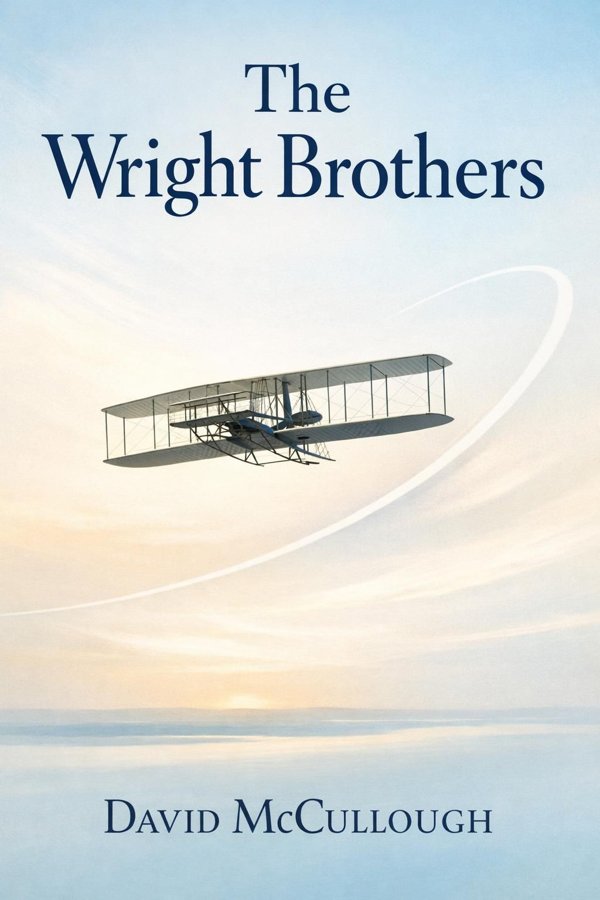
The Wright Brothers: Summary & Key Insights
 10 min9 chaptersAudio available
Key Takeaways from The Wright Brothers
Great breakthroughs often begin in ordinary places.
A dream becomes real only when it submits to measurement.
Progress often depends on going where conditions are hard but useful.
The Wright brothers did more than leave the ground; they solved the deeper problem of control.
When accepted knowledge failed them, the Wright brothers built a better way to learn.
What Is The Wright Brothers About?
The Wright Brothers by David McCullough is a biographies book spanning 5 pages. The Wright Brothers by David McCullough is the story of how two self-educated brothers from Dayton, Ohio, achieved one of the most astonishing breakthroughs in human history: powered flight. Rather than treating Wilbur and Orville Wright as distant legends, McCullough brings them vividly to life as thoughtful, disciplined, private men whose success grew out of patience, technical rigor, and extraordinary moral character. Drawing from family letters, diaries, and historical records, he shows how their achievement in 1903 was not a sudden miracle, but the result of years of trial, error, calculation, and courage. What makes this book matter is that it redefines innovation. The Wright brothers were not backed by universities, governments, or wealthy patrons. They worked from a bicycle shop, studied deeply, tested relentlessly, and trusted evidence over assumption. McCullough, one of America’s most respected historians and biographers, gives the story both sweep and intimacy, revealing the family bonds, setbacks, public skepticism, and eventual global impact behind their success. This is not only a biography of inventors. It is a powerful study of curiosity, perseverance, and what disciplined minds can achieve against the odds.
This FizzRead summary covers all 9 key chapters of The Wright Brothers in approximately 10 minutes, distilling the most important ideas, arguments, and takeaways from David McCullough's work. Also available as an audio summary and Key Quotes Podcast.
The Wright Brothers
The Wright Brothers by David McCullough is the story of how two self-educated brothers from Dayton, Ohio, achieved one of the most astonishing breakthroughs in human history: powered flight. Rather than treating Wilbur and Orville Wright as distant legends, McCullough brings them vividly to life as thoughtful, disciplined, private men whose success grew out of patience, technical rigor, and extraordinary moral character. Drawing from family letters, diaries, and historical records, he shows how their achievement in 1903 was not a sudden miracle, but the result of years of trial, error, calculation, and courage.
What makes this book matter is that it redefines innovation. The Wright brothers were not backed by universities, governments, or wealthy patrons. They worked from a bicycle shop, studied deeply, tested relentlessly, and trusted evidence over assumption. McCullough, one of America’s most respected historians and biographers, gives the story both sweep and intimacy, revealing the family bonds, setbacks, public skepticism, and eventual global impact behind their success. This is not only a biography of inventors. It is a powerful study of curiosity, perseverance, and what disciplined minds can achieve against the odds.
Who Should Read The Wright Brothers?
This book is perfect for anyone interested in biographies and looking to gain actionable insights in a short read. Whether you're a student, professional, or lifelong learner, the key ideas from The Wright Brothers by David McCullough will help you think differently.
- ✓Readers who enjoy biographies and want practical takeaways
- ✓Professionals looking to apply new ideas to their work and life
- ✓Anyone who wants the core insights of The Wright Brothers in just 10 minutes
Want the full summary?
Get instant access to this book summary and 100K+ more with Fizz Moment.
Get Free SummaryAvailable on App Store • Free to download
Key Chapters
Great breakthroughs often begin in ordinary places. One of the most striking lessons in The Wright Brothers is that history did not change because two men were born into privilege or elite scientific circles. It changed because Wilbur and Orville Wright grew up in a home that encouraged curiosity, discipline, and independent thought. Dayton, Ohio, at the turn of the twentieth century, was a lively industrial city filled with tools, machines, workshops, and possibility. The brothers’ father, Bishop Milton Wright, valued books and ideas. Their sister Katharine provided emotional steadiness and intellectual companionship. Together, the family created an atmosphere where learning was expected and imagination was respected.
The Wright brothers were not formally trained engineers. They learned by reading, experimenting, observing, and building. Before they entered aviation, they operated a printing business and later a bicycle shop. Those businesses mattered. Printing taught precision and process. Bicycle mechanics taught balance, motion, materials, and how small adjustments can have large effects. Just as important, the shop gave them a habit of practical problem-solving. They did not romanticize invention. They treated it as work.
McCullough shows that the roots of genius are often cultural and personal, not simply intellectual. The brothers developed a rare combination of humility and confidence. They did not assume they knew enough, but they believed they could learn what was necessary. That mindset made them different from many dreamers who loved the idea of flight more than the labor required to achieve it.
In modern life, this idea applies far beyond aviation. A startup founder, teacher, designer, or student does not need perfect credentials to begin meaningful work. What matters is an environment that rewards questions, a willingness to master fundamentals, and the discipline to keep improving. Skill often grows in modest workshops before it appears on the world stage.
Actionable takeaway: Create your own “Dayton” by building a daily environment of books, tools, disciplined practice, and people who strengthen your curiosity.
A dream becomes real only when it submits to measurement. Human beings had imagined flight for centuries, but as McCullough makes clear, most early attempts were driven more by hope than by reliable engineering. Wilbur and Orville Wright approached the challenge differently. They began by studying everything they could find about previous efforts, especially the work of Otto Lilienthal and Samuel Langley. But they did not worship earlier authorities. They respected past pioneers while remaining willing to question their conclusions.
This was a crucial shift. The brothers understood that flight was not one problem but several: lift, power, control, balance, and the behavior of an aircraft in real air conditions. Many experimenters focused too heavily on engines or wings alone. The Wrights recognized that controlled flight mattered more than merely getting off the ground. A machine that could not be guided safely was not a practical airplane.
Their method was deeply scientific. They observed. They tested. They compared theory with outcomes. When accepted data seemed wrong, they investigated rather than forcing reality to fit established beliefs. This balance of imagination and discipline allowed them to move beyond fantasy. McCullough’s portrait reminds readers that innovation is not just boldness. It is often careful thinking under conditions of uncertainty.
This lesson has broad application. In business, medicine, education, and technology, people often fall in love with vision statements while neglecting system design. The Wright brothers show that ambition must be broken into solvable components. If you are leading a project, asking, “What are the actual variables here?” is often more powerful than asking, “How do we move faster?”
The brothers’ success began not with a triumphant flight, but with the decision to study reality honestly. They treated failure as information, not humiliation. That remains one of the clearest marks of serious creators.
Actionable takeaway: When facing a difficult goal, divide it into specific technical or practical problems, then test each one with evidence instead of assumption.
Progress often depends on going where conditions are hard but useful. The Wright brothers chose Kitty Hawk, North Carolina, not because it was comfortable, but because it offered strong winds, soft sand, and isolation. Those features made it an ideal testing ground. McCullough vividly captures the harshness of the setting: heat, insects, storms, loneliness, and logistical inconvenience. Yet those very hardships helped the brothers do serious work away from distraction, publicity, and premature judgment.
Their years at Kitty Hawk reveal that breakthrough moments are usually the visible tip of a long, hidden process. Before the famous 1903 powered flight, the brothers spent years flying gliders, gathering data, and refining their understanding of balance and control. They suffered crashes, disappointments, and repeated design failures. Rather than becoming discouraged, they treated each failed test as another step toward a more accurate model of reality.
One of their most important strengths was patience. They did not confuse activity with advancement. They adjusted wing shapes, rethought control surfaces, and improved their methods because they understood that nature does not reward impatience. In an age that celebrates quick wins, their example is corrective. They built success through repetition and disciplined iteration.
This principle applies directly to modern work. A product launch, research study, marketing campaign, or personal habit change rarely succeeds in its first form. People who learn quickly from testing outperform those who merely start boldly. The environment you choose also matters. Sometimes growth requires stepping away from noise and into conditions where meaningful feedback is possible.
McCullough also emphasizes the brothers’ courage. Testing experimental flying machines was physically dangerous. They accepted risk, but not recklessly. They reduced uncertainty through preparation, not bravado. That combination of boldness and method is what made Kitty Hawk historic.
Actionable takeaway: Build a “Kitty Hawk” phase into any major goal—a period of focused experimentation where learning matters more than appearance, speed, or early praise.
The Wright brothers did more than leave the ground; they solved the deeper problem of control. This is one of the most important insights in McCullough’s book. Many inventors before them managed short, unstable hops or imagined aircraft with enough power to lift off. But the Wrights understood that true flight required a machine that a human being could guide, steady, and recover. Their greatest conceptual leap was recognizing that control was the heart of aviation.
They developed a three-axis control system involving wing-warping, a movable rudder, and an elevator. That system allowed the pilot to manage roll, yaw, and pitch. In simpler terms, it gave the aircraft the ability to turn, stabilize, and maintain balance in changing conditions. This was not a flashy insight. It was a structural one, and that is why it proved revolutionary. McCullough shows how deeply the brothers thought about the movement of birds, the behavior of air, and the practical demands placed on a pilot.
The lesson here extends far beyond engineering. In almost any field, sustainable success comes not from launching something impressive, but from designing systems that remain stable under pressure. A company may grow quickly, but if it lacks good governance, communication, or decision-making processes, it will fail to steer effectively. A person may achieve short-term success, but without habits and self-regulation, progress becomes fragile.
The Wrights’ achievement also highlights the value of seeing the real bottleneck. Others were chasing speed or publicity. The brothers identified the decisive issue that everyone else was underestimating. That ability to name the true problem is often the difference between ordinary effort and transformational innovation.
McCullough presents them as careful thinkers who did not simply build a machine. They built a controllable relationship between human judgment and mechanical power. That is why their work changed the world.
Actionable takeaway: In your next project, ask what the real “control problem” is—the overlooked system or process that determines whether success can be sustained.
When accepted knowledge failed them, the Wright brothers built a better way to learn. One of the most powerful episodes in The Wright Brothers is their decision to construct a wind tunnel in their bicycle shop after discovering that widely trusted aerodynamic data was unreliable. Instead of continuing to guess, they created their own testing system. This choice captures the essence of evidence-based innovation: when the existing map is wrong, serious thinkers gather better data.
The wind tunnel allowed Wilbur and Orville to test hundreds of wing shapes and angles with remarkable precision. For self-taught inventors working with limited resources, this was extraordinary. They did not have a university laboratory, but they had ingenuity, discipline, and a refusal to trust authority blindly. McCullough shows how this phase of their work was less dramatic than flying, yet absolutely central to their eventual success. The machine they flew in 1903 was built on measurements, not wishful thinking.
This idea is deeply relevant today. In organizations, people often rely on inherited assumptions, conventional wisdom, or metrics that no longer reflect reality. The Wright brothers remind us that progress depends on creating feedback systems that produce trustworthy information. A small business can run experiments on customer behavior. A teacher can test methods instead of relying on habit. A manager can examine actual workflow data instead of repeating familiar opinions.
What makes the brothers remarkable is not just their intelligence, but their intellectual honesty. They were willing to say, in effect, “The books are wrong.” But they did not stop there. They replaced bad assumptions with tested evidence. That is a much rarer trait.
Innovation is often romanticized as inspiration. McCullough restores its harder truth: real innovation usually comes from better questions, better measurement, and better interpretation.
Actionable takeaway: Identify one important assumption in your work or life and design a simple way to test it with real evidence rather than relying on reputation or tradition.
No great achievement is ever entirely individual. Although The Wright Brothers centers on Wilbur and Orville, McCullough makes clear that their success was sustained by an unusually strong family culture. Their father, Milton Wright, encouraged independent judgment and intellectual seriousness. Their sister Katharine played a crucial role as confidante, household anchor, and advocate. Even in absence, this family network gave the brothers emotional steadiness and practical support.
Katharine in particular emerges as essential. Intelligent, capable, and warm, she managed many of the social and domestic demands that allowed her brothers to focus on their work. Later, when public recognition finally arrived, she helped them navigate the wider world with grace. McCullough’s portrayal broadens the usual inventor narrative. It reminds us that achievement is often supported by people whose names do not always receive equal attention.
The bond between Wilbur and Orville themselves was also extraordinary. They worked without egoistic rivalry. They shared credit, questioned each other honestly, and trusted each other deeply. Their collaboration succeeded because each man brought strengths the other respected. This is a rare model of partnership: ambitious but not competitive, exacting but not corrosive.
In today’s culture, achievement is often framed as personal branding or solitary genius. The Wrights offer a healthier picture. Strong work often grows from stable relationships, trusted collaborators, and family or community structures that reduce chaos. Whether you are building a business, writing a book, or pursuing advanced study, the quality of your support system matters more than most people admit.
McCullough subtly argues that character and community are not side notes to accomplishment. They are part of its engine. The Wright brothers flew because they were brilliant and persistent, but they also flew because they belonged to a family that cultivated seriousness, loyalty, and resilience.
Actionable takeaway: Take inventory of the people who strengthen your best work, and intentionally invest in those relationships rather than treating success as a solo project.
The world often resists new truths until proof becomes impossible to ignore. After achieving powered flight in 1903, the Wright brothers were not instantly celebrated. In fact, one of the more surprising elements of McCullough’s narrative is how much skepticism, indifference, and misunderstanding they faced. Newspapers were slow to grasp the significance of what had happened. Officials doubted their claims. Many people either could not imagine the implications or simply did not believe them.
This delayed recognition reveals an uncomfortable reality about innovation: being right does not guarantee being believed. The brothers had accomplished something historic, yet they still needed demonstrations, contracts, legal protection, and public validation. They traveled to Europe, where audiences and governments often showed greater seriousness than many Americans initially did. Their flights in France helped transform them from obscure experimenters into international figures.
McCullough uses this period to show that invention is only part of the journey. Communicating credibility matters too. If your work challenges established assumptions, you may need to demonstrate it repeatedly before others understand its value. This does not mean pandering to public opinion. It means recognizing that social acceptance usually lags behind technical achievement.
For entrepreneurs, creators, researchers, and leaders, this lesson is practical. A breakthrough idea may need evidence, timing, presentation, and persistence before it gains traction. Many people abandon worthwhile efforts because early recognition does not come. The Wright brothers endured that phase without losing faith in the substance of their work.
At the same time, McCullough does not romanticize vindication. Public attention brought pressure, business complexity, and personal strain. Recognition solves some problems and creates others. The key is to remain anchored in the work itself rather than in applause.
Actionable takeaway: If your work is sound but overlooked, focus on stronger proof and clearer demonstration instead of assuming early skepticism means failure.
Success is not only an achievement; it is a new burden. Once the Wright brothers gained international recognition, their lives changed dramatically. McCullough carefully traces how fame brought exhausting travel, public demonstrations, negotiations with governments, patent disputes, and the emotional weight of expectation. The brothers had wanted to solve a problem. After success, they had to manage a global transformation.
This phase of the story is important because it humanizes them. Wilbur especially carried enormous responsibility, and the strain took a toll. Public triumph did not produce a life of ease. Instead, it introduced a different kind of labor—defending their rights, proving their primacy, and keeping control over what they had built. McCullough presents success as morally and emotionally complex. The world admires achievement, but often underestimates the demands that follow it.
There is a timeless lesson here. Many people imagine that once a goal is reached, tension disappears. In reality, advancement often creates new layers of complexity. A growing company requires structure. A bestselling author must manage visibility. A professional promotion brings leadership burdens that competence alone cannot solve. The question is not just how to win, but how to remain steady after winning.
The Wright brothers responded with seriousness and dignity, though not without difficulty. Their example suggests that inner character matters even more after success than before it. Without restraint, perspective, and trusted relationships, achievement can become destabilizing.
McCullough also hints at a deeper irony: the brothers changed the world, yet they remained in many ways private and reserved men. Their modesty made their public role harder, but also more admirable. They never confused celebrity with substance.
Actionable takeaway: Prepare for the consequences of success by building habits, boundaries, and support systems before recognition arrives, not after it overwhelms you.
A true legacy changes not only what people can do, but what they believe is possible. By the end of The Wright Brothers, McCullough makes clear that Wilbur and Orville did far more than invent a machine. They altered human imagination. Once powered flight became real, geography, war, commerce, travel, and global connection were permanently transformed. Distances shrank. Nations saw themselves differently. The sky, once a symbol of limitation, became a domain of human action.
Yet McCullough does not reduce their legacy to technological impact alone. He emphasizes the spirit in which the brothers worked: careful observation, modest habits, devotion to truth, courage under uncertainty, and commitment to one another. Their legacy is not simply the airplane. It is a model of how world-changing work is done. They were patient where others were reckless, empirical where others were speculative, and persistent where others gave up.
This is why the book remains meaningful far beyond aviation history. Readers come away seeing that transformative work does not always begin with grandeur. It often begins with a question seriously pursued over time. The Wright brothers remind us that civilization advances through people who are willing to think clearly, work quietly, and continue when outcomes are uncertain.
In practical terms, their legacy invites us to reconsider our own ambitions. We may not invent a technology that changes the world, but we can adopt the same habits of mind: respect for evidence, resilience in failure, and devotion to craft. These qualities scale from the workshop to the world.
McCullough’s larger achievement is to restore wonder without mythologizing his subjects. The brothers remain human throughout, which makes their accomplishment even more inspiring. Their flight was historic because it was built by ordinary people who practiced extraordinary discipline.
Actionable takeaway: Define your legacy not by how dramatic your ambition sounds, but by whether your daily work combines curiosity, rigor, courage, and persistence.
All Chapters in The Wright Brothers
About the Author
David McCullough (1933–2022) was an acclaimed American historian, biographer, and narrator celebrated for making history vivid, human, and accessible. Over a long and distinguished career, he wrote bestselling works including Truman, John Adams, 1776, and The Path Between the Seas. He received two Pulitzer Prizes, two National Book Awards, and the Presidential Medal of Freedom. McCullough was known for his meticulous research, elegant storytelling, and ability to bring major historical figures to life through letters, diaries, and rich narrative detail. In The Wright Brothers, he applies those strengths to the story of Wilbur and Orville Wright, revealing not just their invention, but their character, family bonds, and perseverance. His work remains widely admired by both scholars and general readers.
Get This Summary in Your Preferred Format
Read or listen to the The Wright Brothers summary by David McCullough anytime, anywhere. FizzRead offers multiple formats so you can learn on your terms — all free.
Available formats: App · Audio · PDF · EPUB — All included free with FizzRead
Download The Wright Brothers PDF and EPUB Summary
Key Quotes from The Wright Brothers
“Great breakthroughs often begin in ordinary places.”
“A dream becomes real only when it submits to measurement.”
“Progress often depends on going where conditions are hard but useful.”
“The Wright brothers did more than leave the ground; they solved the deeper problem of control.”
“When accepted knowledge failed them, the Wright brothers built a better way to learn.”
Frequently Asked Questions about The Wright Brothers
The Wright Brothers by David McCullough is a biographies book that explores key ideas across 9 chapters. The Wright Brothers by David McCullough is the story of how two self-educated brothers from Dayton, Ohio, achieved one of the most astonishing breakthroughs in human history: powered flight. Rather than treating Wilbur and Orville Wright as distant legends, McCullough brings them vividly to life as thoughtful, disciplined, private men whose success grew out of patience, technical rigor, and extraordinary moral character. Drawing from family letters, diaries, and historical records, he shows how their achievement in 1903 was not a sudden miracle, but the result of years of trial, error, calculation, and courage. What makes this book matter is that it redefines innovation. The Wright brothers were not backed by universities, governments, or wealthy patrons. They worked from a bicycle shop, studied deeply, tested relentlessly, and trusted evidence over assumption. McCullough, one of America’s most respected historians and biographers, gives the story both sweep and intimacy, revealing the family bonds, setbacks, public skepticism, and eventual global impact behind their success. This is not only a biography of inventors. It is a powerful study of curiosity, perseverance, and what disciplined minds can achieve against the odds.
More by David McCullough
You Might Also Like
An American Marriage
Tayari Jones
10 min
Benjamin Franklin: An American Life
Walter Isaacson
10 min
I Know Why The Caged Bird Sings
Maya Angelou
10 min
Long Walk to Freedom
Nelson Mandela
10 min
Persepolis
Marjane Satrapi
10 min
Surely You're Joking, Mr. Feynman!
Richard P. Feynman
10 minBrowse by Category
Ready to read The Wright Brothers?
Get the full summary and 100K+ more books with Fizz Moment.