
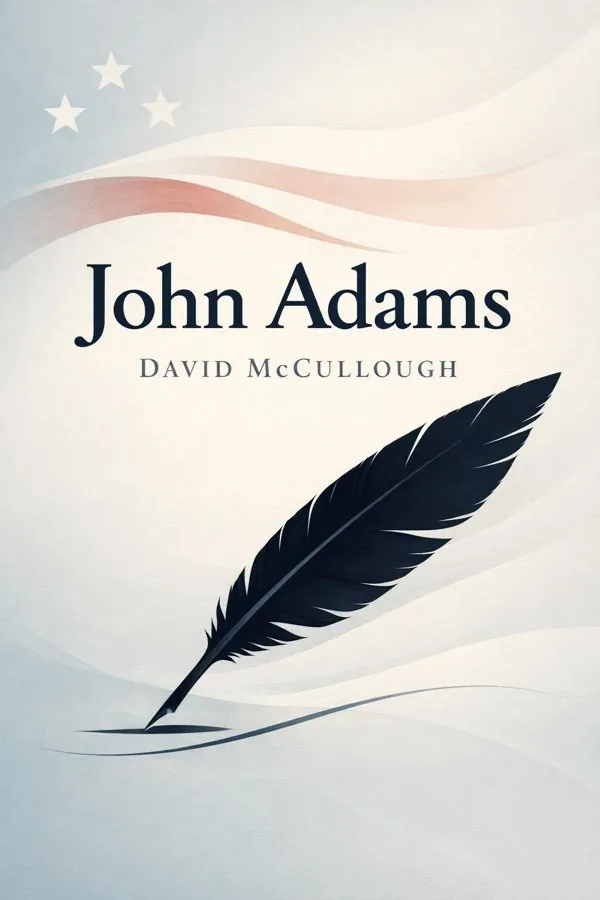
John Adams: Summary & Key Insights
 10 min10 chaptersAudio available
What Is John Adams About?
John Adams by David McCullough is a biographies book spanning 10 pages. A comprehensive biography of John Adams, the second President of the United States, exploring his role in the American Revolution, his political philosophy, and his complex relationship with Thomas Jefferson. McCullough presents Adams as a principled and passionate patriot whose intellect and integrity shaped the early republic.
This FizzRead summary covers all 10 key chapters of John Adams in approximately 10 minutes, distilling the most important ideas, arguments, and takeaways from David McCullough's work. Also available as an audio summary and Key Quotes Podcast.
John Adams
A comprehensive biography of John Adams, the second President of the United States, exploring his role in the American Revolution, his political philosophy, and his complex relationship with Thomas Jefferson. McCullough presents Adams as a principled and passionate patriot whose intellect and integrity shaped the early republic.
Who Should Read John Adams?
This book is perfect for anyone interested in biographies and looking to gain actionable insights in a short read. Whether you're a student, professional, or lifelong learner, the key ideas from John Adams by David McCullough will help you think differently.
- ✓Readers who enjoy biographies and want practical takeaways
- ✓Professionals looking to apply new ideas to their work and life
- ✓Anyone who wants the core insights of John Adams in just 10 minutes
Want the full summary?
Get instant access to this book summary and 100K+ more with Fizz Moment.
Get Free SummaryAvailable on App Store • Free to download
Key Chapters
John Adams’s world began far from the courts and congresses that would one day define him. Braintree in the mid-eighteenth century was a modest farming village governed by Puritan values — discipline, learning, faith, and family. Adams’s father embodied the virtues of diligence and honesty, serving his community as farmer and deacon. His mother’s sturdiness and religious devotion grounded young John in a sense of purpose that never left him.
Yet Adams’s intellectual appetite soon exceeded the boundaries of his hometown. At Harvard College he immersed himself in classical education, reading Cicero, Thucydides, and Locke, texts that ignited his curiosity about the nature of virtue, governance, and freedom. Adams saw in these thinkers the eternal question of how one might live a good life under the constraints of duty. His diary entries reveal a young man torn between ambition and humility, haunted by self-doubt but sustained by an unrelenting drive to improve.
Education transformed Adams from farmer’s son into philosopher and citizen. The Puritan emphasis on moral character coupled with Harvard’s rational rigor produced a mind constantly evaluating itself and its world. For Adams, intellect was not an ornament but a moral instrument. He once described study as a means of self-command — a discipline through which the passions could be aligned with principle.
This formative period taught Adams that ideas have consequences. Every sermon he heard, every debate he participated in, sharpened his belief that public virtue begins with private sincerity. That belief, tested across a lifetime in politics and diplomacy, forms the foundation of his legacy.
Entering the practice of law was for Adams both a calling and an education in human nature. He established himself as a prominent lawyer in Massachusetts, known for his exacting preparation and moral integrity. The profession exposed him to the varieties of colonial injustice and sharpened his capacity for argument. Yet the case that would define his reputation arrived in 1770, following the Boston Massacre.
Five British soldiers, accused of murdering colonists, faced trial in a city seething with revolutionary anger. To defend them was political suicide — but Adams accepted, guided by the principle that justice must stand above passion. His decision was courageous and deeply unpopular, yet his reasoning was simple: he believed that in a society of laws, every accused deserves a fair hearing. His skillful defense led to acquittal of most, and Adams wrote that truth, not popularity, had to be the measure of a lawyer’s duty.
This episode revealed Adams’s core — a man who valued principle over applause. It also marked his entry into colonial politics. Through his essays and speeches he warned against mob mentality while criticizing British overreach. He understood that liberty, if ungoverned by reason, can turn destructive. In these years Adams emerged as both guardian of law and advocate for independence, a paradox that would shape his political philosophy forever.
+ 8 more chapters — available in the FizzRead app
All Chapters in John Adams
About the Author
David McCullough (1933–2022) was an American historian and author known for his meticulously researched biographies and historical works, including 'Truman' and '1776'. He received two Pulitzer Prizes and two National Book Awards for his contributions to American history writing.
Get This Summary in Your Preferred Format
Read or listen to the John Adams summary by David McCullough anytime, anywhere. FizzRead offers multiple formats so you can learn on your terms — all free.
Available formats: App · Audio · PDF · EPUB — All included free with FizzRead
Download John Adams PDF and EPUB Summary
Key Quotes from John Adams
“John Adams’s world began far from the courts and congresses that would one day define him.”
“Entering the practice of law was for Adams both a calling and an education in human nature.”
Frequently Asked Questions about John Adams
John Adams by David McCullough is a biographies book that explores key ideas across 10 chapters. A comprehensive biography of John Adams, the second President of the United States, exploring his role in the American Revolution, his political philosophy, and his complex relationship with Thomas Jefferson. McCullough presents Adams as a principled and passionate patriot whose intellect and integrity shaped the early republic.
More by David McCullough
The Path Between the Seas: The Creation of the Panama Canal, 1870–1914
David McCullough
10 min
The Wright Brothers
David McCullough
10 min
History Matters: Selected Essays on History and the American Experience
David McCullough
10 min
1776
David McCullough
10 minYou Might Also Like
An American Marriage
Tayari Jones
10 min
Benjamin Franklin: An American Life
Walter Isaacson
10 min
I Know Why The Caged Bird Sings
Maya Angelou
10 min
Long Walk to Freedom
Nelson Mandela
10 min
Persepolis
Marjane Satrapi
10 min
Surely You're Joking, Mr. Feynman!
Richard P. Feynman
10 minBrowse by Category
Ready to read John Adams?
Get the full summary and 100K+ more books with Fizz Moment.