
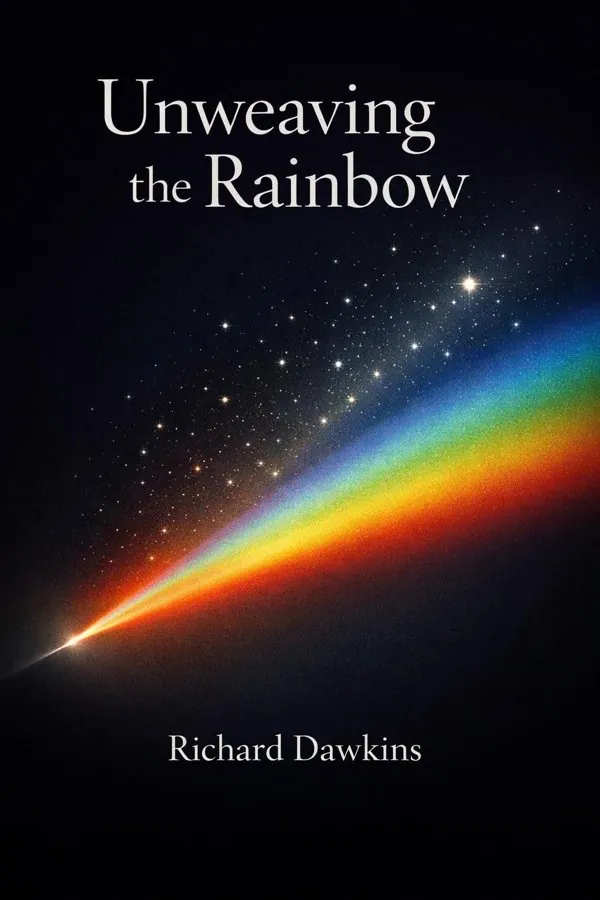
Unweaving the Rainbow: Science, Delusion and the Appetite for Wonder: Summary & Key Insights
 10 min10 chaptersAudio available
Key Takeaways from Unweaving the Rainbow: Science, Delusion and the Appetite for Wonder
The desire to understand the world did not begin in a laboratory; it began in the same human impulse that gave rise to poetry, myth, and music.
A common fear says that explanation kills enchantment.
Facts alone do not produce science; imagination turns facts into explanations.
One of Dawkins’s signature contributions is the gene-centered view of evolution, and this book revisits that perspective as a way of expanding wonder.
What feels impossible is often merely improbable, and what feels meaningful is often just chance wearing a dramatic costume.
What Is Unweaving the Rainbow: Science, Delusion and the Appetite for Wonder About?
Unweaving the Rainbow: Science, Delusion and the Appetite for Wonder by Richard Dawkins is a popular_sci book spanning 10 pages. Can scientific explanation deepen wonder rather than destroy it? In Unweaving the Rainbow, Richard Dawkins answers with a forceful yes. Taking aim at the old complaint that science drains mystery from life, he argues that understanding nature at a deeper level makes the world more astonishing, not less. A rainbow explained by optics is not diminished; it becomes richer, more layered, and more intimate because we see not just its beauty but the extraordinary processes behind it. Dawkins ranges across physics, biology, psychology, poetry, and philosophy to show that science is not the enemy of awe. He explores how humans misread probability, why we are vulnerable to superstition and delusion, how metaphor helps scientists think, and why evolutionary thinking changes how we understand life. Along the way, he insists that imagination is central to good science and that the best explanations can be as elegant as any work of art. The book matters because it defends a vital cultural idea: rational inquiry and emotional wonder belong together. As one of the most influential science writers of his generation, Dawkins brings both authority and literary flair to this passionate case for the poetry of reality.
This FizzRead summary covers all 10 key chapters of Unweaving the Rainbow: Science, Delusion and the Appetite for Wonder in approximately 10 minutes, distilling the most important ideas, arguments, and takeaways from Richard Dawkins's work. Also available as an audio summary and Key Quotes Podcast.
Unweaving the Rainbow: Science, Delusion and the Appetite for Wonder
Can scientific explanation deepen wonder rather than destroy it? In Unweaving the Rainbow, Richard Dawkins answers with a forceful yes. Taking aim at the old complaint that science drains mystery from life, he argues that understanding nature at a deeper level makes the world more astonishing, not less. A rainbow explained by optics is not diminished; it becomes richer, more layered, and more intimate because we see not just its beauty but the extraordinary processes behind it.
Dawkins ranges across physics, biology, psychology, poetry, and philosophy to show that science is not the enemy of awe. He explores how humans misread probability, why we are vulnerable to superstition and delusion, how metaphor helps scientists think, and why evolutionary thinking changes how we understand life. Along the way, he insists that imagination is central to good science and that the best explanations can be as elegant as any work of art.
The book matters because it defends a vital cultural idea: rational inquiry and emotional wonder belong together. As one of the most influential science writers of his generation, Dawkins brings both authority and literary flair to this passionate case for the poetry of reality.
Who Should Read Unweaving the Rainbow: Science, Delusion and the Appetite for Wonder?
This book is perfect for anyone interested in popular_sci and looking to gain actionable insights in a short read. Whether you're a student, professional, or lifelong learner, the key ideas from Unweaving the Rainbow: Science, Delusion and the Appetite for Wonder by Richard Dawkins will help you think differently.
- ✓Readers who enjoy popular_sci and want practical takeaways
- ✓Professionals looking to apply new ideas to their work and life
- ✓Anyone who wants the core insights of Unweaving the Rainbow: Science, Delusion and the Appetite for Wonder in just 10 minutes
Want the full summary?
Get instant access to this book summary and 100K+ more with Fizz Moment.
Get Free SummaryAvailable on App Store • Free to download
Key Chapters
The desire to understand the world did not begin in a laboratory; it began in the same human impulse that gave rise to poetry, myth, and music. Dawkins reminds us that the earliest natural philosophers were not dry technicians but imaginative observers who felt wonder intensely and sought language equal to it. Kepler, Galileo, and Newton were driven by beauty as much as by logic. They wanted not only to measure the heavens but to grasp the hidden order behind them.
This matters because modern culture often separates science from the humanities, as if one deals in cold facts and the other in living meaning. Dawkins argues that this split is artificial. Science at its best is an imaginative quest. It asks us to picture invisible forces, think in analogies, and follow patterns where the senses alone would fail us. A physicist tracing light through raindrops or a biologist reconstructing the history of a gene is engaged in a creative act not unlike that of a poet seeking the right image.
In practical terms, this changes how we teach and receive science. Instead of presenting it as a list of conclusions, we can present it as a drama of curiosity: Why do planets move the way they do? Why do animals look designed? Why do humans see patterns in chance? Framed this way, science becomes a human story of disciplined wonder.
The takeaway is simple: approach science not as a rival to art, but as one of humanity’s grand imaginative traditions. If you want to feel more engaged by scientific ideas, begin with the questions that stir your own sense of beauty and curiosity.
A common fear says that explanation kills enchantment. Dawkins builds his book around rejecting that fear. Keats complained that Newton had “unweaved the rainbow,” as though understanding its optics had somehow spoiled it. Dawkins turns the metaphor around: to unweave is not to destroy but to discover structure, and structure can be breathtaking.
A rainbow does not become less beautiful once you know that sunlight is refracted, reflected, and dispersed through countless raindrops. In fact, the explanation adds layers of appreciation. You learn why the arc appears where it does, why different observers do not see exactly the same rainbow, and why secondary rainbows reverse the color order. Knowledge gives the phenomenon depth. It transforms passive admiration into active participation in reality.
Dawkins uses this point to defend reductionism when it is properly understood. To explain a thing in terms of underlying parts is not to deny the whole. Understanding music as vibrations does not cancel melody. Understanding life through genes does not erase organisms. Levels of explanation can coexist. The molecular account and the lived experience are not enemies.
This perspective is practical in everyday life. Knowing how eclipses happen, how stars are born, or how evolution shapes vision can make ordinary observation more vivid. The next time you see soap bubbles, frost patterns, or a sunset, scientific insight can increase your attention rather than flatten it.
Actionable takeaway: whenever you encounter something beautiful, ask one further question about how it works. Treat explanation as a second form of appreciation, not a threat to the first.
Facts alone do not produce science; imagination turns facts into explanations. Dawkins stresses that great scientists are not merely collectors of data. They are builders of mental worlds. They imagine what cannot be directly seen, test possibilities, and invent models that reveal hidden order. In this sense, science depends on disciplined fantasy.
This insight corrects the stereotype of science as mechanical or emotionally flat. To understand natural selection, for example, one must imagine deep time, countless generations, and tiny differences accumulating into complex adaptations. To understand astronomy, one must picture scales so vast they defeat ordinary intuition. Even the notion of genes as replicators requires conceptual creativity. These are acts of the mind that resemble artistic invention, except they are constrained by evidence.
Dawkins also values metaphor as a bridge for imagination. Phrases such as “the selfish gene” are not literal descriptions but conceptual tools. They help us think clearly about processes that are otherwise abstract. Good scientific metaphors illuminate without misleading; bad ones seduce us into confusion. The challenge is to use imagination boldly while remaining answerable to reality.
In practical terms, this suggests better habits for learners. Instead of memorizing definitions, build mental pictures. If you are reading about evolution, visualize branching trees, environmental pressures, and inheritance. If you are learning probability, imagine repeated trials and outcomes rather than isolated events. Understanding grows when thought becomes visual, narrative, and relational.
Takeaway: strengthen your scientific literacy by practicing imaginative explanation. Ask yourself, “What invisible process would make these visible facts make sense?” That question trains the mind to think like a scientist.
One of Dawkins’s signature contributions is the gene-centered view of evolution, and this book revisits that perspective as a way of expanding wonder. The key idea is not that genes are the only important thing in biology, but that they provide a particularly powerful explanatory level. Genes persist across generations, organisms are temporary vehicles, and natural selection favors genetic variants that replicate effectively.
This framework helps explain the appearance of design in living things. Wings, eyes, camouflage, and cooperation do not require a designer because cumulative selection can build remarkable complexity over immense stretches of time. The gene’s-eye view allows us to see how traits that seem purposeful can emerge from blind but non-random processes. For Dawkins, this is one of the most beautiful insights science has ever produced.
The practical value of this perspective extends beyond evolutionary theory. It shapes how we think about behavior, disease, heredity, and human nature. For example, understanding that a trait has evolutionary roots does not mean it is morally good or socially fixed. Dawkins is careful to separate explanation from justification. Biology can illuminate tendencies without dictating values.
The gene-centered lens also encourages humility. Human beings are not the predetermined climax of nature but one branch in a long evolutionary story. That realization can be sobering, yet it can also be exhilarating because it places us inside a vast web of ancestry and adaptation.
Actionable takeaway: when thinking about a biological trait, ask what reproductive or survival pressures may have shaped it across generations. This habit deepens your grasp of living systems while guarding against simplistic, moralized interpretations of nature.
What feels impossible is often merely improbable, and what feels meaningful is often just chance wearing a dramatic costume. Dawkins devotes important attention to the human inability to reason well about probability. We notice coincidences, forget the countless non-coincidences, and infer design where statistics would suffice. This weakness fuels superstition, pseudoscience, and false wonder.
A striking coincidence can feel too precise to be random: meeting someone from your hometown in a distant country, dreaming about an event before it happens, or drawing the exact card you had in mind. But once you account for the huge number of opportunities for unlikely events to occur, such incidents become less mysterious. Low-probability events happen constantly in a large enough universe with enough observers.
Dawkins’s broader point is not that life is dull because chance is common. It is that statistical reasoning protects us from intellectual traps. People are often impressed by one dramatic anecdote while ignoring base rates, sample size, and selection effects. This leads them to believe in paranormal powers, miraculous healing, or cosmic signals where no strong evidence exists.
In everyday life, better probabilistic thinking can improve decisions. It can help you assess medical claims, interpret headlines, judge risk, and resist emotional manipulation. Rather than asking whether something feels uncanny, ask how many chances there were for something like it to happen, and how many misses are being ignored.
Takeaway: when confronted with a remarkable claim or coincidence, pause and ask what probability, sample size, and selective attention might be doing. Wonder is healthiest when it survives numerical scrutiny.
Human beings are not naturally objective observers. We are pattern-hunters, story-makers, and believers by instinct. Dawkins explores how this leaves us vulnerable to delusion, from paranormal claims to mystical evasions of evidence. He is not merely attacking fringe beliefs; he is examining a basic feature of the mind. We often prefer satisfying narratives to disciplined uncertainty.
This vulnerability takes many forms. We remember hits and forget misses. We trust vivid testimony over controlled experiments. We attribute agency to ambiguous events. We mistake emotional intensity for truth. Once a belief takes hold, confirmation bias helps defend it. We seek evidence that supports our view and reinterpret evidence that challenges it. Dawkins treats these tendencies not as moral failings but as cognitive habits that science must consciously correct.
What makes science special, in his account, is not that scientists are less biased by nature. It is that scientific methods create public checks against private error. Replication, peer criticism, statistical controls, and precise measurement all help compensate for the mind’s weaknesses. Science is valuable partly because humans are so easily fooled.
This insight has broad relevance now. In a world of viral misinformation, manipulated images, and confident pseudoscientific claims, Dawkins’s emphasis on skepticism feels especially urgent. We need habits of verification, not just access to data.
Actionable takeaway: treat your own intuitions as hypotheses, not verdicts. When something seems profound, mysterious, or obviously true, ask what evidence would disconfirm it. That single question is one of the strongest available protections against self-deception.
Scientific language often relies on metaphor, but metaphors are useful only when we remember their limits. Dawkins is a master of memorable scientific phrasing, and he reflects here on how images, analogies, and verbal shortcuts shape thought. We need metaphor because much of science deals with processes too small, large, slow, or abstract for direct experience. Yet the same tool that clarifies can also mislead.
Consider terms like “genetic code,” “selfish gene,” or “arms race” in evolution. These expressions help us grasp relationships quickly by borrowing familiar human concepts. They point toward structure and function. But if taken literally, they create confusion. Genes do not have conscious motives. Nature does not plan. Selection is not a person making choices. The metaphor opens the door, but understanding must walk beyond it.
Dawkins’s caution applies far beyond biology. Public debates are often shaped by metaphors people barely notice: the brain as a computer, society as a machine, the market as a living organism. Each comparison highlights some features and hides others. Thinking improves when we ask what a metaphor illuminates and what it distorts.
For readers, this is a practical method of clearer reasoning. When a scientific concept feels intuitive, examine the analogy doing the work. Is it clarifying the mechanism or smuggling in assumptions? Better questions lead to better understanding.
Takeaway: use metaphor to think, but never let it think for you. Whenever a phrase makes a concept vivid, ask where the comparison breaks down. That is often where deeper insight begins.
Beauty is not confined to surfaces. Dawkins argues that one of science’s greatest gifts is the aesthetic pleasure of explanation itself. A satisfying theory is not merely useful; it can be elegant, economical, and emotionally moving. The mind experiences delight when complexity falls into pattern and when scattered facts suddenly make coherent sense.
This is why scientific understanding can feel like art. A good explanation has form. It compresses many observations into a simple framework without becoming simplistic. Natural selection, the wave theory of light, and the DNA double helix all possess this kind of beauty. They reveal an order that was always present but previously unseen. The resulting pleasure is not separate from truth-seeking; it is part of what draws people deeper into inquiry.
Dawkins does not claim that beauty proves a theory true. Elegant ideas can still be wrong. But he insists that the aesthetic dimension of science deserves recognition. Many people are introduced to science through utility alone, as if its main purpose were technology, medicine, or prediction. Those matter, but they are not the whole story. Science also enlarges the emotional and imaginative range of being human.
In practice, this means we can cultivate appreciation for explanatory beauty just as we cultivate taste in music or literature. When reading about a scientific discovery, ask not only “Is it useful?” but also “What makes this explanation graceful?” Such a question turns learning into a richer experience.
Actionable takeaway: seek out one scientific idea each week not for practical benefit but for sheer intellectual beauty. Let elegance become part of how you value knowledge.
Many people assume that science and art offer incompatible ways of relating to reality. Dawkins rejects this opposition. He does not deny that the arts speak to dimensions of experience that science does not directly measure. But he strongly resists the claim that art depends on preserving ignorance. A poem about a flower is not invalidated because botany explains petals and pollination. If anything, the flower becomes available to both aesthetic and scientific appreciation at once.
Dawkins’s argument is cultural as much as philosophical. He worries that science is too often treated as spiritually impoverished while art is granted sole authority over wonder, depth, and meaning. This division impoverishes both sides. Art can borrow from science’s vast imagery and intellectual daring, while science can learn from the humanities how to speak vividly, metaphorically, and humanely.
Examples are everywhere. Astronomy inspires music and visual art. Evolution shapes novels and ethical debates. Fractals, symmetry, and chaos theory influence architecture and design. Meanwhile, scientists who write well often do so because they understand rhythm, image, and narrative. The best communicators of science rarely sound like instruction manuals.
For everyday readers, the practical lesson is to resist false choices. You do not have to choose between loving Shakespeare and loving spectroscopy, between painting and paleontology. Intellectual life is broader when these traditions enrich one another.
Takeaway: cross the boundary on purpose. Read a poem about nature and then read the science behind the same phenomenon. Let each mode sharpen the other rather than demanding loyalty to one camp.
The deepest message of the book is that mature wonder does not depend on mystery remaining unexplained. Dawkins distinguishes between cheap wonder and earned wonder. Cheap wonder is the thrill of saying something is unknowable, magical, or beyond reason. Earned wonder comes from facing the real complexity of the world and recognizing that rigorous explanation often reveals something far stranger and grander than fantasy would.
This appetite for wonder is central to human life. We seek experiences that enlarge us, whether through religion, art, love, nature, or discovery. Dawkins’s contribution is to argue that science can satisfy this hunger without asking us to abandon evidence. In fact, scientific reality is often more astonishing than comforting myths because it is not tailored to our preferences. A universe governed by deep laws, life shaped by natural selection, and minds prone to illusion together form a picture both humbling and exhilarating.
This is not a call to coldness. Dawkins writes as someone emotionally moved by truth. He wants readers to feel that understanding the age of stars, the evolution of eyes, or the mathematics of chance is a source of existential enrichment. Wonder, in his view, should not fear scrutiny.
In daily life, this means choosing curiosity over mystification. Ask harder questions. Read beyond headlines. Learn enough to be surprised properly. The world does not need embellishment to be marvelous.
Actionable takeaway: build a habit of informed awe. Each time you feel tempted by a mystical explanation, first ask what the best available science says. Let reality earn your wonder.
All Chapters in Unweaving the Rainbow: Science, Delusion and the Appetite for Wonder
About the Author
Richard Dawkins is a British evolutionary biologist, ethologist, and bestselling author known for making complex scientific ideas accessible to general readers. Born in 1941, he studied at Oxford University and later became one of the world’s most influential voices in evolutionary biology. His landmark book The Selfish Gene helped popularize the gene-centered view of evolution, and later works such as The Blind Watchmaker, Climbing Mount Improbable, and Unweaving the Rainbow further established him as a leading science communicator. From 1995 to 2008, he served as Oxford’s Professor for Public Understanding of Science. Dawkins is widely recognized for his lucid prose, his defense of reason and evidence, and his insistence that science is not the enemy of beauty but one of its richest sources.
Get This Summary in Your Preferred Format
Read or listen to the Unweaving the Rainbow: Science, Delusion and the Appetite for Wonder summary by Richard Dawkins anytime, anywhere. FizzRead offers multiple formats so you can learn on your terms — all free.
Available formats: App · Audio · PDF · EPUB — All included free with FizzRead
Download Unweaving the Rainbow: Science, Delusion and the Appetite for Wonder PDF and EPUB Summary
Key Quotes from Unweaving the Rainbow: Science, Delusion and the Appetite for Wonder
“The desire to understand the world did not begin in a laboratory; it began in the same human impulse that gave rise to poetry, myth, and music.”
“A common fear says that explanation kills enchantment.”
“Facts alone do not produce science; imagination turns facts into explanations.”
“One of Dawkins’s signature contributions is the gene-centered view of evolution, and this book revisits that perspective as a way of expanding wonder.”
“What feels impossible is often merely improbable, and what feels meaningful is often just chance wearing a dramatic costume.”
Frequently Asked Questions about Unweaving the Rainbow: Science, Delusion and the Appetite for Wonder
Unweaving the Rainbow: Science, Delusion and the Appetite for Wonder by Richard Dawkins is a popular_sci book that explores key ideas across 10 chapters. Can scientific explanation deepen wonder rather than destroy it? In Unweaving the Rainbow, Richard Dawkins answers with a forceful yes. Taking aim at the old complaint that science drains mystery from life, he argues that understanding nature at a deeper level makes the world more astonishing, not less. A rainbow explained by optics is not diminished; it becomes richer, more layered, and more intimate because we see not just its beauty but the extraordinary processes behind it. Dawkins ranges across physics, biology, psychology, poetry, and philosophy to show that science is not the enemy of awe. He explores how humans misread probability, why we are vulnerable to superstition and delusion, how metaphor helps scientists think, and why evolutionary thinking changes how we understand life. Along the way, he insists that imagination is central to good science and that the best explanations can be as elegant as any work of art. The book matters because it defends a vital cultural idea: rational inquiry and emotional wonder belong together. As one of the most influential science writers of his generation, Dawkins brings both authority and literary flair to this passionate case for the poetry of reality.
More by Richard Dawkins
You Might Also Like

Structures: Or Why Things Don"t Fall Down
J.E. Gordon
10 min
The Road to Wigan Pier
George Orwell
10 min
Bonk: The Curious Coupling of Science and Sex
Mary Roach
10 min
First Bite: How We Learn to Eat
Bee Wilson
10 min
In Pursuit Of The Unknown: 17 Equations That Changed The World
Ian Stewart
10 min
Napoleon's Buttons: 17 Molecules That Changed History
Penny Le Couteur and Jay Burreson
10 minBrowse by Category
Ready to read Unweaving the Rainbow: Science, Delusion and the Appetite for Wonder?
Get the full summary and 100K+ more books with Fizz Moment.