
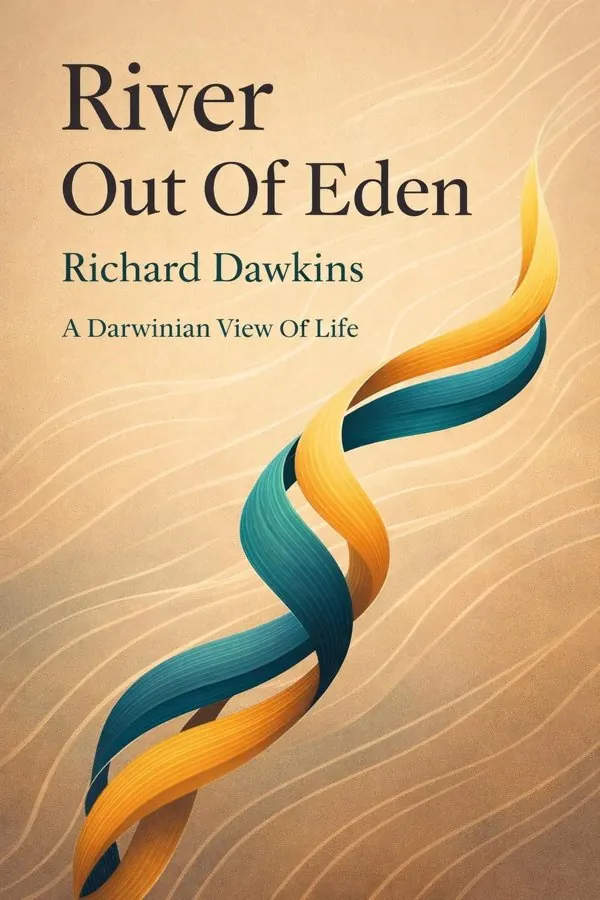
River Out Of Eden: A Darwinian View Of Life: Summary & Key Insights
 10 min9 chaptersAudio available
Key Takeaways from River Out Of Eden: A Darwinian View Of Life
Life looks messy on the surface, but underneath it runs on something astonishingly orderly: digital code.
What if the organism is not the main character of evolution?
The deepest fact about living things is not their difference, but their kinship.
Nothing in evolution happens unless something can copy itself.
The most astonishing thing about living organisms is how designed they appear.
What Is River Out Of Eden: A Darwinian View Of Life About?
River Out Of Eden: A Darwinian View Of Life by Richard Dawkins is a popular_sci book spanning 8 pages. River Out Of Eden is Richard Dawkins’s elegant, compact meditation on what life looks like when seen through Darwin’s lens. First published in 1995, the book argues that the living world is best understood not as a collection of fixed species or purposeful designs, but as a vast river of digital genetic information flowing across deep time. Every organism, including every human being, is a temporary vessel in that stream: a survival machine built by genes that have successfully replicated over countless generations. What makes this book matter is its unusual blend of clarity, imagination, and intellectual force. Dawkins takes difficult ideas from evolutionary biology—genes, replication, ancestry, natural selection, and the tree of life—and makes them vivid through memorable metaphors. He also pushes readers to confront unsettling but important implications: evolution has no predetermined goal, nature is often indifferent rather than benevolent, and meaning is something humans create rather than something biology guarantees. Dawkins writes with authority as one of the most influential evolutionary biologists and science communicators of the modern era. For readers curious about how life works at its deepest level, this book offers a concise but profound Darwinian worldview.
This FizzRead summary covers all 9 key chapters of River Out Of Eden: A Darwinian View Of Life in approximately 10 minutes, distilling the most important ideas, arguments, and takeaways from Richard Dawkins's work. Also available as an audio summary and Key Quotes Podcast.
River Out Of Eden: A Darwinian View Of Life
River Out Of Eden is Richard Dawkins’s elegant, compact meditation on what life looks like when seen through Darwin’s lens. First published in 1995, the book argues that the living world is best understood not as a collection of fixed species or purposeful designs, but as a vast river of digital genetic information flowing across deep time. Every organism, including every human being, is a temporary vessel in that stream: a survival machine built by genes that have successfully replicated over countless generations.
What makes this book matter is its unusual blend of clarity, imagination, and intellectual force. Dawkins takes difficult ideas from evolutionary biology—genes, replication, ancestry, natural selection, and the tree of life—and makes them vivid through memorable metaphors. He also pushes readers to confront unsettling but important implications: evolution has no predetermined goal, nature is often indifferent rather than benevolent, and meaning is something humans create rather than something biology guarantees.
Dawkins writes with authority as one of the most influential evolutionary biologists and science communicators of the modern era. For readers curious about how life works at its deepest level, this book offers a concise but profound Darwinian worldview.
Who Should Read River Out Of Eden: A Darwinian View Of Life?
This book is perfect for anyone interested in popular_sci and looking to gain actionable insights in a short read. Whether you're a student, professional, or lifelong learner, the key ideas from River Out Of Eden: A Darwinian View Of Life by Richard Dawkins will help you think differently.
- ✓Readers who enjoy popular_sci and want practical takeaways
- ✓Professionals looking to apply new ideas to their work and life
- ✓Anyone who wants the core insights of River Out Of Eden: A Darwinian View Of Life in just 10 minutes
Want the full summary?
Get instant access to this book summary and 100K+ more with Fizz Moment.
Get Free SummaryAvailable on App Store • Free to download
Key Chapters
Life looks messy on the surface, but underneath it runs on something astonishingly orderly: digital code. Dawkins’s central image is the river of DNA, a continuous stream of information moving through bodies and generations. DNA is not a vague life force. It is a precise chemical text written in a four-letter alphabet, and that text stores the instructions that help build and maintain living organisms. In this sense, life is informational before it is anatomical. The fur of a fox, the petals of a flower, and the structure of a human eye all arise from coded instructions that have been copied, edited, and tested over immense spans of time.
Calling DNA “digital” matters because digital systems can be copied with high fidelity. That makes heredity stable enough for natural selection to work. If inheritance were too blurry, advantageous changes would dissolve before they could accumulate. But because genes replicate with impressive accuracy—though not perfect accuracy—life can preserve successful designs while also generating variation. Mutation introduces new possibilities; selection filters them.
A practical way to grasp this is through family resemblance. Children often inherit eye color, height tendencies, and aspects of temperament not because a whole person gets copied, but because packets of genetic information are transmitted and recombined. The same principle scales outward to all of biology. Modern genetics, selective breeding, and even forensic science all rely on the fact that living systems are built on stable, readable information.
The takeaway is simple: when trying to understand life, start by thinking in terms of information flow, not just visible organisms. Ask what code is being copied, how faithfully it is transmitted, and what pressures shape which versions survive.
What if the organism is not the main character of evolution? Dawkins revives one of his most famous ideas: animals and plants are survival machines, temporary vehicles constructed by genes to help those genes endure. This does not mean genes think, plan, or have conscious motives. It means that genes which build bodies and behaviors that increase replication tend to become more common over time. From evolution’s perspective, the body is a short-term project; the gene lineage is the longer story.
This view can initially feel cold or reductive, but it clarifies many biological puzzles. Why do bodies invest in survival, feeding, mating, and parental care? Because genes that promoted those tendencies were better represented in future generations. Why are organisms so beautifully fitted to their environments? Because lineages carrying poorly adapted instructions tended to disappear. The result is an illusion of purpose created by repeated selection.
Examples are everywhere. A bird’s wing is not “for” the bird in some ultimate philosophical sense; it persists because ancestors with effective wings left more descendants. A mother mammal’s nurturing behavior can also be understood in this way: genes that influenced successful care were more likely to continue. Even competition within the body, such as cancer cells breaking cooperative rules, highlights that biological systems are coalitions shaped by replication dynamics.
This idea has practical value beyond biology textbooks. It encourages us to separate evolutionary explanation from moral approval. A behavior may have evolved without being ethically desirable. Understanding the selfish logic of genes can help us think more clearly about cooperation, conflict, health, and human nature.
Actionable takeaway: when you observe a trait or behavior, ask how it may have increased reproductive success in ancestral environments. That question often reveals more than simply asking what the trait appears to do now.
The deepest fact about living things is not their difference, but their kinship. Dawkins emphasizes that all organisms are branches on a single tree of life, connected by common descent. Humans are not separate creations standing above the rest of nature; we are one recent twig among countless others. The boundaries we notice—between species, classes, or kingdoms—are real at the present moment, but they emerge from gradual divergence over time.
This image transforms how we interpret biodiversity. Instead of seeing species as isolated units, we see them as historical outcomes. The similarities between human hands, bat wings, and whale flippers make sense because they are variations on inherited anatomical themes. The genetic similarities between humans and chimpanzees are not coincidences; they are traces of shared ancestry. Even the universality of the genetic code across much of life suggests a common origin.
The tree metaphor also helps explain why classification matters in science. Taxonomy is not just a filing system for naming creatures. It is an attempt to map evolutionary relationships. Modern molecular biology has strengthened this picture by showing that DNA comparisons can often reconstruct lineages with remarkable precision. Epidemiology uses the same logic when scientists trace how viruses evolve and spread through populations.
There is also a philosophical consequence. Once we understand that every living being is a relative, the human-centered view of life becomes harder to sustain. Evolution invites humility. It places us within nature rather than outside it.
Actionable takeaway: the next time you encounter an animal, plant, or microbe, think historically rather than categorically. Ask, “What shared ancestor links this form of life to me?” That shift in perspective deepens both scientific understanding and moral imagination.
Nothing in evolution happens unless something can copy itself. Dawkins’s replicator principle is the engine beneath Darwin’s theory: whenever entities make copies, when those copies vary, and when some variants outlast others, evolution by natural selection becomes inevitable. The crucial unit is not necessarily the organism, species, or group, but the replicator—the thing whose structure is reproduced with enough accuracy to persist through time.
Genes are the most important biological replicators on Earth because they combine durability, fecundity, and fidelity. They last long enough to matter, produce many copies, and are copied accurately enough for selection to preserve useful changes. This framing explains why adaptation accumulates. Successful replicators leave more descendants, so their features become more common without any designer needing to direct the process.
A simple analogy comes from culture and technology. Ideas, songs, slogans, and software code also spread by replication. Some versions are copied widely because they are memorable or useful; others fade. Dawkins later developed the term “meme” for cultural replicators, but the core logic is already present here. While biological and cultural evolution differ in important ways, the replicator framework helps us see how complexity can emerge from repeated copying plus selection.
In practical life, this idea encourages systems thinking. Businesses, institutions, and online networks are also shaped by what gets reproduced—habits, incentives, norms, and messages. If destructive patterns keep recurring, it is often because the system rewards their replication.
Actionable takeaway: when analyzing change in any system, identify the replicators. What exactly is being copied? How accurate is the copying? What environment favors some versions over others? Those questions reveal the hidden mechanics of evolution, both biological and cultural.
The most astonishing thing about living organisms is how designed they appear. Eyes seem made for seeing, wings for flying, kidneys for filtering, and flowers for attracting pollinators. Dawkins revisits a core theme from his earlier work: this appearance of design does not require an intelligent designer. Natural selection is a blind but cumulative process that can build extraordinary complexity over time.
The key is gradual accumulation. A fully formed eye does not appear in one leap. Instead, slight variations that improved light sensitivity, direction detection, image formation, and control were preserved generation after generation. No foresight was needed. Each step only had to be better than the alternatives in the local environment. Over millions of years, the result looks purposeful even though it emerged from mindless filtering.
This matters because people often mistakenly think the only alternative to chance is conscious design. Dawkins insists on a third possibility: non-random selection acting on random variation. Mutation may be undirected, but selection is not random with respect to survival and reproduction. That is why complexity can increase without invoking intention.
Real-world examples make this intuitive. Artificial selection by breeders shows how repeated choice can transform wolves into dog breeds or wild cabbage into broccoli, kale, and cauliflower. Nature does something similar, though without a breeder’s plan. The environment “chooses” by allowing some forms to persist better than others.
Actionable takeaway: when confronted by an intricate biological feature, resist the false choice between pure accident and deliberate design. Instead, look for the incremental evolutionary pathway that could have built it one useful step at a time.
Many objections to evolution collapse when we truly grasp the scale of time. Dawkins presents life as a river not only of information but also of deep history. Evolution can seem implausible if imagined over years or centuries, yet over millions and billions of years, tiny changes can accumulate into transformations so vast that they exceed everyday intuition. The river of time gives natural selection room to work.
Human beings are bad at intuiting geological and evolutionary timescales. We understand sudden events, but evolution is often about statistical trends unfolding through immense duration. A slight reproductive advantage, repeated across thousands of generations, can reshape a species. A branching event long ago can eventually produce forms as different as oak trees and orchids, or humans and mice. Deep time is not a background detail; it is a necessary condition for the richness of life.
This perspective also helps explain extinction, contingency, and lineage survival. Most species that have ever lived are gone. The river splits, dries up in places, and continues elsewhere. We are descendants of an unbroken chain of successful reproduction stretching back to life’s earliest beginnings. That fact is both scientifically striking and existentially humbling.
In practical terms, thinking in deep time can sharpen our understanding of current issues such as antibiotic resistance or viral evolution. Changes that seem rapid to us are still examples of the same principle: repeated selection across generations. Evolution is not a theory only about the ancient past; it is ongoing.
Actionable takeaway: whenever an evolutionary claim seems unbelievable, translate it into generations and timescales. Ask what small advantage, repeated relentlessly over vast stretches of time, could produce the observed outcome.
A body is made of matter, but what makes it alive in the evolutionary sense is organized information. Dawkins pushes readers to see life not merely as flesh, tissue, and chemistry, but as patterns that persist by being encoded, copied, and expressed. The atoms in your body are temporary. They come and go through food, air, and metabolism. What endures more meaningfully is the informational arrangement that keeps rebuilding the system and transmitting it onward.
This informational view helps unify biology. Genes do not matter because they are made of a special substance; they matter because they carry instructions. In principle, information can be stored in different media as long as it can be copied with variation and selected. On Earth, DNA became the dominant storage system, but the deeper principle is broader than the molecule itself.
This perspective has practical implications in modern science. Genomics, bioinformatics, synthetic biology, and personalized medicine all depend on treating organisms as information-processing systems. Doctors increasingly use genetic data to assess disease risk. Researchers edit genes to explore function. Conservation biology uses genetic variation to understand population health. In each case, information is the central currency.
The idea also invites a subtle philosophical shift. Identity becomes less about static substance and more about dynamic continuity. You are not exactly the same material object you were years ago, yet a stable informational pattern connects those versions of you.
Actionable takeaway: to better understand health, heredity, and evolution, think beyond the visible body. Focus on the informational instructions being stored, copied, repaired, and modified. That lens often reveals the real biological story.
One of Dawkins’s most provocative points is that the natural world does not operate according to human ideas of fairness, justice, or cosmic purpose. Evolution by natural selection can produce beauty, cooperation, and complexity, but it can also produce suffering, waste, predation, and ruthless competition. The process is effective, not benevolent. Nature rewards what works for replication, not what aligns with human moral ideals.
This distinction matters because people often slide from “this evolved” to “this is good” or “this is meant to be.” Dawkins argues that such conclusions are mistaken. The fact that natural selection shaped aggression, hierarchy, or favoritism does not make those traits ethically admirable. Biology explains what tends to happen in nature; it does not tell us what ought to happen in society. Morality is a human project built partly in resistance to blind natural impulses.
Examples make the point clear. Parasites evolve ingenious ways to exploit hosts. Predators kill prey without malice, and prey suffer without cosmic compensation. Even within families and genomes, there can be conflict. Yet humans are capable of reflecting on these realities and creating norms that value compassion, fairness, and long-term cooperation.
This is one of the book’s most liberating insights. If the universe does not guarantee moral order, then ethical responsibility becomes more urgent, not less. We cannot outsource morality to nature.
Actionable takeaway: never confuse an evolutionary explanation with a moral justification. Use biology to understand behavior, but use reason, empathy, and shared values to decide what kind of world you want to help build.
If evolution has no predetermined goal, does that make human life meaningless? Dawkins’s answer is more subtle than many critics assume. Biology does not assign us a cosmic purpose, but that absence of built-in meaning is not despairing; it is emancipating. We are products of evolutionary history, yet we are also reflective beings capable of understanding the process that made us. That knowledge gives us unusual freedom.
Humans are evolved animals, shaped by genes and natural selection, but we are not locked into a narrow script. Culture, language, institutions, imagination, and conscious foresight allow us to rebel against some biological tendencies. We can choose contraception over reproduction, cooperation over rivalry, and scientific truth over comforting myth. The very capacity to examine our origins scientifically is itself one of evolution’s remarkable outcomes.
This idea has practical significance in everyday life. Understanding your evolved impulses—status seeking, tribal loyalty, fear of outsiders, short-term reward bias—can help you manage them rather than obey them. It also encourages humility. We are not the goal of evolution, nor its masters, but one branch that became self-aware enough to ask ultimate questions.
For readers searching for existential orientation, Dawkins offers a naturalistic one: wonder need not depend on supernatural purpose. The age of life, the elegance of natural selection, and the improbability of your own ancestry are sources of awe in themselves.
Actionable takeaway: use evolutionary understanding as a tool for self-awareness, not fatalism. Recognize your biological inheritance, then deliberately choose values and habits that reflect the kind of life and society you want to create.
All Chapters in River Out Of Eden: A Darwinian View Of Life
About the Author
Richard Dawkins is a British evolutionary biologist, ethologist, and science writer renowned for bringing Darwinian thinking to a wide public audience. Educated at Oxford, where he later taught, he built his reputation through research in animal behavior and through books that clarified the logic of evolution. His landmark work The Selfish Gene introduced a powerful gene-centered way of understanding natural selection, and subsequent books such as The Blind Watchmaker, Climbing Mount Improbable, and River Out Of Eden established him as one of the most influential science communicators of his generation. Dawkins is known for lucid explanations, memorable metaphors, and a firm commitment to rational inquiry. His work has shaped public discussions of evolution, genetics, atheism, and the relationship between science and meaning.
Get This Summary in Your Preferred Format
Read or listen to the River Out Of Eden: A Darwinian View Of Life summary by Richard Dawkins anytime, anywhere. FizzRead offers multiple formats so you can learn on your terms — all free.
Available formats: App · Audio · PDF · EPUB — All included free with FizzRead
Download River Out Of Eden: A Darwinian View Of Life PDF and EPUB Summary
Key Quotes from River Out Of Eden: A Darwinian View Of Life
“Life looks messy on the surface, but underneath it runs on something astonishingly orderly: digital code.”
“What if the organism is not the main character of evolution?”
“The deepest fact about living things is not their difference, but their kinship.”
“Nothing in evolution happens unless something can copy itself.”
“The most astonishing thing about living organisms is how designed they appear.”
Frequently Asked Questions about River Out Of Eden: A Darwinian View Of Life
River Out Of Eden: A Darwinian View Of Life by Richard Dawkins is a popular_sci book that explores key ideas across 9 chapters. River Out Of Eden is Richard Dawkins’s elegant, compact meditation on what life looks like when seen through Darwin’s lens. First published in 1995, the book argues that the living world is best understood not as a collection of fixed species or purposeful designs, but as a vast river of digital genetic information flowing across deep time. Every organism, including every human being, is a temporary vessel in that stream: a survival machine built by genes that have successfully replicated over countless generations. What makes this book matter is its unusual blend of clarity, imagination, and intellectual force. Dawkins takes difficult ideas from evolutionary biology—genes, replication, ancestry, natural selection, and the tree of life—and makes them vivid through memorable metaphors. He also pushes readers to confront unsettling but important implications: evolution has no predetermined goal, nature is often indifferent rather than benevolent, and meaning is something humans create rather than something biology guarantees. Dawkins writes with authority as one of the most influential evolutionary biologists and science communicators of the modern era. For readers curious about how life works at its deepest level, this book offers a concise but profound Darwinian worldview.
More by Richard Dawkins
You Might Also Like

Structures: Or Why Things Don"t Fall Down
J.E. Gordon
10 min
The Road to Wigan Pier
George Orwell
10 min
Bonk: The Curious Coupling of Science and Sex
Mary Roach
10 min
First Bite: How We Learn to Eat
Bee Wilson
10 min
In Pursuit Of The Unknown: 17 Equations That Changed The World
Ian Stewart
10 min
Napoleon's Buttons: 17 Molecules That Changed History
Penny Le Couteur and Jay Burreson
10 minBrowse by Category
Ready to read River Out Of Eden: A Darwinian View Of Life?
Get the full summary and 100K+ more books with Fizz Moment.