
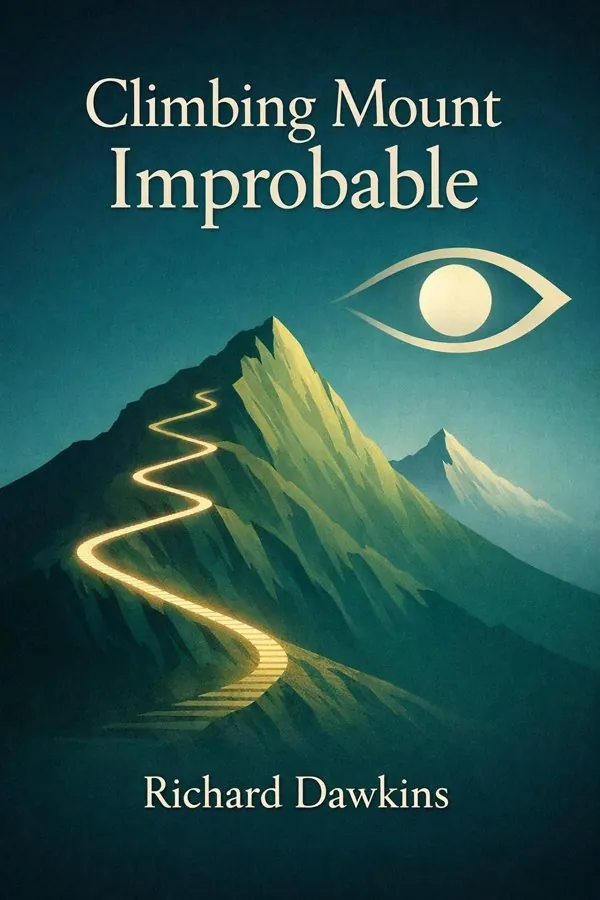
Climbing Mount Improbable: Summary & Key Insights
 10 min9 chaptersAudio available
Key Takeaways from Climbing Mount Improbable
What looks impossible all at once may become entirely plausible when broken into thousands of useful steps.
Few examples have been used against evolution as often as the eye, precisely because it feels too intricate to assemble piece by piece.
The spider’s web appears to be an exquisite act of foresighted design: a geometric trap, tuned to materials, prey behavior, and structural demands.
Wings seem like the kind of invention that should require an inventor.
Because plants do not move in ways we easily notice, people often overlook how sophisticated their adaptations are.
What Is Climbing Mount Improbable About?
Climbing Mount Improbable by Richard Dawkins is a popular_sci book spanning 8 pages. Climbing Mount Improbable is Richard Dawkins’s vivid defense of evolution by natural selection, written to answer a question that has troubled many people for generations: how can extraordinarily complex living things arise without a designer? Dawkins tackles this challenge with one of his most memorable metaphors. From one side, “Mount Improbable” looks impossible to scale: a sheer cliff representing the sudden appearance of intricate organs like eyes, wings, and webs. But from the other side, the mountain has a long, gradual slope. Evolution takes that slope, advancing through tiny, cumulative steps, each one useful in the present. What makes this book matter is not only its scientific content but its clarity. Dawkins shows that the apparent impossibility of life’s complexity is often an illusion created by our intuition. Structures that seem too perfect to have evolved can, in fact, emerge through countless small improvements over immense spans of time. As one of the world’s best-known evolutionary biologists and science communicators, Dawkins combines evidence, analogy, and enthusiasm to make a difficult subject feel graspable. The result is both an argument for Darwinian evolution and a lesson in how to think scientifically about improbable things.
This FizzRead summary covers all 9 key chapters of Climbing Mount Improbable in approximately 10 minutes, distilling the most important ideas, arguments, and takeaways from Richard Dawkins's work. Also available as an audio summary and Key Quotes Podcast.
Climbing Mount Improbable
Climbing Mount Improbable is Richard Dawkins’s vivid defense of evolution by natural selection, written to answer a question that has troubled many people for generations: how can extraordinarily complex living things arise without a designer? Dawkins tackles this challenge with one of his most memorable metaphors. From one side, “Mount Improbable” looks impossible to scale: a sheer cliff representing the sudden appearance of intricate organs like eyes, wings, and webs. But from the other side, the mountain has a long, gradual slope. Evolution takes that slope, advancing through tiny, cumulative steps, each one useful in the present.
What makes this book matter is not only its scientific content but its clarity. Dawkins shows that the apparent impossibility of life’s complexity is often an illusion created by our intuition. Structures that seem too perfect to have evolved can, in fact, emerge through countless small improvements over immense spans of time. As one of the world’s best-known evolutionary biologists and science communicators, Dawkins combines evidence, analogy, and enthusiasm to make a difficult subject feel graspable. The result is both an argument for Darwinian evolution and a lesson in how to think scientifically about improbable things.
Who Should Read Climbing Mount Improbable?
This book is perfect for anyone interested in popular_sci and looking to gain actionable insights in a short read. Whether you're a student, professional, or lifelong learner, the key ideas from Climbing Mount Improbable by Richard Dawkins will help you think differently.
- ✓Readers who enjoy popular_sci and want practical takeaways
- ✓Professionals looking to apply new ideas to their work and life
- ✓Anyone who wants the core insights of Climbing Mount Improbable in just 10 minutes
Want the full summary?
Get instant access to this book summary and 100K+ more with Fizz Moment.
Get Free SummaryAvailable on App Store • Free to download
Key Chapters
What looks impossible all at once may become entirely plausible when broken into thousands of useful steps. That is the central insight behind Dawkins’s metaphor of Mount Improbable. Many critics of evolution imagine complex organs appearing in a single leap, as if nature had to jump straight to the summit. Dawkins argues that this is the wrong picture. Natural selection does not work by giant leaps toward a distant goal. It works by preserving small variations that improve survival or reproduction in the here and now.
This cumulative process explains how complexity can arise without foresight. A tiny change in shape, sensitivity, timing, or behavior may offer a slight advantage. Over generations, those small gains accumulate. What begins as a simple light-sensitive patch can gradually become a lens-based eye. What begins as a membrane used for temperature regulation can, under the right conditions, become a wing. Evolution is not random in the sense of being directionless chaos. Variation may be random, but selection is decidedly non-random: beneficial traits tend to persist.
Dawkins emphasizes the difference between single-step chance and cumulative selection. If you imagine a fully formed adaptation appearing at once, the odds seem absurdly low. But if each step is modest, functional, and retained, the improbable becomes expected. This principle applies beyond biology as well. Languages, technologies, and institutions often evolve through incremental refinement, not perfect design from the outset.
A practical way to use this idea is to challenge “all-or-nothing” thinking. When confronted with any complex achievement, ask: what were the smaller, useful intermediate stages? Actionable takeaway: whenever something seems too complex to have developed naturally, reconstruct the staircase of gradual improvements rather than imagining a single impossible leap.
Few examples have been used against evolution as often as the eye, precisely because it feels too intricate to assemble piece by piece. Dawkins takes this challenge head-on. The mistake, he says, is assuming that anything short of a modern eye would be useless. In reality, many intermediate stages can provide real benefits, and natural selection only needs each stage to work better than what came before.
Start with a patch of cells that can distinguish light from dark. That alone helps an organism orient itself, avoid predators, or seek shelter. If the patch is slightly indented, it gains crude directional sensitivity. If the indentation deepens into a pinhole, the organism can form a rough image. Add a transparent covering, then a denser material that bends light, and eventually a lens emerges. Each stage need not be perfect; it only needs to improve function enough to matter.
Dawkins also points to the diversity of eyes in living animals as a kind of museum of possible stages. Nature contains simple light detectors, cup eyes, compound eyes, and camera-like eyes, showing that vision has evolved multiple times along different paths. This reinforces a key Darwinian point: complexity can arise repeatedly when selection pressures favor it.
The broader lesson is epistemic humility. Human intuition tends to underestimate the power of gradual accumulation. We often see only the finished masterpiece and forget the long sequence of workable drafts.
You can apply this principle whenever you are tempted to dismiss a process because the endpoint seems too advanced. Ask what partial version would already be useful. Actionable takeaway: replace the question “How could this appear fully formed?” with “What simpler version could function well enough to be favored next?”
The spider’s web appears to be an exquisite act of foresighted design: a geometric trap, tuned to materials, prey behavior, and structural demands. Yet Dawkins uses webs to show how elegant architecture can emerge through natural selection rather than conscious planning. A web does not need to begin as a perfect orb to be useful. Simpler silk-using behaviors could already confer advantages, and over time those behaviors can be refined into astonishing complexity.
Some spiders do not build classic orb webs at all. They use silk for draglines, egg protection, burrow lining, or irregular snares. This diversity matters because it suggests multiple evolutionary pathways. A strand used initially as a safety line could later become part of a trap. Sticky silk may evolve after non-sticky silk. Irregular tangles may precede highly organized patterns. At every step, natural selection can favor changes in silk chemistry, spinning behavior, anchor placement, and prey-detection sensitivity.
Dawkins’s deeper point is that behavior and structure often evolve together. Web design is not just a physical artifact; it is the outcome of inherited behavioral rules. A spider need not understand engineering in any conscious sense. If simple, genetically influenced behaviors produce more effective webs, those behaviors spread. Complex outcomes can arise from uncomplicated rules iterated over time.
This is relevant far beyond arachnids. Many systems, including software, cities, and markets, display order without a central planner. We should be cautious before attributing design-like results to deliberate design.
The practical application is to look for layered functionality in apparently perfect systems. What earlier use might each component have served? Actionable takeaway: when you encounter impressive complexity, search for simpler precursor functions and rule-based behaviors that could have been gradually improved.
Wings seem like the kind of invention that should require an inventor. Dawkins shows why that impression is misleading. Flight is one of the most dramatic examples of a trait that appears impossible if imagined as an all-at-once event, yet becomes comprehensible when viewed as a sequence of functional transitions. The crucial question is not “How did full flight suddenly appear?” but “What useful roles could proto-wings play before true flight evolved?”
Possible intermediate functions are surprisingly numerous. Feathered surfaces may first have aided insulation, display, brooding, braking while running, or controlled gliding from heights. Membranes in ancestral gliders could have increased parachuting ability before enabling powered flight. Small improvements in lift, maneuverability, and energy efficiency could be favored one by one. Dawkins emphasizes that natural selection works opportunistically with what already exists, repurposing structures for new uses.
This process is often called co-option or exaptation: traits evolved for one role can later support another. Feathers may not have originated for flight, but once present, they created new possibilities. Evolution is less like building from a blueprint than tinkering with available parts. That is why different lineages achieve similar ends through different designs: birds, bats, and insects all fly, but their wings are built differently.
The larger lesson is that innovation often comes from reuse rather than invention from scratch. In human affairs, too, breakthroughs often emerge when existing tools are adapted to new purposes.
To apply this idea, examine any mature capability by asking what earlier, more modest functions its components could have served. Actionable takeaway: train yourself to see major innovations as layered transformations of existing features, not miraculous appearances of final forms.
Because plants do not move in ways we easily notice, people often overlook how sophisticated their adaptations are. Dawkins corrects this bias by showing that plants are master products of natural selection, engaged in intense competition for light, water, nutrients, pollinators, and dispersal opportunities. Their apparent stillness conceals remarkable evolutionary ingenuity.
Consider flowers. Their colors, scents, shapes, and nectar rewards are not decorative accidents. They are evolved signals and devices for influencing pollinators. Different flowers recruit different animals and shape their behavior with precision. Seeds, too, reveal strategic variety: some hitch rides on fur, some survive digestion, some spin on the wind, some lie dormant until conditions are right. Thorns, toxins, climbing habits, seasonal timing, and root structures all show the same pattern of cumulative adaptation.
Dawkins uses such examples to broaden the reader’s imagination about what counts as complexity. It is not only the eye or the wing that needs explanation. A climbing vine that exploits another plant’s structure, or an orchid that manipulates insect behavior, can be just as astonishing. Natural selection operates wherever heritable variation affects reproductive success.
The plant world also highlights coevolution. Pollinators and flowers, herbivores and chemical defenses, dispersers and fruits can all shape one another over time. This helps explain why ecosystems contain intricate fits between species without requiring any master plan.
A practical benefit of this perspective is improved observation. Gardens, parks, and forests become legible as arenas of evolutionary problem-solving.
Actionable takeaway: the next time you encounter a plant trait that seems ornamental or arbitrary, ask what survival or reproductive challenge it might solve and what interacting species helped shape it.
Adaptation rarely happens in isolation. One of Dawkins’s most compelling themes is that species often evolve in response to one another, creating arms races in which each side drives further change in the other. Predators become faster or stealthier; prey become quicker, better camouflaged, or more toxic. Parasites evolve methods of invasion; hosts evolve defenses. This reciprocal pressure can produce extraordinary complexity.
An arms race helps explain why organisms often seem overengineered. If a gazelle only had to outrun the landscape, moderate speed might suffice. But if it must outrun cheetahs that are themselves being selected for speed, refinement continues. Similarly, immune systems become elaborate because pathogens constantly evolve ways around them. Coevolution is therefore a powerful engine of innovation.
Dawkins uses this idea to show that evolution is dynamic rather than static. There is no final, perfect solution because the environment includes other evolving organisms. The target keeps moving. This also explains why traits that seem costly can still persist if they are necessary responses to equally sophisticated opponents or partners.
The concept has broader applications. In business, cybersecurity, and politics, competitors often improve in response to one another, leading to escalating complexity. Understanding arms races helps us avoid simplistic explanations of why systems become intricate and expensive.
It also encourages long-term thinking. A short-term advantage may provoke counter-adaptation, changing the strategic landscape entirely.
Actionable takeaway: when analyzing any impressive trait or strategy, ask not only what problem it solves but who or what is pushing back. Complexity often makes the most sense when viewed as part of an ongoing evolutionary contest.
One of the subtlest misunderstandings about evolution is the belief that if it lacks intention, it must also lack direction. Dawkins carefully separates these ideas. Natural selection has no conscious goal, but it is not directionless. It consistently favors variants that work better in a given environment. This creates a directional trend toward adaptation even though no mind is planning the outcome.
This distinction matters because people often smuggle purpose into biology with phrases like “in order to” or “designed for.” Dawkins does use design-like language at times, but always as shorthand for the appearance created by selection. Organisms look purpose-built because unsuccessful alternatives have been filtered out. The process is cumulative and directional, but blind.
A useful analogy is a river carving a valley. The river does not intend the shape, yet the result is patterned rather than random. Likewise, natural selection channels variation along routes that improve fitness under local conditions. This can produce convergence, where unrelated lineages evolve similar solutions because similar problems favor similar traits.
The practical importance of this idea is conceptual clarity. Once we understand how direction can emerge without foresight, many false dichotomies disappear. We no longer need to choose between pure randomness and deliberate design. There is a third option: non-random selection acting on random variation.
This way of thinking also improves reasoning in other domains, from machine learning to cultural evolution, where iterative filtering can yield sophisticated outcomes without a central planner.
Actionable takeaway: whenever you hear that something cannot be both unguided and orderly, remember that selection can generate direction through repeated filtering, even in the absence of intention.
Evolution is less like an engineer starting with a clean sheet and more like a tinkerer modifying inherited materials. Dawkins repeatedly highlights this point because it explains both the brilliance and the oddity of living things. Organisms are not built from scratch for ideal efficiency; they are remodeled from what came before. This historical constraint is one reason biological solutions are often ingenious but imperfect.
Structures can shift functions over time. Bones that once served one mechanical role can be adapted for another. Features evolved for temperature control can assist display or locomotion. Developmental pathways that produced one shape can be altered to produce another. Evolution works with available components, and that means new designs are often patchwork arrangements of old elements put to novel use.
This helps explain why organisms contain quirks, redundancies, and jury-rigged arrangements that a rational designer might never choose. Those irregularities are not objections to evolution but evidence for it. They reveal the historical route by which adaptation happened. The route matters as much as the result.
Dawkins’s insight is valuable outside biology because many successful systems are built the same way. Companies reuse processes; programmers refactor old code; cultures repurpose existing symbols and institutions. Innovation often means rearranging inherited parts rather than inventing from nothing.
Seeing the world this way cultivates patience with imperfect systems. It also sharpens our ability to infer history from structure.
Actionable takeaway: when evaluating a complex design, look for signs of reuse, compromise, and historical layering. Those clues often reveal how the system actually evolved and why it looks the way it does.
The greatest obstacle to accepting evolution is often not evidence but imagination. Dawkins’s book is, in large part, an attempt to retrain intuition. Human minds are poorly calibrated for deep time, enormous numbers, and cumulative processes. We intuitively judge probabilities as though complex outcomes had to arise in one step. That makes evolution seem wildly implausible when, in fact, it depends on slow accumulation over millions of generations.
The metaphor of Mount Improbable is powerful because it replaces a misleading mental image with a better one. Instead of a vertical cliff that must be scaled in a single bound, Dawkins offers a gently rising path where each small step is manageable. The mountain’s summit may still be extraordinary, but the route no longer demands miracle-level leaps. Good metaphors matter because they shape what questions seem sensible.
Dawkins also demonstrates a broader scientific habit of mind: explain apparent impossibilities by searching for mechanisms that make them probable over time. This is a useful rule in many fields. Geological formations, social norms, language change, and technological sophistication often look sudden only when we ignore the incremental processes behind them.
For readers, the book is not merely about biology. It is training in disciplined wonder. You can remain amazed by the complexity of life while rejecting supernatural shortcuts. In fact, Dawkins suggests that natural explanations deepen wonder by showing how much creative power blind selection possesses.
Actionable takeaway: when your intuition labels something “too improbable,” pause and ask whether you are imagining the right timescale, the right increments, and the right filtering process.
All Chapters in Climbing Mount Improbable
About the Author
Richard Dawkins is a British evolutionary biologist, ethologist, and celebrated science writer known for making complex ideas in biology accessible to broad audiences. Born in 1941, he studied at Oxford under Nobel Prize-winning ethologist Niko Tinbergen and later became a fellow of New College, Oxford. Dawkins gained international recognition with his 1976 book The Selfish Gene, which helped popularize a gene-centered view of evolution and introduced the concept of the “meme.” His later works, including The Blind Watchmaker, River Out of Eden, and Climbing Mount Improbable, established him as one of the most influential interpreters of Darwinian theory. Beyond biology, he has been a prominent public intellectual in discussions about science, religion, reason, and secular thought.
Get This Summary in Your Preferred Format
Read or listen to the Climbing Mount Improbable summary by Richard Dawkins anytime, anywhere. FizzRead offers multiple formats so you can learn on your terms — all free.
Available formats: App · Audio · PDF · EPUB — All included free with FizzRead
Download Climbing Mount Improbable PDF and EPUB Summary
Key Quotes from Climbing Mount Improbable
“What looks impossible all at once may become entirely plausible when broken into thousands of useful steps.”
“Few examples have been used against evolution as often as the eye, precisely because it feels too intricate to assemble piece by piece.”
“The spider’s web appears to be an exquisite act of foresighted design: a geometric trap, tuned to materials, prey behavior, and structural demands.”
“Wings seem like the kind of invention that should require an inventor.”
“Because plants do not move in ways we easily notice, people often overlook how sophisticated their adaptations are.”
Frequently Asked Questions about Climbing Mount Improbable
Climbing Mount Improbable by Richard Dawkins is a popular_sci book that explores key ideas across 9 chapters. Climbing Mount Improbable is Richard Dawkins’s vivid defense of evolution by natural selection, written to answer a question that has troubled many people for generations: how can extraordinarily complex living things arise without a designer? Dawkins tackles this challenge with one of his most memorable metaphors. From one side, “Mount Improbable” looks impossible to scale: a sheer cliff representing the sudden appearance of intricate organs like eyes, wings, and webs. But from the other side, the mountain has a long, gradual slope. Evolution takes that slope, advancing through tiny, cumulative steps, each one useful in the present. What makes this book matter is not only its scientific content but its clarity. Dawkins shows that the apparent impossibility of life’s complexity is often an illusion created by our intuition. Structures that seem too perfect to have evolved can, in fact, emerge through countless small improvements over immense spans of time. As one of the world’s best-known evolutionary biologists and science communicators, Dawkins combines evidence, analogy, and enthusiasm to make a difficult subject feel graspable. The result is both an argument for Darwinian evolution and a lesson in how to think scientifically about improbable things.
More by Richard Dawkins

The Selfish Gene
Richard Dawkins
10 min
River Out Of Eden: A Darwinian View Of Life
Richard Dawkins
10 min
The Greatest Show on Earth: The Evidence for Evolution
Richard Dawkins
10 min
The Extended Phenotype: The Gene as the Unit of Selection
Richard Dawkins
10 minYou Might Also Like

Structures: Or Why Things Don"t Fall Down
J.E. Gordon
10 min
The Road to Wigan Pier
George Orwell
10 min
Bonk: The Curious Coupling of Science and Sex
Mary Roach
10 min
First Bite: How We Learn to Eat
Bee Wilson
10 min
In Pursuit Of The Unknown: 17 Equations That Changed The World
Ian Stewart
10 min
Napoleon's Buttons: 17 Molecules That Changed History
Penny Le Couteur and Jay Burreson
10 minBrowse by Category
Ready to read Climbing Mount Improbable?
Get the full summary and 100K+ more books with Fizz Moment.