
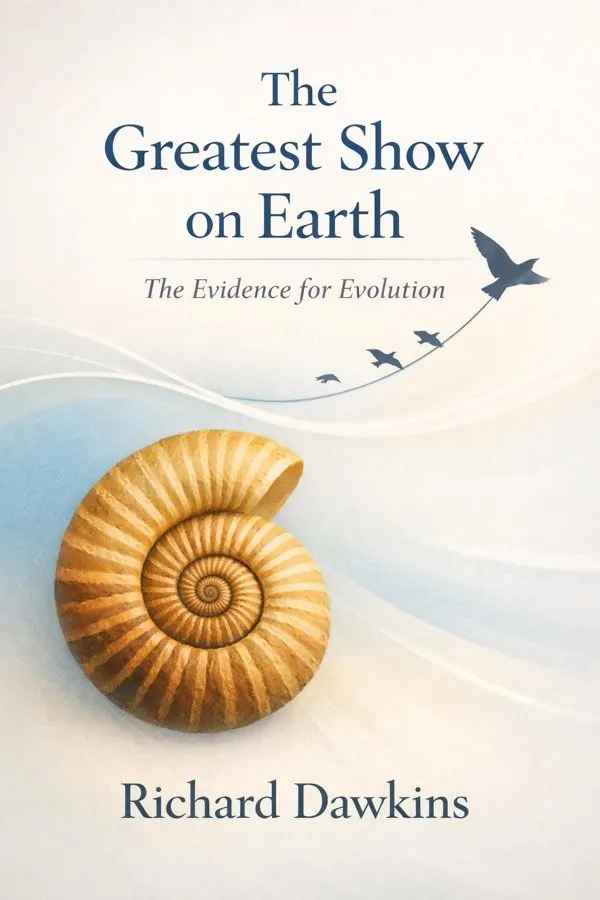
The Greatest Show on Earth: The Evidence for Evolution: Summary & Key Insights
 10 min9 chaptersAudio available
Key Takeaways from The Greatest Show on Earth: The Evidence for Evolution
Confusion is often evolution’s greatest enemy, because people reject ideas they have never properly understood.
The human mind is poorly equipped to feel the reality of billions of years, yet without deep time, evolution seems impossible.
One of the clearest ways to understand evolution is to watch humans do a simplified version of it themselves.
Many critics speak as if evolution belongs only to the ancient past, but some of its most convincing evidence comes from changes we can observe directly.
A fossil is more than a stone imprint; it is a page torn from Earth’s biography.
What Is The Greatest Show on Earth: The Evidence for Evolution About?
The Greatest Show on Earth: The Evidence for Evolution by Richard Dawkins is a life_science book spanning 6 pages. Richard Dawkins wrote The Greatest Show on Earth to answer a surprisingly persistent problem: many people have heard of evolution, but far fewer understand the sheer weight of evidence behind it. This book is not mainly about arguing abstract philosophy or attacking religion. Instead, it is a guided tour through the facts that make evolution one of the most secure conclusions in all of science. Dawkins shows how fossils, genetics, embryology, biogeography, artificial breeding, and direct observation all point to the same story: life on Earth has changed over vast stretches of time, and natural selection helps explain how that change unfolds. What makes the book especially compelling is Dawkins’s gift for turning complex science into vivid, memorable explanation. As one of the world’s best-known evolutionary biologists and science communicators, he combines technical knowledge with a talent for persuasion. He does not ask readers to accept evolution on authority alone; he invites them to examine the evidence for themselves. The result is both an accessible introduction and a forceful defense of scientific thinking in a world still crowded with confusion about how life evolved.
This FizzRead summary covers all 9 key chapters of The Greatest Show on Earth: The Evidence for Evolution in approximately 10 minutes, distilling the most important ideas, arguments, and takeaways from Richard Dawkins's work. Also available as an audio summary and Key Quotes Podcast.
The Greatest Show on Earth: The Evidence for Evolution
Richard Dawkins wrote The Greatest Show on Earth to answer a surprisingly persistent problem: many people have heard of evolution, but far fewer understand the sheer weight of evidence behind it. This book is not mainly about arguing abstract philosophy or attacking religion. Instead, it is a guided tour through the facts that make evolution one of the most secure conclusions in all of science. Dawkins shows how fossils, genetics, embryology, biogeography, artificial breeding, and direct observation all point to the same story: life on Earth has changed over vast stretches of time, and natural selection helps explain how that change unfolds.
What makes the book especially compelling is Dawkins’s gift for turning complex science into vivid, memorable explanation. As one of the world’s best-known evolutionary biologists and science communicators, he combines technical knowledge with a talent for persuasion. He does not ask readers to accept evolution on authority alone; he invites them to examine the evidence for themselves. The result is both an accessible introduction and a forceful defense of scientific thinking in a world still crowded with confusion about how life evolved.
Who Should Read The Greatest Show on Earth: The Evidence for Evolution?
This book is perfect for anyone interested in life_science and looking to gain actionable insights in a short read. Whether you're a student, professional, or lifelong learner, the key ideas from The Greatest Show on Earth: The Evidence for Evolution by Richard Dawkins will help you think differently.
- ✓Readers who enjoy life_science and want practical takeaways
- ✓Professionals looking to apply new ideas to their work and life
- ✓Anyone who wants the core insights of The Greatest Show on Earth: The Evidence for Evolution in just 10 minutes
Want the full summary?
Get instant access to this book summary and 100K+ more with Fizz Moment.
Get Free SummaryAvailable on App Store • Free to download
Key Chapters
Confusion is often evolution’s greatest enemy, because people reject ideas they have never properly understood. Dawkins begins by clearing away one of the most common misunderstandings: evolution is not an individual organism suddenly transforming into another kind of creature. It is the gradual change in populations across generations as inherited traits become more or less common. A single monkey does not give birth to a human, and no modern species is the direct goal of evolution. Instead, all living things are branches on a vast family tree, connected by common ancestry.
This distinction matters because many objections to evolution attack a cartoon version of the theory rather than the real thing. Evolution does not claim that change happens overnight, that every trait is perfect, or that nature is moving toward some prewritten ideal. It says that heritable variation exists, that some variants survive and reproduce better than others in particular environments, and that over long periods these small differences accumulate into large-scale biological change.
A practical way to grasp this is to think about language. Latin did not suddenly turn into Spanish in a single generation. Instead, speech patterns changed bit by bit across populations and centuries. Evolution works in a similar way, except with genes instead of words.
Once the concept is framed correctly, the rest of the evidence becomes easier to interpret. The actionable takeaway is simple: whenever you hear a claim about evolution, first ask whether it describes population change over generations or a distorted caricature of the idea.
The human mind is poorly equipped to feel the reality of billions of years, yet without deep time, evolution seems impossible. Dawkins emphasizes that geological time is not a decorative background to evolution; it is the stage that makes the entire drama plausible. Tiny genetic changes that seem insignificant in one generation can produce extraordinary outcomes when filtered through millions of years of reproduction, selection, extinction, and divergence.
To help readers imagine this, Dawkins uses analogies that compress Earth’s history into more familiar scales. If the age of the planet were stretched across a single year, humans would appear astonishingly late, while the great bulk of life’s history would have unfolded long before us. This perspective dissolves the false intuition that evolution should be visible in the span of a human lifetime. Some changes are visible quickly, especially in microbes or insects, but the grand patterns of biodiversity require vast stretches of time.
Modern science supports this timescale from many independent directions: radiometric dating, rock strata, continental drift, and astronomical evidence about the age of the solar system. These are not isolated guesses but mutually reinforcing measurements. The point is not merely that Earth is old, but that it is old enough for cumulative natural processes to generate complexity.
In practical terms, deep time teaches intellectual patience. Many important processes, from species change to climate shifts, only make sense on the right scale. The actionable takeaway: when judging biological claims, always ask whether you are using the proper timescale, because short-term intuition often fails in a deep-time world.
One of the clearest ways to understand evolution is to watch humans do a simplified version of it themselves. Dawkins highlights artificial selection as a living demonstration of how powerful selection can be when variation is available and reproduction is repeated over generations. Dog breeds, pigeons, cabbages, dairy cattle, and racehorses all show what happens when breeders consistently choose certain traits and allow those traits to accumulate.
The key insight is that dramatic biological change does not require miracles or sudden leaps. It can emerge from ordinary inheritance plus repeated selection. A Chihuahua and a Great Dane look so different that, without background knowledge, they might seem unrelated. Yet both are descendants of wolves, transformed by human preferences acting over surprisingly short evolutionary intervals. Similarly, many crops have been reshaped from wild ancestors into forms that are more edible, larger, sweeter, or more productive.
Artificial selection does not prove every detail of natural evolution, but it makes the core mechanism easier to grasp. If human breeders can produce major changes in centuries or even decades by selecting from existing variation, then nature—working continuously across millions of years—has more than enough opportunity to shape adaptation.
This idea also has practical applications today. Agriculture, conservation breeding, and even managing disease resistance depend on understanding how selection changes populations. The actionable takeaway is to treat domesticated plants and animals as evidence in plain sight: whenever you see a breed or crop variety, you are seeing evolution’s logic made visible.
Many critics speak as if evolution belongs only to the ancient past, but some of its most convincing evidence comes from changes we can observe directly. Dawkins shows that natural selection is not a speculative historical story. It is an ongoing process visible in laboratories, hospitals, farms, and wild ecosystems. Whenever organisms vary, pass on traits, and face unequal chances of survival or reproduction, evolution is happening.
Antibiotic resistance offers one of the starkest examples. Bacteria reproduce rapidly, mutations arise frequently, and drugs create intense selection pressure. The result is that resistant strains spread, sometimes turning once-manageable infections into serious medical threats. The bacteria do not consciously adapt; rather, those already carrying beneficial mutations survive and multiply. Insects evolving resistance to pesticides and viruses evolving to evade immune defenses follow the same principle.
Natural selection can also be observed in the wild. Classic cases include changes in finch beaks during droughts, shifts in coloration where camouflage affects survival, and reproductive timing altered by environmental pressures. These examples matter because they connect the small-scale changes we can measure today to the large-scale patterns preserved in fossils and genes.
The practical lesson is especially important for public health and environmental management. Misusing antibiotics or pesticides accelerates selection for resistant forms. The actionable takeaway: recognize that evolution is not distant theory but present reality, and make decisions—from medicine use to farming practices—with evolutionary consequences in mind.
A fossil is more than a stone imprint; it is a page torn from Earth’s biography. Dawkins argues that the fossil record, though incomplete, is remarkably powerful evidence for evolution because it reveals chronological patterns no static theory of life can explain. Organisms appear in an order that makes sense if species descended from earlier forms, diversified, and sometimes went extinct. Fish precede amphibians, amphibians precede reptiles, reptiles precede mammals, and human ancestors appear very late indeed.
Critics often point to gaps in the fossil record as if missing pages invalidate the whole book. Dawkins answers that incompleteness is exactly what we should expect from a process as selective and fragile as fossilization. Most organisms die without leaving traces. Yet despite that limitation, the available evidence is rich enough to reveal transitions, lineages, and broad trends across geological strata.
Transitional fossils are especially instructive, not because they must represent direct ancestors in every case, but because they display combinations of traits linking major groups. Fossils documenting the evolution of whales from land-dwelling ancestors or birds from dinosaurian lineages are powerful examples. The record repeatedly predicts what should be found in rocks of particular ages, and those predictions are often confirmed.
For everyday readers, fossils offer a discipline in historical reasoning: we infer the past from material traces, just as detectives infer events from clues. The actionable takeaway is to view fossil evidence cumulatively. Do not ask whether one fossil proves evolution; ask whether the overall sequence of forms through time makes sense without common descent. It does not.
Where species live is often as revealing as what they look like. Dawkins uses biogeography—the study of the geographic distribution of organisms—to show that evolution leaves patterns across the planet that are difficult to explain any other way. Islands, continents, and isolated habitats act like natural experiments. Species in these places resemble nearby mainland relatives, not species from distant environments that happen to look superficially similar.
Consider oceanic islands. They are often populated by species capable of arriving by flight, wind, or rafting, while large land mammals are usually absent unless humans bring them. Once established, isolated populations can evolve into distinct forms, producing the famous uniqueness of island life. The finches of the Galápagos, the marsupials of Australia, and the peculiar species of Madagascar all make sense if organisms disperse, split, and adapt after becoming geographically separated.
This distribution also reflects deep geological history. Continental drift explains why related lineages appear on landmasses once joined. The map of life is therefore not random. It is a historical record shaped by migration, isolation, extinction, and adaptation.
Biogeography has practical value in conservation. Protecting biodiversity requires understanding how isolation creates uniqueness and how habitat fragmentation can drive change or extinction. The actionable takeaway is to notice the historical logic of location: when you encounter an unusual species in a particular place, ask how ancestry, movement, and isolation might explain its presence. Evolutionary geography usually provides the answer.
If living things were designed from scratch by an all-powerful engineer, many biological features would be bafflingly poor choices. Dawkins points out that evolution is often most visible not in perfection but in compromise, jury-rigging, and inherited awkwardness. Organisms are built not from ideal plans but from modified versions of what came before. Natural selection can improve what already exists, but it cannot start over whenever history creates a constraint.
Examples abound. The recurrent laryngeal nerve in mammals takes an absurd detour, traveling from the brain down around major arteries before returning to the larynx. In giraffes, this route becomes dramatically elongated. Human backs, knees, and birth anatomy also reflect evolutionary compromise: useful enough for survival and reproduction, but far from optimally engineered. The panda’s “thumb” is not a true digit but a repurposed wrist bone serving a new function.
These imperfections are precisely what we expect from descent with modification. Evolution tinkers; it does not draft blueprints on a clean table. Recognizing this shifts how we interpret biological complexity. Adaptation is real, but it is bounded by ancestry and trade-offs.
This perspective also has practical importance in medicine and ergonomics. Many human vulnerabilities arise from bodies shaped for ancestral conditions rather than modern lifestyles. The actionable takeaway: when you encounter a biological structure that seems clumsy or constrained, consider it evidence of historical evolution, not a failure of nature. Its imperfections often reveal the path by which it came to be.
At the heart of Dawkins’s book is a larger lesson than evolution alone: science earns confidence by testing ideas against evidence, not by protecting comforting beliefs. Dawkins is not merely defending one biological theory; he is defending a method of inquiry. Evolution matters because it has survived scrutiny from multiple disciplines, generated successful predictions, and integrated new discoveries—from radiometric dating to genomics—without collapsing.
This does not mean science is dogmatic. On the contrary, scientific claims remain open to revision when better evidence appears. But there is a crucial difference between healthy skepticism and blanket denial. Skepticism asks, “What is the evidence, and what would change my mind?” Denial refuses the answer before the investigation begins. Dawkins argues that many anti-evolution claims thrive not because the evidence is weak, but because the public often lacks the tools to evaluate scientific reasoning.
The practical application extends far beyond biology. Questions about vaccines, climate, nutrition, and public policy also require weighing expert consensus, understanding probabilities, and distinguishing real controversy from manufactured doubt. Evolution becomes a case study in scientific literacy.
For readers, the deeper challenge is intellectual honesty. Do we follow evidence where it leads, even when it unsettles inherited assumptions? The actionable takeaway is to adopt a scientific habit of mind: seek converging evidence, learn how experts test claims, and judge ideas by explanatory power rather than ideological comfort.
All Chapters in The Greatest Show on Earth: The Evidence for Evolution
About the Author
Richard Dawkins is a British evolutionary biologist, ethologist, and one of the most influential science writers of the modern era. He studied at Oxford University under Nobel Prize-winning ethologist Niko Tinbergen and later became widely known through his groundbreaking 1976 book The Selfish Gene, which helped popularize a gene-centered understanding of evolution. Over the following decades, Dawkins wrote a series of bestselling books on biology, science, and rational inquiry, including The Blind Watchmaker, Climbing Mount Improbable, and The God Delusion. From 1995 to 2008, he served as the University of Oxford’s Professor for Public Understanding of Science. Renowned for his clarity, wit, and intellectual boldness, Dawkins has played a major role in bringing evolutionary science to general audiences around the world.
Get This Summary in Your Preferred Format
Read or listen to the The Greatest Show on Earth: The Evidence for Evolution summary by Richard Dawkins anytime, anywhere. FizzRead offers multiple formats so you can learn on your terms — all free.
Available formats: App · Audio · PDF · EPUB — All included free with FizzRead
Download The Greatest Show on Earth: The Evidence for Evolution PDF and EPUB Summary
Key Quotes from The Greatest Show on Earth: The Evidence for Evolution
“Confusion is often evolution’s greatest enemy, because people reject ideas they have never properly understood.”
“The human mind is poorly equipped to feel the reality of billions of years, yet without deep time, evolution seems impossible.”
“One of the clearest ways to understand evolution is to watch humans do a simplified version of it themselves.”
“Many critics speak as if evolution belongs only to the ancient past, but some of its most convincing evidence comes from changes we can observe directly.”
“A fossil is more than a stone imprint; it is a page torn from Earth’s biography.”
Frequently Asked Questions about The Greatest Show on Earth: The Evidence for Evolution
The Greatest Show on Earth: The Evidence for Evolution by Richard Dawkins is a life_science book that explores key ideas across 9 chapters. Richard Dawkins wrote The Greatest Show on Earth to answer a surprisingly persistent problem: many people have heard of evolution, but far fewer understand the sheer weight of evidence behind it. This book is not mainly about arguing abstract philosophy or attacking religion. Instead, it is a guided tour through the facts that make evolution one of the most secure conclusions in all of science. Dawkins shows how fossils, genetics, embryology, biogeography, artificial breeding, and direct observation all point to the same story: life on Earth has changed over vast stretches of time, and natural selection helps explain how that change unfolds. What makes the book especially compelling is Dawkins’s gift for turning complex science into vivid, memorable explanation. As one of the world’s best-known evolutionary biologists and science communicators, he combines technical knowledge with a talent for persuasion. He does not ask readers to accept evolution on authority alone; he invites them to examine the evidence for themselves. The result is both an accessible introduction and a forceful defense of scientific thinking in a world still crowded with confusion about how life evolved.
More by Richard Dawkins
You Might Also Like
The Selfish Gene
Richard Dawkins
10 min
Awakenings
Oliver Sacks
10 min
Parasite Rex: Inside the Bizarre World of Nature's Most Dangerous Creatures
Carl Zimmer
10 min
The Atlas of Life on Earth
Various
10 min
The Book of Humans: The Story of How We Became Us
Adam Rutherford
10 min
The Horse
Wendy Williams
10 minBrowse by Category
Ready to read The Greatest Show on Earth: The Evidence for Evolution?
Get the full summary and 100K+ more books with Fizz Moment.