
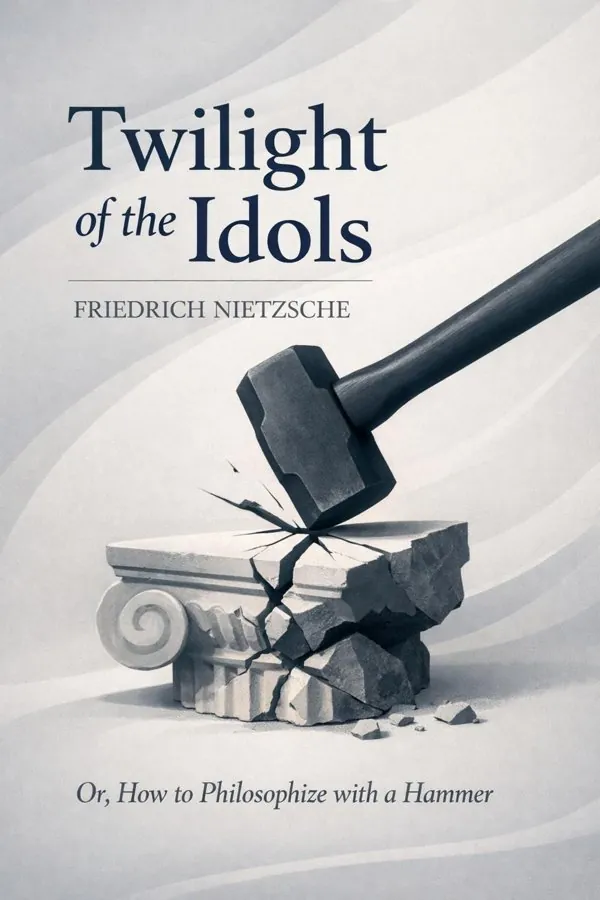
Twilight of the Idols: Or, How to Philosophize with a Hammer: Summary & Key Insights
 10 min10 chaptersAudio available
Key Takeaways from Twilight of the Idols: Or, How to Philosophize with a Hammer
A single sharp sentence can sometimes expose more than a hundred careful pages.
What if the great hero of reason was actually a sign of cultural sickness?
The moment philosophers try to freeze life into fixed concepts, they begin to distort it.
One of Nietzsche’s most brilliant arguments is that the so-called “true world” gradually collapses under its own emptiness.
A moral code can look noble while quietly teaching people to hate themselves.
What Is Twilight of the Idols: Or, How to Philosophize with a Hammer About?
Twilight of the Idols: Or, How to Philosophize with a Hammer by Friedrich Nietzsche is a western_phil book spanning 10 pages. Twilight of the Idols is Friedrich Nietzsche’s compact, explosive attack on the intellectual and moral foundations of Western civilization. Written in 1888 near the end of his productive life, the book condenses many of his most important themes into a fast-moving series of aphorisms, provocations, and short chapters. Nietzsche aims his “hammer” at the great idols of philosophy and culture: absolute truth, moral idealism, metaphysical fantasy, religious resentment, and the belief that reason should rule life. But this hammer is not merely destructive. It is also diagnostic, tapping idols to hear whether they ring solid or hollow. The book matters because Nietzsche is not simply arguing against old ideas; he is asking what kinds of beliefs make human beings weaker, more fearful, and more hostile to life. His challenge remains startlingly relevant in any age that confuses comfort with truth or morality with vitality. As a classical philologist turned radical philosopher, Nietzsche writes with unusual authority about ancient culture, modern decadence, and the psychology behind ideas. Twilight of the Idols is one of the best entry points into his thought: fierce, compressed, and unforgettable.
This FizzRead summary covers all 10 key chapters of Twilight of the Idols: Or, How to Philosophize with a Hammer in approximately 10 minutes, distilling the most important ideas, arguments, and takeaways from Friedrich Nietzsche's work. Also available as an audio summary and Key Quotes Podcast.
Twilight of the Idols: Or, How to Philosophize with a Hammer
Twilight of the Idols is Friedrich Nietzsche’s compact, explosive attack on the intellectual and moral foundations of Western civilization. Written in 1888 near the end of his productive life, the book condenses many of his most important themes into a fast-moving series of aphorisms, provocations, and short chapters. Nietzsche aims his “hammer” at the great idols of philosophy and culture: absolute truth, moral idealism, metaphysical fantasy, religious resentment, and the belief that reason should rule life. But this hammer is not merely destructive. It is also diagnostic, tapping idols to hear whether they ring solid or hollow.
The book matters because Nietzsche is not simply arguing against old ideas; he is asking what kinds of beliefs make human beings weaker, more fearful, and more hostile to life. His challenge remains startlingly relevant in any age that confuses comfort with truth or morality with vitality. As a classical philologist turned radical philosopher, Nietzsche writes with unusual authority about ancient culture, modern decadence, and the psychology behind ideas. Twilight of the Idols is one of the best entry points into his thought: fierce, compressed, and unforgettable.
Who Should Read Twilight of the Idols: Or, How to Philosophize with a Hammer?
This book is perfect for anyone interested in western_phil and looking to gain actionable insights in a short read. Whether you're a student, professional, or lifelong learner, the key ideas from Twilight of the Idols: Or, How to Philosophize with a Hammer by Friedrich Nietzsche will help you think differently.
- ✓Readers who enjoy western_phil and want practical takeaways
- ✓Professionals looking to apply new ideas to their work and life
- ✓Anyone who wants the core insights of Twilight of the Idols: Or, How to Philosophize with a Hammer in just 10 minutes
Want the full summary?
Get instant access to this book summary and 100K+ more with Fizz Moment.
Get Free SummaryAvailable on App Store • Free to download
Key Chapters
A single sharp sentence can sometimes expose more than a hundred careful pages. Nietzsche begins Twilight of the Idols with “Maxims and Arrows,” a set of aphorisms designed to jolt the reader out of inherited habits of thought. These are not polished slogans for easy agreement. They are intellectual projectiles. Their purpose is to unsettle, provoke, and force self-examination.
Nietzsche prefers compression because long explanations often hide weak thinking behind complexity. An aphorism strips thought to its nerve. He uses paradox, irony, and reversal to attack complacency. Instead of telling readers what to think, he creates moments of productive discomfort. A familiar belief suddenly sounds suspicious. A cherished moral principle reveals an unhealthy motive. A statement that first seems outrageous begins to look uncomfortably true.
This method also reflects Nietzsche’s view that philosophy is not merely a system of arguments but a way of evaluating life. Aphorisms test the reader’s instincts. Do you recoil because the claim is false, or because it threatens something you depend on? For Nietzsche, that question matters.
In practical terms, this section teaches us to challenge our own clichés. Consider phrases like “hard work always pays off,” “being nice is always good,” or “truth is never harmful.” Nietzsche would ask: always? for whom? under what conditions? What realities do such sayings conceal? In everyday life, aphoristic thinking can help you identify assumptions embedded in workplace culture, politics, education, or self-help advice.
Actionable takeaway: Take one belief you repeat automatically and rewrite it as a question. Then ask what experience, fear, or desire keeps that belief in place.
What if the great hero of reason was actually a sign of cultural sickness? Nietzsche’s chapter on Socrates offers one of his most provocative reversals. Rather than praising Socrates as the founder of rational philosophy, Nietzsche treats him as a symptom of decline in Greek culture. Socrates appears at a moment when instincts no longer govern life with confidence, and reason is brought in as a desperate remedy.
Nietzsche is not simply attacking one historical figure. He is criticizing the elevation of rational argument to the highest human standard. In his view, Socrates made conscious reasoning into a tyrant. When a culture loses trust in instinct, vitality, and noble self-command, it begins to overvalue justification, debate, and moral universalism. Rationality then becomes less a strength than a compensation for inner disorder.
The famous Socratic equation of reason, virtue, and happiness is central to Nietzsche’s objection. He believes life is not that neat. Human greatness often involves tension, conflict, risk, and drives that cannot be reduced to logical formulas. A person who constantly needs to prove everything may not be healthy but fractured.
This idea has modern applications. Organizations often respond to declining morale with more procedures, more metrics, and more meetings. Individuals do something similar when they overanalyze every decision because they no longer trust their cultivated judgment. Rational tools are useful, but when they become substitutes for strength, they reveal weakness.
Nietzsche’s point is not that reason is bad. It is that reason should serve life, not replace it. A healthy person integrates instinct and intellect instead of worshipping one at the expense of the other.
Actionable takeaway: Notice one area where you overexplain, overjustify, or overanalyze. Ask whether clearer instinct and stronger character would solve more than additional reasoning.
The moment philosophers try to freeze life into fixed concepts, they begin to distort it. In “Reason in Philosophy,” Nietzsche argues that traditional philosophers mistrust becoming, change, multiplicity, and the senses. They prefer stable essences, timeless truths, and abstract categories. Why? Because what changes feels uncertain, and uncertainty threatens the desire for control.
Nietzsche accuses philosophers of “Egypticism,” the tendency to mummify reality. They preserve ideas by killing movement. The living world is fluid, embodied, and perspectival, yet philosophy often treats it as if it were made of permanent substances. For Nietzsche, this is not intellectual rigor but fear of life’s dynamism.
He especially opposes the old split between apparent reality and “true” reality. The senses have been blamed for deception, while abstract reason has been credited with access to a higher world. Nietzsche reverses this. Concepts are often cruder than perception. The problem is not the senses themselves but our interpretation of them. Philosophers create simplifications and then mistake them for reality.
This insight matters far beyond academic philosophy. In modern life, we constantly reduce complex people and situations to labels: introvert, leader, success, toxic, failure. Such categories can be useful, but they become dangerous when treated as exhaustive truths. A child becomes a test score. A worker becomes a productivity metric. A relationship becomes a status label.
Nietzsche invites us to respect complexity without collapsing into confusion. The world is not less real because it changes. It is more real. Better thinking begins by staying closer to experience and by distrusting concepts that claim to explain everything.
Actionable takeaway: Identify one rigid label you use for yourself or someone else. Replace it with a more dynamic description that allows for growth, contradiction, and change.
One of Nietzsche’s most brilliant arguments is that the so-called “true world” gradually collapses under its own emptiness. In the short section “How the ‘True World’ Finally Became a Fable,” he traces the history of Western metaphysics as a story of decline. Philosophers and theologians invented a perfect world beyond this one: eternal, pure, rational, and morally superior. This other world then became a standard used to condemn ordinary life.
Nietzsche compresses this history into stages. First, the true world is promised to the wise and virtuous. Later it becomes inaccessible but still comforting. Eventually it turns unknowable and therefore useless. Finally, it is discarded altogether. Once the “true world” disappears, so does the “apparent world,” because the distinction depended on the fantasy from the start. We are left with this world, the only one.
This is not merely metaphysical housekeeping. It changes ethics, religion, and psychology. If there is no higher realm validating suffering, obedience, or denial of the body, then values must be judged by their effects on life here and now. Nietzsche pushes us to stop measuring existence against imaginary perfection.
Modern versions of the “true world” still exist. They appear as fantasies of a flawless future self, a perfect political system, a pure identity, or a career that will finally justify all present sacrifice. These ideals can inspire, but they often become tools for despising what is real and unfinished.
Nietzsche’s message is not cynical resignation. It is a harder and more liberating demand: affirm this world without appeal to a backup universe.
Actionable takeaway: Notice one idealized standard that makes your actual life seem perpetually inadequate. Ask whether it guides growth or merely fuels contempt for reality.
A moral code can look noble while quietly teaching people to hate themselves. In “Morality as Anti-Nature,” Nietzsche argues that much of traditional morality does not elevate human beings but weakens them by condemning their instincts. Desires, ambition, sensuality, pride, aggression, and the will to power are treated as sins to be suppressed rather than energies to be shaped.
Nietzsche distinguishes between disciplining an impulse and trying to extirpate it. Healthy culture gives form to strong drives. Unhealthy morality declares war on them. The result is not purity but inner division. Drives that are denied do not disappear; they re-emerge as guilt, resentment, hypocrisy, cruelty, or self-loathing. A person trained to fear his own strength becomes easier to control and less capable of creating values.
His criticism is aimed especially at Christian moral ideals of self-denial, chastity, and humility when these are universalized as superior forms of life. Nietzsche believes such ideals often arise from exhausted or resentful temperaments that reinterpret weakness as virtue. This does not mean every restraint is harmful. It means the value of restraint depends on whether it enhances power and style or merely crushes vitality.
In everyday life, this chapter speaks to how we regulate appetite, emotion, and ambition. For example, suppressing anger entirely may look civilized, but unexamined anger often resurfaces as passive aggression or depression. Similarly, treating ambition as shameful may produce outward modesty but inward bitterness.
Nietzsche asks for transformation, not repression. The question is not whether you have strong instincts, but whether you can organize them into a richer form of life.
Actionable takeaway: Choose one impulse you usually condemn in yourself. Instead of suppressing it, ask how it could be redirected into disciplined strength, creativity, or honest expression.
Much of what people call moral wisdom is, for Nietzsche, bad psychology. In “The Four Great Errors,” he identifies recurring mistakes in how human beings explain behavior and assign responsibility. We confuse cause with consequence, imagine false causes, invent imaginary motives, and believe in free will as a tool of moral judgment.
One of his boldest claims is that we often treat the outcomes of health or strength as if they were their causes. We say a person is happy because he is virtuous, when it may be closer to the truth that a flourishing person behaves in ways we later label virtuous. Good conduct may express vitality rather than produce it. This reverses traditional moral thinking.
Nietzsche also attacks the tendency to explain actions with simplified inner causes: “He did it out of evil,” “She succeeded because she believed enough,” “I failed because I am lazy.” Such stories reduce complexity and satisfy our need for moral clarity. But human behavior is layered, physiological, situational, and often opaque even to the actor.
His critique of free will is similarly strategic. He believes the doctrine has been used to justify blame and punishment. By imagining a freely choosing subject behind every action, moral systems create guilt and assign desert. Nietzsche wants us to see how much behavior emerges from character, history, embodiment, and circumstance.
This has practical value. In leadership, parenting, and self-reflection, moralizing explanations are often less useful than structural and psychological ones. If an employee underperforms, the issue may be role mismatch or burnout, not bad character. If you break a habit, the cause may be environment and energy, not virtue alone.
Actionable takeaway: The next time you judge behavior, pause before assigning a moral cause. Ask what conditions, patterns, and constraints might explain it more accurately.
People who claim to improve humanity are often training it into tameness. In “The ‘Improvers’ of Mankind,” Nietzsche examines moral and religious reformers who present themselves as benefactors. His suspicion is that many such “improvements” consist of weakening dangerous energies rather than cultivating excellence. The goal becomes manageability, not greatness.
Nietzsche compares moral training to the breeding and taming of animals. This is intentionally provocative. He wants us to ask what social institutions actually produce. Do they create stronger, more self-governing individuals, or merely obedient ones? A culture obsessed with making everyone harmless may reduce brutality, but it may also extinguish courage, independence, and creative force.
He is especially critical of systems that use guilt and fear to reshape people. If you teach someone to obey by making them ashamed of their instincts, you may gain compliance at the cost of depth and vitality. Improvement then means internalized surveillance.
The modern relevance is obvious. Schools, workplaces, platforms, and governments all use incentives and norms to shape behavior. Some forms of socialization are necessary. The question Nietzsche raises is whether our institutions cultivate excellence or simply reward conformity. A company may praise “professionalism” when it really wants silence. A school may praise “good behavior” when it means intellectual passivity.
Nietzsche is not defending chaos or cruelty. He is demanding a higher standard for education and culture: formation that produces capable, disciplined, life-affirming individuals rather than frightened rule-followers.
Actionable takeaway: Examine one system you belong to and ask what it rewards most consistently. Does it cultivate strength and originality, or mainly punish deviation and encourage docility?
A civilization can possess wealth, institutions, and learning while lacking inner seriousness. In “What the Germans Lack,” Nietzsche broadens his critique into cultural diagnosis. Though framed around Germany, the argument applies more generally: national pride, scholarship, and political success do not guarantee genuine culture. A people may become more organized and more educated while growing spiritually coarse.
Nietzsche objects to heavy-handed nationalism, intellectual laziness, and the substitution of mass opinion for cultivated taste. He worries that modern culture mistakes information for formation. Universities produce specialists, newspapers manufacture reactions, and politics rewards noise over depth. Under these conditions, culture becomes crowded but thin.
His criticism of Germany includes attacks on complacency after political triumph and on the influence of figures he sees as flattening rather than elevating standards. More deeply, he is asking what kind of human beings a culture produces. Does it encourage discipline, style, and the capacity to rank values? Or does it celebrate mediocrity by making everything equally respectable?
Today this feels familiar. Societies often confuse access with achievement and visibility with excellence. Endless commentary can replace thought. Cultural production becomes rapid, reactive, and disposable. Nietzsche reminds us that true culture requires selectivity, patience, and standards that are not embarrassed by hierarchy.
On a personal level, the chapter encourages resistance to cultural drift. You do not need to accept the tastes, distractions, and slogans most heavily marketed to you. You can cultivate a more demanding inner life through reading, conversation, artistic seriousness, and disciplined attention.
Actionable takeaway: Choose one part of your mental environment to elevate this week by replacing passive consumption with a more demanding cultural practice.
To think well, you often have to think against your time. In “Skirmishes of an Untimely Man,” Nietzsche offers a wide-ranging collection of observations on art, modernity, education, women and men, politics, psychology, and decadence. The section is less a unified argument than a field of tactical strikes. Its unifying principle is untimeliness: the refusal to let current fashions dictate judgment.
Nietzsche sees modern life as saturated with noise, haste, and moral posturing. In such an environment, people absorb opinions before they have experiences strong enough to justify them. Untimely thinking interrupts this process. It asks what is being celebrated too quickly, what is being condemned too mechanically, and what kinds of human beings prevailing values are producing.
Many of Nietzsche’s remarks are deliberately abrasive and some are deeply controversial. Yet even where readers reject his conclusions, the method remains powerful. He models suspicion toward consensus. He shows that critique is not negativity for its own sake but a way of preserving intellectual independence.
Practically, untimely thinking matters whenever social pressure narrows inquiry. In workplaces, it can mean questioning a trend that everyone praises but no one has tested. In personal life, it can mean declining ready-made scripts about success, relationships, or identity. In media habits, it can mean delaying judgment until immediate outrage loses its grip.
Nietzsche’s larger point is that independence requires friction. If your views never risk isolation, they may not be your views at all.
Actionable takeaway: Pick one opinion you hold mainly because your environment rewards it. Investigate the strongest argument against it and see whether your belief survives serious pressure.
Not all past cultures are equal, and some understood strength better than modernity does. In “What I Owe to the Ancients,” Nietzsche explains his admiration for Greek and Roman antiquity, especially for its capacity to affirm life without disguising its cruelty, conflict, or sensuality. He praises forms of classical culture that did not moralize away the body or seek redemption in another world.
A key contrast appears in his discussion of Dionysian affirmation. The Greeks at their height, as Nietzsche imagines them, could face suffering tragically without turning existence into a moral accusation. They created art not to escape reality but to intensify and justify it. This stands opposed to what Nietzsche sees in later moral and religious traditions: fatigue, resentment, and a need to judge life from the standpoint of weakness.
His admiration for antiquity is selective, not antiquarian. He is not recommending that modern readers imitate ancient customs literally. He is using the ancients as a counterexample to show that human beings can value strength, beauty, hierarchy, discipline, and artistic style without immediately translating everything into guilt.
This can be applied personally through the idea of style as self-formation. The ancients matter because they suggest that character can be sculpted. One need not drift between impulses and social expectations. Life can be composed. Habits, tastes, posture, speech, work, and friendship can all be shaped into a coherent form.
Nietzsche’s debt to the ancients is therefore a debt to a more robust image of human flourishing.
Actionable takeaway: Identify one aspect of your life that feels shapeless and treat it as material for deliberate cultivation rather than passive self-expression.
All Chapters in Twilight of the Idols: Or, How to Philosophize with a Hammer
About the Author
Friedrich Nietzsche (1844–1900) was a German philosopher, philologist, and one of the most influential critics of modern Western culture. Appointed professor of classical philology at Basel at just 24, he left academia early because of chronic health problems and devoted himself to writing. His major works include The Birth of Tragedy, Thus Spoke Zarathustra, Beyond Good and Evil, On the Genealogy of Morality, and Twilight of the Idols. Nietzsche challenged Christianity, traditional morality, metaphysics, and democratic herd values, while developing ideas such as the will to power, life-affirmation, and the revaluation of all values. Though his thought is often provocative and controversial, it shaped existentialism, psychology, literary theory, and modern philosophy. He collapsed mentally in 1889 and spent his final years incapacitated.
Get This Summary in Your Preferred Format
Read or listen to the Twilight of the Idols: Or, How to Philosophize with a Hammer summary by Friedrich Nietzsche anytime, anywhere. FizzRead offers multiple formats so you can learn on your terms — all free.
Available formats: App · Audio · PDF · EPUB — All included free with FizzRead
Download Twilight of the Idols: Or, How to Philosophize with a Hammer PDF and EPUB Summary
Key Quotes from Twilight of the Idols: Or, How to Philosophize with a Hammer
“A single sharp sentence can sometimes expose more than a hundred careful pages.”
“What if the great hero of reason was actually a sign of cultural sickness?”
“The moment philosophers try to freeze life into fixed concepts, they begin to distort it.”
“One of Nietzsche’s most brilliant arguments is that the so-called “true world” gradually collapses under its own emptiness.”
“A moral code can look noble while quietly teaching people to hate themselves.”
Frequently Asked Questions about Twilight of the Idols: Or, How to Philosophize with a Hammer
Twilight of the Idols: Or, How to Philosophize with a Hammer by Friedrich Nietzsche is a western_phil book that explores key ideas across 10 chapters. Twilight of the Idols is Friedrich Nietzsche’s compact, explosive attack on the intellectual and moral foundations of Western civilization. Written in 1888 near the end of his productive life, the book condenses many of his most important themes into a fast-moving series of aphorisms, provocations, and short chapters. Nietzsche aims his “hammer” at the great idols of philosophy and culture: absolute truth, moral idealism, metaphysical fantasy, religious resentment, and the belief that reason should rule life. But this hammer is not merely destructive. It is also diagnostic, tapping idols to hear whether they ring solid or hollow. The book matters because Nietzsche is not simply arguing against old ideas; he is asking what kinds of beliefs make human beings weaker, more fearful, and more hostile to life. His challenge remains startlingly relevant in any age that confuses comfort with truth or morality with vitality. As a classical philologist turned radical philosopher, Nietzsche writes with unusual authority about ancient culture, modern decadence, and the psychology behind ideas. Twilight of the Idols is one of the best entry points into his thought: fierce, compressed, and unforgettable.
More by Friedrich Nietzsche

You Might Also Like
A Little History of Philosophy
Nigel Warburton
10 min
Areopagitica
John Milton
10 min
How To Think Like A Philosopher: Essential Principles For Clear Thinking
Peter Cave
10 min
Language, Truth and Logic
A. J. Ayer
10 min
The Age of Reason
Thomas Paine
10 min
The Essays
Michel De Montaigne
10 minBrowse by Category
Ready to read Twilight of the Idols: Or, How to Philosophize with a Hammer?
Get the full summary and 100K+ more books with Fizz Moment.