
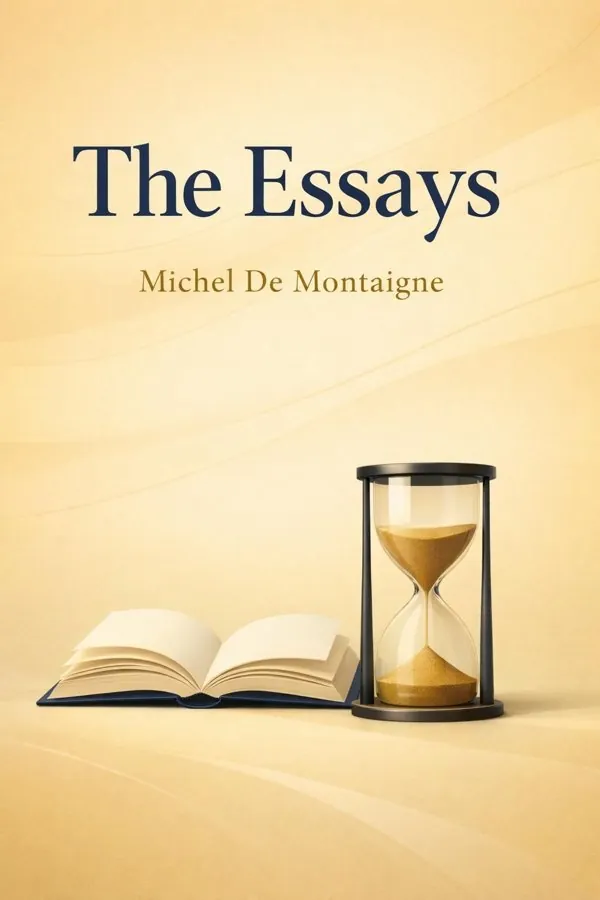
The Essays: Summary & Key Insights
 10 min9 chaptersAudio available
Key Takeaways from The Essays
A surprising truth runs through The Essays: the person we know least well may be ourselves.
One of Montaigne’s most important lessons is that human beings are far less certain than they like to imagine.
Many of the beliefs people call natural are, in Montaigne’s view, nothing more than habit wearing the mask of truth.
Montaigne’s reflections on education feel startlingly modern because they challenge a problem that still exists: confusing information with wisdom.
Montaigne insists on a difficult but clarifying idea: learning how to die teaches us how to live.
What Is The Essays About?
The Essays by Michel De Montaigne is a western_phil book. What if the most reliable way to understand human nature was not through rigid theory, but through honest self-examination? That is the radical promise of The Essays by Michel de Montaigne, a landmark work of Renaissance thought and one of the founding texts of modern introspection. First published in 1580 and expanded over the course of Montaigne’s life, this wide-ranging collection explores friendship, education, death, custom, emotion, knowledge, politics, and the unstable nature of the self. Rather than presenting a neat philosophical system, Montaigne thinks aloud on the page, testing ideas against his own experience, classical literature, and the contradictions of ordinary life. His famous question, “What do I know?” captures the spirit of the work: skeptical, humane, curious, and deeply aware of human limitation. Montaigne matters because he helped invent a new literary form, the essay, while also modeling a way of thinking that remains strikingly modern. He writes with the authority of a statesman, scholar, and careful observer of himself, but above all as a person trying to live wisely in an uncertain world.
This FizzRead summary covers all 9 key chapters of The Essays in approximately 10 minutes, distilling the most important ideas, arguments, and takeaways from Michel De Montaigne's work. Also available as an audio summary and Key Quotes Podcast.
The Essays
What if the most reliable way to understand human nature was not through rigid theory, but through honest self-examination? That is the radical promise of The Essays by Michel de Montaigne, a landmark work of Renaissance thought and one of the founding texts of modern introspection. First published in 1580 and expanded over the course of Montaigne’s life, this wide-ranging collection explores friendship, education, death, custom, emotion, knowledge, politics, and the unstable nature of the self. Rather than presenting a neat philosophical system, Montaigne thinks aloud on the page, testing ideas against his own experience, classical literature, and the contradictions of ordinary life. His famous question, “What do I know?” captures the spirit of the work: skeptical, humane, curious, and deeply aware of human limitation. Montaigne matters because he helped invent a new literary form, the essay, while also modeling a way of thinking that remains strikingly modern. He writes with the authority of a statesman, scholar, and careful observer of himself, but above all as a person trying to live wisely in an uncertain world.
Who Should Read The Essays?
This book is perfect for anyone interested in western_phil and looking to gain actionable insights in a short read. Whether you're a student, professional, or lifelong learner, the key ideas from The Essays by Michel De Montaigne will help you think differently.
- ✓Readers who enjoy western_phil and want practical takeaways
- ✓Professionals looking to apply new ideas to their work and life
- ✓Anyone who wants the core insights of The Essays in just 10 minutes
Want the full summary?
Get instant access to this book summary and 100K+ more with Fizz Moment.
Get Free SummaryAvailable on App Store • Free to download
Key Chapters
A surprising truth runs through The Essays: the person we know least well may be ourselves. Montaigne does not write as a teacher handing down final answers. He writes as an observer of his own mind, moods, habits, fears, and contradictions. This is what makes his work so enduring. Instead of pretending to possess certainty, he treats self-inquiry as an ongoing experiment. His essays are attempts, not conclusions. He notices how quickly opinions shift, how emotion distorts judgment, and how people often disguise pride as wisdom. By placing his own inconsistencies on display, he reveals a universal human condition.
This approach was revolutionary because it made personal experience a serious source of philosophical insight. Montaigne shows that understanding oneself requires humility. We are not fixed beings with transparent motives. We are changing, unstable, and frequently opaque even to ourselves. That does not make self-examination useless; it makes it necessary. His skepticism is not cynical. It is liberating. If we stop pretending to be perfectly rational or morally complete, we can begin the harder task of becoming more honest.
In practical life, this means paying closer attention to your own reactions before judging others. If a disagreement at work feels especially aggravating, Montaigne would ask what in your own temperament is being exposed. If your confidence in a belief is absolute, he would likely suggest caution. Reflection journals, regular quiet thinking, and asking “Why do I really think this?” are all modern ways of practicing his method.
Actionable takeaway: replace certainty with inquiry by regularly examining one strong opinion or emotional reaction and asking what it reveals about you.
One of Montaigne’s most important lessons is that human beings are far less certain than they like to imagine. He repeatedly questions whether reason, tradition, education, or social status truly give us secure knowledge. His skepticism does not deny that truth exists; rather, it warns that our access to it is fragile, partial, and often distorted by habit and vanity. The famous spirit of his thought is summed up in the question: what do I know? That question is not a surrender. It is a discipline.
Montaigne lived during an age of religious conflict, political instability, and ideological certainty. He saw how quickly people turned opinions into weapons. In response, he developed a style of thinking that resists fanaticism. He reminds readers that much of what we defend as natural, obvious, or unquestionable is simply inherited custom. We often confuse familiarity with truth. By doubting our own certainty, we become less cruel, less dogmatic, and more open to complexity.
This has immediate modern relevance. In public debate, social media, and even private relationships, people often speak as if disagreement proves bad faith or stupidity. Montaigne offers an alternative: intellectual modesty. Before sharing a strong claim, ask what evidence supports it, what assumptions shape it, and what a reasonable critic might say. In leadership, skepticism can improve decision-making by encouraging teams to test assumptions rather than defend ego.
Actionable takeaway: when you feel completely sure about a contentious issue, pause and identify at least two plausible objections before you speak or act.
Many of the beliefs people call natural are, in Montaigne’s view, nothing more than habit wearing the mask of truth. One of his sharpest insights is that custom governs human life more powerfully than reason usually does. We inherit manners, moral assumptions, tastes, social norms, and political loyalties so early and so deeply that they feel self-evident. Yet if we had been raised elsewhere, many of those same convictions would look entirely different.
Montaigne uses this observation to undermine cultural arrogance. He compares societies, reflects on reports of peoples beyond Europe, and questions the tendency to call unfamiliar practices barbaric while excusing cruelty closer to home. His point is not that all customs are equally good, but that judgment should begin with awareness of our own conditioning. Without that awareness, criticism becomes hypocrisy.
This idea remains powerful in everyday life. Workplace culture, family expectations, and national traditions all teach us invisible rules: what counts as success, what emotions may be shown, how authority should be treated, what kind of life is respectable. Because these norms feel normal, we rarely inspect them. But many personal conflicts arise when two sets of customs collide. A manager may read silence as disengagement, while an employee sees it as respect. A parent may interpret independence as selfishness, while a child experiences it as maturity.
Montaigne invites us to notice these inherited scripts. Once we do, we become more capable of judging practices on their merits rather than their familiarity. That can make us fairer in moral reasoning and more flexible in daily life.
Actionable takeaway: identify one belief you consider obvious and ask whether it comes from evidence, principle, or simply the habits of your culture or upbringing.
Montaigne’s reflections on education feel startlingly modern because they challenge a problem that still exists: confusing information with wisdom. He criticizes forms of schooling that reward memorization, imitation, and passive obedience while neglecting judgment. For him, the purpose of education is not to stuff the mind with facts but to shape a person capable of thinking, choosing, and living well. A learned fool is still a fool.
He argues that students should digest what they learn rather than merely repeat it. Knowledge should become part of one’s understanding, character, and practical conduct. Teachers should encourage questioning, comparison, and conversation. Instead of asking whether a student can recite authorities, Montaigne wants to know whether the student can evaluate ideas and apply them to life. Education must train discernment.
This principle matters far beyond formal schooling. In professional settings, people can gather endless data without improving judgment. In personal development, readers can consume books, podcasts, and advice while remaining unchanged. Montaigne would ask whether learning is transforming conduct or simply decorating the ego. For example, reading about communication is not enough; the real test is whether you listen better during conflict. Studying ethics matters only if it affects how you treat colleagues, family, or strangers.
His ideal learner is active, self-aware, and engaged with reality. Such a person is less likely to become dogmatic because genuine learning exposes complexity. It also encourages independence, since judgment cannot be borrowed whole from others.
Actionable takeaway: after learning something new, ask not “Can I repeat it?” but “How will I use it in one real decision, conversation, or habit this week?”
Montaigne insists on a difficult but clarifying idea: learning how to die teaches us how to live. He does not mean this morbidly. Rather, he believes that much human anxiety comes from our refusal to face mortality. We push death to the margins of awareness, then allow fear of loss, aging, illness, and uncertainty to quietly govern our choices. By contemplating death directly, we reduce its power to terrify and recover a deeper appreciation for life.
For Montaigne, death is not an abstract philosophical topic. It is the unavoidable boundary that gives urgency and proportion to existence. When people deny that boundary, they often become attached to status, possessions, and petty grievances as though these were permanent. Remembering death helps strip away illusion. It asks: what actually matters, if time is limited? Which quarrels are trivial? Which pleasures are real? Which duties deserve attention now rather than later?
This perspective can be applied practically without becoming gloomy. Someone overwhelmed by workplace politics may realize, under the horizon of mortality, that reputation management is less important than integrity. Someone postponing meaningful relationships, rest, or creative work may see that delay has a cost. Even simple rituals such as attending funerals thoughtfully, reflecting on impermanence, or writing about what you would regret not doing can sharpen priorities.
Montaigne’s ultimate point is freedom. If we become less enslaved by fear of death, we become more capable of courage, gratitude, and presence. Mortality, accepted rather than denied, can make life more vivid.
Actionable takeaway: once a week, ask yourself what would matter most if your time were clearly limited, then let that answer guide one concrete choice.
Among Montaigne’s most moving reflections are those on friendship, especially his account of his bond with Étienne de La Boétie. He presents true friendship as one of life’s rarest and most complete forms of human connection. Unlike relationships based on utility, pleasure, family obligation, or social advantage, genuine friendship is freely chosen and grounded in mutual recognition of character. It is valuable not because it serves another goal, but because the bond itself expresses something noble in human life.
Montaigne’s description of friendship is memorable because it resists reduction. His famous explanation, in essence, is that he loved his friend because it was he, because it was I. The relationship cannot be fully explained by calculation. It is a meeting of selves marked by trust, candor, and depth. Such friendship allows a person to be more fully known, and therefore more fully human.
This idea is especially relevant in a time when many relationships are transactional, hurried, or mediated by constant distraction. Montaigne challenges the assumption that networking, convenience, or shared entertainment are enough. Real friendship requires time, honesty, loyalty, and attention. It deepens through difficult conversations, mutual correction, and presence in suffering as well as joy.
Practically, this means valuing a few strong relationships over a large field of shallow contacts. It means speaking truthfully, listening without performance, and making room for friendships that are not immediately useful. Such bonds support moral growth because a true friend reflects us back to ourselves without flattery.
Actionable takeaway: invest intentionally in one meaningful friendship this month through undistracted conversation, truthful exchange, and a concrete act of loyalty or care.
Montaigne’s portrait of human nature is neither flattering nor despairing. He sees people as unstable, mixed, and contradictory. We are brave in one setting and cowardly in another, generous one day and petty the next, principled in public but evasive in private. Rather than treating this inconsistency as a flaw to hide, Montaigne makes it a central fact of honest psychology. A person is not a fixed statue but a moving, changing pattern.
This insight matters because moral and intellectual life often suffer when we demand impossible coherence from ourselves and others. We simplify people into labels, identities, or single moments. Montaigne refuses this simplification. He observes that context, health, mood, habit, and circumstance all affect conduct. That does not erase responsibility, but it should make judgment more nuanced. To understand a person, including oneself, we must accept fluctuation.
In practical terms, this helps with self-compassion and accountability at the same time. If you fail to live up to your ideals, Montaigne would not excuse the failure, but he would warn against drawing grand conclusions about your whole character from one episode. Likewise, in leadership or parenting, recognizing inconsistency can lead to better systems. Instead of relying on willpower alone, create routines and environments that support your better tendencies. If you know stress makes you impatient, build pauses into your schedule before difficult conversations.
Montaigne’s realism is humane. He does not ask us to become pure beings free of contradiction. He asks us to know our variability and live more wisely within it.
Actionable takeaway: stop defining yourself by a single success or failure and instead track the conditions that bring out your best and worst behavior.
One of Montaigne’s quiet revolutions is his insistence that philosophy belongs not only in grand systems but in ordinary life. He writes about digestion, sleep, conversation, fear, clothing, riding, habits, aging, and countless small experiences that earlier thinkers might have dismissed as trivial. Yet for Montaigne, daily life is where human nature actually appears. If philosophy cannot speak to eating, grieving, arguing, parenting, resting, and enduring discomfort, it has missed the point.
This attention to the everyday gives The Essays their distinctive freshness. Montaigne does not separate lofty reflection from embodied life. The body matters. Temperament matters. Social interaction matters. Even inconvenience and boredom matter, because they reveal how we respond when life is not dramatic enough to flatter our ideals. He teaches that wisdom is tested less by abstract declaration than by the way we carry ourselves through common experience.
The practical implication is significant. Many people postpone reflection until moments of crisis, but Montaigne finds meaning in routine. A commute can reveal impatience. A meal can reveal excess or gratitude. A conversation can show vanity, curiosity, or care. This does not mean obsessively analyzing everything. It means treating life itself as material for understanding.
Modern readers can use this by bringing reflective attention into normal patterns rather than waiting for perfect conditions. A few minutes after an ordinary day can yield insight: What disturbed me? What delighted me? What habit keeps shaping my behavior? Philosophy then becomes lived practice, not distant theory.
Actionable takeaway: spend five minutes at the end of each day reflecting on one ordinary event and what it revealed about your values, habits, or state of mind.
Montaigne consistently distrusts excess, whether in emotion, ideology, ambition, or moral posturing. He sees that people are drawn to extremes because they are dramatic and flattering. We like to imagine ourselves absolutely virtuous, unwaveringly rational, or passionately committed beyond compromise. But in practice, such extremity often leads to self-deception, rigidity, and harm. Montaigne prefers moderation, not as timidity, but as a realistic art of living.
His moderation arises from his view of human limitation. Because we are finite, changeable, and vulnerable to error, the good life usually depends less on heroic intensity than on balance. This applies to pleasures, beliefs, work, discipline, and political judgment. He does not deny that conviction matters. He denies that intensity alone proves truth or virtue. Often, the person most certain of moral superiority is the least aware of their own distortions.
In contemporary life, this lesson can be applied almost everywhere. Work culture praises burnout as commitment; Montaigne would call that a confusion of effort with wisdom. Public discourse rewards outrage; he would ask whether heat is replacing thought. Personal improvement often swings between indulgence and severe self-control; he would recommend steadier habits that can actually endure. Moderation helps preserve judgment by preventing impulse from taking over.
This is not a call to mediocrity. It is a call to proportion. The wise person knows when to resist, when to yield, when to enjoy, and when to stop. Such balance makes freedom more sustainable because it is rooted in self-knowledge rather than performance.
Actionable takeaway: find one area where you live in cycles of excess and correction, then replace the cycle with a smaller, steadier practice you can maintain consistently.
All Chapters in The Essays
About the Author
Michel de Montaigne (1533-1592) was a French Renaissance writer, statesman, and philosopher whose Essays helped define one of literature’s most enduring forms. Born into a wealthy family near Bordeaux, he received a classical education and later worked as a magistrate. After the death of his close friend Étienne de La Boétie, Montaigne increasingly turned toward reflection and writing. He retired to his family estate, where he composed and revised the Essays over many years, drawing on personal experience, ancient authors, and political observation. He also served as mayor of Bordeaux during a turbulent period in French history. Montaigne’s influence has been immense: his skeptical, candid, and humane style shaped later thinkers and writers from Pascal and Shakespeare to Emerson and Nietzsche.
Get This Summary in Your Preferred Format
Read or listen to the The Essays summary by Michel De Montaigne anytime, anywhere. FizzRead offers multiple formats so you can learn on your terms — all free.
Available formats: App · Audio · PDF · EPUB — All included free with FizzRead
Download The Essays PDF and EPUB Summary
Key Quotes from The Essays
“A surprising truth runs through The Essays: the person we know least well may be ourselves.”
“One of Montaigne’s most important lessons is that human beings are far less certain than they like to imagine.”
“Many of the beliefs people call natural are, in Montaigne’s view, nothing more than habit wearing the mask of truth.”
“Montaigne’s reflections on education feel startlingly modern because they challenge a problem that still exists: confusing information with wisdom.”
“Montaigne insists on a difficult but clarifying idea: learning how to die teaches us how to live.”
Frequently Asked Questions about The Essays
The Essays by Michel De Montaigne is a western_phil book that explores key ideas across 9 chapters. What if the most reliable way to understand human nature was not through rigid theory, but through honest self-examination? That is the radical promise of The Essays by Michel de Montaigne, a landmark work of Renaissance thought and one of the founding texts of modern introspection. First published in 1580 and expanded over the course of Montaigne’s life, this wide-ranging collection explores friendship, education, death, custom, emotion, knowledge, politics, and the unstable nature of the self. Rather than presenting a neat philosophical system, Montaigne thinks aloud on the page, testing ideas against his own experience, classical literature, and the contradictions of ordinary life. His famous question, “What do I know?” captures the spirit of the work: skeptical, humane, curious, and deeply aware of human limitation. Montaigne matters because he helped invent a new literary form, the essay, while also modeling a way of thinking that remains strikingly modern. He writes with the authority of a statesman, scholar, and careful observer of himself, but above all as a person trying to live wisely in an uncertain world.
More by Michel De Montaigne
You Might Also Like
A Little History of Philosophy
Nigel Warburton
10 min
Areopagitica
John Milton
10 min
How To Think Like A Philosopher: Essential Principles For Clear Thinking
Peter Cave
10 min
Language, Truth and Logic
A. J. Ayer
10 min
The Age of Reason
Thomas Paine
10 min
The Meaning Of Life
Terry Eagleton
10 minBrowse by Category
Ready to read The Essays?
Get the full summary and 100K+ more books with Fizz Moment.