
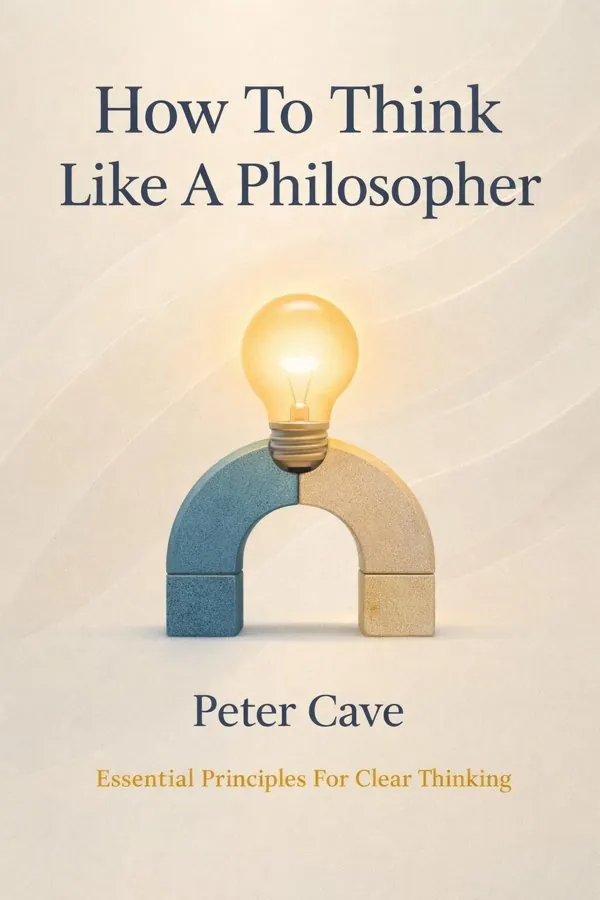
How To Think Like A Philosopher: Essential Principles For Clear Thinking: Summary & Key Insights
by Peter Cave
 10 min9 chaptersAudio available
Key Takeaways from How To Think Like A Philosopher: Essential Principles For Clear Thinking
The most dangerous beliefs are often the ones we never think to examine.
A persuasive tone is not the same thing as a sound argument.
Many disputes persist not because people disagree about facts, but because they are using the same words in different ways.
People often hold inconsistent beliefs without noticing, and philosophy helps reveal those fractures.
Imagined scenarios can reveal truths about real life more clearly than familiar situations ever could.
What Is How To Think Like A Philosopher: Essential Principles For Clear Thinking About?
How To Think Like A Philosopher: Essential Principles For Clear Thinking by Peter Cave is a western_phil book. How To Think Like A Philosopher: Essential Principles For Clear Thinking is a practical, accessible guide to one of the most valuable skills in modern life: learning how to think carefully, question assumptions, and reason well. In a world crowded with confident opinions, emotional arguments, and superficial takes, Peter Cave shows why philosophy is not an abstract academic exercise but a powerful toolkit for everyday judgment. The book explores how to identify weak arguments, recognize hidden contradictions, test beliefs, and remain intellectually honest even when certainty is tempting. Rather than presenting philosophy as a dry history of ideas, Cave treats it as a living method for handling real questions about truth, morality, knowledge, identity, freedom, and decision-making. That is what makes the book so useful: it helps readers become sharper, calmer, and more independent thinkers. Peter Cave is well placed to write such a book. A respected philosopher and popular writer, he is known for making difficult ideas engaging, humorous, and relevant. His strength lies in translating philosophical habits of mind into tools any reader can apply immediately.
This FizzRead summary covers all 9 key chapters of How To Think Like A Philosopher: Essential Principles For Clear Thinking in approximately 10 minutes, distilling the most important ideas, arguments, and takeaways from Peter Cave's work. Also available as an audio summary and Key Quotes Podcast.
How To Think Like A Philosopher: Essential Principles For Clear Thinking
How To Think Like A Philosopher: Essential Principles For Clear Thinking is a practical, accessible guide to one of the most valuable skills in modern life: learning how to think carefully, question assumptions, and reason well. In a world crowded with confident opinions, emotional arguments, and superficial takes, Peter Cave shows why philosophy is not an abstract academic exercise but a powerful toolkit for everyday judgment. The book explores how to identify weak arguments, recognize hidden contradictions, test beliefs, and remain intellectually honest even when certainty is tempting. Rather than presenting philosophy as a dry history of ideas, Cave treats it as a living method for handling real questions about truth, morality, knowledge, identity, freedom, and decision-making. That is what makes the book so useful: it helps readers become sharper, calmer, and more independent thinkers. Peter Cave is well placed to write such a book. A respected philosopher and popular writer, he is known for making difficult ideas engaging, humorous, and relevant. His strength lies in translating philosophical habits of mind into tools any reader can apply immediately.
Who Should Read How To Think Like A Philosopher: Essential Principles For Clear Thinking?
This book is perfect for anyone interested in western_phil and looking to gain actionable insights in a short read. Whether you're a student, professional, or lifelong learner, the key ideas from How To Think Like A Philosopher: Essential Principles For Clear Thinking by Peter Cave will help you think differently.
- ✓Readers who enjoy western_phil and want practical takeaways
- ✓Professionals looking to apply new ideas to their work and life
- ✓Anyone who wants the core insights of How To Think Like A Philosopher: Essential Principles For Clear Thinking in just 10 minutes
Want the full summary?
Get instant access to this book summary and 100K+ more with Fizz Moment.
Get Free SummaryAvailable on App Store • Free to download
Key Chapters
The most dangerous beliefs are often the ones we never think to examine. One of the central lessons in Peter Cave’s book is that philosophy begins not with knowing, but with doubting well. Many of our strongest convictions feel self-evident simply because they are familiar, socially reinforced, or emotionally comfortable. Philosophical thinking asks us to slow down and ask: How do I know this? What assumptions am I making? Could the opposite also make sense?
Cave encourages readers to see that clear thinking starts when certainty loosens its grip. This does not mean becoming cynical or believing nothing. It means refusing to confuse confidence with truth. For example, someone might say, “Success always comes from hard work.” It sounds sensible, but a philosopher notices the missing factors: luck, privilege, timing, health, opportunity, and definitions of success itself. Once examined, the statement becomes more nuanced and more useful.
This habit matters in everyday life. In politics, it helps us spot slogans disguised as arguments. At work, it prevents us from following bad processes just because “that’s how we’ve always done it.” In relationships, it allows us to revisit assumptions about fairness, loyalty, and intention instead of reacting automatically. Even our self-image benefits: beliefs such as “I’m bad at speaking” or “people never change” often survive because they go unchallenged.
Cave’s broader point is that philosophy is not only about large abstract questions. It trains us to notice the invisible framework beneath ordinary thought. Once we recognize that many “obvious” truths are built on unstated premises, we become more careful, less dogmatic, and more open to better explanations.
Actionable takeaway: Choose one belief you hold strongly today and write down three reasons it might be incomplete, overstated, or wrong.
A persuasive tone is not the same thing as a sound argument. Cave repeatedly draws attention to a distinction many people blur: rhetoric can move us, but reasons justify beliefs. Philosophical thinking involves learning how to separate emotional force, social pressure, or verbal cleverness from actual logical support.
This matters because people are often convinced by style before they assess substance. A speaker may sound authoritative, passionate, or morally certain, yet still offer weak reasoning. Cave invites readers to ask basic but powerful questions: What is the claim? What reasons support it? Do those reasons really lead to that conclusion? Are important alternatives being ignored?
Consider a common public claim such as, “This policy must be right because the majority supports it.” A philosopher immediately sees a gap. Popularity may explain why a view spreads, but it does not prove truth or justice. History is full of majorities being mistaken. Similarly, in personal life, someone might argue, “If you cared about me, you would agree.” That statement uses emotional leverage instead of evidence.
Cave’s approach helps readers resist manipulation. Advertising, political messaging, workplace presentations, and online debates often rely on repetition, urgency, tribal cues, or selective framing. Once you know to look for the structure of an argument, it becomes easier to identify when there is no real structure at all.
Importantly, philosophy also improves how we present our own ideas. Instead of overstating, we can define terms, acknowledge uncertainty, and support claims proportionately. That leads to better conversations and more credible judgment.
Actionable takeaway: The next time someone makes a strong claim, summarize it as premises plus conclusion and ask whether the conclusion truly follows from the reasons given.
Many disputes persist not because people disagree about facts, but because they are using the same words in different ways. Cave shows that philosophical thinking often begins with a deceptively simple task: define the terms. Without clarity about what words mean, debate becomes confusion disguised as discussion.
Concepts such as freedom, justice, happiness, equality, truth, responsibility, and identity sound familiar, yet they often contain multiple meanings. If one person thinks freedom means absence of external interference, while another thinks it means having the resources and power to live well, they may appear to disagree when they are actually answering different questions. Philosophy tries to uncover these hidden shifts in meaning.
This is practical, not merely academic. In workplace settings, teams often argue about “quality,” “efficiency,” or “innovation” without shared definitions. In families, conflicts over “respect” or “support” may continue because each person means something different. Online arguments become especially unproductive when emotionally loaded words are left vague.
Cave’s emphasis on definition also protects against verbal traps. Broad, undefined language can create false agreement or strategic ambiguity. Politicians may promise “reform” without specifying who benefits. Organizations may celebrate “merit” while never explaining the criteria. In personal reasoning, vague concepts make us think we understand an issue when we are only reacting to labels.
Philosophical clarity does not mean that every concept can be perfectly defined. Some ideas are complex and contested. But even noticing that a term is slippery is progress. It allows more precise questions: What exactly do we mean here? Which definition are we using? What follows from that choice?
Actionable takeaway: In your next disagreement, pause and ask both sides to define the most important word in the conversation before arguing about it.
Imagined scenarios can reveal truths about real life more clearly than familiar situations ever could. Cave highlights one of philosophy’s most distinctive tools: the thought experiment. By altering conditions, stripping away distractions, or pushing an idea to its limits, thought experiments help us see what we really believe and why.
Philosophers ask unusual questions for a reason. What if a person’s memories were transferred into another body? What if lying would prevent great harm? What if no one could ever discover your injustice? These scenarios may sound artificial, but they uncover assumptions about identity, morality, responsibility, and motivation. Because the situation is simplified, the structure of the problem becomes easier to inspect.
Cave suggests that this method is not confined to classrooms. In ordinary life, we already use primitive versions of thought experiments when we ask, “What if everyone behaved this way?” or “Would I still think this was fair if I were on the other side?” These questions introduce distance from emotion and habit. They help us test principles rather than merely defend preferences.
For instance, if you believe remote workers should always be monitored closely, imagine being a highly responsible employee under invasive surveillance. Would your view change? If you defend a rule for junior staff, would you still support it if executives had to follow it too? The hypothetical setting reveals whether your judgment is consistent or self-serving.
Thought experiments also foster creativity. By exploring possibilities, we become less trapped by existing categories and more capable of seeing alternatives. They train flexibility without demanding relativism.
Actionable takeaway: When facing a difficult decision, create a hypothetical version that changes one key variable and ask whether your principle still holds under the new conditions.
Many people treat doubt as a failure of conviction, but Cave presents intellectual humility as a mark of serious thinking. Philosophy teaches that uncertainty is not always a problem to eliminate. Often it is the honest result of examining complex issues carefully. The trouble begins when people demand certainty where evidence only supports probability, interpretation, or provisional judgment.
This lesson is especially valuable in a culture that rewards instant opinions. Social media, partisan debate, and workplace pressure often push us to speak with more confidence than understanding warrants. Cave argues that clear thinkers learn to say, “I may be wrong,” “The evidence is mixed,” or “It depends what we mean.” These are not evasions when used sincerely; they are signs that thought has replaced reflex.
Uncertainty also improves decision-making. If you acknowledge what you do not know, you ask better questions, seek more evidence, and remain open to revision. In medicine, business, law, and personal relationships, overconfidence can be more dangerous than ignorance because it blocks correction. Someone who is certain they understand another person’s motives, for example, may never bother to ask.
Cave does not recommend paralysis. Philosophy is compatible with action. We often must decide without perfect knowledge. But there is a difference between acting under uncertainty and pretending uncertainty does not exist. The first is realistic; the second is intellectually reckless.
A deeper benefit of humility is moral as well as cognitive. It makes conversation possible. When we accept that our own beliefs may be partial or flawed, we become less defensive and more capable of listening seriously to others.
Actionable takeaway: In your next important discussion, deliberately state one point of uncertainty in your own view before criticizing someone else’s position.
Moral judgment often feels immediate, but feeling strongly is not the same as reasoning well. Cave shows that philosophy helps us examine ethical reactions by asking whether the principles behind them are fair, consistent, and defensible. Instead of relying only on instinct, philosophical ethics tests whether we can justify our judgments across different cases.
A classic moral problem arises when the same action seems acceptable in one context and unacceptable in another. Why do we excuse deception in some situations but condemn it in others? Why do we value freedom yet support restrictions under certain conditions? Cave encourages readers to move beyond slogan-level morality and ask what underlying rule they are using, whether that rule has exceptions, and whether those exceptions can be explained without special pleading.
This is highly practical. In parenting, leadership, friendship, and citizenship, we constantly apply moral standards. If you praise honesty but reward people for telling you only what you want to hear, your principle is compromised. If you condemn waste in others but ignore your own habits, your ethics become selective. Philosophy exposes this asymmetry.
Cave also reminds us that ethical reasoning is difficult because values can conflict. Compassion, justice, loyalty, truth, and autonomy do not always point in the same direction. The philosopher’s task is not to produce easy purity but to think more carefully about trade-offs. That includes asking who bears the cost of our principles and whether we would accept the same rule if roles were reversed.
Ethical clarity makes action more trustworthy. Even when people disagree with our conclusions, they can better understand the reasoning behind them.
Actionable takeaway: The next time you make a moral judgment, ask whether you would endorse the same principle if the people involved switched places.
We often analyze ideas while ignoring the person doing the thinking. Cave suggests that philosophy turns inward as well as outward. To think clearly, we must ask not only whether an argument is valid, but also how our desires, fears, identity, and social environment shape what we are willing to believe.
This is a crucial corrective because reasoning is rarely detached. We are drawn to ideas that flatter us, protect our status, confirm our group loyalties, or reduce anxiety. A person may believe they reached a conclusion purely through logic when, in fact, emotion and self-interest prepared the ground. Philosophy does not eliminate bias entirely, but it teaches awareness of how the mind can deceive itself.
For example, if you strongly oppose a policy that would inconvenience you, can you honestly say your reasoning is impartial? If you dismiss criticism from someone you dislike, are you evaluating the argument or merely reacting to the person? If your identity is invested in being “the rational one,” are you more likely to hide your own irrationality? These are philosophical questions because they concern truth, selfhood, and the conditions of honest judgment.
Cave’s broader message is that clear thinking requires character as much as technique. Patience, courage, openness, and willingness to lose a favored belief are intellectual virtues. Without them, even logical skills can be used defensively rather than truthfully.
Self-examination also improves relationships. When we understand our tendencies toward defensiveness, projection, or certainty, we become better listeners and less reactive participants in disagreement.
Actionable takeaway: After your next strong disagreement, ask yourself which part of your reaction came from evidence and which part came from ego, identity, or fear.
Philosophy matters most when it leaves the page and enters ordinary life. Cave’s book insists that clear thinking is not reserved for academics, rare geniuses, or formal debate. It is a daily discipline available to anyone willing to question, clarify, reason, and reflect. The goal is not to become impressive in argument, but wiser in judgment.
This means philosophical thinking can shape routine decisions as much as grand theories. It helps when evaluating news headlines, interpreting workplace conflicts, deciding what obligations we owe family, considering how much certainty evidence justifies, or asking what a good life really involves. Cave portrays philosophy as a practical art of mental housekeeping: clearing clutter, checking foundations, and resisting confusion.
Importantly, philosophy is not only destructive skepticism. It does not merely tear ideas down. It also builds better habits: precision in language, patience with complexity, fairness to opposing views, awareness of assumptions, and readiness to revise. Over time, these habits create a more resilient mind. Instead of being pushed around by trends, authority, or mood, we become more capable of standing in thoughtful independence.
This approach also changes how we engage with others. Conversations improve when we ask sincere questions instead of scoring points. Decisions improve when we separate what we know from what we assume. Even disagreement becomes more productive when the aim is understanding rather than victory.
Cave ultimately treats philosophy as training for life under uncertainty. It equips us to think better, live more honestly, and navigate complexity without surrendering to confusion.
Actionable takeaway: Build a simple philosophical routine by asking once each day: What assumption did I make today, and how could I test whether it was justified?
All Chapters in How To Think Like A Philosopher: Essential Principles For Clear Thinking
About the Author
Peter Cave is a British philosopher and author known for bringing philosophy to a wide general audience. He studied and taught philosophy and has written extensively on topics including ethics, religion, paradoxes, logic, and everyday reasoning. Cave is especially respected for his ability to combine intellectual seriousness with wit, clarity, and accessibility, making difficult ideas feel approachable without oversimplifying them. In addition to academic work, he has written popular philosophy books, essays, and commentaries that show how philosophical questions shape ordinary life. His writing often invites readers to challenge assumptions, think more carefully, and engage with big questions in a practical way. Through books like How To Think Like A Philosopher, Cave has helped many readers see philosophy not as a remote subject, but as a useful discipline for clearer living.
Get This Summary in Your Preferred Format
Read or listen to the How To Think Like A Philosopher: Essential Principles For Clear Thinking summary by Peter Cave anytime, anywhere. FizzRead offers multiple formats so you can learn on your terms — all free.
Available formats: App · Audio · PDF · EPUB — All included free with FizzRead
Download How To Think Like A Philosopher: Essential Principles For Clear Thinking PDF and EPUB Summary
Key Quotes from How To Think Like A Philosopher: Essential Principles For Clear Thinking
“The most dangerous beliefs are often the ones we never think to examine.”
“A persuasive tone is not the same thing as a sound argument.”
“Many disputes persist not because people disagree about facts, but because they are using the same words in different ways.”
“People often hold inconsistent beliefs without noticing, and philosophy helps reveal those fractures.”
“Imagined scenarios can reveal truths about real life more clearly than familiar situations ever could.”
Frequently Asked Questions about How To Think Like A Philosopher: Essential Principles For Clear Thinking
How To Think Like A Philosopher: Essential Principles For Clear Thinking by Peter Cave is a western_phil book that explores key ideas across 9 chapters. How To Think Like A Philosopher: Essential Principles For Clear Thinking is a practical, accessible guide to one of the most valuable skills in modern life: learning how to think carefully, question assumptions, and reason well. In a world crowded with confident opinions, emotional arguments, and superficial takes, Peter Cave shows why philosophy is not an abstract academic exercise but a powerful toolkit for everyday judgment. The book explores how to identify weak arguments, recognize hidden contradictions, test beliefs, and remain intellectually honest even when certainty is tempting. Rather than presenting philosophy as a dry history of ideas, Cave treats it as a living method for handling real questions about truth, morality, knowledge, identity, freedom, and decision-making. That is what makes the book so useful: it helps readers become sharper, calmer, and more independent thinkers. Peter Cave is well placed to write such a book. A respected philosopher and popular writer, he is known for making difficult ideas engaging, humorous, and relevant. His strength lies in translating philosophical habits of mind into tools any reader can apply immediately.
You Might Also Like
A Little History of Philosophy
Nigel Warburton
10 min
Areopagitica
John Milton
10 min
Language, Truth and Logic
A. J. Ayer
10 min
The Age of Reason
Thomas Paine
10 min
The Essays
Michel De Montaigne
10 min
The Meaning Of Life
Terry Eagleton
10 minBrowse by Category
Ready to read How To Think Like A Philosopher: Essential Principles For Clear Thinking?
Get the full summary and 100K+ more books with Fizz Moment.