
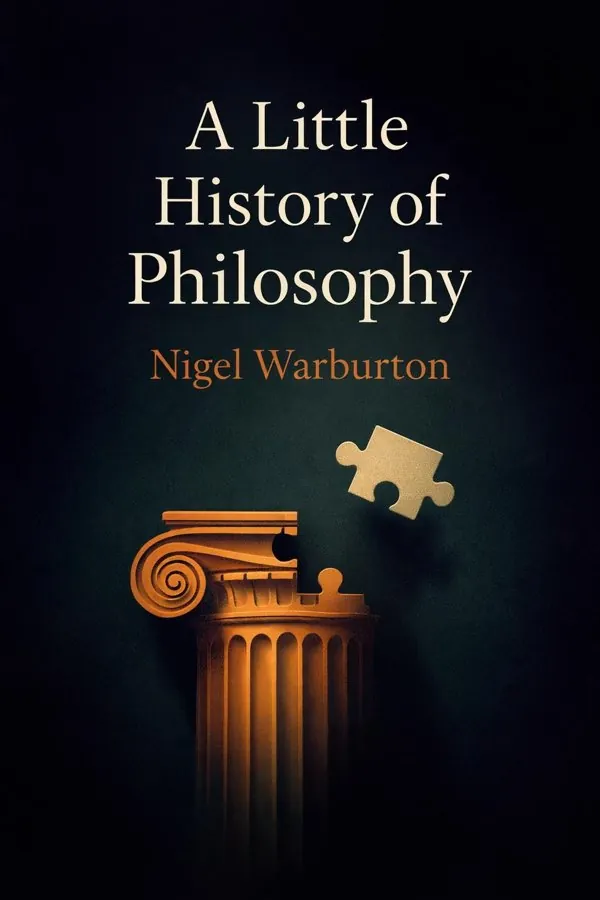
A Little History of Philosophy: Summary & Key Insights
 10 min8 chaptersAudio available
Key Takeaways from A Little History of Philosophy
A life filled with activity can still be intellectually asleep.
We often assume that reality is exactly what our senses present to us, but Plato and Aristotle show two very different ways to challenge that assumption.
Many people chase happiness as if it were a reward waiting somewhere in the future, but ancient philosophers often saw it as a skill of living.
Philosophy did not disappear when religion became culturally dominant; it entered into a new and demanding partnership with faith.
Certainty is harder to achieve than most people think, and the early modern philosophers made that problem impossible to ignore.
What Is A Little History of Philosophy About?
A Little History of Philosophy by Nigel Warburton is a western_phil book published in 2011 spanning 13 pages. What if the biggest questions in life were not obstacles to avoid, but invitations to think more deeply? In A Little History of Philosophy, Nigel Warburton turns the history of Western philosophy into a lively, human story filled with argument, curiosity, and intellectual courage. Rather than presenting philosophy as a dense academic subject reserved for specialists, he introduces it as an ongoing conversation about truth, justice, happiness, knowledge, freedom, religion, and the meaning of life. Moving from Socrates in ancient Athens to modern thinkers such as Nietzsche, Sartre, and contemporary analytic philosophers, Warburton shows how major ideas emerged in response to real problems people faced in their societies and in themselves. Each philosopher is treated not as a monument, but as a person wrestling with difficult questions that still matter today. The book matters because it makes philosophy accessible without oversimplifying it. Warburton, a British philosopher, writer, and co-founder of the widely respected Philosophy Bites podcast, is especially skilled at explaining difficult ideas with clarity and energy. The result is an inviting guide for anyone who wants to understand how philosophy has shaped the modern mind.
This FizzRead summary covers all 8 key chapters of A Little History of Philosophy in approximately 10 minutes, distilling the most important ideas, arguments, and takeaways from Nigel Warburton's work. Also available as an audio summary and Key Quotes Podcast.
A Little History of Philosophy
What if the biggest questions in life were not obstacles to avoid, but invitations to think more deeply? In A Little History of Philosophy, Nigel Warburton turns the history of Western philosophy into a lively, human story filled with argument, curiosity, and intellectual courage. Rather than presenting philosophy as a dense academic subject reserved for specialists, he introduces it as an ongoing conversation about truth, justice, happiness, knowledge, freedom, religion, and the meaning of life.
Moving from Socrates in ancient Athens to modern thinkers such as Nietzsche, Sartre, and contemporary analytic philosophers, Warburton shows how major ideas emerged in response to real problems people faced in their societies and in themselves. Each philosopher is treated not as a monument, but as a person wrestling with difficult questions that still matter today.
The book matters because it makes philosophy accessible without oversimplifying it. Warburton, a British philosopher, writer, and co-founder of the widely respected Philosophy Bites podcast, is especially skilled at explaining difficult ideas with clarity and energy. The result is an inviting guide for anyone who wants to understand how philosophy has shaped the modern mind.
Who Should Read A Little History of Philosophy?
This book is perfect for anyone interested in western_phil and looking to gain actionable insights in a short read. Whether you're a student, professional, or lifelong learner, the key ideas from A Little History of Philosophy by Nigel Warburton will help you think differently.
- ✓Readers who enjoy western_phil and want practical takeaways
- ✓Professionals looking to apply new ideas to their work and life
- ✓Anyone who wants the core insights of A Little History of Philosophy in just 10 minutes
Want the full summary?
Get instant access to this book summary and 100K+ more with Fizz Moment.
Get Free SummaryAvailable on App Store • Free to download
Key Chapters
A life filled with activity can still be intellectually asleep. That is the unsettling lesson Socrates leaves us with when he insists that “the unexamined life is not worth living.” In Warburton’s account, Socrates is not important because he wrote great books—he wrote none—but because he changed philosophy into a practice of questioning. He walked through Athens asking apparently simple questions such as “What is justice?” or “What is courage?” and then exposing how weak, inconsistent, or confused many confident answers really were.
Socrates’ method, often called the elenchus, was a disciplined form of dialogue. He did not merely argue for victory; he challenged people to test whether their beliefs truly held together. This made him irritating, even dangerous, because he revealed ignorance in those who claimed wisdom. Yet his deeper point was constructive: if we care about living well, we must care about whether our beliefs are true.
This idea remains strikingly practical. When we say we value honesty, fairness, or success, have we thought carefully about what those terms mean? In workplaces, relationships, and politics, people often repeat slogans they have never examined. Socratic questioning can uncover assumptions before they become harmful decisions.
You can apply this by choosing one belief you take for granted—about success, morality, religion, or happiness—and asking yourself: What do I mean by this? Why do I believe it? Could I defend it under pressure? Actionable takeaway: once this week, have one genuinely Socratic conversation in which your goal is not to win, but to clarify what you and another person really think.
We often assume that reality is exactly what our senses present to us, but Plato and Aristotle show two very different ways to challenge that assumption. Warburton presents Plato as the thinker who pushed beyond the visible world. For Plato, the world of change and imperfection is not the deepest level of reality. Behind it stand the Forms—perfect, timeless realities such as Justice, Beauty, and Goodness. In the famous allegory of the cave, ordinary life resembles watching shadows on a wall while mistaking them for the whole truth.
Aristotle, Plato’s student, admired reason but distrusted excessive abstraction. He turned philosophy toward observation, classification, and careful study of how things actually function in the world. Instead of locating reality in a separate realm of Forms, Aristotle examined causes, purposes, and the nature of living beings here and now. His approach laid foundations for logic, ethics, biology, and political thought.
Together, they establish a tension that still shapes modern thinking: should we trust abstract ideals or empirical investigation? We see this today in debates about education, law, and leadership. Plato reminds us to ask what justice ideally is; Aristotle reminds us to study how real institutions and real people actually behave.
A balanced thinker needs both impulses. Without ideals, we become cynical pragmatists. Without observation, we become detached dreamers. Actionable takeaway: when evaluating any major issue—whether a policy, career path, or personal goal—ask two questions: What is the ideal here? And what does the evidence about reality actually show?
Many people chase happiness as if it were a reward waiting somewhere in the future, but ancient philosophers often saw it as a skill of living. Warburton brings this out through Epicurus and the Stoics, who offered rival but surprisingly compatible visions of how to live well.
Epicurus is often misunderstood as a philosopher of indulgence. In fact, he argued that true pleasure is not endless luxury but freedom from unnecessary pain, fear, and disturbance. He recommended simple living, friendship, moderation, and freedom from irrational anxieties—especially fear of death and the gods. A calm meal with close friends could be more pleasurable than extravagance because it produced lasting contentment rather than craving.
The Stoics, including thinkers such as Epictetus and Seneca, placed even more emphasis on inner discipline. Their core insight is that suffering often comes less from events themselves than from our judgments about them. Since much of life lies beyond our control—illness, reputation, loss, other people’s behavior—we should focus on what does lie within it: our character, choices, and responses.
These ideas remain powerfully relevant in an age of overstimulation, consumer pressure, and anxiety. Epicurus challenges the assumption that more is better. Stoicism offers tools for resilience when outcomes are uncertain. Together they suggest that happiness depends less on external success than on mental clarity, moderation, and self-command.
Actionable takeaway: make two lists—what is within your control and what is not—then direct today’s energy toward one controllable action and let one uncontrollable worry go.
Philosophy did not disappear when religion became culturally dominant; it entered into a new and demanding partnership with faith. Warburton shows how medieval thinkers wrestled with a central question: if reason and revelation both aim at truth, how do they fit together? Philosophers such as Augustine and Thomas Aquinas did not see belief as the end of inquiry. Instead, they asked how human reason could illuminate religious doctrines and how faith could shape ethical and metaphysical understanding.
Augustine explored inwardness, memory, evil, and the restless human search for God. He treated self-examination not merely as psychology but as a route toward spiritual truth. Aquinas, drawing heavily on Aristotle, developed a grand synthesis in which reason could investigate the natural world and even provide arguments for God’s existence, while revelation completed what reason alone could not fully grasp.
This medieval effort matters because it helped define enduring debates about authority, interpretation, morality, and the scope of human understanding. Even for secular readers, these thinkers raise live questions: Can moral values exist without a transcendent source? Are there limits to what empirical science can explain? What should we do when intellectual reasoning and inherited tradition seem to conflict?
In practical life, most people still navigate tensions between evidence and commitment, between private belief and public argument. Medieval philosophy models serious engagement rather than easy dismissal. It shows that disagreement over ultimate truths need not eliminate disciplined thought.
Actionable takeaway: identify one belief you hold because of upbringing, culture, or tradition, and ask whether you can give a reasoned account of it that would make sense to someone outside your background.
Certainty is harder to achieve than most people think, and the early modern philosophers made that problem impossible to ignore. Warburton introduces a turning point in thinkers such as Descartes, Hobbes, Locke, Berkeley, and Hume, who asked not only what is true, but how we can know anything at all.
Descartes begins with radical doubt. If the senses sometimes deceive us, and if dreams can feel real, perhaps almost everything we believe is uncertain. He searches for one indubitable truth and finds it in the famous cogito: I think, therefore I am. From there he rebuilds knowledge through reason. Others went in a different direction. Locke argued that the mind begins as a blank slate and gains ideas from experience. Berkeley questioned whether material substance exists independently of perception. Hume pushed empiricism toward skepticism, arguing that many assumptions—such as causation or the stable self—rest more on habit than rational proof.
These debates are not relics. They shape current disputes about misinformation, scientific evidence, perception, memory, and AI-generated realities. How much should we trust our senses? How do habits shape beliefs? What separates knowledge from confidence?
Warburton’s great achievement is to show that these philosophers were not playing word games; they were trying to establish secure foundations for thought in a rapidly changing world. Their disagreements remain productive because they force us to examine how belief is formed.
Actionable takeaway: the next time you feel certain about a controversial claim, pause and identify its source—is it reason, experience, authority, habit, or emotion? Then test whether that source is strong enough.
Doing the right thing is not always about producing the best consequences. Sometimes morality seems to demand something stricter: act from principle, even when it costs you. Warburton presents Immanuel Kant as the philosopher who gave this intuition its most powerful form. Kant believed that morality is grounded in reason itself, not in pleasure, social approval, or changing circumstances.
His most famous idea, the categorical imperative, asks us to act only on principles we could will to become universal laws. If you consider lying to escape trouble, ask whether a world in which everyone lied when convenient could still support trust, promises, or communication. If the principle destroys the conditions that make the action possible, it fails the test. Kant also insists that people must always be treated as ends in themselves, never merely as means. Human dignity, on this view, sets moral limits on what we may do.
This framework still influences law, human rights, medicine, and public life. It explains why some actions feel wrong even when they seem efficient—deception, manipulation, exploitation, coercion. In everyday settings, Kantian thinking encourages us to respect persons rather than use them strategically.
Kant is difficult, but Warburton makes the central point accessible: morality requires consistency, universality, and respect. We are not just creatures of appetite or convenience. We are rational agents accountable for our choices.
Actionable takeaway: before making a morally difficult decision, phrase your reason for acting as a general rule, then ask two questions: Could everyone act this way? And does this treat other people as persons with dignity rather than tools for my goal?
Private morality is only part of philosophy’s task; we also need principles for organizing society. Warburton traces this through utilitarian thinkers such as Jeremy Bentham and John Stuart Mill, alongside political philosophers concerned with freedom, power, and social order. The utilitarian insight is elegantly simple: actions and policies should be judged by their consequences, especially by whether they promote the greatest happiness for the greatest number.
Bentham gave this idea a reforming energy. He wanted laws, punishments, and institutions assessed not by tradition but by measurable effects on human well-being. Mill refined the view by distinguishing higher and lower pleasures and by defending individual liberty in ways that still resonate strongly. His harm principle suggests that society should interfere with personal freedom only to prevent harm to others.
These ideas remain deeply practical. Governments weigh costs and benefits in health policy, education, transportation, and criminal justice. Individuals also think this way when choosing the option that helps the most people. But Warburton also highlights the tension: what if maximizing overall happiness justifies sacrificing the interests of a minority? What protects rights when utility points elsewhere?
This is why utilitarianism is both influential and controversial. It encourages humane, evidence-based reform, yet it can struggle to account for justice, fairness, and inviolable dignity. Its value lies partly in forcing us to ask who benefits, who suffers, and what outcomes our principles actually produce.
Actionable takeaway: when judging a rule, decision, or policy, consider three lenses together—overall consequences, individual rights, and long-term social trust—before deciding what is genuinely best.
The modern world often feels fragmented: old certainties weaken, institutions lose authority, and individuals are left asking what meaning, if any, they must create for themselves. Warburton captures this atmosphere through thinkers such as Nietzsche, Sartre, and later philosophers of language and contemporary critique.
Nietzsche challenges inherited morality, especially values presented as universal and unquestionable. He suspects that many moral systems mask resentment, weakness, or the will to power. His call is not simply to reject morality, but to examine where our values come from and whether they affirm life or diminish it. Sartre intensifies the challenge. If there is no fixed human essence given in advance, then we are radically free—and therefore radically responsible. We cannot hide behind roles, excuses, or social scripts forever.
Alongside this existential current, twentieth-century philosophy also turned to language. Thinkers such as Wittgenstein asked how philosophical confusion often arises from misunderstanding the way words work. Instead of chasing false abstractions, philosophy might clarify meaning and dissolve pseudo-problems.
Together, these strands speak directly to contemporary life. We confront identity questions, ideological conflict, media distortion, and the pressure to define ourselves in uncertain conditions. Existentialism asks whether we are living authentically. Philosophy of language asks whether our arguments even mean what we think they mean.
Warburton’s broader lesson is that philosophy remains alive because the conditions of human life keep changing, but the need for clarity, honesty, and courage does not. Actionable takeaway: when facing a major personal decision, ask not only “What do people expect of me?” but also “What values am I choosing, and are the words I use actually clear enough to guide my life?”
All Chapters in A Little History of Philosophy
About the Author
Nigel Warburton is a British philosopher, author, editor, and broadcaster known for bringing philosophy to a wide general audience. He studied philosophy at the University of Bristol and later taught at the Open University, where he helped make complex ideas accessible to non-specialists. Warburton has written several popular books on philosophy, ethics, and critical thinking, often focusing on clarity rather than academic jargon. He is also the co-founder of the highly regarded Philosophy Bites podcast, which features short conversations with leading thinkers on major philosophical questions. His work stands out for its combination of intellectual seriousness, readability, and enthusiasm. In A Little History of Philosophy, Warburton uses those strengths to introduce readers to the central figures and debates of Western philosophy in a way that is both engaging and trustworthy.
Get This Summary in Your Preferred Format
Read or listen to the A Little History of Philosophy summary by Nigel Warburton anytime, anywhere. FizzRead offers multiple formats so you can learn on your terms — all free.
Available formats: App · Audio · PDF · EPUB — All included free with FizzRead
Download A Little History of Philosophy PDF and EPUB Summary
Key Quotes from A Little History of Philosophy
“A life filled with activity can still be intellectually asleep.”
“We often assume that reality is exactly what our senses present to us, but Plato and Aristotle show two very different ways to challenge that assumption.”
“Many people chase happiness as if it were a reward waiting somewhere in the future, but ancient philosophers often saw it as a skill of living.”
“Philosophy did not disappear when religion became culturally dominant; it entered into a new and demanding partnership with faith.”
“Certainty is harder to achieve than most people think, and the early modern philosophers made that problem impossible to ignore.”
Frequently Asked Questions about A Little History of Philosophy
A Little History of Philosophy by Nigel Warburton is a western_phil book that explores key ideas across 8 chapters. What if the biggest questions in life were not obstacles to avoid, but invitations to think more deeply? In A Little History of Philosophy, Nigel Warburton turns the history of Western philosophy into a lively, human story filled with argument, curiosity, and intellectual courage. Rather than presenting philosophy as a dense academic subject reserved for specialists, he introduces it as an ongoing conversation about truth, justice, happiness, knowledge, freedom, religion, and the meaning of life. Moving from Socrates in ancient Athens to modern thinkers such as Nietzsche, Sartre, and contemporary analytic philosophers, Warburton shows how major ideas emerged in response to real problems people faced in their societies and in themselves. Each philosopher is treated not as a monument, but as a person wrestling with difficult questions that still matter today. The book matters because it makes philosophy accessible without oversimplifying it. Warburton, a British philosopher, writer, and co-founder of the widely respected Philosophy Bites podcast, is especially skilled at explaining difficult ideas with clarity and energy. The result is an inviting guide for anyone who wants to understand how philosophy has shaped the modern mind.
You Might Also Like

Areopagitica
John Milton
10 min
How To Think Like A Philosopher: Essential Principles For Clear Thinking
Peter Cave
10 min
Language, Truth and Logic
A. J. Ayer
10 min
The Age of Reason
Thomas Paine
10 min
The Essays
Michel De Montaigne
10 min
The Meaning Of Life
Terry Eagleton
10 minFeatured In
Browse by Category
Ready to read A Little History of Philosophy?
Get the full summary and 100K+ more books with Fizz Moment.