
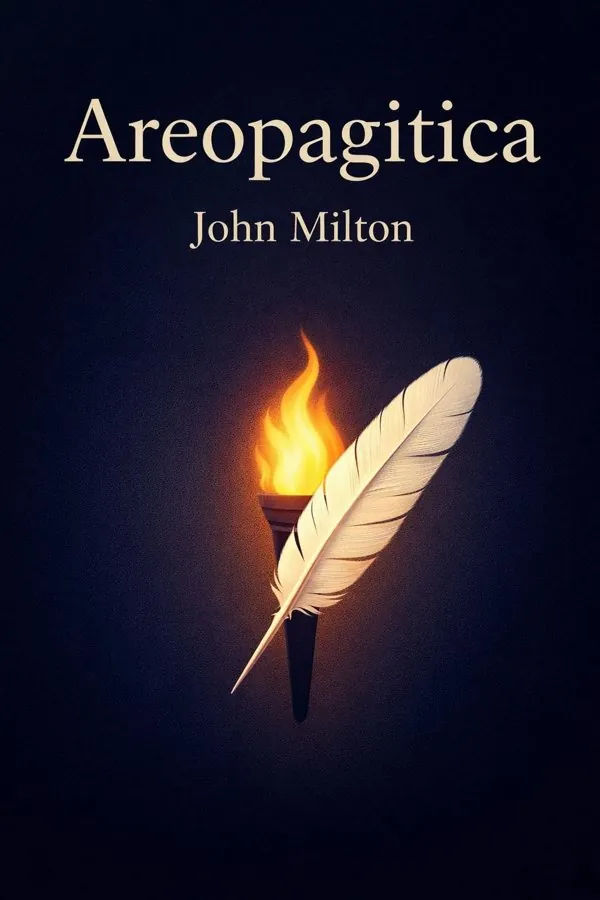
Areopagitica: Summary & Key Insights
by John Milton
 10 min8 chaptersAudio available
Key Takeaways from Areopagitica
A truth that cannot survive challenge is not much of a truth at all.
Censorship often presents itself as order, but Milton sees in it a form of intellectual laziness imposed by power.
Milton treats reading not as passive consumption but as a discipline of the soul.
Milton understands that control over printing is never just about books.
One of Milton’s sharpest observations is that moral goodness cannot be created by removing every bad influence.
What Is Areopagitica About?
Areopagitica by John Milton is a western_phil book. What happens to truth when authorities decide in advance what people may read? In Areopagitica, first published in 1644, John Milton delivers one of the most powerful defenses of intellectual freedom ever written. Framed as an address to the English Parliament, this prose work argues against pre-publication licensing, the system that required official approval before books could be printed. Milton insists that truth is not fragile and does not need protection from debate. On the contrary, he argues that truth grows stronger when tested against error in open contest. The work matters far beyond its historical moment. Although written in the turbulence of seventeenth-century England, Areopagitica speaks directly to modern struggles over censorship, free speech, misinformation, education, and public debate. Milton does not simply praise liberty in the abstract; he links freedom of reading to moral development, civic responsibility, and human dignity. His authority comes from more than literary genius. A scholar, polemicist, and one of the greatest writers in English, Milton combines classical learning, political urgency, and moral seriousness to create a text that still shapes how democratic societies think about expression, conscience, and the right to encounter ideas.
This FizzRead summary covers all 8 key chapters of Areopagitica in approximately 10 minutes, distilling the most important ideas, arguments, and takeaways from John Milton's work. Also available as an audio summary and Key Quotes Podcast.
Areopagitica
What happens to truth when authorities decide in advance what people may read? In Areopagitica, first published in 1644, John Milton delivers one of the most powerful defenses of intellectual freedom ever written. Framed as an address to the English Parliament, this prose work argues against pre-publication licensing, the system that required official approval before books could be printed. Milton insists that truth is not fragile and does not need protection from debate. On the contrary, he argues that truth grows stronger when tested against error in open contest.
The work matters far beyond its historical moment. Although written in the turbulence of seventeenth-century England, Areopagitica speaks directly to modern struggles over censorship, free speech, misinformation, education, and public debate. Milton does not simply praise liberty in the abstract; he links freedom of reading to moral development, civic responsibility, and human dignity. His authority comes from more than literary genius. A scholar, polemicist, and one of the greatest writers in English, Milton combines classical learning, political urgency, and moral seriousness to create a text that still shapes how democratic societies think about expression, conscience, and the right to encounter ideas.
Who Should Read Areopagitica?
This book is perfect for anyone interested in western_phil and looking to gain actionable insights in a short read. Whether you're a student, professional, or lifelong learner, the key ideas from Areopagitica by John Milton will help you think differently.
- ✓Readers who enjoy western_phil and want practical takeaways
- ✓Professionals looking to apply new ideas to their work and life
- ✓Anyone who wants the core insights of Areopagitica in just 10 minutes
Want the full summary?
Get instant access to this book summary and 100K+ more with Fizz Moment.
Get Free SummaryAvailable on App Store • Free to download
Key Chapters
A truth that cannot survive challenge is not much of a truth at all. This is one of Milton’s most enduring insights in Areopagitica. He argues that censorship rests on a weak and fearful view of truth, as if true ideas are too delicate to coexist with false ones. Milton rejects that assumption. Truth, he says, gains strength when it meets error openly and defeats it through reason, evidence, and persuasion. To suppress opposing views before they are heard is not confidence in truth but distrust of it.
This idea matters because it changes how we think about public discourse. If a government, institution, or platform blocks ideas in advance, it prevents citizens from developing the habits needed to judge well. People do not become wise by being shielded from every mistake; they become wise by learning how to distinguish what is sound from what is misleading. Milton sees this process as intellectually and morally necessary.
In modern life, this principle applies to classrooms, media, and even workplace culture. A university that permits debate on difficult issues trains students to think critically. A reader who compares conflicting reports on a controversial event becomes more discerning than one who sees only pre-approved conclusions. Even parents and teachers can apply Milton’s logic by guiding young people through difficult material rather than banning it outright.
Milton does not say all ideas are equally valid. He says valid ideas must be tested, not merely asserted. That is a demanding vision of freedom because it puts responsibility on readers, not censors. The goal is not chaos but mature judgment.
Actionable takeaway: When you encounter a disturbing or opposing view, resist the impulse to dismiss it instantly; examine it carefully and ask what evidence, logic, and values best reveal the truth.
Censorship often presents itself as order, but Milton sees in it a form of intellectual laziness imposed by power. In Areopagitica, he specifically attacks the licensing system that required books to receive official approval before publication. His argument is not only that this process is inconvenient or unfair to authors. He believes it corrupts public reason by placing a small group of gatekeepers above the collective intelligence of society.
Milton points out the practical absurdity of such systems. No handful of licensers can reliably judge every subject, discipline, or argument. They will miss what matters, misunderstand what they read, or impose their own prejudices. Worse, licensing encourages a passive culture in which readers outsource judgment to authorities instead of exercising their own capacities. Once people assume that whatever reaches them has been pre-screened, they become less vigilant, less analytical, and less free.
This remains highly relevant. Modern forms of licensing may not always look like state censors stamping manuscripts, but similar dynamics can emerge when institutions suppress publication through ideological conformity, risk-aversion, or bureaucratic approval chains. In corporate, academic, or digital settings, overreliance on gatekeepers can narrow what is discussable and flatten public conversation.
Milton’s critique also warns against equating access control with wisdom. A platform that removes every controversial statement may not create an informed public. It may instead create a less resilient one, unable to evaluate claims independently. The better long-term answer is often stronger media literacy, better education, and open rebuttal.
Milton understands that bad books exist. His deeper point is that trying to prevent them all through preemptive control causes broader damage to freedom and judgment than the books themselves.
Actionable takeaway: Before supporting a rule that restricts publication in advance, ask whether it truly protects the public or merely transfers the burden of thinking from citizens to gatekeepers.
Milton treats reading not as passive consumption but as a discipline of the soul. In Areopagitica, books are not inert objects; they carry the living force of thought, argument, memory, and character. To read well is therefore to engage in moral and intellectual formation. This is why censorship is so dangerous in his view: it interferes with one of the central ways human beings cultivate judgment.
Milton rejects the idea that virtue can be produced by insulation. A person who has never confronted error, temptation, or complexity may appear obedient, but that is not the same as being wise or good. Genuine virtue requires discernment. One must learn to recognize what is false, seductive, shallow, or destructive and then choose what is better. Reading difficult, even troubling, material can contribute to that process when approached seriously.
This insight has practical force today. Many people ask whether exposure to controversial books or arguments is harmful. Milton’s answer would be that exposure without guidance may confuse, but exposure with reflection can strengthen. A student reading propaganda in a history course can learn how manipulation works. A citizen comparing ideological arguments can sharpen democratic judgment. A reader engaging with flawed texts from the past can better understand both human limitations and moral progress.
Milton is not naïve. He knows some texts can corrupt, sensationalize, or degrade. But he believes the answer is not blanket restriction; it is the cultivation of better readers. Families, teachers, communities, and institutions should aim to form discernment rather than dependency.
In this way, Areopagitica connects freedom with responsibility. The right to read is meaningful only if readers are willing to think, question, and judge.
Actionable takeaway: Treat challenging reading as training for discernment by asking, after every difficult text, what it assumes, what it gets right, where it misleads, and what it teaches you about good judgment.
Milton understands that control over printing is never just about books. It is about power over minds, institutions, and public life. In Areopagitica, he argues that the freedom to print is essential to a healthy commonwealth because political liberty depends on the ability to question, persuade, criticize, and reform. If authorities can halt publication before a case is even made, they can shape not only what citizens know but what they are capable of imagining.
This makes freedom of printing a civic principle, not merely a literary privilege. A society that permits publication creates space for grievances to be aired, abuses to be exposed, reforms to be proposed, and competing visions of justice to be debated. A society that suppresses publication risks preserving error simply because correction never reaches the public. Milton therefore links the liberty of the press with the possibility of self-government.
The practical implications are enormous. Investigative journalism, whistleblowing, dissenting scholarship, opposition movements, and minority perspectives all depend on some version of Milton’s principle. When publication is constrained by fear of prior restraint, public institutions become less accountable. Even in organizations, teams function better when people can raise concerns before problems harden into crises.
Milton’s defense of printing also reminds us that liberty is not secured once and for all. It must be renewed through habits of openness and tolerance for disagreement. Societies often claim to support free expression in general while finding endless reasons to suppress particular speakers, ideas, or documents. Areopagitica challenges that inconsistency.
For Milton, public freedom is sustained not by silence but by circulation: of arguments, criticisms, proposals, and truths not yet recognized.
Actionable takeaway: Support systems, institutions, and communities that allow criticism to be voiced openly before authority decides what may be said on behalf of everyone else.
One of Milton’s sharpest observations is that moral goodness cannot be created by removing every bad influence. In Areopagitica, he argues that forced purity is counterfeit virtue. A person who avoids wrongdoing only because alternatives were hidden from view has not truly chosen the good. Real virtue emerges from knowledge, struggle, and deliberate preference for what is right over what is false or harmful.
This point strikes at the paternal logic behind censorship. Authorities often justify restrictions by claiming they protect citizens from corruption. Milton answers that such protection can infantilize the public. It may produce outward conformity, but it cannot produce inward strength. Moral maturity requires freedom because choice is essential to character.
This insight applies well beyond books. In education, students who are never allowed to engage with morally difficult questions may memorize approved answers without understanding them. In religious life, faith enforced by suppression may look stable but remain shallow. In civic life, citizens who never encounter competing political claims may repeat slogans rather than develop convictions. Even in personal development, resilience comes not from the absence of challenge but from learning how to respond to it.
Milton’s argument does not deny the need for boundaries. Children need age-appropriate guidance. Communities need laws against incitement, fraud, and direct harm. But he insists that broad attempts to purify society by controlling ideas are misguided. They confuse order with virtue and obedience with wisdom.
His larger claim is deeply humanistic: people become better not by living in sterilized environments but by exercising conscience amid complexity. That view remains unsettling because it gives freedom a demanding moral purpose.
Actionable takeaway: Instead of trying to eliminate every troubling influence from your environment, focus on building the habits of judgment, self-command, and reflection that enable genuine virtue.
Milton writes about books with unusual reverence because he sees them as more than containers of information. In Areopagitica, books preserve the vitality of human thought across time. To destroy or suppress them is not simply to remove paper from circulation; it is to injure the living labor of minds and to limit future generations’ access to wisdom, error, memory, and debate. This gives his defense of print a cultural and almost sacred intensity.
By emphasizing the life within books, Milton expands the stakes of censorship. A banned book is not merely a disputed object. It may hold a perspective that helps later readers understand their world, challenge accepted falsehoods, or rediscover neglected truths. Even flawed books can matter because they reveal how ideas develop, how societies justify themselves, and how errors take shape. To erase them is to narrow historical understanding.
This principle is easy to apply today. Archival preservation, open libraries, and access to contested texts all reflect Milton’s belief that culture depends on continuity of thought. A society that removes uncomfortable books from curricula or public shelves may imagine it is protecting values, yet it may also be weakening historical memory. Researchers, students, and ordinary readers need contact with the record of human thinking, not just its sanitized highlights.
Milton’s reverence for books also invites readers to approach them with seriousness. If books carry the effort of living minds, then reading becomes a form of encounter. It asks for attention, humility, and response. We do not merely consume texts; we inherit conversations.
In an age of endless content, Milton’s view is corrective. It reminds us that preserving and engaging books is part of preserving civilization’s capacity to think.
Actionable takeaway: Read and preserve books not only for agreement or entertainment, but as participation in a larger human conversation that should remain available to future minds.
A policy can be repressive and ineffective at the same time. Milton repeatedly suggests this about censorship in Areopagitica. Even if one grants the censor’s aim of reducing harmful influence, pre-publication control still fails on practical grounds. Ideas do not disappear just because officials prohibit them. They circulate privately, migrate across borders, reappear in rumor, or gain appeal precisely because they are forbidden. Meanwhile, legitimate scholarship and honest debate are impeded.
Milton’s realism is one reason the work still resonates. He understands that social control through suppression rarely works as neatly as lawmakers imagine. Harmful content can evade official channels, while useful content gets delayed or blocked. The result is often a system that burdens conscientious writers more than reckless ones. Serious authors, printers, and scholars face scrutiny; cruder material finds other routes.
Modern readers can see parallels everywhere. Attempts to suppress controversial information online often amplify it by making it seem secret or dangerous. Organizations that silence criticism internally may drive dissent underground, where distrust grows. Political regimes that ban books often elevate them into symbols of resistance. In each case, censorship not only limits discussion but can intensify the very dynamics it seeks to control.
Milton’s argument here is not absolute permissiveness. It is a challenge to simplistic confidence in suppression as a solution. Societies should ask not only whether a restriction is well-intentioned but whether it is likely to achieve its stated purpose without causing greater harm to inquiry and trust.
This is a pragmatic defense of freedom: open argument often works better than prohibition. Errors can be answered, exposed, contextualized, and diminished publicly. Once hidden, they become harder to evaluate and easier to mythologize.
Actionable takeaway: When confronted with bad ideas, consider whether transparent rebuttal, education, and context would reduce their influence more effectively than trying to suppress them outright.
Milton’s defense of liberty is inseparable from his expectations of citizens. Areopagitica is not a plea for careless expression or thoughtless consumption. It assumes that a free society can endure only if people are capable of reading, listening, and judging with seriousness. In that sense, the work is both liberating and demanding. It grants freedom, but it also asks readers to grow into it.
This is one reason the text remains so relevant. Contemporary discussions of free speech often focus on rights while neglecting capacities. Milton reminds us that the value of open discourse depends partly on the quality of attention brought to it. If readers are impulsive, credulous, tribal, or lazy, then public debate becomes easier to manipulate. Freedom without discernment can produce noise; freedom with discernment can produce knowledge.
How does a society cultivate mature readers? Milton’s logic points toward education in rhetoric, history, logic, ethics, and the habits of close reading. It also points toward cultural norms that reward patience over outrage and analysis over slogan repetition. In practical terms, this means reading beyond headlines, verifying sources, comparing arguments, and resisting the lure of intellectual comfort.
The idea applies personally as well. Every reader participates in the moral ecology of public discourse. To spread claims without checking them, to reject books unread, or to equate discomfort with harm is to weaken the conditions of freedom. To read carefully, question honestly, and revise one’s views is to strengthen them.
Milton’s vision is not easy because it refuses both authoritarian control and passive liberty. It calls for disciplined freedom, where citizens accept the burden of thought as the price of self-government.
Actionable takeaway: Strengthen your capacity for free citizenship by practicing slow, critical reading and by evaluating claims before sharing, endorsing, or condemning them.
All Chapters in Areopagitica
About the Author
John Milton was an English poet, intellectual, and political writer born in London in 1608. Educated at St Paul’s School and Christ’s College, Cambridge, he developed extraordinary mastery of classical literature, theology, history, and rhetoric. Though best known for his epic poem Paradise Lost, Milton was also a formidable prose author who wrote on church reform, divorce, politics, and liberty of conscience. During the English Civil War era, he became deeply involved in public controversy and used his writing to defend republican and anti-censorship positions. Areopagitica, published in 1644, remains one of his most influential prose works. Despite losing his eyesight later in life, Milton continued writing and produced some of the greatest works in English literature before his death in 1674.
Get This Summary in Your Preferred Format
Read or listen to the Areopagitica summary by John Milton anytime, anywhere. FizzRead offers multiple formats so you can learn on your terms — all free.
Available formats: App · Audio · PDF · EPUB — All included free with FizzRead
Download Areopagitica PDF and EPUB Summary
Key Quotes from Areopagitica
“A truth that cannot survive challenge is not much of a truth at all.”
“Censorship often presents itself as order, but Milton sees in it a form of intellectual laziness imposed by power.”
“Milton treats reading not as passive consumption but as a discipline of the soul.”
“Milton understands that control over printing is never just about books.”
“One of Milton’s sharpest observations is that moral goodness cannot be created by removing every bad influence.”
Frequently Asked Questions about Areopagitica
Areopagitica by John Milton is a western_phil book that explores key ideas across 8 chapters. What happens to truth when authorities decide in advance what people may read? In Areopagitica, first published in 1644, John Milton delivers one of the most powerful defenses of intellectual freedom ever written. Framed as an address to the English Parliament, this prose work argues against pre-publication licensing, the system that required official approval before books could be printed. Milton insists that truth is not fragile and does not need protection from debate. On the contrary, he argues that truth grows stronger when tested against error in open contest. The work matters far beyond its historical moment. Although written in the turbulence of seventeenth-century England, Areopagitica speaks directly to modern struggles over censorship, free speech, misinformation, education, and public debate. Milton does not simply praise liberty in the abstract; he links freedom of reading to moral development, civic responsibility, and human dignity. His authority comes from more than literary genius. A scholar, polemicist, and one of the greatest writers in English, Milton combines classical learning, political urgency, and moral seriousness to create a text that still shapes how democratic societies think about expression, conscience, and the right to encounter ideas.
More by John Milton
You Might Also Like
A Little History of Philosophy
Nigel Warburton
10 min
How To Think Like A Philosopher: Essential Principles For Clear Thinking
Peter Cave
10 min
Language, Truth and Logic
A. J. Ayer
10 min
The Age of Reason
Thomas Paine
10 min
The Essays
Michel De Montaigne
10 min
The Meaning Of Life
Terry Eagleton
10 minBrowse by Category
Ready to read Areopagitica?
Get the full summary and 100K+ more books with Fizz Moment.