
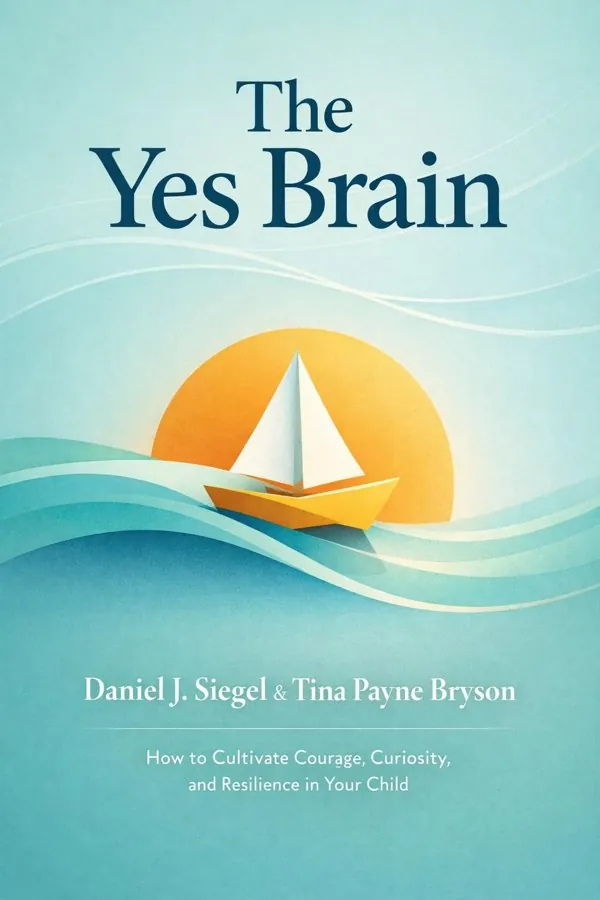
The Yes Brain: How to Cultivate Courage, Curiosity, and Resilience in Your Child: Summary & Key Insights
by Daniel J. Siegel, Tina Payne Bryson
 10 min8 chaptersAudio available
What Is The Yes Brain: How to Cultivate Courage, Curiosity, and Resilience in Your Child About?
The Yes Brain: How to Cultivate Courage, Curiosity, and Resilience in Your Child by Daniel J. Siegel, Tina Payne Bryson is a parenting book spanning 8 pages. In this insightful guide, Daniel J. Siegel and Tina Payne Bryson explore how parents can help children develop a 'Yes Brain'—a mindset characterized by openness, curiosity, and emotional balance. The book provides practical strategies to nurture resilience, empathy, and self-regulation, enabling children to thrive in challenging situations and build healthy relationships.
This FizzRead summary covers all 8 key chapters of The Yes Brain: How to Cultivate Courage, Curiosity, and Resilience in Your Child in approximately 10 minutes, distilling the most important ideas, arguments, and takeaways from Daniel J. Siegel, Tina Payne Bryson's work. Also available as an audio summary and Key Quotes Podcast.
The Yes Brain: How to Cultivate Courage, Curiosity, and Resilience in Your Child
In this insightful guide, Daniel J. Siegel and Tina Payne Bryson explore how parents can help children develop a 'Yes Brain'—a mindset characterized by openness, curiosity, and emotional balance. The book provides practical strategies to nurture resilience, empathy, and self-regulation, enabling children to thrive in challenging situations and build healthy relationships.
Who Should Read The Yes Brain: How to Cultivate Courage, Curiosity, and Resilience in Your Child?
This book is perfect for anyone interested in parenting and looking to gain actionable insights in a short read. Whether you're a student, professional, or lifelong learner, the key ideas from The Yes Brain: How to Cultivate Courage, Curiosity, and Resilience in Your Child by Daniel J. Siegel, Tina Payne Bryson will help you think differently.
- ✓Readers who enjoy parenting and want practical takeaways
- ✓Professionals looking to apply new ideas to their work and life
- ✓Anyone who wants the core insights of The Yes Brain: How to Cultivate Courage, Curiosity, and Resilience in Your Child in just 10 minutes
Want the full summary?
Get instant access to this book summary and 100K+ more with Fizz Moment.
Get Free SummaryAvailable on App Store • Free to download
Key Chapters
Children’s behavior is the visible expression of their brain’s inner state. When their nervous systems are balanced and integrated, they are kind, curious, flexible, and engaged. When those same systems become disorganized—through fear, stress, or overstimulation—their world contracts into a 'No Brain' state: defensive, reactive, and rigid.
In neurobiological terms, the Yes Brain represents an integrated brain, one where the emotional, thinking, and relational centers are communicating fluidly. The prefrontal cortex—the seat of executive function, empathy, and emotional regulation—works harmoniously with deeper emotional structures like the amygdala and limbic system. Integration allows children to feel emotions without being consumed by them. They can pause before reacting, consider context, and choose responses congruent with their values.
The challenge is that integration doesn’t come fully formed. The child’s prefrontal cortex continues to develop well into their twenties. This means the child’s ability to respond reflectively rather than reactively depends greatly on the caregiver’s presence. When parents model calm in moments of chaos—when they recognize that a tantrum is not manipulation but a stress response—they’re literally helping to shape their child’s neural wiring toward regulation and resilience.
A 'No Brain' state, conversely, activates the brain’s threat circuits. The amygdala fires a signal of alarm, and the rational parts of the brain go offline. The child’s body floods with stress hormones; their ability to access empathy, perspective, and logic vanishes. In this state, lecturing or punishment only deepens the shutdown. The vital first step is connection—helping the child’s brain return to safety so that integration can resume. Over time, repeated experiences of repair and reconnection help wire a brain that naturally finds its way back to 'Yes.'
Balance is the foundation of the Yes Brain—a sense of internal stability that lets a child feel grounded even amidst strong emotions. When a child becomes overwhelmed, they are pulled out of the 'river of well-being' on either side: chaos on one shore, rigidity on the other. The goal of balance is not to avoid emotion but to stay afloat within it, to experience feelings without being swept away.
We can teach balance by first practicing co-regulation. Before a child can calm themselves, they must borrow our calm. When we respond with soothing tone, eye contact, and empathy, we lend them the prefrontal cortex they don’t yet have enough access to use alone. Over time, these moments become internalized; the child learns that emotions can rise and fall without undoing them.
Mindfulness, too, enhances balance. By gently drawing attention to the present—through breath, sensory awareness, or naming feelings—we help children strengthen neural pathways that control attention and reduce impulsivity. When a child learns to notice their inner world without judgment, they begin to recognize they are more than any passing feeling or thought.
Parents often worry that empathy or understanding might spoil discipline, but in fact, the opposite is true. Empathy provides the internal safety that allows learning to occur. A child who feels safe enough to feel will also be safe enough to grow.
+ 6 more chapters — available in the FizzRead app
All Chapters in The Yes Brain: How to Cultivate Courage, Curiosity, and Resilience in Your Child
About the Authors
Daniel J. Siegel, M.D., is a clinical professor of psychiatry at the UCLA School of Medicine and executive director of the Mindsight Institute. Tina Payne Bryson, Ph.D., is a psychotherapist and parenting educator, co-authoring several bestselling books with Siegel on child development and neuroscience.
Get This Summary in Your Preferred Format
Read or listen to the The Yes Brain: How to Cultivate Courage, Curiosity, and Resilience in Your Child summary by Daniel J. Siegel, Tina Payne Bryson anytime, anywhere. FizzRead offers multiple formats so you can learn on your terms — all free.
Available formats: App · Audio · PDF · EPUB — All included free with FizzRead
Download The Yes Brain: How to Cultivate Courage, Curiosity, and Resilience in Your Child PDF and EPUB Summary
Key Quotes from The Yes Brain: How to Cultivate Courage, Curiosity, and Resilience in Your Child
“Children’s behavior is the visible expression of their brain’s inner state.”
“Balance is the foundation of the Yes Brain—a sense of internal stability that lets a child feel grounded even amidst strong emotions.”
Frequently Asked Questions about The Yes Brain: How to Cultivate Courage, Curiosity, and Resilience in Your Child
The Yes Brain: How to Cultivate Courage, Curiosity, and Resilience in Your Child by Daniel J. Siegel, Tina Payne Bryson is a parenting book that explores key ideas across 8 chapters. In this insightful guide, Daniel J. Siegel and Tina Payne Bryson explore how parents can help children develop a 'Yes Brain'—a mindset characterized by openness, curiosity, and emotional balance. The book provides practical strategies to nurture resilience, empathy, and self-regulation, enabling children to thrive in challenging situations and build healthy relationships.
More by Daniel J. Siegel, Tina Payne Bryson
The Whole-Brain Child: 12 Revolutionary Strategies to Nurture Your Child's Developing Mind
Daniel J. Siegel, Tina Payne Bryson
10 min
No-Drama Discipline: The Whole-Brain Way to Calm the Chaos and Nurture Your Child's Developing Mind
Daniel J. Siegel, Tina Payne Bryson
10 min
The Power of Showing Up: How Parental Presence Shapes Who Our Kids Become and How Their Brains Get Wired
Daniel J. Siegel, Tina Payne Bryson
10 minYou Might Also Like
Never Enough
Jennifer Breheny Wallace
10 min
Bluey: Sleepytime
Joe Brumm
10 min
In My Heart: A Book of Feelings
Jo Witek
10 min
Love From The Crayons
Drew Daywalt, Oliver Jeffers
10 min
Pete The Cat: Big Easter Adventure
James Dean, Kimberly Dean
10 min
Smart Money Smart Kids: Raising the Next Generation to Win with Money
Dave Ramsey, Rachel Cruze
10 minBrowse by Category
Ready to read The Yes Brain: How to Cultivate Courage, Curiosity, and Resilience in Your Child?
Get the full summary and 100K+ more books with Fizz Moment.