
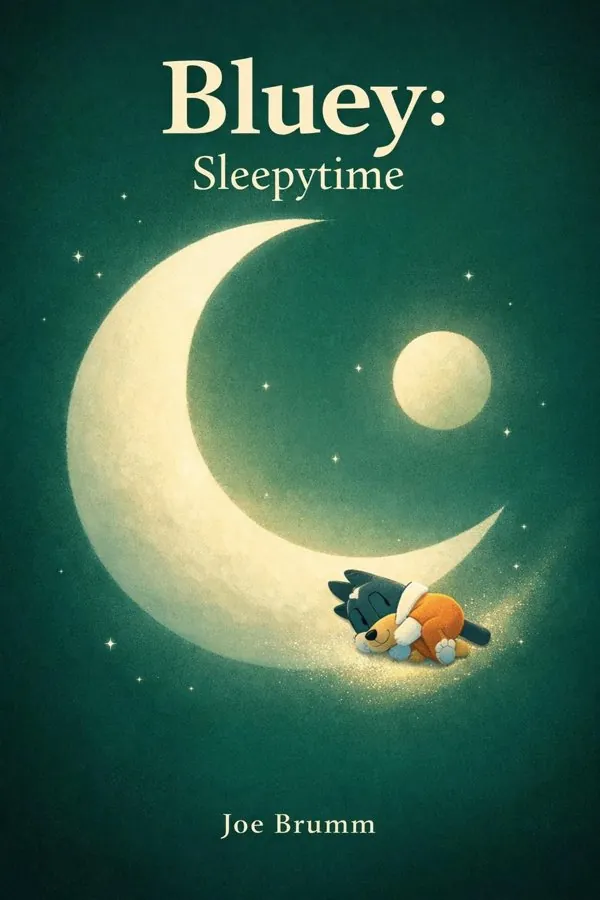
Bluey: Sleepytime: Summary & Key Insights
by Joe Brumm
 10 min8 chaptersAudio available
Key Takeaways from Bluey: Sleepytime
The moments before sleep often reveal feelings children cannot easily explain during the day.
Children become more independent not when they are pushed away, but when they feel deeply secure.
A child’s imagination is not a distraction from reality; it is often the way reality gets understood.
Some of the most important parenting happens in small, almost wordless moments.
Every stage of childhood asks children to move a little farther from complete dependence, and that movement can feel both exciting and sad.
What Is Bluey: Sleepytime About?
Bluey: Sleepytime by Joe Brumm is a parenting book. Bluey: Sleepytime by Joe Brumm turns a simple bedtime story into a moving reflection on childhood, security, and the quiet courage it takes for children to drift into sleep on their own. Adapted from one of the most beloved episodes of the Bluey animated series, this picture book follows Bingo through a dreamlike nighttime journey filled with warmth, wonder, and the reassuring presence of family love. On the surface, it is a gentle story about sleep. Beneath that surface, it explores separation, emotional safety, imagination, and a child’s growing independence. For parents, caregivers, and anyone raising young children, the book matters because bedtime is rarely just about sleep. It is often a daily moment when fears, attachment, routine, and emotional regulation all come together. Brumm captures that truth with exceptional sensitivity. As the creator of Bluey, he has earned a reputation for portraying family life with unusual honesty, humor, and emotional intelligence. In Sleepytime, he combines those strengths in a way that speaks to both children and adults. The result is a comforting, beautifully resonant story that offers more than entertainment: it gives families a language for closeness, reassurance, and growing up.
This FizzRead summary covers all 8 key chapters of Bluey: Sleepytime in approximately 10 minutes, distilling the most important ideas, arguments, and takeaways from Joe Brumm's work. Also available as an audio summary and Key Quotes Podcast.
Bluey: Sleepytime
Bluey: Sleepytime by Joe Brumm turns a simple bedtime story into a moving reflection on childhood, security, and the quiet courage it takes for children to drift into sleep on their own. Adapted from one of the most beloved episodes of the Bluey animated series, this picture book follows Bingo through a dreamlike nighttime journey filled with warmth, wonder, and the reassuring presence of family love. On the surface, it is a gentle story about sleep. Beneath that surface, it explores separation, emotional safety, imagination, and a child’s growing independence.
For parents, caregivers, and anyone raising young children, the book matters because bedtime is rarely just about sleep. It is often a daily moment when fears, attachment, routine, and emotional regulation all come together. Brumm captures that truth with exceptional sensitivity. As the creator of Bluey, he has earned a reputation for portraying family life with unusual honesty, humor, and emotional intelligence. In Sleepytime, he combines those strengths in a way that speaks to both children and adults. The result is a comforting, beautifully resonant story that offers more than entertainment: it gives families a language for closeness, reassurance, and growing up.
Who Should Read Bluey: Sleepytime?
This book is perfect for anyone interested in parenting and looking to gain actionable insights in a short read. Whether you're a student, professional, or lifelong learner, the key ideas from Bluey: Sleepytime by Joe Brumm will help you think differently.
- ✓Readers who enjoy parenting and want practical takeaways
- ✓Professionals looking to apply new ideas to their work and life
- ✓Anyone who wants the core insights of Bluey: Sleepytime in just 10 minutes
Want the full summary?
Get instant access to this book summary and 100K+ more with Fizz Moment.
Get Free SummaryAvailable on App Store • Free to download
Key Chapters
The moments before sleep often reveal feelings children cannot easily explain during the day. In Bluey: Sleepytime, bedtime is not treated as a mechanical routine of bath, pajamas, and lights out. Instead, Joe Brumm shows it as an emotional threshold where imagination, vulnerability, and the need for comfort become especially intense. Bingo’s nighttime experience reflects a truth many parents recognize: when the day quiets down, children’s inner worlds grow louder.
The story invites adults to see bedtime behavior differently. Resistance to sleep is not always stubbornness. A child climbing out of bed, asking for one more hug, or needing a parent nearby may be expressing uncertainty, overstimulation, or a fear of separation. Sleepytime reframes these behaviors with empathy. Bingo’s dream journey is expansive and cosmic, suggesting that even small children are processing big feelings. What seems minor to adults can feel enormous to a child lying in the dark.
This perspective can change how families approach evenings. Instead of focusing only on compliance, parents can build routines that acknowledge emotion. A predictable sequence, softer lighting, calming words, and physical reassurance can help children feel safe enough to relax. Even a brief conversation like, “Was anything hard today?” can ease the transition to sleep.
The practical lesson is simple but powerful: bedtime is an emotional event, not just a schedule item. When adults respond with curiosity rather than frustration, children are more likely to settle with confidence. Actionable takeaway: treat bedtime as a chance to connect with your child’s feelings, and build routines that soothe both body and mind.
Children become more independent not when they are pushed away, but when they feel deeply secure. One of the most meaningful themes in Bluey: Sleepytime is that closeness and independence are not opposites. Bingo ventures through a dreamscape that suggests distance and personal discovery, yet the emotional thread connecting her to her mother remains constant. The message is subtle and profound: children can move outward into the world because they trust that love remains available.
This is especially relevant in parenting conversations about self-soothing and sleeping alone. Adults sometimes assume that offering comfort will create dependency. Brumm presents the opposite view. Emotional reassurance gives children the confidence to tolerate brief separation. When a child knows a parent is near, loving, and dependable, they are better able to relax into sleep and, over time, handle more independence.
In daily family life, this may look like sitting with a child for a few minutes at bedtime, using a consistent goodnight phrase, or returning briefly after lights out if the child calls. These gestures are not failures of firmness; they are investments in trust. Over time, children internalize that reassurance. The parent’s voice, rhythm, and predictability become part of the child’s own sense of safety.
Sleepytime reminds us that healthy independence begins in connection. Rather than asking, “How do I get my child to need me less?” parents might ask, “How can I help my child feel secure enough to rest?” Actionable takeaway: strengthen bedtime independence by making your child’s sense of safety more reliable, not less.
A child’s imagination is not a distraction from reality; it is often the way reality gets understood. In Bluey: Sleepytime, Bingo’s dream journey transforms ordinary sleep into something cosmic, emotional, and symbolic. Through stars, space, movement, and distance, the story communicates feelings that might be impossible for a young child to state directly. Brumm uses imaginative storytelling to show that children often work through fear, wonder, longing, and confidence in symbolic ways.
This matters because adults sometimes rush to make children “realistic” when what they actually need is room to imagine. A child who says their room feels scary, or who invents elaborate bedtime stories, may be trying to process vulnerability through play and fantasy. Rather than shutting those moments down, parents can use them as entry points. Imaginative language can help children feel understood. For example, a parent might say, “Let’s fill your room with brave star light,” or “Your blanket is your spaceship shield tonight.”
Stories and rituals shaped by imagination can also reduce bedtime tension. A sleepy toy parade, moon-watching, or a pretend trip to dreamland can create continuity between the child’s inner world and the practical task of settling down. This does not mean overstimulating bedtime with endless play. It means respecting imagination as an emotional tool.
Sleepytime demonstrates that fantasy can be deeply regulating when it is gentle, meaningful, and grounded in love. Actionable takeaway: use imaginative language and bedtime storytelling to help your child express feelings, build comfort, and move toward sleep with less fear.
Some of the most important parenting happens in small, almost wordless moments. Bluey: Sleepytime captures this beautifully through the calm, steady presence of Bingo’s mother. The story does not depend on lectures or long explanations. Instead, reassurance comes through nearness, tone, and the implicit promise that love continues even when a child must face a challenge alone. This reflects a broader truth in parenting: children often regulate themselves not because adults say the perfect thing, but because they feel a trusted adult nearby.
In bedtime routines, parents can underestimate how much their own emotional state shapes the atmosphere. A hurried, irritated presence communicates tension, even if the words are gentle. A calm voice, slower pace, and predictable touch can signal safety more effectively than repeated instructions to “just go to sleep.” Presence is not merely physical. It is emotional availability.
Practical applications are simple. Sit for a moment on the edge of the bed before leaving. Use the same soothing phrase each night. Place a hand on your child’s back for a few breaths. If your child wakes and needs help, respond with steadiness rather than making the moment feel dramatic. Over time, children absorb these experiences and begin to recreate that calm internally.
Brumm’s story reminds adults that reassurance does not need to be elaborate to be transformative. Children remember how parents made them feel, especially in vulnerable moments. Actionable takeaway: bring calm, consistent presence to bedtime, and let your steadiness become part of your child’s ability to settle and sleep.
Every stage of childhood asks children to move a little farther from complete dependence, and that movement can feel both exciting and sad. Bluey: Sleepytime portrays this beautifully by linking sleep with separation. Falling asleep means letting go of the day, of direct parental contact, and of conscious control. For young children, this can feel like a surprisingly big step. Joe Brumm treats that transition with tenderness rather than dismissal.
The book suggests that growth is not about eliminating a child’s need for closeness. It is about helping them tolerate temporary distance while still feeling connected. This is why bedtime can become such an emotionally charged family moment. A child may want to be “big” and still want one more cuddle. Those desires can coexist. Sleepytime validates both.
For parents, the practical implication is to expect mixed signals. A child may insist they are brave and then cry when the room gets dark. Instead of interpreting that as manipulation or inconsistency, adults can see it as normal development. One helpful approach is to pair encouragement with reassurance: “You can do this, and I’m still close by.” Transitional objects like a favorite stuffed animal, family photo, or recorded lullaby can also support that bridge between closeness and independence.
The emotional maturity in Sleepytime lies in its recognition that loving someone often means helping them go a little farther on their own. Actionable takeaway: support your child’s growing independence by normalizing the discomfort of separation and offering concrete reminders that connection remains.
Children rarely find comfort in abstract promises; they find it in repeated experiences. Bluey: Sleepytime highlights the soothing power of familiar rhythms, even as it moves into a dreamlike and expansive emotional world. Beneath the wonder of the story is a very practical parenting truth: bedtime rituals create structure that helps children feel secure. What happens night after night becomes a kind of emotional map.
Rituals are powerful because they reduce uncertainty. Young children often do not have the language to ask for predictability, but their behavior shows how much they need it. A consistent sequence such as bath, story, cuddle, song, and lights out tells the body and mind what comes next. This lowers resistance, not because children become perfectly cooperative, but because the routine itself carries reassuring familiarity.
Families do not need elaborate routines to benefit from this idea. In fact, simpler is often better. A ten-minute pattern done consistently may be more effective than a long routine that changes every night. Sleepytime also reminds us that rituals can carry emotional meaning. A whispered phrase, a kiss on the forehead, or pointing out the moon can become symbols of love and continuity.
Parents can use rituals during difficult phases too. Travel, illness, developmental leaps, or school changes often disrupt sleep. Bringing one or two familiar bedtime elements into those situations can help children regain a sense of steadiness.
The lesson is clear: repetition is not boring to children; it is regulating. Actionable takeaway: create a short, reliable bedtime ritual and protect it consistently so your child learns to associate nighttime with safety and rest.
When adults minimize children’s fears, they often increase them. One of the quiet strengths of Bluey: Sleepytime is that it never mocks or trivializes the emotional intensity of childhood. Bingo’s nighttime experience is treated as meaningful, not silly. This matters because bedtime struggles are frequently met with phrases like “There’s nothing to be scared of” or “You’re fine.” While well intentioned, those responses can make children feel misunderstood.
Validation does not mean agreeing with every fear or letting a child control the entire evening. It means recognizing the feeling as real. A parent can say, “It sounds like nighttime feels hard right now,” while still keeping the routine moving. This kind of response reduces shame and opens the door to problem-solving. A child who feels heard is more likely to accept comfort.
In practice, emotional validation at bedtime might involve naming what you see: “You want me close because it feels lonely when it gets dark.” It can also mean helping the child build coping tools: breathing together, choosing a comfort item, or creating a “goodnight plan” for what happens if they wake. These responses preserve boundaries while respecting emotion.
Sleepytime offers a model of compassionate understanding. It assumes that a child’s inner life deserves dignity. That approach can transform bedtime from a battle of wills into a moment of emotional coaching and connection. Actionable takeaway: respond to bedtime fears by first validating the feeling, then guiding your child toward one or two practical ways to feel safer.
The most memorable children’s books often work on two levels at once: they comfort children while quietly moving adults. Bluey: Sleepytime is a perfect example. On its surface, it is a gentle bedtime story connected to a beloved family series. At a deeper level, it reflects on love, growth, trust, and the emotional journey of letting children become themselves. Joe Brumm shows that picture books do not need complexity in plot to achieve emotional richness.
This is one reason the story resonates so strongly with parents. Adults reading it aloud may recognize their own feelings in the background: the wish to protect, the sadness of watching children grow, the pride of seeing them become more capable. The book creates shared meaning across generations. Children enjoy the soothing imagery and emotional reassurance, while adults appreciate the depth beneath the simplicity.
That layered quality makes Sleepytime useful beyond entertainment. It can become part of family conversations about sleep, courage, and closeness. After reading, a parent might ask, “What helps you feel safe at night?” or “What do you think Bingo learned?” Even very young children can respond in surprising ways when stories mirror their experiences.
Brumm’s achievement is a reminder that stories need not be long or complicated to shape family life. Sometimes a brief, beautifully told picture book can open the deepest conversations. Actionable takeaway: revisit meaningful children’s books regularly and use them as gentle prompts for talking about emotions, routines, and growing up.
All Chapters in Bluey: Sleepytime
About the Author
Joe Brumm is an Australian writer, animator, and storyteller best known as the creator of Bluey, one of the most acclaimed children’s series of recent years. His work is widely praised for capturing the emotional truth of family life with humor, warmth, and unusual sensitivity. Before creating Bluey, Brumm built a career in animation and children’s entertainment, developing a strong understanding of how stories can engage both young viewers and adults. His storytelling style blends playful imagination with realistic parenting dynamics, making everyday moments feel meaningful and memorable. In Bluey: Sleepytime, Brumm demonstrates the qualities that have made his work so influential: emotional intelligence, respect for children’s inner lives, and an ability to turn simple family experiences into stories that resonate across generations.
Get This Summary in Your Preferred Format
Read or listen to the Bluey: Sleepytime summary by Joe Brumm anytime, anywhere. FizzRead offers multiple formats so you can learn on your terms — all free.
Available formats: App · Audio · PDF · EPUB — All included free with FizzRead
Download Bluey: Sleepytime PDF and EPUB Summary
Key Quotes from Bluey: Sleepytime
“The moments before sleep often reveal feelings children cannot easily explain during the day.”
“Children become more independent not when they are pushed away, but when they feel deeply secure.”
“A child’s imagination is not a distraction from reality; it is often the way reality gets understood.”
“Some of the most important parenting happens in small, almost wordless moments.”
“Every stage of childhood asks children to move a little farther from complete dependence, and that movement can feel both exciting and sad.”
Frequently Asked Questions about Bluey: Sleepytime
Bluey: Sleepytime by Joe Brumm is a parenting book that explores key ideas across 8 chapters. Bluey: Sleepytime by Joe Brumm turns a simple bedtime story into a moving reflection on childhood, security, and the quiet courage it takes for children to drift into sleep on their own. Adapted from one of the most beloved episodes of the Bluey animated series, this picture book follows Bingo through a dreamlike nighttime journey filled with warmth, wonder, and the reassuring presence of family love. On the surface, it is a gentle story about sleep. Beneath that surface, it explores separation, emotional safety, imagination, and a child’s growing independence. For parents, caregivers, and anyone raising young children, the book matters because bedtime is rarely just about sleep. It is often a daily moment when fears, attachment, routine, and emotional regulation all come together. Brumm captures that truth with exceptional sensitivity. As the creator of Bluey, he has earned a reputation for portraying family life with unusual honesty, humor, and emotional intelligence. In Sleepytime, he combines those strengths in a way that speaks to both children and adults. The result is a comforting, beautifully resonant story that offers more than entertainment: it gives families a language for closeness, reassurance, and growing up.
You Might Also Like
Never Enough
Jennifer Breheny Wallace
10 min
In My Heart: A Book of Feelings
Jo Witek
10 min
Love From The Crayons
Drew Daywalt, Oliver Jeffers
10 min
Pete The Cat: Big Easter Adventure
James Dean, Kimberly Dean
10 min
Smart Money Smart Kids: Raising the Next Generation to Win with Money
Dave Ramsey, Rachel Cruze
10 min
1-2-3 Magic: Effective Discipline for Children 2–12
Thomas W. Phelan
10 minFeatured In
Browse by Category
Ready to read Bluey: Sleepytime?
Get the full summary and 100K+ more books with Fizz Moment.