
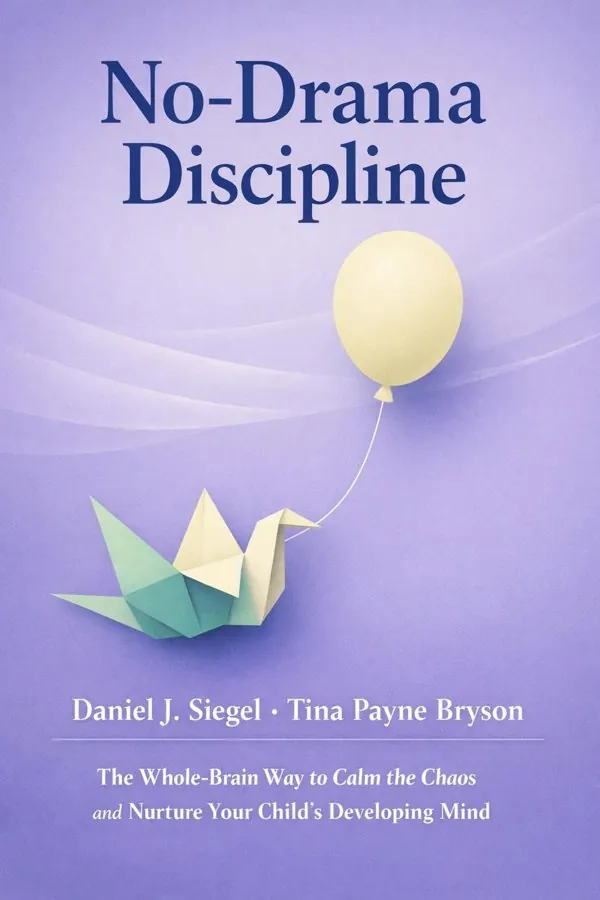
No-Drama Discipline: The Whole-Brain Way to Calm the Chaos and Nurture Your Child's Developing Mind: Summary & Key Insights
by Daniel J. Siegel, Tina Payne Bryson
 10 min8 chaptersAudio available
What Is No-Drama Discipline: The Whole-Brain Way to Calm the Chaos and Nurture Your Child's Developing Mind About?
No-Drama Discipline: The Whole-Brain Way to Calm the Chaos and Nurture Your Child's Developing Mind by Daniel J. Siegel, Tina Payne Bryson is a parenting book spanning 8 pages. No-Drama Discipline offers a practical approach to parenting that emphasizes understanding a child's brain development and emotional needs. The authors present strategies to help parents respond to misbehavior with empathy and connection rather than punishment, fostering long-term emotional growth and cooperation.
This FizzRead summary covers all 8 key chapters of No-Drama Discipline: The Whole-Brain Way to Calm the Chaos and Nurture Your Child's Developing Mind in approximately 10 minutes, distilling the most important ideas, arguments, and takeaways from Daniel J. Siegel, Tina Payne Bryson's work. Also available as an audio summary and Key Quotes Podcast.
No-Drama Discipline: The Whole-Brain Way to Calm the Chaos and Nurture Your Child's Developing Mind
No-Drama Discipline offers a practical approach to parenting that emphasizes understanding a child's brain development and emotional needs. The authors present strategies to help parents respond to misbehavior with empathy and connection rather than punishment, fostering long-term emotional growth and cooperation.
Who Should Read No-Drama Discipline: The Whole-Brain Way to Calm the Chaos and Nurture Your Child's Developing Mind?
This book is perfect for anyone interested in parenting and looking to gain actionable insights in a short read. Whether you're a student, professional, or lifelong learner, the key ideas from No-Drama Discipline: The Whole-Brain Way to Calm the Chaos and Nurture Your Child's Developing Mind by Daniel J. Siegel, Tina Payne Bryson will help you think differently.
- ✓Readers who enjoy parenting and want practical takeaways
- ✓Professionals looking to apply new ideas to their work and life
- ✓Anyone who wants the core insights of No-Drama Discipline: The Whole-Brain Way to Calm the Chaos and Nurture Your Child's Developing Mind in just 10 minutes
Want the full summary?
Get instant access to this book summary and 100K+ more with Fizz Moment.
Get Free SummaryAvailable on App Store • Free to download
Key Chapters
The central principle of No-Drama Discipline begins with connection. Before correction, before reasoning, before consequences—connection. Neuroscience shows us that when a child’s emotional brain is activated, logical reasoning simply can’t penetrate. The prefrontal cortex—the part responsible for decision-making and reflection—goes offline during strong emotional surges. As parents, if we meet disconnection with more disconnection—if we yell, threaten, or shame—we amplify the crisis. But if we first connect emotionally, signaling safety and empathy, we help the child’s brain re-engage its thoughtful capacities.
Connecting doesn’t mean agreeing with inappropriate behavior. It means communicating that beneath the surface of any misbehavior lies a feeling—a fear, a frustration, a need—and that feeling deserves to be seen. When we respond with calm presence, a reassuring tone, and genuine curiosity, our child’s nervous system calms. Only then can we begin to guide them toward better choices.
The phrase 'connect and redirect' captures this rhythm beautifully: we connect to bring the child’s emotional state back into balance, and then redirect to teach, to problem-solve, to repair. When parents practice this consistently, discipline transforms into collaboration. Children feel understood even while being guided toward accountability. This approach doesn’t just stop undesirable behavior—it strengthens the neural circuits that make future self-regulation possible.
At the heart of no-drama discipline lies an understanding of the brain. A child’s brain is a work in progress, particularly the connections between the emotional limbic system and the higher-order regions of the prefrontal cortex. These pathways—responsible for impulse control, empathy, and rational decision-making—are still under construction throughout childhood and adolescence. When we interpret misbehavior as moral failure rather than neurological immaturity, we miss the deeper truth. Children don’t misbehave to trouble us; they struggle because their brains are still learning to manage complex feelings.
From a neurological perspective, discipline should be viewed as teaching the child’s brain how to integrate its various parts. The 'whole-brain' model we explore emphasizes balance and harmony between logic and emotion. When parents model empathy and steady composure, they literally help wire these connections through repeated experience. Every calm conversation, every moment of emotional understanding, reinforces synaptic growth.
So when your child melts down in frustration, it’s an opportunity. It’s their brain revealing its limits—and you have the chance to help those limits expand. Pausing to breathe before reacting, naming emotions accurately, and guiding reflection afterward all cultivate integration. This integration is what produces long-term resilience, not enforced obedience.
+ 6 more chapters — available in the FizzRead app
All Chapters in No-Drama Discipline: The Whole-Brain Way to Calm the Chaos and Nurture Your Child's Developing Mind
About the Authors
Daniel J. Siegel, M.D., is a clinical professor of psychiatry at the UCLA School of Medicine and executive director of the Mindsight Institute. Tina Payne Bryson, Ph.D., is a psychotherapist and parenting educator, co-authoring several books with Siegel on child development and neuroscience-informed parenting.
Get This Summary in Your Preferred Format
Read or listen to the No-Drama Discipline: The Whole-Brain Way to Calm the Chaos and Nurture Your Child's Developing Mind summary by Daniel J. Siegel, Tina Payne Bryson anytime, anywhere. FizzRead offers multiple formats so you can learn on your terms — all free.
Available formats: App · Audio · PDF · EPUB — All included free with FizzRead
Download No-Drama Discipline: The Whole-Brain Way to Calm the Chaos and Nurture Your Child's Developing Mind PDF and EPUB Summary
Key Quotes from No-Drama Discipline: The Whole-Brain Way to Calm the Chaos and Nurture Your Child's Developing Mind
“The central principle of No-Drama Discipline begins with connection.”
“At the heart of no-drama discipline lies an understanding of the brain.”
Frequently Asked Questions about No-Drama Discipline: The Whole-Brain Way to Calm the Chaos and Nurture Your Child's Developing Mind
No-Drama Discipline: The Whole-Brain Way to Calm the Chaos and Nurture Your Child's Developing Mind by Daniel J. Siegel, Tina Payne Bryson is a parenting book that explores key ideas across 8 chapters. No-Drama Discipline offers a practical approach to parenting that emphasizes understanding a child's brain development and emotional needs. The authors present strategies to help parents respond to misbehavior with empathy and connection rather than punishment, fostering long-term emotional growth and cooperation.
More by Daniel J. Siegel, Tina Payne Bryson
The Whole-Brain Child: 12 Revolutionary Strategies to Nurture Your Child's Developing Mind
Daniel J. Siegel, Tina Payne Bryson
10 min
The Yes Brain: How to Cultivate Courage, Curiosity, and Resilience in Your Child
Daniel J. Siegel, Tina Payne Bryson
10 min
The Power of Showing Up: How Parental Presence Shapes Who Our Kids Become and How Their Brains Get Wired
Daniel J. Siegel, Tina Payne Bryson
10 minYou Might Also Like

Never Enough
Jennifer Breheny Wallace
10 min
Bluey: Sleepytime
Joe Brumm
10 min
In My Heart: A Book of Feelings
Jo Witek
10 min
Love From The Crayons
Drew Daywalt, Oliver Jeffers
10 min
Pete The Cat: Big Easter Adventure
James Dean, Kimberly Dean
10 min
Smart Money Smart Kids: Raising the Next Generation to Win with Money
Dave Ramsey, Rachel Cruze
10 minBrowse by Category
Ready to read No-Drama Discipline: The Whole-Brain Way to Calm the Chaos and Nurture Your Child's Developing Mind?
Get the full summary and 100K+ more books with Fizz Moment.