
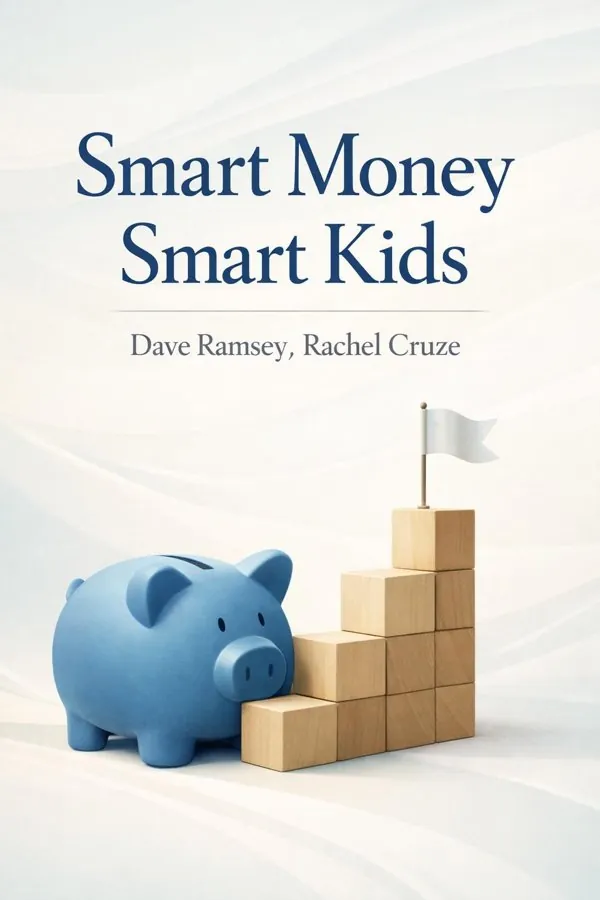
Smart Money Smart Kids: Raising the Next Generation to Win with Money: Summary & Key Insights
 10 min9 chaptersAudio available
Key Takeaways from Smart Money Smart Kids: Raising the Next Generation to Win with Money
A child’s financial future is shaped less by formal lessons and more by what is normalized at home.
Children do not become financially responsible by receiving things; they become responsible by contributing.
Free money often teaches the wrong lesson.
Telling children to save money is easy; helping them understand why to save is far more powerful.
Financial education is incomplete if it focuses only on keeping and growing money.
What Is Smart Money Smart Kids: Raising the Next Generation to Win with Money About?
Smart Money Smart Kids: Raising the Next Generation to Win with Money by Dave Ramsey, Rachel Cruze is a parenting book. Money habits rarely begin with a first paycheck; they begin at home, long before children understand interest rates, taxes, or retirement accounts. In Smart Money Smart Kids, personal finance expert Dave Ramsey and his daughter Rachel Cruze argue that parents are not just responsible for providing for their children, but for preparing them to handle money with wisdom, confidence, and character. The book is not about turning kids into miniature accountants. It is about raising grounded, generous, hardworking adults who understand that money is a tool, not a master. What makes this book matter is its practical, family-centered approach. Ramsey draws from decades of financial coaching and his widely known debt-free philosophy, while Cruze adds the perspective of someone raised with these principles from childhood. Together, they show how to teach earning, saving, spending, giving, and avoiding entitlement at every stage of development. Their message is especially relevant in a culture shaped by instant gratification, easy credit, and consumer pressure. For parents who want to replace anxiety and confusion with clear financial values, this book offers a straightforward roadmap for raising kids who can truly win with money.
This FizzRead summary covers all 9 key chapters of Smart Money Smart Kids: Raising the Next Generation to Win with Money in approximately 10 minutes, distilling the most important ideas, arguments, and takeaways from Dave Ramsey, Rachel Cruze's work. Also available as an audio summary and Key Quotes Podcast.
Smart Money Smart Kids: Raising the Next Generation to Win with Money
Money habits rarely begin with a first paycheck; they begin at home, long before children understand interest rates, taxes, or retirement accounts. In Smart Money Smart Kids, personal finance expert Dave Ramsey and his daughter Rachel Cruze argue that parents are not just responsible for providing for their children, but for preparing them to handle money with wisdom, confidence, and character. The book is not about turning kids into miniature accountants. It is about raising grounded, generous, hardworking adults who understand that money is a tool, not a master.
What makes this book matter is its practical, family-centered approach. Ramsey draws from decades of financial coaching and his widely known debt-free philosophy, while Cruze adds the perspective of someone raised with these principles from childhood. Together, they show how to teach earning, saving, spending, giving, and avoiding entitlement at every stage of development. Their message is especially relevant in a culture shaped by instant gratification, easy credit, and consumer pressure. For parents who want to replace anxiety and confusion with clear financial values, this book offers a straightforward roadmap for raising kids who can truly win with money.
Who Should Read Smart Money Smart Kids: Raising the Next Generation to Win with Money?
This book is perfect for anyone interested in parenting and looking to gain actionable insights in a short read. Whether you're a student, professional, or lifelong learner, the key ideas from Smart Money Smart Kids: Raising the Next Generation to Win with Money by Dave Ramsey, Rachel Cruze will help you think differently.
- ✓Readers who enjoy parenting and want practical takeaways
- ✓Professionals looking to apply new ideas to their work and life
- ✓Anyone who wants the core insights of Smart Money Smart Kids: Raising the Next Generation to Win with Money in just 10 minutes
Want the full summary?
Get instant access to this book summary and 100K+ more with Fizz Moment.
Get Free SummaryAvailable on App Store • Free to download
Key Chapters
A child’s financial future is shaped less by formal lessons and more by what is normalized at home. One of the strongest ideas in Smart Money Smart Kids is that children absorb money beliefs early, often by watching how their parents talk, argue, budget, give, and spend. If money is treated as secret, stressful, or impulsive, kids internalize those patterns. If it is handled with clarity, discipline, and purpose, they learn that too.
Ramsey and Cruze emphasize that parents should not wait until the teenage years to start teaching financial responsibility. Even very young children can understand basic ideas like work, choice, waiting, and generosity. A child who learns that toys cost money, that money comes from effort, and that not every desire gets fulfilled is already developing a financial foundation. The authors argue that these early lessons shape character as much as they shape financial skill.
This principle also challenges a common parental instinct: shielding children from every limitation. When parents constantly rescue, overprovide, or say yes to every request, they may unintentionally teach that resources are unlimited and that someone else will always solve the problem. By contrast, honest conversations about priorities help children understand reality without fear.
For example, a parent might say, “We are not buying that today because it is not in the budget,” instead of making excuses or giving in. Over time, children learn that spending reflects values and choices. They begin to see money management not as punishment, but as a normal part of life.
Actionable takeaway: Start age-appropriate money conversations now, using everyday moments to teach that money is earned, choices have consequences, and values should guide spending.
Children do not become financially responsible by receiving things; they become responsible by contributing. A central lesson in the book is that work is not merely a way to earn money. It is a way to build character, confidence, discipline, and self-respect. When kids are expected to participate meaningfully in family life and later earn money through effort, they begin to understand the true relationship between labor and reward.
Ramsey and Cruze distinguish between basic household responsibilities and paid jobs. Some tasks should be expected simply because a child is part of the family. Making the bed, helping clean up, or taking responsibility for personal belongings are not special achievements deserving payment. They are part of learning responsibility. Other tasks can be linked to earning opportunities, giving children a direct experience of effort leading to income.
This distinction matters because it prevents children from viewing family contribution as a transaction while still allowing them to learn how work creates value. A child who washes the family car for extra money or helps with a special project experiences an important truth: money is earned by solving problems and serving others.
The authors also push back against entitlement. When children receive money without effort or expect parents to fund every want, they may lose motivation and appreciation. By learning to work for nonessential purchases, they become more thoughtful consumers and more resilient people.
In practice, parents can create simple earning systems. A young child might earn money by doing extra tasks beyond normal responsibilities. A teenager might babysit, mow lawns, tutor younger students, or take a part-time job. The goal is not maximizing income, but teaching ownership and initiative.
Actionable takeaway: Separate expected family chores from optional paid work, and give your child regular opportunities to earn money through effort rather than automatic rewards.
Free money often teaches the wrong lesson. One of the book’s most memorable arguments is the preference for commission over a no-strings-attached allowance. The authors believe that when children are simply handed money every week regardless of behavior or contribution, they can begin to assume money appears automatically. Commission, by contrast, connects earning with action.
This idea is not about being harsh or turning childhood into a payroll system. It is about teaching a realistic financial principle: income generally follows work. When a child completes agreed-upon extra tasks and receives agreed-upon pay, they learn accountability, reliability, and the value of follow-through. The system also introduces negotiation, expectations, and delayed gratification.
A practical example might include a child earning a set amount for helping organize the garage, pulling weeds, or assisting with a larger household project. The parent clearly defines the task, the standard, and the payment. If the work is incomplete or carelessly done, the child experiences natural consequences. This mirrors real life in a manageable, age-appropriate way.
Commission also changes how children spend. Kids tend to treat earned money more carefully than gifted money. They think longer before buying a disposable toy or impulsive treat because they remember the effort behind the dollars. That memory creates respect for money without creating fear around it.
Importantly, the authors do not suggest monetizing every aspect of family life. Children still need to understand that they contribute because they belong to the family. Commission is simply a tool for teaching an economic principle in a way children can grasp.
Actionable takeaway: Replace automatic allowance with a simple commission system for extra tasks, so your child experiences the link between responsibility, effort, and income.
Telling children to save money is easy; helping them understand why to save is far more powerful. Smart Money Smart Kids teaches that saving should be connected to clear goals rather than presented as a moral slogan. Children are much more likely to develop disciplined saving habits when they can see a purpose on the other side of waiting.
The authors recommend practical systems that make saving visible and concrete, especially for younger children. Instead of discussing abstract financial discipline, parents can use envelopes, jars, or digital categories labeled for specific goals. One might be for a bike, another for gifts, another for long-term savings. This helps kids grasp that saving is not just about deprivation. It is a way to create future options.
Purposeful saving also teaches patience in a culture built around instant gratification. When a child wants a new game or gadget, parents can resist the urge to buy it immediately and instead help create a plan. How much does it cost? How long will it take to save? What trade-offs are involved? These questions develop planning skills and emotional control.
This approach becomes even more valuable as children grow older. Teenagers can save for a phone upgrade, car expenses, college costs, or travel. They begin to understand opportunity cost: money used in one area cannot be used elsewhere. That realization is foundational to adult financial maturity.
The broader lesson is that saving is not merely defensive. It reflects hope, discipline, and intentionality. Children who learn to save for goals become adults better equipped to build emergency funds, avoid debt, and make thoughtful long-term choices.
Actionable takeaway: Help your child choose one meaningful savings goal, track progress visibly, and connect every saved dollar to a future outcome they genuinely care about.
Financial education is incomplete if it focuses only on keeping and growing money. Ramsey and Cruze insist that generosity must be part of a child’s money training because giving shapes the heart behind financial behavior. Children who learn only to earn and save may become efficient with money, but not necessarily wise or compassionate. Teaching generosity helps prevent money from becoming a source of selfishness or identity.
The book presents giving as a regular practice, not an occasional emotional gesture. When children are taught to set aside part of what they earn for helping others, supporting causes, or participating in family generosity, they begin to see money as a tool for impact. This reframes financial success. It is not just about personal comfort; it is also about the ability to bless others.
Parents can model this in simple ways. A family might give to a local charity, support a neighbor in need, contribute through a place of worship, or help buy school supplies for another child. Involving children in the decision matters. When they understand where the money is going and why, generosity becomes personal rather than performative.
Giving also fosters gratitude. Children who regularly think about others become less consumed by comparison and less likely to assume that every dollar should serve their own desires. This mindset can protect against entitlement and consumerism. It reminds them that having resources carries responsibility.
The authors argue that generous kids often become more grounded adults because giving teaches that money has moral dimensions. Financial competence matters, but so does the purpose behind it.
Actionable takeaway: Create a dedicated giving category for your child’s money and regularly involve them in choosing where and why those funds will be shared.
One of the greatest financial threats facing children is not ignorance, but entitlement. In a culture saturated with advertising, social comparison, and convenience, kids can easily begin to believe they deserve immediate access to whatever they want. Smart Money Smart Kids warns that when parents constantly indulge every request, they may unintentionally raise children who expect comfort without effort and consumption without limits.
The authors encourage parents to teach contentment, which is not the same as low ambition. Contentment means learning to appreciate what one has, delay unnecessary upgrades, and resist defining self-worth through possessions. This is especially important in families with higher incomes, where parents may have the means to provide almost anything. The presence of resources does not remove the need for restraint; in some cases, it increases the need for intentional boundaries.
Practical teaching often happens in ordinary moments. A child wants brand-name shoes because friends have them. A teen demands a newer phone even though the current one works. Instead of reflexively buying or launching into a lecture, parents can ask questions: Why do you want this? Is it a need or a want? What would you be willing to contribute? These conversations move children from emotional desire to thoughtful evaluation.
Contentment also grows when children see that joy does not depend on constant purchasing. Family experiences, gratitude practices, and responsible limits all reinforce this lesson. Kids learn that “not now” or “not necessary” is not deprivation. It is wisdom.
Actionable takeaway: When your child asks for something nonessential, pause the purchase and guide them through need-versus-want thinking, contribution, and gratitude before making any decision.
Many children grow up assuming debt is just a normal part of adult life. Credit cards, car loans, and student debt are so common that they often appear unavoidable. Smart Money Smart Kids directly challenges that assumption. Ramsey and Cruze want parents to teach children early that borrowing is not a harmless convenience but a serious obligation that limits freedom.
The authors’ anti-debt perspective is one of the book’s strongest and most distinctive themes. They argue that when children understand debt as risk rather than routine, they are more likely to make careful decisions later about spending, college, cars, and lifestyle inflation. This lesson must begin before young adults start signing contracts they barely understand.
Parents can teach this with simple examples. If a child wants something they cannot afford, instead of saying, “Just put it on credit,” parents can help them save up and wait. If a teenager is considering college options, the conversation should include cost, affordability, and future consequences, not just prestige or emotion. A child who learns to connect borrowing with repayment, stress, and reduced flexibility gains a realistic lens on money.
This does not mean kids need constant fear around finances. The goal is to connect freedom with living within one’s means. Children should see that avoiding debt preserves choices, lowers pressure, and creates room for generosity and long-term planning.
By normalizing cash flow, saving, and patience, parents can give children a healthier default than the debt-driven culture around them.
Actionable takeaway: Talk openly with your children about how debt works, and whenever possible, model buying with saved money rather than borrowing for lifestyle purchases.
Children listen to money advice, but they study money behavior. One of the book’s most important messages is that parental example carries more weight than parental instruction. A parent can lecture about budgeting, restraint, and generosity, but if daily life tells a different story, children will trust what they observe over what they hear.
This idea can feel confronting because it shifts the conversation away from clever teaching techniques and toward personal integrity. Ramsey and Cruze make it clear that raising money-smart kids begins with adults examining their own habits. Do parents argue constantly about money? Make impulse purchases? Hide financial realities? Live beyond their means? Or do they budget, plan, communicate honestly, and practice self-control?
Modeling does not require perfection. In fact, honest humility may be even more powerful. Parents can say, “We made mistakes with money, and here is what we are doing differently now.” That kind of transparency teaches resilience and responsibility. It shows children that financial maturity is built through choices, not image management.
Practical modeling can include family budget conversations, visible saving for goals, thoughtful charitable giving, and calm explanations of why certain purchases are not made. Teenagers especially benefit from seeing the mechanics of adult money management rather than being kept completely in the dark.
Ultimately, the authors argue that the most effective money lesson is a household culture where values are consistently practiced. Children raised in that environment are far more likely to carry those patterns into adulthood.
Actionable takeaway: Choose one financial behavior to model more visibly this month, such as budgeting, saving, or giving, and explain your decision-making process to your children.
Financial independence does not suddenly appear at age eighteen. It develops through a gradual transfer of responsibility over many years. Smart Money Smart Kids emphasizes that parents should prepare children for adulthood by steadily increasing the level of ownership they have over money decisions and consequences.
This progression begins small. Young children can manage a few dollars in jars or envelopes. As they grow, they can take responsibility for budgeting birthday money, saving toward purchases, and making simple spending choices. Older children and teenagers can handle larger categories such as clothing budgets, entertainment spending, gas money, or parts of phone and car expenses. Each new layer gives them a chance to practice before the stakes become high.
The authors argue that many parents unintentionally sabotage independence by doing too much for too long. They pay for every want, solve every shortage, and remove every consequence. Then they are surprised when a young adult lacks judgment or discipline. Real maturity requires practice. Children need safe opportunities to make mistakes while the costs are manageable.
A teenager who blows their clothing budget early in the season may have to wait before buying more. That discomfort can become a valuable teacher. A child who spends all their fun money on a low-value purchase learns something no lecture could fully convey.
The book’s broader point is that responsibility should expand with age and demonstrated readiness. Parents are not just protecting children in the present; they are equipping them for life after the home.
Actionable takeaway: Identify one age-appropriate money category your child can manage independently and let them experience both the freedom and consequences that come with ownership.
All Chapters in Smart Money Smart Kids: Raising the Next Generation to Win with Money
About the Authors
Dave Ramsey is a bestselling author, radio host, and personal finance educator known for his straightforward advice on budgeting, debt elimination, and wealth building. Through his books, media platform, and financial coaching programs, he has helped millions of people rethink their relationship with money. Rachel Cruze, his daughter, is also a personal finance author and speaker who focuses on saving, budgeting, and intentional living. Having grown up with the principles her father teaches, she brings a practical next-generation perspective to family finance. Together, Ramsey and Cruze combine decades of financial coaching experience with personal insight into how money values are formed at home, making them a credible and influential voice in parenting and financial education.
Get This Summary in Your Preferred Format
Read or listen to the Smart Money Smart Kids: Raising the Next Generation to Win with Money summary by Dave Ramsey, Rachel Cruze anytime, anywhere. FizzRead offers multiple formats so you can learn on your terms — all free.
Available formats: App · Audio · PDF · EPUB — All included free with FizzRead
Download Smart Money Smart Kids: Raising the Next Generation to Win with Money PDF and EPUB Summary
Key Quotes from Smart Money Smart Kids: Raising the Next Generation to Win with Money
“A child’s financial future is shaped less by formal lessons and more by what is normalized at home.”
“Children do not become financially responsible by receiving things; they become responsible by contributing.”
“Free money often teaches the wrong lesson.”
“Telling children to save money is easy; helping them understand why to save is far more powerful.”
“Financial education is incomplete if it focuses only on keeping and growing money.”
Frequently Asked Questions about Smart Money Smart Kids: Raising the Next Generation to Win with Money
Smart Money Smart Kids: Raising the Next Generation to Win with Money by Dave Ramsey, Rachel Cruze is a parenting book that explores key ideas across 9 chapters. Money habits rarely begin with a first paycheck; they begin at home, long before children understand interest rates, taxes, or retirement accounts. In Smart Money Smart Kids, personal finance expert Dave Ramsey and his daughter Rachel Cruze argue that parents are not just responsible for providing for their children, but for preparing them to handle money with wisdom, confidence, and character. The book is not about turning kids into miniature accountants. It is about raising grounded, generous, hardworking adults who understand that money is a tool, not a master. What makes this book matter is its practical, family-centered approach. Ramsey draws from decades of financial coaching and his widely known debt-free philosophy, while Cruze adds the perspective of someone raised with these principles from childhood. Together, they show how to teach earning, saving, spending, giving, and avoiding entitlement at every stage of development. Their message is especially relevant in a culture shaped by instant gratification, easy credit, and consumer pressure. For parents who want to replace anxiety and confusion with clear financial values, this book offers a straightforward roadmap for raising kids who can truly win with money.
You Might Also Like
Never Enough
Jennifer Breheny Wallace
10 min
Bluey: Sleepytime
Joe Brumm
10 min
In My Heart: A Book of Feelings
Jo Witek
10 min
Love From The Crayons
Drew Daywalt, Oliver Jeffers
10 min
Pete The Cat: Big Easter Adventure
James Dean, Kimberly Dean
10 min
1-2-3 Magic: Effective Discipline for Children 2–12
Thomas W. Phelan
10 minBrowse by Category
Ready to read Smart Money Smart Kids: Raising the Next Generation to Win with Money?
Get the full summary and 100K+ more books with Fizz Moment.