
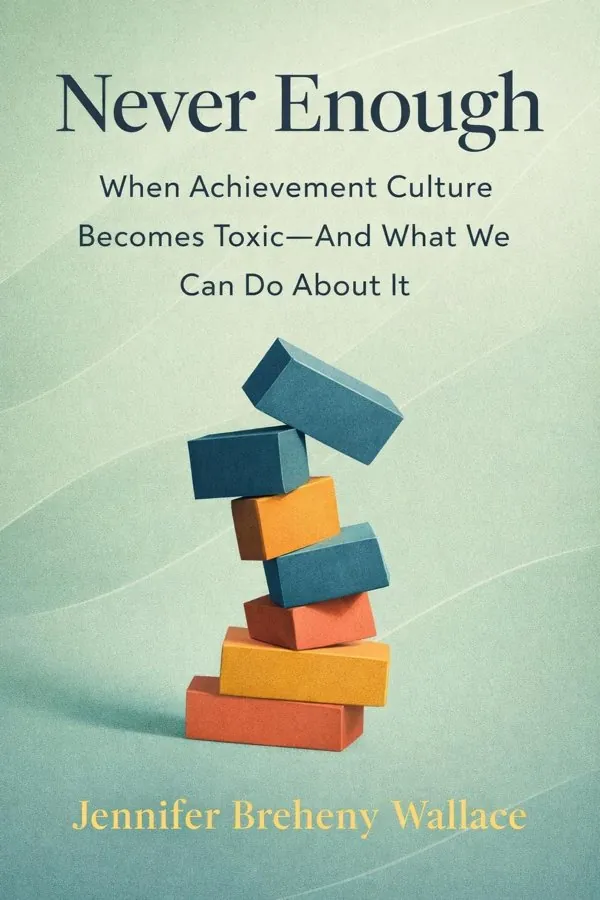
Never Enough: Summary & Key Insights
 10 min10 chaptersAudio available
Key Takeaways from Never Enough
One of the most unsettling truths in Never Enough is that achievement culture can feel normal precisely because it has become so pervasive.
The children who look most successful on paper are not always the ones who are doing best internally.
Many parents do not endorse achievement culture in theory, yet they still participate in it every day.
If achievement culture asks children to earn their worth, Wallace offers a more protective alternative: children need to feel that they matter no matter what.
Statistics can describe a crisis, but stories reveal how it feels to live inside one.
What Is Never Enough About?
Never Enough by Jennifer Breheny Wallace is a parenting book published in 2023 spanning 10 pages. In Never Enough, journalist Jennifer Breheny Wallace examines one of the defining parenting dilemmas of our time: what happens when children grow up in a culture that equates worth with achievement. Across schools, sports, extracurriculars, and college admissions, many young people absorb the message that they are only as valuable as their latest performance. Wallace argues that this pressure is not merely stressful; it is reshaping childhood, family life, and mental health in alarming ways. Drawing on reporting, interviews, and research from psychology, education, and sociology, she shows how anxiety, perfectionism, burnout, and disconnection often flourish in environments that appear successful from the outside. Yet the book is not a rejection of ambition. Instead, it is a call to build a healthier model of success rooted in belonging, mattering, character, and intrinsic motivation. Wallace writes with the authority of an award-winning journalist who has spent years listening to parents, educators, and students navigating these pressures firsthand. The result is a timely, practical, and deeply humane guide for anyone who wants children to thrive without being crushed by the pursuit of excellence.
This FizzRead summary covers all 10 key chapters of Never Enough in approximately 10 minutes, distilling the most important ideas, arguments, and takeaways from Jennifer Breheny Wallace's work. Also available as an audio summary and Key Quotes Podcast.
Never Enough
In Never Enough, journalist Jennifer Breheny Wallace examines one of the defining parenting dilemmas of our time: what happens when children grow up in a culture that equates worth with achievement. Across schools, sports, extracurriculars, and college admissions, many young people absorb the message that they are only as valuable as their latest performance. Wallace argues that this pressure is not merely stressful; it is reshaping childhood, family life, and mental health in alarming ways. Drawing on reporting, interviews, and research from psychology, education, and sociology, she shows how anxiety, perfectionism, burnout, and disconnection often flourish in environments that appear successful from the outside. Yet the book is not a rejection of ambition. Instead, it is a call to build a healthier model of success rooted in belonging, mattering, character, and intrinsic motivation. Wallace writes with the authority of an award-winning journalist who has spent years listening to parents, educators, and students navigating these pressures firsthand. The result is a timely, practical, and deeply humane guide for anyone who wants children to thrive without being crushed by the pursuit of excellence.
Who Should Read Never Enough?
This book is perfect for anyone interested in parenting and looking to gain actionable insights in a short read. Whether you're a student, professional, or lifelong learner, the key ideas from Never Enough by Jennifer Breheny Wallace will help you think differently.
- ✓Readers who enjoy parenting and want practical takeaways
- ✓Professionals looking to apply new ideas to their work and life
- ✓Anyone who wants the core insights of Never Enough in just 10 minutes
Want the full summary?
Get instant access to this book summary and 100K+ more with Fizz Moment.
Get Free SummaryAvailable on App Store • Free to download
Key Chapters
One of the most unsettling truths in Never Enough is that achievement culture can feel normal precisely because it has become so pervasive. Wallace explains that this culture did not emerge overnight. Over decades, social mobility fears, rising inequality, competitive college admissions, and public narratives about optimization have gradually convinced families that every decision must improve a child’s future standing. Success becomes narrowly defined by measurable outputs: grades, awards, athletic rankings, leadership titles, and elite admissions. Children learn early that résumé lines can matter more than curiosity, kindness, or joy.
Wallace’s insight is not that ambition is bad, but that when achievement becomes the dominant moral language of a family or school, children start to confuse performance with identity. A bad test score is no longer just a setback; it becomes evidence that they are falling behind in life. Parents may unintentionally reinforce this mindset by praising outcomes more than effort, character, or contribution. Schools can intensify it through tracking, constant assessment, and status hierarchies around prestige.
A practical example is the overscheduled student whose week is packed with honors classes, club leadership, private coaching, and volunteer hours, not because each activity is meaningful, but because each one signals competitiveness. Wallace encourages readers to ask a deeper question: What are these activities for? Are they helping a child grow, or simply helping them appear accomplished?
The actionable takeaway is to audit the messages children receive at home and in school. Notice when success is defined only by external markers, and begin expanding the conversation to include purpose, relationships, ethics, and well-being.
Many parents do not endorse achievement culture in theory, yet they still participate in it every day. Wallace shows that this is not simply hypocrisy; it is often fear. Parents worry that if they opt out, their children will lose opportunities in an increasingly unequal and competitive world. They may dislike the intensity of the system while also believing they cannot afford to ignore it.
This creates what Wallace describes as a trap. Even thoughtful, caring parents can become managers of performance, monitoring grades, scheduling enrichment, negotiating with coaches, and constantly planning for future advantage. Love becomes entangled with anxiety. Family life can start revolving around optimization rather than connection. Children then read parental involvement as conditional, even when that is not the parent’s intention.
Wallace is especially useful in showing that pressure does not come only from individual parents. Schools, social media, peer communities, and the college admissions economy all amplify the sense that childhood must be strategically engineered. In affluent communities, this can look like competitive overinvestment. In less advantaged communities, it may look like the equally stressful belief that one wrong move can close off a fragile path to stability.
A practical application is for parents to notice when they are operating from fear rather than values. Before pushing harder, they can ask: Is this decision aligned with my child’s well-being and interests, or am I reacting to comparison and status anxiety? Families can also explicitly name trade-offs, such as choosing sleep, family dinners, or free time over one more credential-building activity.
The actionable takeaway is to replace fear-driven parenting with values-driven parenting. Define what matters most in your family, and let those principles guide decisions more than social pressure does.
If achievement culture asks children to earn their worth, Wallace offers a more protective alternative: children need to feel that they matter no matter what. One of the book’s strongest contributions is its focus on the concepts of belonging and mattering. Belonging means feeling accepted as part of a group. Mattering goes a step further: it means feeling significant to others, knowing that your presence has weight and your life has value beyond performance.
Wallace argues that mattering acts as a psychological buffer against the instability of achievement-based identity. A child who feels deeply valued at home, in school, or in community is less likely to interpret every setback as a threat to their worth. They can fail, regroup, and keep perspective because they are anchored by something more enduring than praise.
This idea has powerful practical implications. Parents can communicate mattering by being emotionally available, listening without immediately correcting, and expressing appreciation for who a child is rather than what they produce. Teachers can strengthen mattering by noticing overlooked students, inviting participation, and showing students how they contribute to the classroom community. Even small actions, like remembering a detail from a child’s day or asking for their help in meaningful ways, signal significance.
Wallace’s framework also helps explain why some high-achieving children cope better than others. It is not only pressure that matters, but whether that pressure exists within a stable web of unconditional regard.
The actionable takeaway is to make mattering visible. Tell children directly and repeatedly that they are loved, needed, and valued for more than results, and back those words with attention, time, and trust.
Statistics can describe a crisis, but stories reveal how it feels to live inside one. Throughout Never Enough, Wallace draws on interviews and case studies with students, parents, and educators to show how achievement pressure plays out in ordinary life. These stories make clear that the problem is not limited to a few extreme households. It appears in subtle daily patterns: a child terrified of disappointing adults, a parent who cannot stop micromanaging, a school culture where everyone seems accomplished yet privately overwhelmed.
The power of these examples lies in their familiarity. Wallace describes young people who have internalized the idea that rest is laziness, mistakes are dangerous, and self-worth must be continuously earned. Some seem outwardly confident but inwardly feel empty or fraudulent. Others comply for years, then burn out suddenly. Parents in these stories often love their children deeply, yet find themselves reinforcing the very dynamics that harm them.
Case studies also show that change is possible. Children begin to recover when adults shift from monitoring outcomes to supporting development. A student who is allowed to drop an activity may rediscover energy and joy. A parent who stops leading every conversation with questions about performance may open the door to honesty. A school that rethinks homework, grading, or counseling support can reduce ambient stress for everyone.
For readers, these stories serve as mirrors. They invite self-reflection without blame. Which patterns feel familiar? What assumptions have become normalized? What costs have gone unnoticed because everyone around you is living similarly?
The actionable takeaway is to use lived examples as diagnostic tools. Pay attention to the emotional realities beneath achievement, and let concrete stories guide more compassionate decisions at home and in school.
Achievement pressure is widespread, but Wallace is careful to show that it does not look the same for every family. Cultural expectations, immigration histories, socioeconomic insecurity, race, and access to opportunity all influence how success is defined and pursued. This is one of the book’s most important nuances: a critique of achievement culture must account for structural realities, not just personal choices.
For some families, academic excellence is tied to sacrifice, survival, or mobility. Parents who have faced exclusion or instability may understandably see high performance as protection. In affluent communities, pressure can stem from status competition and fear of downward mobility. In working-class or marginalized communities, pressure may come from the awareness that opportunities are scarce and mistakes are punished more harshly. The emotional burden can be intense in both cases, though the sources differ.
Wallace’s point is not to flatten these differences but to help readers see how systems shape parenting. Telling families to simply relax can sound naive if they are navigating real barriers. At the same time, even justified pressure can become psychologically corrosive if children come to believe that their value depends solely on achievement.
A practical application is to have more honest conversations about why certain expectations exist. Families can distinguish between goals rooted in real necessity and those driven by comparison or inherited scripts. Educators can be more careful not to universalize one model of success or assume every child has the same resources and pressures.
The actionable takeaway is to approach achievement with both compassion and context. Understand the structural reasons families push hard, but still protect children from absorbing the message that success is the only path to worth.
Children thrive when they are driven by interest, purpose, and agency, not merely by fear or external reward. Wallace draws on motivational science to explain why this matters. When young people pursue goals because they find them meaningful, they tend to show greater persistence, creativity, and well-being. When they are driven primarily by approval, status, or avoidance of failure, motivation becomes brittle and exhausting.
A central distinction in the book is between intrinsic and extrinsic motivation. Intrinsic motivation grows from curiosity, enjoyment, mastery, and personal meaning. Extrinsic motivation depends on rewards, rankings, praise, or pressure. Wallace does not claim that external incentives are irrelevant; after all, grades and admissions are real. But when external validation dominates, children can lose touch with what they actually care about. They may become skilled at performing motivation rather than feeling it.
This has practical consequences for parenting and education. A child pushed into activities solely for prestige may comply but feel detached. A student allowed to pursue a genuine interest, even if it looks less impressive on paper, often develops deeper engagement and resilience. Adults can nurture intrinsic motivation by offering choice, emphasizing learning over image, and responding to setbacks with curiosity rather than panic.
For example, instead of saying, “You need this class because it will look good,” a parent might ask, “What kind of challenge excites you?” Instead of praising only top results, a teacher can notice persistence, experimentation, and growth.
The actionable takeaway is to help children connect effort with meaning. Prioritize interests, autonomy, and mastery, and use achievement as feedback rather than as the foundation of identity.
The problem with many modern definitions of success is not that they ask too much, but that they ask the wrong things. Wallace urges readers to widen the lens. A successful life cannot be measured only by admissions letters, job titles, or polished résumés. It must also include emotional health, moral development, meaningful relationships, and the capacity to contribute to others.
This reframing is both philosophical and practical. Philosophically, it challenges the belief that external distinction is the highest good. Practically, it changes the questions adults ask children every day. Instead of centering achievement alone, families can discuss character, purpose, courage, empathy, and citizenship. Children then begin to understand that excellence matters, but not at the expense of humanity.
Wallace is not arguing for lowered expectations or complacency. She is arguing for a fuller understanding of what thriving looks like. A child who learns to collaborate, recover from setbacks, care about others, and pursue meaningful goals may be better prepared for adulthood than one who accumulates credentials while feeling anxious, empty, or disconnected.
In everyday life, reframing success might mean celebrating a child for supporting a friend, showing integrity under pressure, or making a thoughtful choice about balance. It may mean resisting status-driven decisions, such as selecting an activity only because it sounds impressive. Schools can reinforce this broader vision by honoring community contribution and well-being alongside academic outcomes.
The actionable takeaway is to create a family definition of success that includes who your child is becoming, not just what your child is achieving. Return to that definition often, especially when outside pressures intensify.
Children do not develop resilience in isolation; they build it within relationships, routines, and cultures that make stress manageable and meaning visible. Wallace emphasizes that if achievement culture is social, the antidote must be social too. Individual mindset shifts matter, but lasting change also requires healthier family norms, school practices, and community values.
At the family level, resilience grows when children experience emotional safety, predictable support, and room to be imperfect. This can include regular family meals, honest conversations about failure, limits on overscheduling, and adults modeling balance rather than constant striving. When parents admit their own mistakes and separate love from performance, children learn that struggle is survivable.
At the community level, resilience depends on whether environments reward only competition or also foster connection. Schools can help by reducing unnecessary pressure, investing in counseling, creating advisory systems, and ensuring students are known well by adults. Communities can support families through mentoring, inclusive extracurricular opportunities, and public narratives that celebrate many paths to adulthood rather than a single prestige ladder.
Wallace’s insight is that resilience is not simply toughness. It is the ability to face challenge while remaining grounded in support, purpose, and self-worth. A resilient child is not one who tolerates endless pressure without complaint, but one who can engage difficulty without being defined by it.
The actionable takeaway is to strengthen the relational infrastructure around children. Protect time for connection, normalize imperfection, and seek communities that value people over performance.
Parents can make meaningful changes at home, but Wallace argues that family-level efforts are not enough if the broader system continues to reward exhaustion and comparison. Educational institutions and policy frameworks play a major role in shaping what children believe matters. If schools praise overwork, sort students relentlessly, and attach disproportionate value to narrow measures of success, they reinforce the very harms the book describes.
Wallace points toward reforms that can reduce pressure without sacrificing excellence. These include rethinking excessive homework, providing more mental health support, creating assessment systems that value growth, and broadening definitions of merit beyond test scores and elite credentials. She also invites schools to examine whether their cultures unintentionally send the message that only the top performers truly count.
At the policy level, the stakes are equally significant. When access to opportunity is highly unequal, families become more fearful and competitive. Addressing affordability, college admissions pressures, and resource disparities can reduce the desperation that fuels achievement obsession. Wallace’s broader argument is that personal well-being and institutional design are connected; you cannot fully solve the problem by asking individuals to be calmer inside a system built on scarcity and status.
For educators and leaders, this means looking beyond isolated wellness initiatives. A mindfulness assembly will not counteract a culture organized around chronic stress. Structural incentives must align with the values of healthy development.
The actionable takeaway is to advocate for systemic change where you have influence. Whether you are a parent, teacher, counselor, or school leader, push for environments that promote challenge with humanity rather than excellence at any cost.
All Chapters in Never Enough
About the Author
Jennifer Breheny Wallace is an award-winning journalist and author whose work focuses on parenting, child development, psychology, and the social pressures shaping modern family life. She has written for major publications including The Wall Street Journal and The Washington Post, where she has explored how cultural expectations influence well-being, education, and mental health. Wallace is known for combining rigorous reporting with accessible storytelling, drawing on interviews, research, and lived experience to illuminate complex issues. In Never Enough, she brings this journalistic strength to one of the most urgent challenges facing parents and educators today: the damaging effects of achievement culture on children. Her writing stands out for its empathy, clarity, and practical relevance, making her an important voice in conversations about raising healthy, resilient young people.
Get This Summary in Your Preferred Format
Read or listen to the Never Enough summary by Jennifer Breheny Wallace anytime, anywhere. FizzRead offers multiple formats so you can learn on your terms — all free.
Available formats: App · Audio · PDF · EPUB — All included free with FizzRead
Download Never Enough PDF and EPUB Summary
Key Quotes from Never Enough
“One of the most unsettling truths in Never Enough is that achievement culture can feel normal precisely because it has become so pervasive.”
“The children who look most successful on paper are not always the ones who are doing best internally.”
“Many parents do not endorse achievement culture in theory, yet they still participate in it every day.”
“If achievement culture asks children to earn their worth, Wallace offers a more protective alternative: children need to feel that they matter no matter what.”
“Statistics can describe a crisis, but stories reveal how it feels to live inside one.”
Frequently Asked Questions about Never Enough
Never Enough by Jennifer Breheny Wallace is a parenting book that explores key ideas across 10 chapters. In Never Enough, journalist Jennifer Breheny Wallace examines one of the defining parenting dilemmas of our time: what happens when children grow up in a culture that equates worth with achievement. Across schools, sports, extracurriculars, and college admissions, many young people absorb the message that they are only as valuable as their latest performance. Wallace argues that this pressure is not merely stressful; it is reshaping childhood, family life, and mental health in alarming ways. Drawing on reporting, interviews, and research from psychology, education, and sociology, she shows how anxiety, perfectionism, burnout, and disconnection often flourish in environments that appear successful from the outside. Yet the book is not a rejection of ambition. Instead, it is a call to build a healthier model of success rooted in belonging, mattering, character, and intrinsic motivation. Wallace writes with the authority of an award-winning journalist who has spent years listening to parents, educators, and students navigating these pressures firsthand. The result is a timely, practical, and deeply humane guide for anyone who wants children to thrive without being crushed by the pursuit of excellence.
You Might Also Like

Bluey: Sleepytime
Joe Brumm
10 min
In My Heart: A Book of Feelings
Jo Witek
10 min
Love From The Crayons
Drew Daywalt, Oliver Jeffers
10 min
Pete The Cat: Big Easter Adventure
James Dean, Kimberly Dean
10 min
Smart Money Smart Kids: Raising the Next Generation to Win with Money
Dave Ramsey, Rachel Cruze
10 min
1-2-3 Magic: Effective Discipline for Children 2–12
Thomas W. Phelan
10 minFeatured In
Browse by Category
Ready to read Never Enough?
Get the full summary and 100K+ more books with Fizz Moment.