
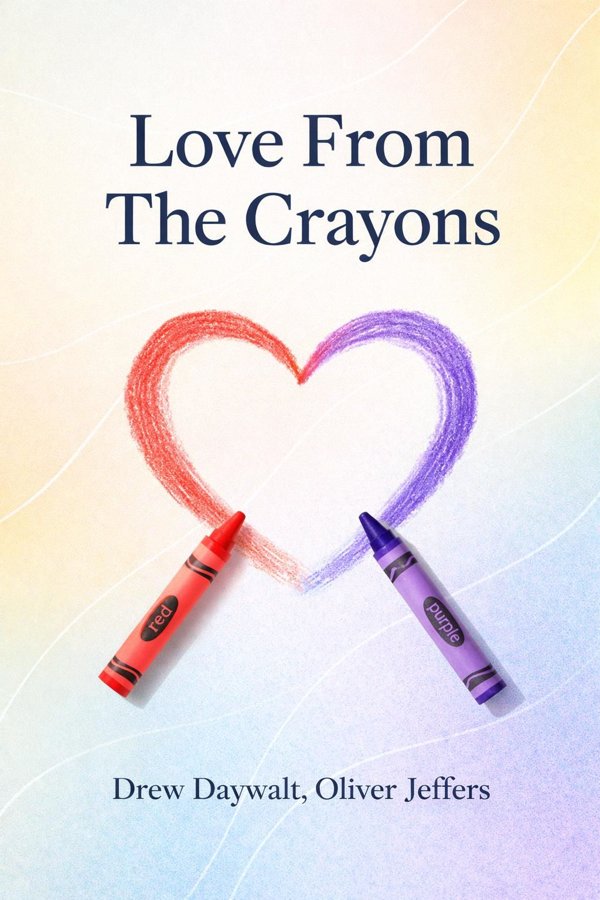
Love From The Crayons: Summary & Key Insights
by Drew Daywalt, Oliver Jeffers
 10 min9 chaptersAudio available
Key Takeaways from Love From The Crayons
One of the most powerful ideas in children’s literature is that the deepest truths often hide in the simplest scenes.
A child’s emotional world grows stronger when love is shown in more than one form.
Children often absorb serious lessons best when they arrive wrapped in laughter.
Children do not only read words; they read images, expressions, colors, and atmosphere.
Children thrive on repetition because repeated patterns create familiarity, and familiarity creates safety.
What Is Love From The Crayons About?
Love From The Crayons by Drew Daywalt, Oliver Jeffers is a parenting book. Love can be loud, playful, messy, surprising, and wonderfully ordinary. That is the heart of Love From The Crayons, a warm and witty picture book by bestselling author Drew Daywalt and acclaimed illustrator Oliver Jeffers. Returning to the beloved Crayons universe, the book uses bright personalities and simple observations to show children that love appears in many forms: in hugs and gifts, in shared adventures, in favorite colors, in family routines, and even in the small comforts that make a child feel safe. Rather than offering a narrow or overly sentimental definition, the story invites young readers to recognize love all around them. This book matters because it helps children build emotional language through humor, visual storytelling, and repetition they can easily grasp. For parents, caregivers, and educators, it opens a natural way to talk about affection, belonging, kindness, and connection without becoming preachy. Daywalt is known for writing clever, child-centered stories that respect how kids think and feel, while Jeffers brings emotional depth and charm through instantly recognizable illustrations. Together, they create a picture book that is entertaining enough for repeated read-alouds and meaningful enough to spark lasting family conversations.
This FizzRead summary covers all 9 key chapters of Love From The Crayons in approximately 10 minutes, distilling the most important ideas, arguments, and takeaways from Drew Daywalt, Oliver Jeffers's work. Also available as an audio summary and Key Quotes Podcast.
Love From The Crayons
Love can be loud, playful, messy, surprising, and wonderfully ordinary. That is the heart of Love From The Crayons, a warm and witty picture book by bestselling author Drew Daywalt and acclaimed illustrator Oliver Jeffers. Returning to the beloved Crayons universe, the book uses bright personalities and simple observations to show children that love appears in many forms: in hugs and gifts, in shared adventures, in favorite colors, in family routines, and even in the small comforts that make a child feel safe. Rather than offering a narrow or overly sentimental definition, the story invites young readers to recognize love all around them.
This book matters because it helps children build emotional language through humor, visual storytelling, and repetition they can easily grasp. For parents, caregivers, and educators, it opens a natural way to talk about affection, belonging, kindness, and connection without becoming preachy. Daywalt is known for writing clever, child-centered stories that respect how kids think and feel, while Jeffers brings emotional depth and charm through instantly recognizable illustrations. Together, they create a picture book that is entertaining enough for repeated read-alouds and meaningful enough to spark lasting family conversations.
Who Should Read Love From The Crayons?
This book is perfect for anyone interested in parenting and looking to gain actionable insights in a short read. Whether you're a student, professional, or lifelong learner, the key ideas from Love From The Crayons by Drew Daywalt, Oliver Jeffers will help you think differently.
- ✓Readers who enjoy parenting and want practical takeaways
- ✓Professionals looking to apply new ideas to their work and life
- ✓Anyone who wants the core insights of Love From The Crayons in just 10 minutes
Want the full summary?
Get instant access to this book summary and 100K+ more with Fizz Moment.
Get Free SummaryAvailable on App Store • Free to download
Key Chapters
One of the most powerful ideas in children’s literature is that the deepest truths often hide in the simplest scenes. Love From The Crayons builds on that insight by showing that love is not only found in dramatic gestures or holiday celebrations. It lives in everyday life: a warm blanket, a favorite toy, a shared laugh, a comforting routine, or time spent with someone who cares. By presenting love through common childhood experiences, the book helps children understand that love is not distant or abstract. It is something they already know.
This matters because young children learn best through what they can see, touch, and remember. When a child hears that love can look like a hand held on the way to school or a bedtime kiss after a long day, the concept becomes real. The Crayons make this lesson playful and accessible. Their bright colors and funny personalities hold attention, while the examples quietly teach emotional awareness. Instead of defining love with complicated language, the book surrounds the reader with recognizable expressions of care.
For parents, this creates a practical opportunity. Reading the book can become a prompt for asking children where they notice love in their own day. A caregiver might say, “What felt loving to you today?” or “How do we show love at home?” Teachers can use it in classrooms to help students name supportive relationships and acts of kindness.
An actionable takeaway: after reading, invite your child to point out three ordinary moments each day that make them feel loved. This simple habit strengthens gratitude, emotional vocabulary, and a sense of security.
A child’s emotional world grows stronger when love is shown in more than one form. Love From The Crayons is especially effective because it does not limit love to romance, grand affection, or a single family structure. Instead, it suggests that love can be playful, gentle, silly, loyal, cozy, generous, and even quiet. This broad representation gives children a fuller emotional map.
Why is that so important? Because children are constantly learning what relationships look like. If they only hear about love as hugs and sweet words, they may miss other meaningful expressions such as showing patience, making space for someone else, fixing a problem, or staying present when things feel hard. The book expands the emotional vocabulary by connecting love to a range of experiences children can understand. A child may realize that helping a sibling zip a coat, saving the last cookie for someone else, or drawing a picture for a grandparent are also ways of loving.
This wider lens is useful for caregivers too. Not every parent is naturally expressive in the same way. Some show love through time, routines, protection, acts of service, or playful attention. The book offers reassurance that love does not have to look identical in every home to be real and meaningful. It creates room for conversations about different ways people care for one another.
In practice, families can use the story to make a “many kinds of love” list. One column can include things people say, another things people do, and another ways love feels. This helps children connect words, actions, and emotions.
An actionable takeaway: ask your child to name one way they receive love and one way they can give love each day. Over time, this builds empathy and a more flexible understanding of relationships.
Children often absorb serious lessons best when they arrive wrapped in laughter. Drew Daywalt understands this well, and Love From The Crayons uses charm and humor to make emotional themes feel inviting rather than heavy. The Crayons are expressive, opinionated, and funny, which lowers resistance and keeps children engaged. Instead of presenting love as a solemn subject, the book treats it as joyful, colorful, and relatable.
This approach is not just entertaining; it is pedagogically smart. When children laugh, they relax. When they relax, they are more open to learning, discussing feelings, and making personal connections. Humor gives adults a natural way to talk about big ideas without making children feel pressured to respond in a particular way. In the book, amusing visual details and unexpected crayon associations keep the reading experience light even as the story touches on tenderness, care, and belonging.
Parents can use this lesson beyond the page. Emotional learning at home does not always need to be formal or intense. Children often respond better to playful questions than direct interrogation. Instead of asking, “How do you define love?” a caregiver might say, “If your feelings were crayons today, what color would they be?” or “Which crayon in the book felt most like our family?” These playful prompts invite expression without stress.
In classrooms, this same strategy can support social-emotional learning. Teachers can encourage students to draw their own “love crayons” and explain what each color represents, blending art, literacy, and emotional reflection.
An actionable takeaway: use humor and imagination when discussing feelings with children. A lighthearted conversation often opens the door to more honest, meaningful emotional sharing.
Children do not only read words; they read images, expressions, colors, and atmosphere. That is why Oliver Jeffers’s illustrations are so central to the impact of Love From The Crayons. The visuals do more than decorate the text. They help communicate warmth, connection, and nuance in ways young readers can grasp immediately. Through composition, facial expression, and the playful use of color, the book turns abstract emotion into something visible.
This is especially important for early readers and pre-readers. Before children can fully process complex explanations, they can recognize a cuddly scene, a joyful interaction, or a comforting image. Illustrations act as emotional anchors. They allow children to infer meaning, predict feelings, and participate in storytelling even if they are not yet decoding every word. In this way, the book supports not only emotional development but also visual literacy.
For adults, the images provide a powerful read-aloud advantage. Parents can pause on a page and ask, “What do you think is happening here?” or “How can you tell this picture shows love?” These questions teach children to notice clues and connect visual details with emotional meaning. Educators can use the book to model how illustrations contribute to comprehension, making it useful in both literacy and social-emotional settings.
The broader takeaway is that emotional conversations do not always need to begin with language alone. Children often show what they feel through art, play, and imagery before they can explain it directly. Books like this honor that developmental reality.
An actionable takeaway: after reading, invite your child to draw a picture of what love looks like in their life. Use the drawing as a starting point for conversation instead of asking for verbal explanations first.
Children thrive on repetition because repeated patterns create familiarity, and familiarity creates safety. Love From The Crayons works beautifully as a read-aloud partly because its structure reinforces emotional ideas in a memorable, rhythmic way. As the book offers example after example of what love can look like, children begin to internalize the message: love is abundant, recognizable, and close at hand.
This repeated framing matters developmentally. Young children often need to hear the same emotional truth many times before it fully settles in. A single statement like “You are loved” is meaningful, but repeated examples make the idea more believable and concrete. When children see love linked to bedtime, play, family time, comfort objects, and acts of care, they start to build a sturdy internal model of connection. This is especially valuable during times of change, anxiety, or transition, when familiar books can offer reassurance.
Parents can use repetition intentionally. Reading this book often, especially during routines like bedtime, can become part of a child’s emotional foundation. Over time, certain phrases or pages may become cues of comfort. Caregivers can also repeat related language in daily life: “That was a loving choice,” “This is one of our love rituals,” or “Let’s notice love today.” These repeated verbal patterns help children link behavior and feeling.
Teachers can create classroom rituals around repetition too, such as a daily moment when students name one kind action they saw. Repeated attention to love and kindness normalizes them as part of everyday community life.
An actionable takeaway: choose one repeated family phrase or ritual inspired by the book, such as naming one loving moment before bed each night. Repetition turns abstract values into lasting emotional habits.
Sometimes the greatest value of a picture book lies not only in its story but in the relationship it helps build around the story. Love From The Crayons is an ideal example. It is short, vivid, and emotionally rich, which makes it perfect for shared reading moments between children and caregivers. The experience of reading together becomes part of the book’s message: love is shown through presence, attention, and shared delight.
This is one reason picture books matter so much in parenting. A child rarely separates the content of a beloved book from the feeling of being read to. The lap, the voice, the laughter, the pause to point at a picture, the repetition of favorite pages, all of these become part of the emotional memory. In that sense, the book does more than describe love. It helps enact it.
For busy families, this is a useful reminder that connection does not always require elaborate activities. A five-minute read-aloud can provide reassurance, predictability, and closeness, especially when repeated over time. The Crayons’ familiar world also encourages engagement from both adults and children, making the reading experience enjoyable rather than dutiful. When adults enjoy the book too, children often sense that shared enthusiasm.
There are practical ways to extend this connection. Caregivers might pair the book with a coloring activity, ask children to choose the crayon that matches their mood, or create a family “love wall” where each person adds drawings of caring moments. These small extensions deepen the emotional impact without requiring much preparation.
An actionable takeaway: use the book as a regular connection ritual. Even a brief shared reading can become a dependable signal to your child that love includes time, attention, and joyful togetherness.
Children cannot express what they have not yet learned to name. One of the quiet strengths of Love From The Crayons is its ability to introduce emotional understanding using clear, simple, age-appropriate language. Rather than overwhelming young readers with abstract explanations, the book offers concrete associations that make the feeling of love easier to identify and discuss.
This simplicity is not a weakness; it is exactly what makes the book useful. Early emotional vocabulary often begins with recognizable experiences: warm, safe, happy, close, missed, shared, held. From there, children slowly build toward more nuanced ideas such as comfort, affection, belonging, admiration, and care. By presenting love through examples instead of lectures, the book gives adults a natural bridge into these conversations.
For example, after reading a page, a parent might ask, “Does this feel like cozy love, playful love, or helping love?” A teacher might create a classroom chart with categories such as “love looks like,” “love sounds like,” and “love feels like.” These activities help children sort experiences into emotional meaning. Over time, they become better able to describe their own needs and recognize the needs of others.
This matters beyond literary appreciation. Children with stronger emotional vocabulary often find it easier to ask for support, solve conflicts, and build healthy relationships. Picture books can be a surprisingly effective foundation for those lifelong skills.
An actionable takeaway: pick two or three feeling words from your reading and reuse them in daily life. When children hear emotional language connected to real experiences, they learn to recognize and communicate their feelings more confidently.
What children repeatedly notice, they begin to value. Love From The Crayons emphasizes that love is often made visible through small acts of care rather than heroic gestures. This idea is especially meaningful for parenting because it helps children understand that kindness, attentiveness, and generosity are not separate from love; they are some of its clearest expressions.
In a child’s world, small acts carry enormous weight. Sharing a crayon, saving a seat, helping clean up, drawing a picture for someone sad, or checking whether a friend is okay may seem minor to adults, but to children these are concrete lessons in how relationships work. The book presents care in ways that feel manageable and real, which makes it easier for children to imitate. Love becomes something they can practice, not just receive.
This is a useful shift for caregivers and educators. Rather than only telling children to “be loving” or “be nice,” adults can point to specific behaviors. We can say, “You showed love when you waited for your brother,” or “That was caring when you helped your classmate.” Labeling actions this way helps children connect moral behavior with emotional meaning.
At home, families might create a weekly “small acts of love” challenge with simple goals like writing a note, helping with a chore, or offering a hug. In school, teachers can build a kindness board where students add examples of caring behavior they witnessed. The focus stays on what is doable, observable, and repeatable.
An actionable takeaway: start naming everyday caring behaviors as acts of love. When children see love as something practical and within reach, they are more likely to turn it into a habit.
At its core, love is not only about affection; it is about belonging. Love From The Crayons gently communicates that being loved means being welcomed, noticed, included, and held within a circle of care. This is one of the book’s most meaningful contributions, especially for young children who are still forming their sense of identity and security.
Belonging is a foundational emotional need. Children want to know where they fit, who is for them, and whether they matter in the spaces they inhabit. Picture books that reflect warmth and connection can reinforce that sense of place. The Crayons, already familiar from earlier stories, create a comforting emotional universe where every color has a role and every expression contributes to the whole. That atmosphere subtly mirrors what many children need in real life: reassurance that there is room for them exactly as they are.
For families, this theme can open important conversations. Parents can ask, “What makes you feel like you belong in our family?” or “How can we help others feel included?” These questions move the idea of love beyond private affection and into community-building. In classrooms, the book can support discussions about inclusion, friendship, and making sure everyone feels seen.
This message is especially helpful for children navigating transitions such as a new sibling, a move, preschool entry, or shifting routines. Books that emphasize warmth and togetherness can offer emotional steadiness when the world feels uncertain.
An actionable takeaway: create one simple family or classroom ritual that reinforces belonging, such as a special greeting, a shared phrase, or a daily check-in. Children feel love more deeply when they can experience their place in it.
All Chapters in Love From The Crayons
About the Authors
Drew Daywalt is a bestselling American author known for inventive, humorous children’s books that give everyday objects surprising personalities and emotional depth. He is best known for The Day the Crayons Quit series, which became a major favorite among children, parents, and teachers for its wit and originality. Oliver Jeffers is a Northern Irish artist, illustrator, and author whose picture books are celebrated worldwide for their distinctive visual style, emotional warmth, and imaginative storytelling. His works often blend simplicity with philosophical depth in ways that resonate across ages. Together, Daywalt and Jeffers have created one of contemporary children’s publishing’s most recognizable partnerships, combining playful text and memorable illustration to make stories that are both fun to read aloud and rich in feeling.
Get This Summary in Your Preferred Format
Read or listen to the Love From The Crayons summary by Drew Daywalt, Oliver Jeffers anytime, anywhere. FizzRead offers multiple formats so you can learn on your terms — all free.
Available formats: App · Audio · PDF · EPUB — All included free with FizzRead
Download Love From The Crayons PDF and EPUB Summary
Key Quotes from Love From The Crayons
“One of the most powerful ideas in children’s literature is that the deepest truths often hide in the simplest scenes.”
“A child’s emotional world grows stronger when love is shown in more than one form.”
“Children often absorb serious lessons best when they arrive wrapped in laughter.”
“Children do not only read words; they read images, expressions, colors, and atmosphere.”
“Children thrive on repetition because repeated patterns create familiarity, and familiarity creates safety.”
Frequently Asked Questions about Love From The Crayons
Love From The Crayons by Drew Daywalt, Oliver Jeffers is a parenting book that explores key ideas across 9 chapters. Love can be loud, playful, messy, surprising, and wonderfully ordinary. That is the heart of Love From The Crayons, a warm and witty picture book by bestselling author Drew Daywalt and acclaimed illustrator Oliver Jeffers. Returning to the beloved Crayons universe, the book uses bright personalities and simple observations to show children that love appears in many forms: in hugs and gifts, in shared adventures, in favorite colors, in family routines, and even in the small comforts that make a child feel safe. Rather than offering a narrow or overly sentimental definition, the story invites young readers to recognize love all around them. This book matters because it helps children build emotional language through humor, visual storytelling, and repetition they can easily grasp. For parents, caregivers, and educators, it opens a natural way to talk about affection, belonging, kindness, and connection without becoming preachy. Daywalt is known for writing clever, child-centered stories that respect how kids think and feel, while Jeffers brings emotional depth and charm through instantly recognizable illustrations. Together, they create a picture book that is entertaining enough for repeated read-alouds and meaningful enough to spark lasting family conversations.
You Might Also Like
Never Enough
Jennifer Breheny Wallace
10 min
Bluey: Sleepytime
Joe Brumm
10 min
In My Heart: A Book of Feelings
Jo Witek
10 min
Pete The Cat: Big Easter Adventure
James Dean, Kimberly Dean
10 min
Smart Money Smart Kids: Raising the Next Generation to Win with Money
Dave Ramsey, Rachel Cruze
10 min
1-2-3 Magic: Effective Discipline for Children 2–12
Thomas W. Phelan
10 minBrowse by Category
Ready to read Love From The Crayons?
Get the full summary and 100K+ more books with Fizz Moment.