
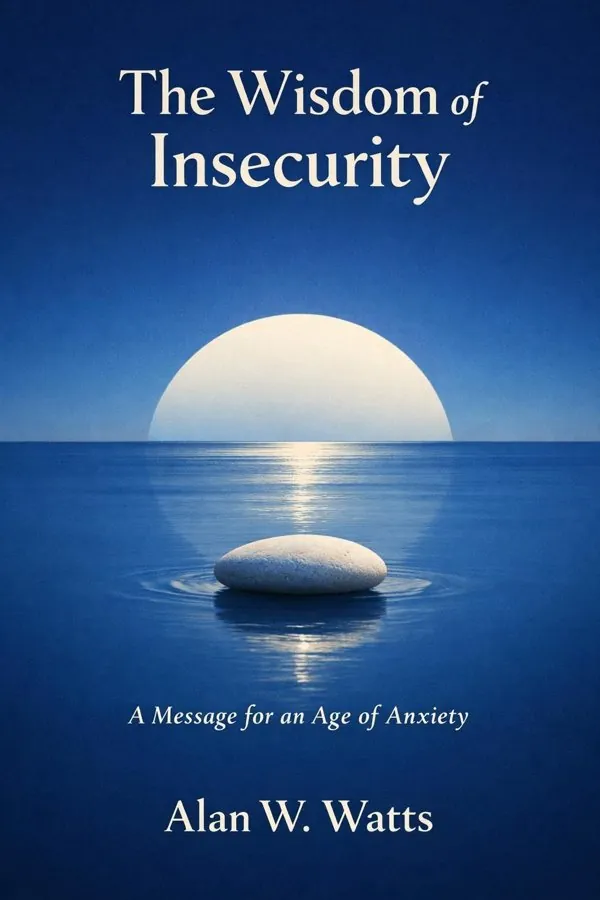
The Wisdom of Insecurity: Summary & Key Insights
by Alan Watts
 10 min9 chaptersAudio available
Key Takeaways from The Wisdom of Insecurity
The more desperately we seek psychological security, the more insecure we tend to feel.
Much of our suffering comes from treating passing things as if they should stay.
One of Watts’s most radical claims is that the self we constantly protect may be more imagined than real.
We lose life by living almost entirely for later.
Real faith is not rigid belief; it is the courage to live without guarantees.
What Is The Wisdom of Insecurity About?
The Wisdom of Insecurity by Alan Watts is a philosophy book published in 1951 spanning 10 pages. What if the very thing you keep chasing—security—is the source of your unease? In The Wisdom of Insecurity, Alan Watts examines one of the deepest contradictions of modern life: our attempt to create lasting psychological safety in a world defined by change. We pursue certainty through money, beliefs, routines, relationships, ambition, and self-improvement, yet the harder we cling, the more fragile and anxious we become. Watts argues that peace does not come from controlling life but from participating in it fully, without demanding guarantees it cannot give. First published in 1951, this brief but profound work remains strikingly relevant in an age of burnout, constant comparison, and future-focused worry. Drawing on Zen Buddhism, Taoism, Christian mysticism, and modern psychology, Watts translates complex spiritual insights into clear, accessible language for Western readers. He is not offering a productivity system or a doctrine to believe in. Instead, he invites us to see how fear is amplified by our resistance to uncertainty, and how freedom begins when we stop living for tomorrow and awaken to the only reality we ever truly have: the present moment.
This FizzRead summary covers all 9 key chapters of The Wisdom of Insecurity in approximately 10 minutes, distilling the most important ideas, arguments, and takeaways from Alan Watts's work. Also available as an audio summary and Key Quotes Podcast.
The Wisdom of Insecurity
What if the very thing you keep chasing—security—is the source of your unease? In The Wisdom of Insecurity, Alan Watts examines one of the deepest contradictions of modern life: our attempt to create lasting psychological safety in a world defined by change. We pursue certainty through money, beliefs, routines, relationships, ambition, and self-improvement, yet the harder we cling, the more fragile and anxious we become. Watts argues that peace does not come from controlling life but from participating in it fully, without demanding guarantees it cannot give.
First published in 1951, this brief but profound work remains strikingly relevant in an age of burnout, constant comparison, and future-focused worry. Drawing on Zen Buddhism, Taoism, Christian mysticism, and modern psychology, Watts translates complex spiritual insights into clear, accessible language for Western readers. He is not offering a productivity system or a doctrine to believe in. Instead, he invites us to see how fear is amplified by our resistance to uncertainty, and how freedom begins when we stop living for tomorrow and awaken to the only reality we ever truly have: the present moment.
Who Should Read The Wisdom of Insecurity?
This book is perfect for anyone interested in philosophy and looking to gain actionable insights in a short read. Whether you're a student, professional, or lifelong learner, the key ideas from The Wisdom of Insecurity by Alan Watts will help you think differently.
- ✓Readers who enjoy philosophy and want practical takeaways
- ✓Professionals looking to apply new ideas to their work and life
- ✓Anyone who wants the core insights of The Wisdom of Insecurity in just 10 minutes
Want the full summary?
Get instant access to this book summary and 100K+ more with Fizz Moment.
Get Free SummaryAvailable on App Store • Free to download
Key Chapters
The more desperately we seek psychological security, the more insecure we tend to feel. Watts begins with a paradox: human beings crave stability in a universe that never stops moving. We want certainty about our careers, health, relationships, identity, and future. Yet because all these things are subject to change, any attempt to make them permanently safe creates ongoing tension. We end up guarding what cannot be guaranteed.
Watts distinguishes practical security from psychological security. It is sensible to save money, lock your door, or plan ahead. But psychological security is different. It is the inner demand that life must remain predictable for us to feel okay. That demand becomes a breeding ground for anxiety because reality refuses to obey it. Instead of living, we monitor. Instead of relating, we possess. Instead of trusting the flow of experience, we try to freeze it.
This dynamic shows up everywhere. A person checks their investments constantly, not because it changes anything, but because uncertainty feels intolerable. A partner seeks endless reassurance, hoping to eliminate all risk of loss. A high achiever collects credentials yet still feels unsteady because no external accomplishment can remove existential insecurity.
Watts’s insight is not that security is worthless, but that making it the foundation of inner peace is self-defeating. When we insist on certainty from an uncertain world, we create the very fear we want to escape. The mind becomes a machine for scanning threats and imagining future collapse.
Actionable takeaway: Notice one area where you are demanding guarantees from life. Replace the question “How can I make this completely safe?” with “How can I meet this experience more openly and intelligently right now?”
Much of our suffering comes from treating passing things as if they should stay. Watts argues that impermanence is not a tragic flaw in life; it is life’s basic structure. Everything changes: bodies age, emotions shift, relationships evolve, seasons turn, ideas fade, and civilizations rise and fall. We suffer less from change itself than from our resistance to it.
We often behave as though joy should be permanent if it is real. We want love without vulnerability, success without fluctuation, identity without revision. But trying to preserve experiences beyond their natural life is like trying to hold a wave in place. The tighter the grip, the more quickly the living quality disappears. This is true in ordinary moments as well. A vacation becomes less enjoyable when we start worrying about it ending. A meaningful conversation loses its freshness when we try to convert it into a fixed definition of the relationship.
Watts draws from Eastern traditions to show that wisdom begins with accepting transience, not defeating it. A flower is beautiful partly because it fades. Music is moving because its notes vanish as they are heard. Human life, too, gains intensity and tenderness from its fragility. To deny impermanence is to deny reality; to accept it is to become more intimate with experience.
In practice, this means loosening the habit of possession. Instead of asking how to keep every good thing forever, ask how to receive it fully while it is here. Grief, too, changes under this view. Loss still hurts, but it no longer feels like a cosmic mistake. It becomes part of the rhythm of being alive.
Actionable takeaway: When you notice yourself clinging to a pleasant experience, pause and silently say, “This too is changing.” Let that thought deepen your appreciation rather than diminish it.
One of Watts’s most radical claims is that the self we constantly protect may be more imagined than real. We usually think of ourselves as fixed inner entities—separate egos moving through the world, trying to survive, succeed, and maintain control. But when we look closely, this “self” is difficult to pin down. Is it the body, which changes continuously? Is it memory, which is selective and unreliable? Is it thought, which comes and goes without permission?
Watts suggests that the ego is largely a mental construction made of stories, labels, and social roles. We say, “This is who I am,” then spend enormous energy defending that image. We become anxious when others misunderstand us, when our status changes, or when we act out of character. But this anxiety arises because we are trying to stabilize something fluid. Identity is not a finished object; it is an ongoing process.
This idea has practical implications. Someone who strongly identifies as “the successful one” may fall apart after a setback. Someone attached to being “the calm person” may resist acknowledging anger or grief. The problem is not having a personality. The problem is confusing temporary patterns with an unchanging essence.
Watts does not deny individuality. Rather, he invites us to see that we are not isolated fragments standing apart from life. We are expressions of a larger process—like waves in the ocean rather than objects placed on top of it. This shift softens fear because there is less “self” to preserve at all costs.
Actionable takeaway: Observe your thoughts for one day and note every time you say “I am” followed by a label. Ask yourself whether that label describes a permanent truth or just a temporary pattern.
We lose life by living almost entirely for later. Watts argues that modern people are trapped in psychological time—haunted by the past and preoccupied with the future—while barely inhabiting the present. We remember, anticipate, compare, calculate, and postpone, often believing that real living will begin once a certain problem is solved or milestone is reached.
This creates a fundamental distortion. The future matters, but it is never experienced directly. When it arrives, it appears as the present. Likewise, the past exists only as memory in the present. Yet most people treat the current moment as merely a bridge to somewhere else. As a result, they never quite arrive. The student lives for graduation, the worker for promotion, the parent for the next stage, the retiree for peace—only to discover that the habit of postponing life continues.
Watts is not rejecting clocks, plans, or responsibility. Chronological time is necessary for practical life. The problem is psychological time: the constant feeling that fulfillment lies elsewhere. This mindset fuels anxiety because the mind is always leaning forward, trying to secure an imaginary future against an uncertain reality.
A simple example is eating dinner while checking email and thinking about tomorrow’s meeting. The body is in one place, but awareness is elsewhere. Over time, this fractured attention becomes a way of life. We become strangers to immediate experience.
Watts’s alternative is not recklessness but presence. To live in the present is to bring full awareness to what is happening now, whether pleasant or unpleasant, instead of using the now merely as a means to an end.
Actionable takeaway: Choose one routine activity today—eating, showering, walking, or making tea—and do it without multitasking. Let it be complete in itself rather than preparation for what comes next.
Real faith is not rigid belief; it is the courage to live without guarantees. Watts challenges the common idea that faith means clinging to doctrines, certainties, or systems of explanation. In his view, that kind of certainty often masks fear. We use beliefs to defend ourselves against the mystery of existence, hoping that if we can name everything, we will no longer feel vulnerable.
But life does not offer final proof. Relationships can fail, plans can collapse, bodies can break down, and even our strongest convictions may evolve. Faith, then, is not certainty about outcomes. It is a willingness to move with reality even when outcomes remain unknown. It resembles trust more than dogma—a readiness to participate in life without requiring that it become risk-free first.
This distinction matters in everyday decisions. A person may stay in an unfulfilling job because uncertainty feels unbearable. Another may avoid intimacy because love cannot be controlled. Someone may cling to ideology not because it is true, but because doubt feels dangerous. Watts invites us to see that excessive certainty deadens life. It narrows our experience and separates us from what is living, dynamic, and unresolved.
Paradoxically, uncertainty can deepen confidence. Once you stop expecting the universe to reassure you constantly, you become more resilient. You no longer confuse not knowing with failure. You become available to discovery, improvisation, and genuine encounter.
Watts’s faith is not blind optimism. It is an openness to reality as it is. It accepts that not everything can be predicted, explained, or secured in advance.
Actionable takeaway: Think of one decision you have been delaying until you feel completely certain. Ask, “What would wise trust look like here, even if certainty never comes?” Then take one small step.
We often mistake our descriptions of life for life itself. Watts warns that thought and language, while incredibly useful, can also trap us in abstraction. The mind labels, categorizes, compares, and narrates. This helps us function, but it also tempts us to believe that our concepts are more real than immediate experience.
For example, you may think “I am anxious” and then live inside the label rather than noticing the actual sensations in your body—tightness, heat, shallow breathing, racing thoughts. Or you may call someone “difficult” and stop seeing the complexity of who they are in each moment. Language freezes living processes into nouns and identities. It gives the illusion that reality is neat, fixed, and separable, when in fact it is fluid and interconnected.
This matters because many forms of suffering are intensified by the stories we tell about our experience. Pain becomes “my ruined future.” A mistake becomes “proof that I’m a failure.” A moment of loneliness becomes “I will always be alone.” The event is real, but thought wraps it in interpretation and repetition. Soon we are responding less to life than to our own commentary on life.
Watts encourages a return to direct perception. What is happening before the mind divides it into names and judgments? What do you hear, feel, and see right now? This is not anti-intellectual. It is a reminder that thought is a tool, not the whole of reality.
When used skillfully, language points beyond itself. When used unconsciously, it imprisons us in concepts and cuts us off from freshness.
Actionable takeaway: The next time you feel overwhelmed, pause and describe your experience without labels or interpretations. Focus only on direct sensations, sounds, colors, and movements for one minute.
Life cannot be fully understood from a distance; it has to be lived. Watts argues that many people relate to existence as if they were standing outside it, trying to analyze, control, and manage every part before participating. We want a map before taking a step, a guarantee before loving, a conclusion before beginning. But reality is not something we can master intellectually and then enter. We are already in it.
This is why overanalysis often leads to paralysis. Someone may endlessly evaluate whether they are happy, spiritually awakened, in the right relationship, or on the correct career path. Reflection has value, but when it becomes an attempt to achieve total conceptual clarity before acting, it cuts us off from direct living. You cannot think your way into the fullness of a sunset, a friendship, a meal, or a moment of silence.
Watts emphasizes immediate experience as the ground of truth. Not truth in the sense of rigid propositions, but truth as contact with what is. When you are fully present, even ordinary things regain vitality. Washing dishes, listening to rain, or sitting quietly can become complete experiences rather than dead time between important events.
This perspective also changes how we handle discomfort. Instead of constantly trying to escape unpleasant feelings through distraction, explanation, or self-correction, we can meet them directly. Often, the felt experience of sadness, fear, or uncertainty is more workable than the mind’s resistance to it.
To experience reality is not to abandon reason. It is to stop using reason as a shield against being alive. There is wisdom in contact, in attention, in participation.
Actionable takeaway: For five minutes today, stop trying to improve, analyze, or interpret your experience. Simply notice what is happening in and around you, as if you were meeting reality for the first time.
Where there is control, love becomes strained. Watts suggests that much of what we call love is actually attachment mixed with fear. We want the other person to stay, to reassure us, to behave predictably, to confirm our worth, and to fit the image we hold of them. But the more we try to possess people emotionally, the more fragile and tense the relationship becomes.
True love, in Watts’s view, is rooted in acceptance rather than ownership. It allows space for change, difference, and mystery. This does not mean indifference or passivity. It means recognizing that another person is not an object designed to stabilize your identity. They are a living being, changing as you are changing. To love them well is to meet them as they are, not only as you wish them to be.
This applies to friendship, romance, parenting, and even self-love. Parents often suffer when they cannot let children become themselves. Partners create conflict when they demand constant emotional guarantees. Individuals punish themselves when they cannot accept their own complexity and change. In each case, anxiety grows from the urge to fix life into a secure form.
Acceptance transforms relationships because it reduces defensive pressure. Conversation becomes more honest. Conflict becomes less catastrophic. Presence replaces strategy. Love becomes an act of participation rather than management.
Watts does not promise that acceptance prevents pain. Loving openly always includes vulnerability. But trying to eliminate vulnerability destroys the very openness that makes love real.
Actionable takeaway: In one close relationship, notice where you are subtly trying to control, reassure, or define the other person. Practice one act of love today that gives more space than pressure—listening without correcting, asking without assuming, or appreciating without possessing.
Anxiety is often intensified not by uncertainty itself, but by our refusal to allow uncertainty. Watts’s deepest practical insight is that inner peace does not come from finally arranging life into a risk-free structure. It comes from changing our relationship to insecurity. The moment we stop demanding that life be solid before we can relax, a different kind of freedom becomes possible.
This does not mean that fear disappears overnight. Human beings are vulnerable creatures, and concern is natural. But anxiety becomes chronic when the mind constantly argues with reality: this should not be happening, I must know what comes next, I cannot tolerate not being in control. Such inner resistance multiplies distress. We are afraid, and then we become afraid of being afraid.
Watts proposes a different posture: feel the instability of life directly, without immediately building a psychological fortress against it. Notice uncertainty in the body. Let the future be open rather than treating openness as danger. Attend to what can actually be done now, instead of spinning endless scenarios. This approach does not solve every external problem, but it interrupts the cycle in which imagination amplifies suffering.
For example, before a medical test, a job interview, or a difficult conversation, the mind may race through catastrophic futures. Some preparation is useful; obsessive rehearsal is not. Returning to the present—breath, posture, immediate facts—restores proportion. It reminds you that life is lived one moment at a time, not all at once.
Watts’s “wisdom of insecurity” is the discovery that insecurity is not the enemy of life. It is the condition under which life is vivid, real, and awake.
Actionable takeaway: When anxiety rises, ask two questions: “What is actually happening right now?” and “What one concrete thing can I do in this moment?” Let those answers anchor you in reality.
All Chapters in The Wisdom of Insecurity
About the Author
Alan Wilson Watts (1915–1973) was a British-born philosopher, writer, and lecturer who became one of the most influential interpreters of Eastern thought for Western audiences. Deeply interested in Zen Buddhism, Taoism, Hindu philosophy, and comparative religion, he wrote extensively about consciousness, identity, spirituality, and the nature of reality. Watts had a rare ability to translate complex philosophical and mystical ideas into vivid, accessible language without stripping them of depth. Over the course of his career, he published more than twenty books and delivered hundreds of talks that continue to attract new listeners and readers. His work remains especially valued by those exploring mindfulness, nonduality, and alternatives to rigid religious or materialist worldviews. The Wisdom of Insecurity is among his most enduring books.
Get This Summary in Your Preferred Format
Read or listen to the The Wisdom of Insecurity summary by Alan Watts anytime, anywhere. FizzRead offers multiple formats so you can learn on your terms — all free.
Available formats: App · Audio · PDF · EPUB — All included free with FizzRead
Download The Wisdom of Insecurity PDF and EPUB Summary
Key Quotes from The Wisdom of Insecurity
“The more desperately we seek psychological security, the more insecure we tend to feel.”
“Much of our suffering comes from treating passing things as if they should stay.”
“One of Watts’s most radical claims is that the self we constantly protect may be more imagined than real.”
“We lose life by living almost entirely for later.”
“Real faith is not rigid belief; it is the courage to live without guarantees.”
Frequently Asked Questions about The Wisdom of Insecurity
The Wisdom of Insecurity by Alan Watts is a philosophy book that explores key ideas across 9 chapters. What if the very thing you keep chasing—security—is the source of your unease? In The Wisdom of Insecurity, Alan Watts examines one of the deepest contradictions of modern life: our attempt to create lasting psychological safety in a world defined by change. We pursue certainty through money, beliefs, routines, relationships, ambition, and self-improvement, yet the harder we cling, the more fragile and anxious we become. Watts argues that peace does not come from controlling life but from participating in it fully, without demanding guarantees it cannot give. First published in 1951, this brief but profound work remains strikingly relevant in an age of burnout, constant comparison, and future-focused worry. Drawing on Zen Buddhism, Taoism, Christian mysticism, and modern psychology, Watts translates complex spiritual insights into clear, accessible language for Western readers. He is not offering a productivity system or a doctrine to believe in. Instead, he invites us to see how fear is amplified by our resistance to uncertainty, and how freedom begins when we stop living for tomorrow and awaken to the only reality we ever truly have: the present moment.
More by Alan Watts

You Might Also Like



Featured In
Browse by Category
Ready to read The Wisdom of Insecurity?
Get the full summary and 100K+ more books with Fizz Moment.