
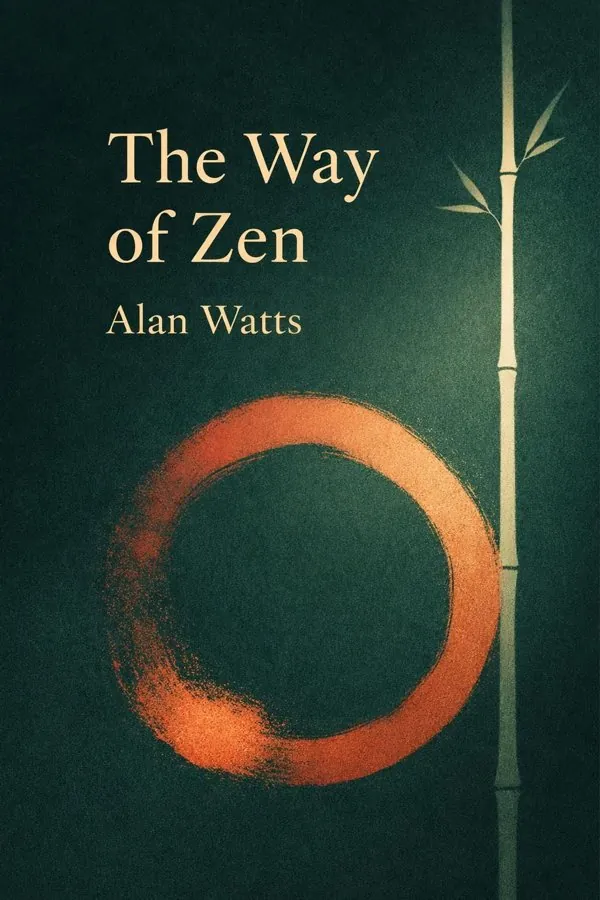
The Way of Zen: Summary & Key Insights
by Alan Watts
 10 min9 chaptersAudio available
Key Takeaways from The Way of Zen
The most radical spiritual revolutions often begin not with new beliefs, but with a new way of seeing.
A tradition matures when it expands compassion as much as insight.
Zen became truly itself when Buddhism met the Chinese genius for naturalness.
A spiritual path becomes powerful when it descends from abstraction into the texture of ordinary life.
When a tradition crosses cultures, it does not merely travel; it transforms.
What Is The Way of Zen About?
The Way of Zen by Alan Watts is a eastern_wisdom book spanning 9 pages. The Way of Zen is Alan Watts’s elegant and influential guide to one of the most misunderstood spiritual traditions in the modern world. Rather than treating Zen as an exotic religion full of riddles, Watts explains it as a disciplined yet playful way of seeing reality directly, without the usual filters of concepts, ego, and anxiety. The book traces Zen from the teachings of the historical Buddha through the development of Mahayana Buddhism, the shaping influence of Taoism in China, and the flowering of Chan and Japanese Zen practice. Along the way, Watts shows how Zen points beyond abstract belief toward immediate experience, spontaneity, and a deep harmony with life as it is. This matters because Zen addresses a problem that still defines modern life: our tendency to overthink, divide ourselves from the world, and search for certainty where only living presence can satisfy. Watts is a compelling guide because he combined serious study of Eastern traditions with an unusual gift for translating them into vivid, accessible English for Western readers. The result is both a historical introduction and a practical invitation to a freer way of being.
This FizzRead summary covers all 9 key chapters of The Way of Zen in approximately 10 minutes, distilling the most important ideas, arguments, and takeaways from Alan Watts's work. Also available as an audio summary and Key Quotes Podcast.
The Way of Zen
The Way of Zen is Alan Watts’s elegant and influential guide to one of the most misunderstood spiritual traditions in the modern world. Rather than treating Zen as an exotic religion full of riddles, Watts explains it as a disciplined yet playful way of seeing reality directly, without the usual filters of concepts, ego, and anxiety. The book traces Zen from the teachings of the historical Buddha through the development of Mahayana Buddhism, the shaping influence of Taoism in China, and the flowering of Chan and Japanese Zen practice. Along the way, Watts shows how Zen points beyond abstract belief toward immediate experience, spontaneity, and a deep harmony with life as it is. This matters because Zen addresses a problem that still defines modern life: our tendency to overthink, divide ourselves from the world, and search for certainty where only living presence can satisfy. Watts is a compelling guide because he combined serious study of Eastern traditions with an unusual gift for translating them into vivid, accessible English for Western readers. The result is both a historical introduction and a practical invitation to a freer way of being.
Who Should Read The Way of Zen?
This book is perfect for anyone interested in eastern_wisdom and looking to gain actionable insights in a short read. Whether you're a student, professional, or lifelong learner, the key ideas from The Way of Zen by Alan Watts will help you think differently.
- ✓Readers who enjoy eastern_wisdom and want practical takeaways
- ✓Professionals looking to apply new ideas to their work and life
- ✓Anyone who wants the core insights of The Way of Zen in just 10 minutes
Want the full summary?
Get instant access to this book summary and 100K+ more with Fizz Moment.
Get Free SummaryAvailable on App Store • Free to download
Key Chapters
The most radical spiritual revolutions often begin not with new beliefs, but with a new way of seeing. Watts starts by returning Zen to its original source: the awakening of Siddhartha Gautama, the Buddha. What the Buddha discovered was not a system of dogmas about God, the soul, or the universe. He saw, with penetrating clarity, that suffering arises from craving, clinging, and the illusion that we are isolated selves struggling against a separate world. In this sense, Buddhism begins as a practical diagnosis of human confusion rather than a speculative philosophy.
Watts emphasizes that the Buddha’s teaching is grounded in experience. The Four Noble Truths and the Eightfold Path are not commandments to obey blindly but tools for understanding how the mind traps itself. We suffer because we grasp at permanence in a reality that is constantly changing. We build identities, possessions, ambitions, and opinions as if they could secure us, then feel shaken when life moves on. Zen inherits this original insight but strips away excess explanation. It asks us to notice directly what the Buddha noticed: thoughts come and go, sensations come and go, the self we defend so fiercely is more fluid than we imagine.
A practical example is how we respond to stress. If criticism at work immediately becomes “I am a failure,” suffering expands. But if we observe the reaction as a passing process—tightness, thought, emotion, story—space opens. Zen does not promise a life without pain; it teaches freedom from the compulsive mental habits that turn pain into ongoing torment.
Actionable takeaway: When you feel caught in anxiety or frustration, pause and ask, “What am I clinging to right now?” Then observe the experience without trying to control it.
A tradition matures when it expands compassion as much as insight. Watts shows that Mahayana Buddhism transformed the early Buddhist emphasis on individual liberation into a vast and generous vision. Instead of presenting enlightenment as an achievement for a rare spiritual elite, Mahayana insists that awakening is inseparable from the liberation of all beings. The ideal figure is no longer just the arhat who escapes suffering, but the bodhisattva who realizes wisdom and compassion together.
This shift matters deeply for Zen. Mahayana introduces the notion of emptiness, not as a bleak void but as the recognition that nothing exists independently. Every person, object, and event is interwoven with everything else. From this perspective, compassion is not a moral add-on; it is the natural expression of seeing clearly. If there is no isolated self standing apart from the world, then helping others is not sacrifice in the usual sense. It is participation in a shared life.
In practical terms, Mahayana corrects the tendency to turn spirituality into self-improvement. A person may meditate, read philosophy, and pursue calmness, yet still remain subtly self-centered. Zen influenced by Mahayana challenges this. The point is not to become a perfected private individual, but to awaken to relational existence. Caring for a child, listening fully to a friend, or doing ordinary work without vanity can all become expressions of bodhisattva practice.
Watts also helps Western readers see that paradox in Mahayana is intentional. If all beings are already expressions of Buddha-nature, why strive? Because striving itself softens when one sees that there is nowhere else to arrive. Practice becomes less like climbing a ladder and more like removing what blocks an obvious truth.
Actionable takeaway: Treat one ordinary act of care today—answering patiently, cleaning, listening, helping—as part of awakening rather than a distraction from it.
Zen became truly itself when Buddhism met the Chinese genius for naturalness. Watts argues that while Zen is rooted in Buddhism, its distinctive flavor was profoundly shaped by Taoism. Taoist thought, especially as expressed in Lao-tzu and Chuang-tzu, brought an appreciation for spontaneity, non-forcing, and harmony with the flow of life. Where Indian philosophy often leaned toward analytical precision, Taoism celebrated intuitive wisdom, humor, and effortless action. Zen absorbed this atmosphere deeply.
The Taoist principle of wu-wei, often translated as “non-striving” or “effortless action,” is central here. It does not mean passivity or laziness. It means acting without the friction of self-consciousness, as water flows around rocks or a skilled dancer moves without calculating every step. Zen practice carries this spirit into daily life. Enlightenment is not an artificial state produced by spiritual tension; it appears when the mind stops interfering with reality through constant grasping and commentary.
Consider common experiences of overcontrol. A conversation goes badly because you try too hard to sound intelligent. Sleep becomes impossible because you force yourself to relax. Creativity dries up because you demand brilliance. Taoist-infused Zen points to a different mode: attentive yet unforced presence. The archer hits the mark best when not obsessed with hitting it. The musician plays best when not anxiously monitoring every note.
Watts uses Taoism to show why Zen often sounds playful or elusive. A rigid mind wants formulas, but Zen points to a living process that cannot be captured in fixed language. The more tightly you grip it, the more you miss it. The lesson is not anti-intellectualism; it is freedom from making thought the master of life.
Actionable takeaway: Choose one task today—walking, eating, writing, speaking—and do it with full attention but less inner forcing. Notice how much effort comes from self-conscious tension rather than the task itself.
A spiritual path becomes powerful when it descends from abstraction into the texture of ordinary life. Watts explains that Chinese Chan developed when Buddhist insight and Taoist naturalness fused into a tradition that distrusted metaphysical excess and prized direct realization. Chan masters did not encourage endless speculation about ultimate reality. Instead, they pointed students back to immediate experience: this breath, this sound, this movement, this moment before thought divides the world into subject and object.
One of Chan’s defining contributions is its earthy sanity. Enlightenment is not somewhere outside the marketplace. It is found in chopping wood, carrying water, washing bowls, and meeting life without psychological resistance. This does not trivialize awakening; it deepens it. If truth is real, it must be present in the ordinary, not hidden in exotic states or rarefied ideas.
Chan also developed distinctive methods to disrupt conceptual habits. Dialogues between masters and students, startling gestures, and abrupt responses were meant to short-circuit the mind’s tendency to seek safe conclusions. A student asks a lofty philosophical question and receives an answer about a tree, a shout, or a blow. These are not irrational theatrics for their own sake. They are attempts to awaken perception before it hardens into explanation.
In modern life, this insight is highly relevant. We often postpone living until we solve ourselves intellectually. We imagine that once we understand enough, optimize enough, and secure enough certainty, peace will follow. Chan reverses the order. Peace appears when we stop trying to stand outside life and master it from a distance.
Actionable takeaway: Bring full awareness to one routine activity today—washing dishes, making tea, commuting—and treat it as complete in itself, not merely a means to the next thing.
When a tradition crosses cultures, it does not merely travel; it transforms. Watts traces how Zen moved from Chinese Chan into Japan, where it developed new institutional forms, aesthetics, and disciplines while preserving its central insight into direct awakening. In Japan, Zen became associated above all with the Rinzai and Soto schools. Each emphasized different methods, but both sought to reveal the same non-dual reality beyond the grasping ego.
Rinzai Zen is often known for its use of koans—paradoxical questions or statements designed to break the mind’s dependence on logic alone. A koan does not reward cleverness. It corners the intellect until a deeper mode of understanding becomes possible. Soto Zen, by contrast, emphasizes shikantaza, often rendered as “just sitting,” where meditation is not a technique to reach enlightenment but the expression of enlightenment itself. These approaches differ in style, but Watts shows that both challenge the ordinary habit of treating life as a problem to solve.
Japanese Zen also shaped architecture, gardening, tea ceremony, calligraphy, martial arts, and codes of discipline. This did not happen by accident. Zen in Japan became a way of embodying awareness in form. Simplicity, restraint, precision, and silence were not merely aesthetic preferences; they were expressions of a mind no longer cluttered by excess self-reference.
For modern readers, the Japanese development of Zen demonstrates that insight must take shape in habit, environment, and action. A calm idea is not enough. The way you arrange a room, prepare food, move your body, or speak to another person can either reinforce distraction or reveal presence.
Actionable takeaway: Simplify one part of your environment today—a desk, room, or routine—so it supports clarity, stillness, and deliberate attention.
Many people approach spirituality the way they approach productivity: as a method for becoming a better, calmer, more impressive self. Watts warns that this attitude easily corrupts Zen practice. The essence of Zen is not spiritual self-improvement in the egoic sense, but awakening from the very illusion of a separate self that needs endless upgrading. Meditation, posture, breathing, and discipline matter, yet they are misunderstood if turned into badges of seriousness or achievements to accumulate.
Zen practice is fundamentally about direct presence. In seated meditation, one does not hunt for mystical experiences or force the mind into blankness. One sits, breathes, notices, allows, returns. Thoughts arise, emotions move, sounds appear, bodily discomfort comes and goes. The key is not suppression but non-grasping awareness. This is why practice can seem deceptively simple. The mind wants special results; Zen keeps leading it back to what is immediate.
Watts helps readers see that discipline in Zen is not harsh moralism. It is a way of becoming intimate with reality. A monk sweeping a courtyard or a layperson preparing a meal can practice with the same spirit: complete attention, no extra drama, no resistance to the task at hand. In our time, this has enormous relevance. We are constantly tempted to convert every inner practice into measurable progress. Zen offers relief from that compulsion.
A practical application is to reconsider meditation itself. Instead of asking, “Am I doing this right?” or “Why am I not calmer yet?” ask, “Can I let this moment be exactly what it is?” That shift alone can turn practice from struggle into discovery.
Actionable takeaway: For ten minutes today, sit quietly without trying to achieve anything. Notice breath, body, and thoughts, and gently return to simple awareness whenever you drift into judging the experience.
The mind searches furiously for what may be hidden by the search itself. One of Watts’s most important insights is that Zen presents enlightenment as profoundly paradoxical. We look for awakening as if it were a distant object, future accomplishment, or unusual state. Yet Zen insists that what we seek is not elsewhere. The problem is not lack of reality but the mental habits that prevent us from seeing it. Enlightenment is both the most ordinary thing and the most elusive because the grasping mind keeps turning it into a possession.
This is why Zen language can sound baffling. If you ask, “How do I attain enlightenment?” the question already assumes a separate self trying to capture an experience. Zen responds with paradox, silence, or a shock because ordinary conceptual thought cannot solve a problem created by conceptual thought. The point is not to glorify obscurity. It is to undermine the illusion that truth can be held the way one holds an opinion.
In practice, this means awakening is less like acquiring something new and more like relaxing a contraction. Imagine trying to smooth muddy water by stirring it. The harder you work, the cloudier it becomes. Let it settle, and clarity appears by itself. Likewise, when we stop insisting that life conform to our inner scripts, a more spacious awareness emerges.
This paradox has psychological value. Many people exhaust themselves trying to become worthy, pure, or spiritually advanced. Zen cuts through this drama by suggesting that the very life happening now, in all its immediacy, is the field of awakening. The challenge is not to manufacture truth but to stop overlooking it.
Actionable takeaway: When you catch yourself chasing a future moment of peace, ask, “What is missing from this moment before I add my story about it?”
A worldview reveals itself most clearly in what it creates. Watts shows that Zen is not confined to monasteries or philosophical texts; it comes alive in artistic expression. In painting, calligraphy, poetry, gardening, flower arrangement, tea ceremony, and martial arts, Zen appears as simplicity, immediacy, asymmetry, restraint, and living presence. These forms are not decorative extras attached to doctrine. They are embodiments of a mind that has learned to move without unnecessary self-division.
Zen art often looks sparse to eyes trained to expect spectacle. A few brushstrokes, an empty space, an unadorned room, a silent pause in the tea ceremony—these suggest that fullness does not require excess. Emptiness is not lack but openness. In aesthetic terms, Zen trains perception to appreciate what is subtle, transient, and incomplete. A weathered bowl, a falling leaf, a pause between notes can reveal more than polished perfection.
This has practical significance even for people who never study traditional Japanese arts. Zen invites us to create and perceive without constant self-display. A writer can draft without obsessing over image. A cook can prepare a meal with care rather than performance. A manager can design a meeting with simplicity and attention instead of clutter and noise. The artistic lesson of Zen is that form can carry consciousness.
Watts also suggests that Zen art dissolves the split between artist and activity. The best work emerges when the maker is not anxiously inserting the ego into every gesture. In that sense, the arts become training grounds for non-dual awareness. One does not paint an idea of nature; one paints from participation in it.
Actionable takeaway: Approach one creative or practical task today with simplicity—remove one unnecessary element, slow down, and focus on the quality of attention you bring rather than the impression you create.
The final test of wisdom is whether it survives contact with ordinary life. Watts repeatedly returns to the idea that Zen is not an escape from the world but a way of inhabiting it fully. If awakening only exists in meditation halls, special retreats, or mystical moods, it has not penetrated deeply enough. Zen insists that reality is always present in the most ordinary circumstances: eating breakfast, answering email, caring for family, dealing with frustration, waiting in line, hearing rain at the window.
This emphasis rescues spirituality from artificial separation. Many people divide life into sacred and mundane, inner and outer, spiritual and practical. Zen breaks down these categories. The question is not whether an activity looks spiritual, but whether it is met with wakefulness. Washing a cup while mentally rushing three steps ahead is one kind of life. Washing the same cup with complete presence is another. The activity barely changes; consciousness does.
Watts does not romanticize this. Everyday Zen is difficult precisely because ordinary life exposes our habits: impatience, self-importance, distraction, resentment, and compulsive planning. But these moments are not obstacles to practice. They are the material of practice. A traffic jam reveals grasping. An argument reveals identity-clinging. Fatigue reveals resistance. Each becomes an opportunity to see clearly without condemnation.
For contemporary readers overwhelmed by speed and fragmentation, this may be Zen’s most transformative gift. You do not need to withdraw from life to begin. You can start where you are. Presence in ordinary activity gradually dissolves the fantasy that fulfillment lies elsewhere.
Actionable takeaway: Pick three routine moments today—your first sip of a drink, opening a door, and beginning a conversation—and use them as reminders to return fully to the present.
All Chapters in The Way of Zen
About the Author
Alan Watts (1915–1973) was a British-born philosopher, writer, and lecturer who became one of the most influential interpreters of Eastern thought for Western audiences. Educated in both Christian and Asian religious traditions, he developed a distinctive voice that blended scholarship, wit, and psychological insight. Watts wrote more than twenty-five books on Zen Buddhism, Taoism, Hindu philosophy, mysticism, and the nature of consciousness, helping generations of readers engage with ideas that were once unfamiliar in the English-speaking world. He was especially gifted at showing how ancient spiritual traditions could illuminate modern problems such as alienation, anxiety, and the search for meaning. Though not a formal representative of any single school, Watts remains widely read for his ability to make complex philosophical ideas vivid, accessible, and deeply relevant.
Get This Summary in Your Preferred Format
Read or listen to the The Way of Zen summary by Alan Watts anytime, anywhere. FizzRead offers multiple formats so you can learn on your terms — all free.
Available formats: App · Audio · PDF · EPUB — All included free with FizzRead
Download The Way of Zen PDF and EPUB Summary
Key Quotes from The Way of Zen
“The most radical spiritual revolutions often begin not with new beliefs, but with a new way of seeing.”
“A tradition matures when it expands compassion as much as insight.”
“Zen became truly itself when Buddhism met the Chinese genius for naturalness.”
“A spiritual path becomes powerful when it descends from abstraction into the texture of ordinary life.”
“When a tradition crosses cultures, it does not merely travel; it transforms.”
Frequently Asked Questions about The Way of Zen
The Way of Zen by Alan Watts is a eastern_wisdom book that explores key ideas across 9 chapters. The Way of Zen is Alan Watts’s elegant and influential guide to one of the most misunderstood spiritual traditions in the modern world. Rather than treating Zen as an exotic religion full of riddles, Watts explains it as a disciplined yet playful way of seeing reality directly, without the usual filters of concepts, ego, and anxiety. The book traces Zen from the teachings of the historical Buddha through the development of Mahayana Buddhism, the shaping influence of Taoism in China, and the flowering of Chan and Japanese Zen practice. Along the way, Watts shows how Zen points beyond abstract belief toward immediate experience, spontaneity, and a deep harmony with life as it is. This matters because Zen addresses a problem that still defines modern life: our tendency to overthink, divide ourselves from the world, and search for certainty where only living presence can satisfy. Watts is a compelling guide because he combined serious study of Eastern traditions with an unusual gift for translating them into vivid, accessible English for Western readers. The result is both a historical introduction and a practical invitation to a freer way of being.
More by Alan Watts

You Might Also Like
A New Earth
Eckhart Tolle
10 min
The Daily Stoic
Ryan Holiday, Stephen Hanselman
10 min
Buddhism: Plain and Simple
Steve Hagen
10 min
Enchiridion
Epictetus
10 min
The Book of Tea
Kakuzō Okakura
10 min
The Light We Give: How Sikh Wisdom Can Transform Your Life
Simran Jeet Singh
10 minBrowse by Category
Ready to read The Way of Zen?
Get the full summary and 100K+ more books with Fizz Moment.