
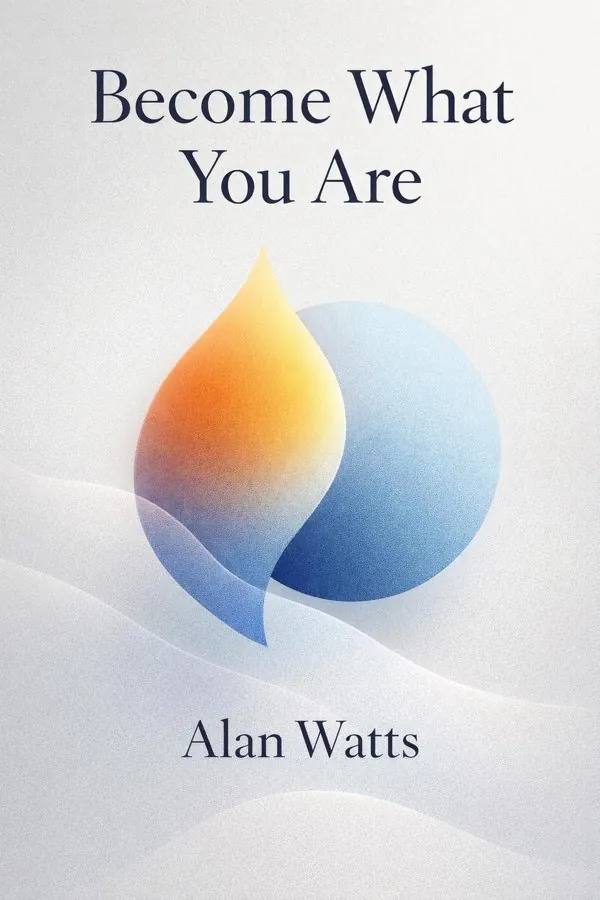
Become What You Are: Summary & Key Insights
by Alan Watts
 10 min8 chaptersAudio available
What Is Become What You Are About?
Become What You Are by Alan Watts is a eastern_wisdom book spanning 8 pages. A collection of essays by Alan Watts exploring the nature of self, identity, and the process of becoming. Written in Watts’s distinctive philosophical style, the book delves into Eastern and Western perspectives on consciousness, freedom, and authenticity.
This FizzRead summary covers all 8 key chapters of Become What You Are in approximately 10 minutes, distilling the most important ideas, arguments, and takeaways from Alan Watts's work. Also available as an audio summary and Key Quotes Podcast.
Become What You Are
A collection of essays by Alan Watts exploring the nature of self, identity, and the process of becoming. Written in Watts’s distinctive philosophical style, the book delves into Eastern and Western perspectives on consciousness, freedom, and authenticity.
Who Should Read Become What You Are?
This book is perfect for anyone interested in eastern_wisdom and looking to gain actionable insights in a short read. Whether you're a student, professional, or lifelong learner, the key ideas from Become What You Are by Alan Watts will help you think differently.
- ✓Readers who enjoy eastern_wisdom and want practical takeaways
- ✓Professionals looking to apply new ideas to their work and life
- ✓Anyone who wants the core insights of Become What You Are in just 10 minutes
Want the full summary?
Get instant access to this book summary and 100K+ more with Fizz Moment.
Get Free SummaryAvailable on App Store • Free to download
Key Chapters
We begin with the notion most fundamental to human confusion: the idea that you are a lonely ego, an entity enclosed in skin and divided from others and the world. This sense of separation is a conceptual trick—useful for survival but disastrous for understanding. The ego, as I describe, is nothing more than the mental image we hold of ourselves, a selective memory of habits, roles, and stories. It is a process of imagining, not a solid thing. Yet we cling to it fiercely. The belief in an isolated 'I' turns the universe into something external, a place of struggle where we must fight to establish control.
In truth, there is no boundary where you end and the world begins. The air you breathe was not made by you; your body is composed of minerals and water that once belonged to mountains and oceans. When you look deeply, the idea of autonomy dissolves. This insight may sound mystical, but it is profoundly practical. Our anxieties—about success, time, death—are born from this division. The moment we identify ourselves as separate, we start defending that identity. But life is not an enemy to be subdued; it is a dance, and your conscious experience is simply one movement of its rhythm.
I often compare this realization to the experience of music. A musical note doesn’t exist alone; its meaning arises from relations to other notes. Likewise, your identity finds significance only through relationship with everything else. Once you grasp this, you stop confronting reality and start participating in it. This is the end of loneliness, the cure for the neurosis of separation. It is the awakening that Zen calls seeing your true nature.
Reality, when undistorted by our conceptual frames, reveals itself as a seamless process. It is not composed of isolated things but of endless transformations. From Taoism we learn that this process—the Tao—is spontaneous and unforced. From Zen we learn that attempting to describe this flow in words inevitably distorts it. What can be known directly through experience cannot be confined in ideas.
When I speak of reality as interdependence, I am not making a metaphysical claim; I am pointing to what can be observed. Every form arises because of every other form. You cannot have a figure without a background; you cannot have being without nonbeing. Life and death, pleasure and pain, self and other—all define and contain each other. To perceive only one polarity and reject the other is to live half-conscious.
In our habitual Western mode, we look for controlling principles—a God outside creation, a set of laws behind the universe—but the Eastern vision sees divinity not behind things but in things. The Tao is not a creator; it is the creative happening itself. Such understanding does not diminish rational inquiry; it complements it by reminding us that intelligence pervades the entire fabric of existence. When you see that the universe plays itself as a grand harmony of opposites, you cease trying to make life fit your concepts. You flow with it.
+ 6 more chapters — available in the FizzRead app
All Chapters in Become What You Are
About the Author
Alan Watts (1915–1973) was a British philosopher, writer, and speaker known for interpreting and popularizing Eastern philosophy for Western audiences. His works often explore Zen Buddhism, Taoism, and the nature of consciousness.
Get This Summary in Your Preferred Format
Read or listen to the Become What You Are summary by Alan Watts anytime, anywhere. FizzRead offers multiple formats so you can learn on your terms — all free.
Available formats: App · Audio · PDF · EPUB — All included free with FizzRead
Download Become What You Are PDF and EPUB Summary
Key Quotes from Become What You Are
“We begin with the notion most fundamental to human confusion: the idea that you are a lonely ego, an entity enclosed in skin and divided from others and the world.”
“Reality, when undistorted by our conceptual frames, reveals itself as a seamless process.”
Frequently Asked Questions about Become What You Are
Become What You Are by Alan Watts is a eastern_wisdom book that explores key ideas across 8 chapters. A collection of essays by Alan Watts exploring the nature of self, identity, and the process of becoming. Written in Watts’s distinctive philosophical style, the book delves into Eastern and Western perspectives on consciousness, freedom, and authenticity.
More by Alan Watts
You Might Also Like
A New Earth
Eckhart Tolle
10 min
The Daily Stoic
Ryan Holiday, Stephen Hanselman
10 min
Buddhism: Plain and Simple
Steve Hagen
10 min
Enchiridion
Epictetus
10 min
The Book of Tea
Kakuzō Okakura
10 min
The Light We Give: How Sikh Wisdom Can Transform Your Life
Simran Jeet Singh
10 minFeatured In
Browse by Category
Ready to read Become What You Are?
Get the full summary and 100K+ more books with Fizz Moment.