

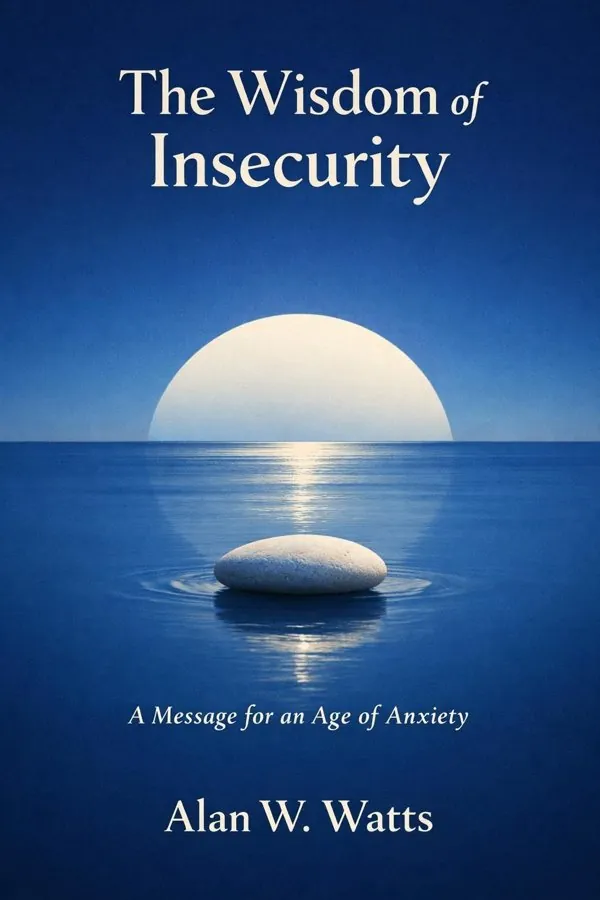
The Wisdom of Insecurity: A Message for an Age of Anxiety: Summary & Key Insights
by Alan Watts
 10 min9 chaptersAudio available
What Is The Wisdom of Insecurity: A Message for an Age of Anxiety About?
The Wisdom of Insecurity: A Message for an Age of Anxiety by Alan Watts is a eastern_wisdom book spanning 9 pages. In this philosophical classic, Alan Watts explores the paradox of seeking security in an inherently insecure world. He argues that true peace and happiness come not from clinging to certainty but from embracing the present moment and the flow of life. Drawing on insights from Eastern philosophy and modern psychology, Watts offers a profound reflection on the human condition and the art of living fully in the now.
This FizzRead summary covers all 9 key chapters of The Wisdom of Insecurity: A Message for an Age of Anxiety in approximately 10 minutes, distilling the most important ideas, arguments, and takeaways from Alan Watts's work. Also available as an audio summary and Key Quotes Podcast.
The Wisdom of Insecurity: A Message for an Age of Anxiety
In this philosophical classic, Alan Watts explores the paradox of seeking security in an inherently insecure world. He argues that true peace and happiness come not from clinging to certainty but from embracing the present moment and the flow of life. Drawing on insights from Eastern philosophy and modern psychology, Watts offers a profound reflection on the human condition and the art of living fully in the now.
Who Should Read The Wisdom of Insecurity: A Message for an Age of Anxiety?
This book is perfect for anyone interested in eastern_wisdom and looking to gain actionable insights in a short read. Whether you're a student, professional, or lifelong learner, the key ideas from The Wisdom of Insecurity: A Message for an Age of Anxiety by Alan Watts will help you think differently.
- ✓Readers who enjoy eastern_wisdom and want practical takeaways
- ✓Professionals looking to apply new ideas to their work and life
- ✓Anyone who wants the core insights of The Wisdom of Insecurity: A Message for an Age of Anxiety in just 10 minutes
Want the full summary?
Get instant access to this book summary and 100K+ more with Fizz Moment.
Get Free SummaryAvailable on App Store • Free to download
Key Chapters
We compulsively seek security—in love, money, status, even our beliefs. We build systems, religions, and ideologies around the promise that they will protect us from the unknown. Yet, the more we tighten our grip, the more we feel something slipping away. The brain insists that it can plan, calculate, and ensure the future, but the heart knows that life remains mysterious and untamed.
The need for perfect safety is the very engine of fear. For when we demand guarantees from a world that offers none, anxiety naturally arises. You may have noticed this paradox in your own life: at the very moment you acquire some stability, a small but unmistakable unease whispers, 'What if I lose it?' The attempt to secure pleasure, love, or existence itself makes us painfully aware of their impermanence.
The problem of security, then, is not that we lack it, but that we expect the impossible—that life should stand still. The solution is not to become careless or fatalistic, but to recognize that security, as we imagine it, is an illusion based on denial of change. When we love people as if they were fixed entities, we kill the spark of relationship; when we live today only for the sake of tomorrow, we die without ever having lived.
The Western mind has inherited from both religion and science a strange dualism—a belief in the separation between self and world, mind and body, eternal truth and temporal change. We yearn for something permanent—a heaven that never fades, a soul that never dies, a truth that outlasts time. Yet this craving blinds us to the fact that the essence of life is movement.
Look at the sea. Its waves are never still, but the sea itself remains the sea precisely because it moves. So it is with us. We misunderstand existence by imagining that there must be a stable, separate 'I' behind all the flux. But that 'I' is a concept, an image in memory—not a living process. The sense of self is like the surface of water: real, but never static.
When you see this clearly, the illusion of permanence dissolves like mist. Loss and change cease to be enemies; they become expressions of the same dynamic unity that gives life meaning. Instead of seeking immutability, we discover a deeper security in flow itself. In the impermanence of all forms lies the continuity of energy, the dance of being in which we are always participating.
+ 7 more chapters — available in the FizzRead app
All Chapters in The Wisdom of Insecurity: A Message for an Age of Anxiety
About the Author
Alan Watts (1915–1973) was a British philosopher, writer, and speaker best known for interpreting and popularizing Eastern philosophy for Western audiences. His works on Zen Buddhism, Taoism, and the nature of consciousness have influenced generations of readers seeking spiritual insight and self-understanding.
Get This Summary in Your Preferred Format
Read or listen to the The Wisdom of Insecurity: A Message for an Age of Anxiety summary by Alan Watts anytime, anywhere. FizzRead offers multiple formats so you can learn on your terms — all free.
Available formats: App · Audio · PDF · EPUB — All included free with FizzRead
Download The Wisdom of Insecurity: A Message for an Age of Anxiety PDF and EPUB Summary
Key Quotes from The Wisdom of Insecurity: A Message for an Age of Anxiety
“We compulsively seek security—in love, money, status, even our beliefs.”
“The Western mind has inherited from both religion and science a strange dualism—a belief in the separation between self and world, mind and body, eternal truth and temporal change.”
Frequently Asked Questions about The Wisdom of Insecurity: A Message for an Age of Anxiety
The Wisdom of Insecurity: A Message for an Age of Anxiety by Alan Watts is a eastern_wisdom book that explores key ideas across 9 chapters. In this philosophical classic, Alan Watts explores the paradox of seeking security in an inherently insecure world. He argues that true peace and happiness come not from clinging to certainty but from embracing the present moment and the flow of life. Drawing on insights from Eastern philosophy and modern psychology, Watts offers a profound reflection on the human condition and the art of living fully in the now.
More by Alan Watts



You Might Also Like

A New Earth
Eckhart Tolle
10 min
The Daily Stoic
Ryan Holiday, Stephen Hanselman
10 min
Buddhism: Plain and Simple
Steve Hagen
10 min
Enchiridion
Epictetus
10 min
The Book of Tea
Kakuzō Okakura
10 min
The Light We Give: How Sikh Wisdom Can Transform Your Life
Simran Jeet Singh
10 minBrowse by Category
Ready to read The Wisdom of Insecurity: A Message for an Age of Anxiety?
Get the full summary and 100K+ more books with Fizz Moment.