
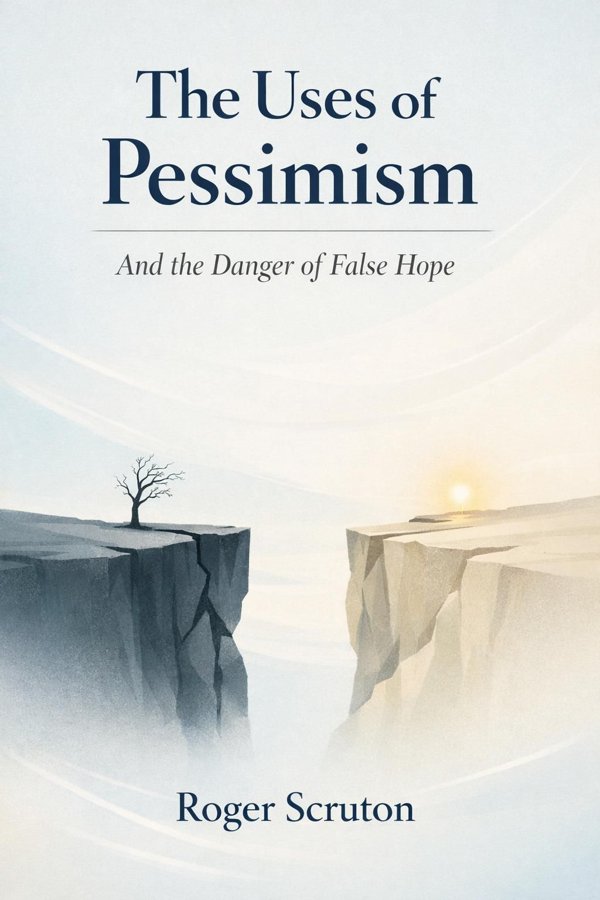
The Uses of Pessimism: And the Danger of False Hope: Summary & Key Insights
 10 min10 chaptersAudio available
What Is The Uses of Pessimism: And the Danger of False Hope About?
The Uses of Pessimism: And the Danger of False Hope by Roger Scruton is a western_phil book spanning 10 pages. In this philosophical work, Roger Scruton argues that optimism, when detached from reality, can lead to destructive social and political outcomes. He defends a rational form of pessimism as a necessary counterbalance to utopian thinking, exploring how false hopes have shaped modern ideologies and undermined moral responsibility.
This FizzRead summary covers all 10 key chapters of The Uses of Pessimism: And the Danger of False Hope in approximately 10 minutes, distilling the most important ideas, arguments, and takeaways from Roger Scruton's work. Also available as an audio summary and Key Quotes Podcast.
The Uses of Pessimism: And the Danger of False Hope
In this philosophical work, Roger Scruton argues that optimism, when detached from reality, can lead to destructive social and political outcomes. He defends a rational form of pessimism as a necessary counterbalance to utopian thinking, exploring how false hopes have shaped modern ideologies and undermined moral responsibility.
Who Should Read The Uses of Pessimism: And the Danger of False Hope?
This book is perfect for anyone interested in western_phil and looking to gain actionable insights in a short read. Whether you're a student, professional, or lifelong learner, the key ideas from The Uses of Pessimism: And the Danger of False Hope by Roger Scruton will help you think differently.
- ✓Readers who enjoy western_phil and want practical takeaways
- ✓Professionals looking to apply new ideas to their work and life
- ✓Anyone who wants the core insights of The Uses of Pessimism: And the Danger of False Hope in just 10 minutes
Want the full summary?
Get instant access to this book summary and 100K+ more with Fizz Moment.
Get Free SummaryAvailable on App Store • Free to download
Key Chapters
False hope enters the moral world through our yearning for control and certainty. We wish to abolish suffering, to perfect society, to eradicate the flaws that make human existence tragic. But these desires, though understandable, become destructive when they harden into an ideology. False hope, in the sense I use it, is the belief that we can transcend the limits of human nature through reason, technology, or politics — that imperfection itself is an error to be corrected rather than a permanent condition to be endured.
History offers endless lessons in this regard. The revolutions of the twentieth century, from Bolshevism to radical social engineering schemes, operated under the banner of hope — hope for equality, abundance, freedom without restraint. They promised to liberate humanity but achieved only tyranny and despair. False hope blinds its believers to unintended consequences. When we imagine we can make men better by changing external conditions alone, we forget that moral growth depends on internal reflection and self-discipline. Institutions are not mere prisons; they are stabilizing forms through which our flawed nature finds order.
My purpose in identifying false hope is not to mock idealism but to rescue it from its delusions. Hope has its rightful place — as an orientation toward the good, tempered by respect for what is possible. Only when we know the boundaries of our power can we preserve what is truly precious. Rational pessimism, therefore, is not opposed to hope but to the falsity that masquerades as hope. It insists that the moral life begins with realism and that genuine improvement arises from humble acts within the world we actually inhabit, not from fantasies of transforming human nature itself.
We are inclined to judge plans and ideologies by their imagined success rather than their probable outcome. The fallacy of the best case arises when we assume everything will go right, that all agents will cooperate, that every contingency will be favorable. In politics and business alike, this fallacy is endemic. We construct grand scenarios in which human motives align perfectly with our ideals, and then we are astonished when the real world refuses to conform.
Consider the modern tendency toward large-scale social experiments — massive welfare systems, international institutions, global interventions. In their planning phase, these schemes appear flawless because they presuppose rational actors and benevolent cooperation. But human life is not an algorithm; it is a drama of conflicting desires, misunderstandings, and moral failures. The pessimist asks: what happens when self-interest, ignorance, or envy intrudes? What costs are we prepared to bear when the dream collapses into reality?
This fallacy is not confined to public policy; it pervades private life as well. We marry, invest, and plan careers as though the world would honor our projections. Yet the virtue of pessimism teaches us to imagine failure, to evaluate the fragile links that hold our arrangements together. To recognize potential failure is not to forsake action; it is to act wisely, with steady courage rather than reckless hope. In acknowledging what could go wrong, we preserve the possibility of what might endure.
+ 8 more chapters — available in the FizzRead app
All Chapters in The Uses of Pessimism: And the Danger of False Hope
About the Author
Roger Scruton (1944–2020) was a British philosopher, writer, and public intellectual known for his contributions to aesthetics, political philosophy, and conservatism. He authored numerous books on culture, art, and ethics, and was recognized for his defense of traditional values and critical engagement with modern thought.
Get This Summary in Your Preferred Format
Read or listen to the The Uses of Pessimism: And the Danger of False Hope summary by Roger Scruton anytime, anywhere. FizzRead offers multiple formats so you can learn on your terms — all free.
Available formats: App · Audio · PDF · EPUB — All included free with FizzRead
Download The Uses of Pessimism: And the Danger of False Hope PDF and EPUB Summary
Key Quotes from The Uses of Pessimism: And the Danger of False Hope
“False hope enters the moral world through our yearning for control and certainty.”
“We are inclined to judge plans and ideologies by their imagined success rather than their probable outcome.”
Frequently Asked Questions about The Uses of Pessimism: And the Danger of False Hope
The Uses of Pessimism: And the Danger of False Hope by Roger Scruton is a western_phil book that explores key ideas across 10 chapters. In this philosophical work, Roger Scruton argues that optimism, when detached from reality, can lead to destructive social and political outcomes. He defends a rational form of pessimism as a necessary counterbalance to utopian thinking, exploring how false hopes have shaped modern ideologies and undermined moral responsibility.
More by Roger Scruton


You Might Also Like
A Little History of Philosophy
Nigel Warburton
10 min
Areopagitica
John Milton
10 min
How To Think Like A Philosopher: Essential Principles For Clear Thinking
Peter Cave
10 min
Language, Truth and Logic
A. J. Ayer
10 min
The Age of Reason
Thomas Paine
10 min
The Essays
Michel De Montaigne
10 minBrowse by Category
Ready to read The Uses of Pessimism: And the Danger of False Hope?
Get the full summary and 100K+ more books with Fizz Moment.