
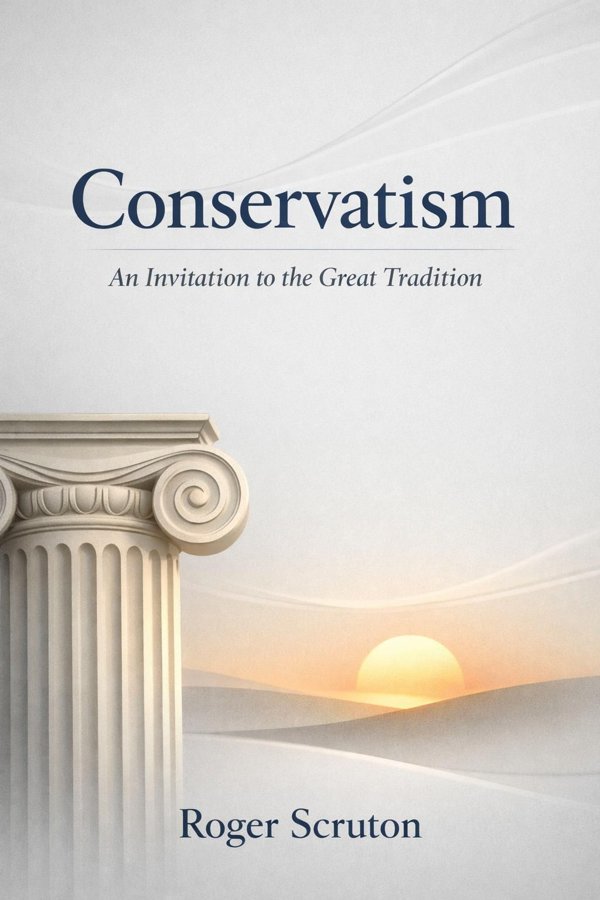
Conservatism: An Invitation to the Great Tradition: Summary & Key Insights
 10 min9 chaptersAudio available
Key Takeaways from Conservatism: An Invitation to the Great Tradition
Conservatives did not deny that injustice existed.
A society survives not only by laws and force, but by imagination—the ability to see institutions, duties, and inherited forms as worthy of love.
Even in secular societies, people continue to hunger for the sacred.
Freedom is rarely secured in the abstract; it is usually protected within a home.
Ownership does more than distribute wealth; it teaches stewardship.
What Is Conservatism: An Invitation to the Great Tradition About?
Conservatism: An Invitation to the Great Tradition by Roger Scruton is a politics book spanning 9 pages. Roger Scruton’s Conservatism: An Invitation to the Great Tradition is a lucid and deeply felt defense of the conservative mind. Rather than treating conservatism as mere resistance to change or loyalty to a political party, Scruton presents it as a moral and cultural inheritance: a way of valuing what has been built over generations and of protecting the fragile institutions that make freedom, order, and belonging possible. He traces conservatism from its reaction to the French Revolution through its major themes—tradition, religion, nationhood, property, education, moral order, and skepticism toward utopian schemes. What makes this book especially valuable is Scruton’s ability to combine philosophical seriousness with practical insight. He shows that conservative thought begins not in abstract theories about how society should be redesigned, but in gratitude for the customs, loyalties, and laws that allow people to live together in peace. Few modern thinkers were better equipped to make this case. As one of the most influential conservative philosophers of the past century, Scruton writes with historical depth, literary elegance, and a lifetime of engagement with politics, culture, and the moral foundations of civilization.
This FizzRead summary covers all 9 key chapters of Conservatism: An Invitation to the Great Tradition in approximately 10 minutes, distilling the most important ideas, arguments, and takeaways from Roger Scruton's work. Also available as an audio summary and Key Quotes Podcast.
Conservatism: An Invitation to the Great Tradition
Roger Scruton’s Conservatism: An Invitation to the Great Tradition is a lucid and deeply felt defense of the conservative mind. Rather than treating conservatism as mere resistance to change or loyalty to a political party, Scruton presents it as a moral and cultural inheritance: a way of valuing what has been built over generations and of protecting the fragile institutions that make freedom, order, and belonging possible. He traces conservatism from its reaction to the French Revolution through its major themes—tradition, religion, nationhood, property, education, moral order, and skepticism toward utopian schemes. What makes this book especially valuable is Scruton’s ability to combine philosophical seriousness with practical insight. He shows that conservative thought begins not in abstract theories about how society should be redesigned, but in gratitude for the customs, loyalties, and laws that allow people to live together in peace. Few modern thinkers were better equipped to make this case. As one of the most influential conservative philosophers of the past century, Scruton writes with historical depth, literary elegance, and a lifetime of engagement with politics, culture, and the moral foundations of civilization.
Who Should Read Conservatism: An Invitation to the Great Tradition?
This book is perfect for anyone interested in politics and looking to gain actionable insights in a short read. Whether you're a student, professional, or lifelong learner, the key ideas from Conservatism: An Invitation to the Great Tradition by Roger Scruton will help you think differently.
- ✓Readers who enjoy politics and want practical takeaways
- ✓Professionals looking to apply new ideas to their work and life
- ✓Anyone who wants the core insights of Conservatism: An Invitation to the Great Tradition in just 10 minutes
Want the full summary?
Get instant access to this book summary and 100K+ more with Fizz Moment.
Get Free SummaryAvailable on App Store • Free to download
Key Chapters
Conservatism begins with a question that modern politics often forgets to ask: what if the social order we inherit contains wisdom that no single generation could invent for itself? Scruton argues that the conservative temperament arose in response to the upheavals of the eighteenth century, especially the French Revolution, when sweeping theories of liberation promised to rebuild society on purely rational foundations. Conservatives did not deny that injustice existed. Their concern was that tearing down institutions in the name of abstract ideals often destroys the slow, unplanned achievements that make civilized life possible.
For Scruton, conservatism is not simply a doctrine but a disposition. It begins in gratitude rather than resentment, in affection for the familiar rather than faith in total reinvention. Families, legal systems, local communities, customs, and inherited moral norms are not accidental leftovers from the past. They are social achievements shaped by trial and error, sacrifice, and adaptation over time. Because they evolved to meet real human needs, they deserve respect even when they are imperfect.
This way of thinking has immediate relevance. In workplaces, schools, or governments, leaders often rush to replace old systems with new ones because novelty feels efficient or progressive. Yet many practices that appear outdated embody hard-won experience. A school uniform, a legal ceremony, a neighborhood association, or a parliamentary rule may carry moral meaning that is not visible at first glance. To abolish such things without understanding their function can weaken the habits of trust and continuity that hold people together.
Scruton’s point is not that all inherited practices are good, but that reform should begin with humility. Before changing an institution, ask what human goods it protects and what unintended losses reform might bring. Actionable takeaway: when confronted with calls for radical change, first identify what is worth preserving and why.
A society survives not only by laws and force, but by imagination—the ability to see institutions, duties, and inherited forms as worthy of love. Scruton places Edmund Burke at the center of the conservative tradition because Burke understood that political life depends on sentiments as much as on principles. Burke’s critique of the French Revolution was not merely that it was violent, but that it treated society as raw material for ideological redesign. In doing so, it severed people from the customs, symbols, and loyalties that make freedom humane and sustainable.
The phrase “moral imagination” captures Burke’s insight. Human beings do not flourish by abstract rights alone. They need ceremonies, manners, habits of restraint, and reverence for institutions that teach them how to live with others. A constitution, a crown, a church, a court, or a family is not only a mechanism; it is also a source of meaning. When these are mocked as irrational relics, society may become more efficient in theory yet poorer in spirit.
Scruton uses Burke to show that conservatism values reform, but reform guided by imagination rather than destruction. Burke supported the American colonists because he believed they were defending inherited liberties. He opposed the French Revolution because he saw it replacing living traditions with doctrinaire abstractions. The lesson is that prudent change respects continuity. It mends what is broken while preserving the emotional and moral bonds that give institutions legitimacy.
This applies today whenever people debate history, public monuments, school curricula, or constitutional norms. A purely technocratic mindset asks what works. The conservative mindset also asks what deserves allegiance. Actionable takeaway: before dismissing a tradition or symbol as outdated, consider what habits of belonging, restraint, or gratitude it may be quietly sustaining.
Even in secular societies, people continue to hunger for the sacred. Scruton argues that religion has been central to the conservative tradition not only because of theology, but because it teaches reverence—an attitude of respect toward things that should not be treated as disposable. Conservatism, in his account, recognizes that human beings do not live by contracts and interests alone. They live by loves, loyalties, obligations, and a sense that some things are higher than personal desire.
Religion historically gave shape to this experience. It sanctified marriage, burial, law, festivals, charity, and the calendar of communal life. It reminded people that they belong to a moral order not of their own making. For Scruton, when the sacred disappears entirely, societies often do not become more rational; they become more vulnerable to substitute faiths—political cults, ideological movements, and utopian projects that demand total devotion. The twentieth century offered devastating examples of secular ideologies behaving like religions while lacking religion’s restraints, humility, and acknowledgment of human fallibility.
This does not mean conservatism requires a theocracy or that unbelievers cannot be conservative. Scruton’s larger point is that civilizations need spaces of reverence. These may include churches, memorials, rituals of mourning, civic ceremonies, and the moral language of duty and sacrifice. A society that desacralizes everything risks producing citizens who see no reason to honor boundaries or inheritances.
In practical terms, this idea matters in debates about education, family life, and public culture. Communities need rituals that remind people they are not self-created and not alone. Parents who preserve family traditions, citizens who honor the dead, and schools that teach respect rather than pure self-expression are all sustaining this moral ecology. Actionable takeaway: cultivate at least one shared ritual or place of reverence in your life that reminds you of duties beyond the self.
Freedom is rarely secured in the abstract; it is usually protected within a home. For Scruton, the nation is one of conservatism’s most important concepts because it creates the shared loyalty that allows strangers to accept laws, make sacrifices, and live under common institutions. A nation is not simply a state with borders or an economy with regulations. It is a historical community bound by memory, territory, language, customs, and a sense of mutual belonging.
Scruton distinguishes national loyalty from aggressive nationalism. The former is an affection for a political home; the latter often becomes a dangerous ideology of superiority. Conservatism, as he presents it, defends the nation because democratic accountability and the rule of law depend on a people who recognize each other as “we.” Without that bond, politics can become transactional, fragmented, or imperial. Citizens cease to feel responsible for one another, and public institutions lose legitimacy.
This idea has contemporary force in an age of globalization. Large bureaucratic structures may coordinate markets and regulations, but they often struggle to inspire civic trust. People are more willing to obey laws, pay taxes, serve in emergencies, and compromise with opponents when they believe they share a common inheritance. Local and national attachments can coexist with openness to the wider world, but they cannot be replaced by abstract humanity alone.
In daily life, national loyalty is expressed in ordinary things: learning a country’s history, honoring its legal traditions, preserving landscapes and monuments, respecting its constitutional forms, and welcoming newcomers into a culture rather than pretending culture does not matter. Scruton’s defense of the nation is therefore also a defense of political responsibility. Actionable takeaway: strengthen civic belonging by learning the history, institutions, and cultural habits that make your political community more than a marketplace.
Ownership does more than distribute wealth; it teaches stewardship. Scruton emphasizes property as a core conservative institution because it links freedom with responsibility. To own something—a house, a plot of land, a business, a tool, a family heirloom—is to have a protected sphere in which one can act without constant permission from the state or from others. But property is not merely private power. It also binds people to the future, encouraging care, maintenance, and accountability.
For conservatism, property underwrites civil society. Homeowners maintain neighborhoods, family firms build local trust, and independent institutions flourish when people have stable domains they can manage. By contrast, when everything is centralized or treated as collectively owned in theory but bureaucratically managed in practice, responsibility often becomes diffuse. If no one truly owns what everyone uses, neglect can follow. Scruton therefore sees property as a moral practice as much as an economic arrangement.
This view does not mean all forms of wealth are automatically good or that markets should go unchecked. Conservatives are wary of concentrations of power whether in the state or in private monopolies. The key point is that a society of owners is healthier than a society of dependents. Property gives people incentives to preserve rather than exploit, to invest rather than consume, and to think across generations.
Examples are easy to see. Families who save for a home often become more rooted in community life. Farmers care for land differently when their children will inherit it. Small business owners often display a long-term concern for reputation that short-term administrators lack. Actionable takeaway: wherever possible, build forms of ownership and stewardship in your life—whether of property, responsibilities, or institutions—so your freedom is tied to care rather than mere consumption.
The real political question is not whether society should change, but how. Scruton rejects the caricature that conservatives simply oppose change. Human societies always change, and many traditions survive precisely because they adapt. What conservatism resists is reckless change driven by ideology, impatience, or contempt for inherited forms. The conservative approach is reformist rather than revolutionary: preserve what works, repair what is damaged, and alter institutions only with full awareness of the goods they embody.
This principle rests on a sober understanding of human limits. No planner, politician, or intellectual possesses enough knowledge to redesign a complex society from first principles. Institutions such as marriage, courts, local governments, schools, and professional norms carry tacit knowledge accumulated across generations. Their purposes are often broader than their formal rules. If reformers look only at visible inefficiencies, they may remove hidden sources of stability, loyalty, and trust.
Scruton’s account of change resembles careful restoration rather than demolition. A decaying building is not improved by leveling it simply because restoration is slow. Likewise, a flawed institution should not be discarded until we understand what irreplaceable functions it serves. This is not complacency. It is prudence. Conservatives can support abolition of bad laws, expansion of rights, or modernization of old systems—but they insist on continuity, legitimacy, and respect for social fabric.
In practical life, this mindset helps in organizations and families as much as in politics. A new manager should not scrap routines before learning why they exist. Parents should update traditions without erasing the rituals that create belonging. Governments should pilot reforms, test consequences, and preserve institutional memory. Actionable takeaway: whenever you seek change, identify what must remain continuous so that reform strengthens trust instead of dissolving it.
The most dangerous political ideas are often the most flattering ones—the ones that promise to remove conflict, suffering, and imperfection altogether. Scruton warns that conservatism’s enduring role is to oppose utopianism: the belief that society can be remade into harmony if only the right theory gains power. Such ideologies usually begin by diagnosing real grievances, but they turn destructive when they reduce human beings to categories and institutions to obstacles.
Utopian politics treats the world as if it were simple enough to fit a blueprint. It imagines that old loyalties—family, religion, nation, custom—are merely instruments of oppression and can be swept away without moral loss. Yet because human beings are flawed, attached, and historically situated, these schemes inevitably collide with reality. When they fail, ideologues rarely blame the theory. They blame saboteurs, enemies, or the people themselves. This is why utopian movements so often slide toward coercion.
Scruton’s conservative alternative is not cynicism but realism. Human life contains tragedy, trade-offs, unintended consequences, and permanent tensions between freedom and order, rights and duties, loyalty and justice. Good politics does not promise paradise. It creates conditions in which ordinary people can pursue decent lives under lawful institutions. That is a humbler vision, but a safer and more humane one.
The lesson applies beyond politics. In business, education, and personal development, grand schemes that ignore human complexity often disappoint. The manager who seeks total cultural transformation overnight may destroy morale. The activist who sees all compromise as betrayal may achieve nothing durable. Actionable takeaway: be suspicious of any program that promises moral purity or total social renewal, and favor solutions that acknowledge limits, trade-offs, and the need for gradual correction.
A civilization endures only if it teaches itself to the next generation. Scruton gives culture and education a central place in conservative thought because political order cannot survive without moral and aesthetic formation. Laws may restrain conduct, but they cannot by themselves produce good judgment, self-command, or love of what is noble. Those qualities are cultivated through families, schools, literature, music, religion, and the countless informal practices by which a society hands down standards of excellence.
For Scruton, education is not merely vocational training or the transfer of technical skills. It is initiation into a cultural world. Students should inherit a language rich in meaning, encounter great works of art and philosophy, and learn to admire achievements larger than themselves. This process is not oppressive simply because it transmits the past. On the contrary, genuine freedom requires access to a moral and cultural inheritance that expands the soul and deepens judgment.
When education becomes purely utilitarian or relentlessly politicized, it ceases to conserve civilization. Students may learn to critique everything while loving nothing. They may become fluent in suspicion but unable to recognize beauty, gratitude, or obligation. Scruton believes this hollowness leaves societies culturally defenseless and spiritually exhausted.
The practical implications are far-reaching. Parents who read classic stories aloud, teachers who insist on discipline and intellectual seriousness, communities that maintain local arts and rituals, and institutions that honor excellence rather than fashion are all preserving civilizational continuity. A culture cannot be outsourced; it must be practiced. Actionable takeaway: deliberately pass on one element of cultural inheritance—books, music, stories, manners, or rituals—to someone younger, so transmission becomes a living act rather than a theory.
The modern world does not make conservatism obsolete; it makes it necessary. Scruton argues that the pressures of globalization, technological acceleration, bureaucratic expansion, and cultural fragmentation have intensified the need for a philosophy of home, continuity, and restraint. When economies become abstract, communities mobile, and identities unstable, people can lose the institutions that once gave life coherence. Conservatism responds by asking how freedom can remain rooted rather than weightless.
This does not mean trying to freeze society in an earlier age. Scruton knew that contemporary life includes pluralism, rapid innovation, and changed social realities. The conservative task is to humanize modernity by defending the mediating institutions between isolated individuals and impersonal power: families, neighborhoods, churches, local associations, schools, and nations. These are the places where responsibility is learned and belonging is experienced.
He is also attentive to modern threats that come from both state and market. The centralizing state can weaken initiative and local responsibility, while consumer culture can dissolve inherited values into appetite and entertainment. Conservatism therefore cannot be reduced to economic libertarianism or administrative managerialism. It is a broader defense of civilizational health.
Today this perspective can guide responses to digital life, polarization, urban anonymity, and institutional distrust. The question is always the same: what practices and loyalties keep people connected to real places, real responsibilities, and real one another? Communities that preserve public spaces, families that defend shared time, and citizens who revive local participation are practicing conservatism in action. Actionable takeaway: choose one modern convenience or habit that weakens your ties to place or community, and counterbalance it with a regular practice of local, embodied participation.
All Chapters in Conservatism: An Invitation to the Great Tradition
About the Author
Roger Scruton (1944–2020) was a British philosopher, essayist, novelist, and cultural critic whose work ranged across political philosophy, aesthetics, religion, architecture, and education. One of the leading conservative thinkers of his era, he wrote more than fifty books and became known for his defense of tradition, beauty, national loyalty, and the moral foundations of social order. Scruton taught at several universities, contributed widely to public debate, and remained an influential voice in both academic and popular discussions of culture and politics. His prose combined philosophical seriousness with literary elegance, allowing him to address complex ideas in a way that reached broad audiences. In works such as Conservatism: An Invitation to the Great Tradition, he sought to articulate conservatism not as a partisan reflex, but as a humane philosophy of stewardship, continuity, and civilized life.
Get This Summary in Your Preferred Format
Read or listen to the Conservatism: An Invitation to the Great Tradition summary by Roger Scruton anytime, anywhere. FizzRead offers multiple formats so you can learn on your terms — all free.
Available formats: App · Audio · PDF · EPUB — All included free with FizzRead
Download Conservatism: An Invitation to the Great Tradition PDF and EPUB Summary
Key Quotes from Conservatism: An Invitation to the Great Tradition
“Conservatism begins with a question that modern politics often forgets to ask: what if the social order we inherit contains wisdom that no single generation could invent for itself?”
“A society survives not only by laws and force, but by imagination—the ability to see institutions, duties, and inherited forms as worthy of love.”
“Even in secular societies, people continue to hunger for the sacred.”
“Freedom is rarely secured in the abstract; it is usually protected within a home.”
“Ownership does more than distribute wealth; it teaches stewardship.”
Frequently Asked Questions about Conservatism: An Invitation to the Great Tradition
Conservatism: An Invitation to the Great Tradition by Roger Scruton is a politics book that explores key ideas across 9 chapters. Roger Scruton’s Conservatism: An Invitation to the Great Tradition is a lucid and deeply felt defense of the conservative mind. Rather than treating conservatism as mere resistance to change or loyalty to a political party, Scruton presents it as a moral and cultural inheritance: a way of valuing what has been built over generations and of protecting the fragile institutions that make freedom, order, and belonging possible. He traces conservatism from its reaction to the French Revolution through its major themes—tradition, religion, nationhood, property, education, moral order, and skepticism toward utopian schemes. What makes this book especially valuable is Scruton’s ability to combine philosophical seriousness with practical insight. He shows that conservative thought begins not in abstract theories about how society should be redesigned, but in gratitude for the customs, loyalties, and laws that allow people to live together in peace. Few modern thinkers were better equipped to make this case. As one of the most influential conservative philosophers of the past century, Scruton writes with historical depth, literary elegance, and a lifetime of engagement with politics, culture, and the moral foundations of civilization.
More by Roger Scruton
You Might Also Like

Antifa: The Anti-Fascist Handbook
Mark Bray
10 min
Attack from Within: How Disinformation Is Sabotaging America
Barbara McQuade
10 min
Coercion, Capital, and European States, AD 990–1992
Charles Tilly
10 min
Digital Democracy: Concepts, Methodologies, Tools, and Applications
Various Authors
10 min
Fascism
Stanley G. Payne
10 min
Fire And Fury: Inside The Trump White House
Michael Wolff
10 minBrowse by Category
Ready to read Conservatism: An Invitation to the Great Tradition?
Get the full summary and 100K+ more books with Fizz Moment.