
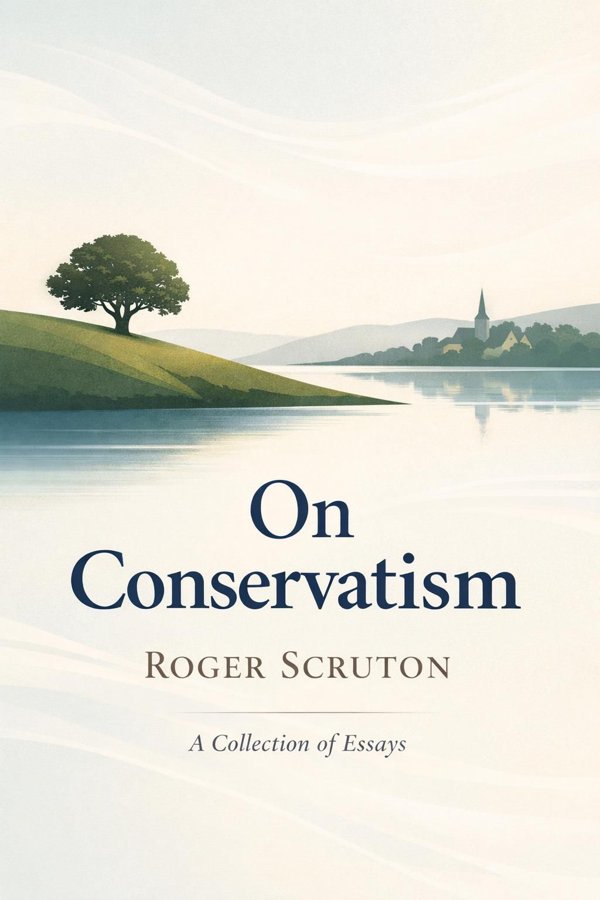
On Conservatism: A Collection of Essays: Summary & Key Insights
 10 min13 chaptersAudio available
What Is On Conservatism: A Collection of Essays About?
On Conservatism: A Collection of Essays by Roger Scruton is a politics book spanning 13 pages. This collection of essays by British philosopher Roger Scruton explores the intellectual foundations, moral vision, and cultural significance of conservatism. Drawing on political philosophy, history, and aesthetics, Scruton articulates a defense of conservative thought as a philosophy rooted in love of home, tradition, and the social order that sustains human flourishing.
This FizzRead summary covers all 13 key chapters of On Conservatism: A Collection of Essays in approximately 10 minutes, distilling the most important ideas, arguments, and takeaways from Roger Scruton's work. Also available as an audio summary and Key Quotes Podcast.
On Conservatism: A Collection of Essays
This collection of essays by British philosopher Roger Scruton explores the intellectual foundations, moral vision, and cultural significance of conservatism. Drawing on political philosophy, history, and aesthetics, Scruton articulates a defense of conservative thought as a philosophy rooted in love of home, tradition, and the social order that sustains human flourishing.
Who Should Read On Conservatism: A Collection of Essays?
This book is perfect for anyone interested in politics and looking to gain actionable insights in a short read. Whether you're a student, professional, or lifelong learner, the key ideas from On Conservatism: A Collection of Essays by Roger Scruton will help you think differently.
- ✓Readers who enjoy politics and want practical takeaways
- ✓Professionals looking to apply new ideas to their work and life
- ✓Anyone who wants the core insights of On Conservatism: A Collection of Essays in just 10 minutes
Want the full summary?
Get instant access to this book summary and 100K+ more with Fizz Moment.
Get Free SummaryAvailable on App Store • Free to download
Key Chapters
Modern conservatism arose as a response, not a mere reaction, to the revolutionary fervor unleashed by the Enlightenment. In the eighteenth century, thinkers like Edmund Burke saw with clarity that reason unmoored from tradition led not to liberation but to tyranny. The French Revolution, in its quest to remake society from abstract principles, destroyed the very soil in which moral and civic life had grown. Conservatism’s roots lie in this warning: civilization is fragile, and when we forget its organic development — the slow accumulation of habits, practices, and inherited wisdom — we invite chaos.
I trace this historical awareness through Europe’s intellectual lineage. From Burke to de Maistre, from Coleridge to T.S. Eliot, conservatives have recognized that society is not a machine to be designed but a living organism to be nurtured. The Enlightenment gave birth to brilliant discoveries, but it also bred an arrogance — the belief that reason alone could dissolve authority and rebuild the world anew. Conservatism emerged to remind us that rationality depends on unspoken trust, shared symbols, and institutions that predate our cognition. Without reverence for what came before, freedom collapses into solipsism.
To understand the roots of conservatism is to recognize that every generation inherits a moral ecosystem built by its predecessors. The conservative mind sees history as an unfolding narrative, not a series of revolutions. It resists the temptation to wipe the slate clean precisely because it detects, within the imperfections of our inherited forms, the depth of human learning. This trust in continuity is what separates conservative thought from mere opposition to reform — it honors progress that grows from respect, not rebellion.
The moral vision underlying conservatism begins with the virtue of gratitude. We are moral beings because we stand within a web of inherited relationships, and gratitude is the sentiment that acknowledges this dependence. Duty and virtue emerge not from abstract calculations but from belonging — from knowing that one’s life unfolds within a shared moral order. In my view, conservatism challenges the modern notion that freedom means disconnection. True freedom is fulfilled when anchored in responsibility and trust.
In these essays I argue that virtue is learned in concrete institutions: the family that teaches fidelity and care; the nation that asks loyalty and sacrifice; the church that reminds us of transcendence. The moral life is continuous, stretching across generations. We are the guardians of a moral inheritance, not its creators. This idea may sound restrictive to modern ears, but it is in fact liberating. When duty shapes desire, the self expands rather than shrinks, participating in a collective good that endures beyond the individual lifespan.
Conservatism, as I see it, stands opposed to moral relativism not because it seeks to impose orthodoxy but because it knows that order and virtue grow from shared meaning. To deny continuities of moral life — to treat each generation as a beginning — is to deprive individuals of moral context. A society without sacred continuity becomes a market of appetites, restless and unsatisfied. My plea, therefore, is for the recovery of moral depth. Conservatism invites us to live as inheritors, not consumers.
+ 11 more chapters — available in the FizzRead app
All Chapters in On Conservatism: A Collection of Essays
About the Author
Roger Scruton (1944–2020) was an English philosopher, writer, and public commentator known for his work in aesthetics, political philosophy, and cultural criticism. He authored more than fifty books and was one of the most influential conservative thinkers of his generation.
Get This Summary in Your Preferred Format
Read or listen to the On Conservatism: A Collection of Essays summary by Roger Scruton anytime, anywhere. FizzRead offers multiple formats so you can learn on your terms — all free.
Available formats: App · Audio · PDF · EPUB — All included free with FizzRead
Download On Conservatism: A Collection of Essays PDF and EPUB Summary
Key Quotes from On Conservatism: A Collection of Essays
“Modern conservatism arose as a response, not a mere reaction, to the revolutionary fervor unleashed by the Enlightenment.”
“The moral vision underlying conservatism begins with the virtue of gratitude.”
Frequently Asked Questions about On Conservatism: A Collection of Essays
On Conservatism: A Collection of Essays by Roger Scruton is a politics book that explores key ideas across 13 chapters. This collection of essays by British philosopher Roger Scruton explores the intellectual foundations, moral vision, and cultural significance of conservatism. Drawing on political philosophy, history, and aesthetics, Scruton articulates a defense of conservative thought as a philosophy rooted in love of home, tradition, and the social order that sustains human flourishing.
More by Roger Scruton
You Might Also Like

Antifa: The Anti-Fascist Handbook
Mark Bray
10 min
Attack from Within: How Disinformation Is Sabotaging America
Barbara McQuade
10 min
Coercion, Capital, and European States, AD 990–1992
Charles Tilly
10 min
Digital Democracy: Concepts, Methodologies, Tools, and Applications
Various Authors
10 min
Fascism
Stanley G. Payne
10 min
Fire And Fury: Inside The Trump White House
Michael Wolff
10 minBrowse by Category
Ready to read On Conservatism: A Collection of Essays?
Get the full summary and 100K+ more books with Fizz Moment.