
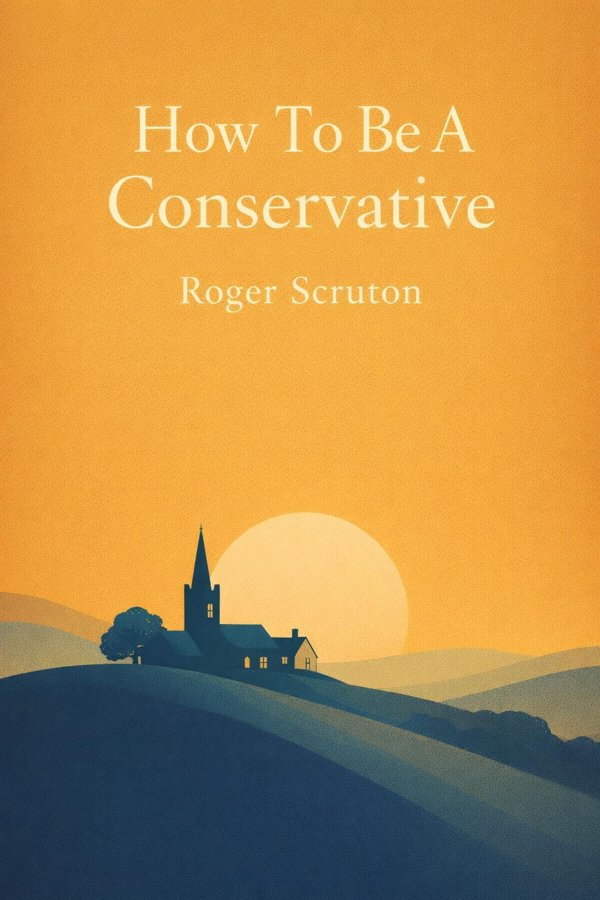
How To Be A Conservative: Summary & Key Insights
 10 min10 chaptersAudio available
What Is How To Be A Conservative About?
How To Be A Conservative by Roger Scruton is a politics book spanning 10 pages. In this book, British philosopher Roger Scruton presents a thoughtful defense of conservatism as a philosophy rooted in love of home, tradition, and the inherited institutions that sustain social order. He contrasts conservative principles with liberal and socialist ideologies, arguing that true freedom and community arise from respect for cultural continuity and moral responsibility. The work combines political theory, cultural reflection, and moral reasoning to articulate a humane and intellectually rigorous vision of conservative thought.
This FizzRead summary covers all 10 key chapters of How To Be A Conservative in approximately 10 minutes, distilling the most important ideas, arguments, and takeaways from Roger Scruton's work. Also available as an audio summary and Key Quotes Podcast.
How To Be A Conservative
In this book, British philosopher Roger Scruton presents a thoughtful defense of conservatism as a philosophy rooted in love of home, tradition, and the inherited institutions that sustain social order. He contrasts conservative principles with liberal and socialist ideologies, arguing that true freedom and community arise from respect for cultural continuity and moral responsibility. The work combines political theory, cultural reflection, and moral reasoning to articulate a humane and intellectually rigorous vision of conservative thought.
Who Should Read How To Be A Conservative?
This book is perfect for anyone interested in politics and looking to gain actionable insights in a short read. Whether you're a student, professional, or lifelong learner, the key ideas from How To Be A Conservative by Roger Scruton will help you think differently.
- ✓Readers who enjoy politics and want practical takeaways
- ✓Professionals looking to apply new ideas to their work and life
- ✓Anyone who wants the core insights of How To Be A Conservative in just 10 minutes
Want the full summary?
Get instant access to this book summary and 100K+ more with Fizz Moment.
Get Free SummaryAvailable on App Store • Free to download
Key Chapters
The word *oikophilia*—love of home—is at the heart of conservatism. It is not a sentimental attachment to the place one happens to inhabit, but a moral sense of belonging. Home, for me, is the first environment in which we learn responsibility. It is where we discover that freedom flourishes only within order, that love endures through protection and care, and that identity is born from continuity. Home is not a mere private refuge; it is the microcosm of civilization itself.
When we love our home, we also commit ourselves to preserving it—for others and for posterity. That love awakens stewardship: care for family, property, countryside, and community. When ideology tears up these roots, it replaces belonging with alienation. Conservatism’s task is to resist that uprooting and to remind people that true social progress begins with gratitude for the familiar. I defend home not as a fortress but as a foundation—an inheritance we must renew, not abandon. This affection for home extends naturally to loyalty toward our country, our language, our culture—each an embodiment of shared meaning carried across generations.
We must reject the modern conceit that society is a contract between self-interested individuals. Society is not designed; it grows. It is an organism of customs, institutions, and moral habits that bind us together through trust rather than calculation. To treat society as an artifact to be engineered is to misunderstand its organic character. Civil order develops through generations of trial, error, and reconciliation; it cannot be reconstructed overnight by plans or revolutions.
In my analysis, the family, law, nation, and culture are not mere instruments—they are living forms endowed with meaning. Conservatism therefore sees institutions as the accumulated wisdom of a people. When we dismantle them in pursuit of purity or equality, we extinguish the very soil in which our freedoms have grown. I contrast this with liberal and socialist visions: the liberal emphasizes rights as if separate from duties; the socialist emphasizes collective ownership as if detached from civil affection. The conservative, on the other hand, sees both liberty and solidarity as dependent on the invisible network of inherited trust. That trust cannot be legislated; it must be cultivated.
+ 8 more chapters — available in the FizzRead app
All Chapters in How To Be A Conservative
About the Author
Roger Scruton (1944–2020) was an English philosopher, writer, and public intellectual known for his contributions to aesthetics, political philosophy, and cultural criticism. He authored more than fifty books on topics ranging from art and architecture to politics and religion, and was widely regarded as one of the leading conservative thinkers of his generation.
Get This Summary in Your Preferred Format
Read or listen to the How To Be A Conservative summary by Roger Scruton anytime, anywhere. FizzRead offers multiple formats so you can learn on your terms — all free.
Available formats: App · Audio · PDF · EPUB — All included free with FizzRead
Download How To Be A Conservative PDF and EPUB Summary
Key Quotes from How To Be A Conservative
“The word *oikophilia*—love of home—is at the heart of conservatism.”
“We must reject the modern conceit that society is a contract between self-interested individuals.”
Frequently Asked Questions about How To Be A Conservative
How To Be A Conservative by Roger Scruton is a politics book that explores key ideas across 10 chapters. In this book, British philosopher Roger Scruton presents a thoughtful defense of conservatism as a philosophy rooted in love of home, tradition, and the inherited institutions that sustain social order. He contrasts conservative principles with liberal and socialist ideologies, arguing that true freedom and community arise from respect for cultural continuity and moral responsibility. The work combines political theory, cultural reflection, and moral reasoning to articulate a humane and intellectually rigorous vision of conservative thought.
More by Roger Scruton

You Might Also Like

Antifa: The Anti-Fascist Handbook
Mark Bray
10 min
Attack from Within: How Disinformation Is Sabotaging America
Barbara McQuade
10 min
Coercion, Capital, and European States, AD 990–1992
Charles Tilly
10 min
Digital Democracy: Concepts, Methodologies, Tools, and Applications
Various Authors
10 min
Fascism
Stanley G. Payne
10 min
Fire And Fury: Inside The Trump White House
Michael Wolff
10 minBrowse by Category
Ready to read How To Be A Conservative?
Get the full summary and 100K+ more books with Fizz Moment.