
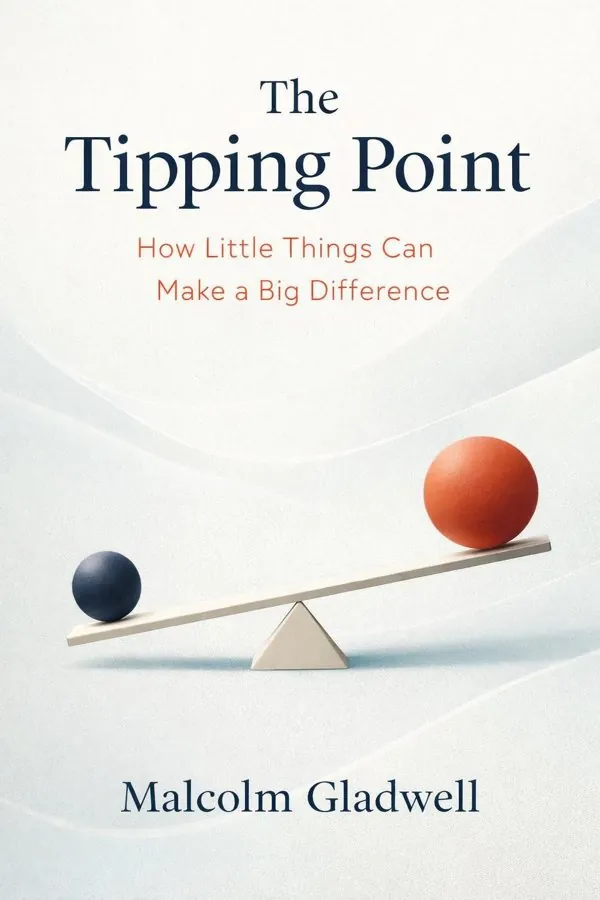
The Tipping Point: Summary & Key Insights
 10 min9 chaptersAudio available
Key Takeaways from The Tipping Point
Big social shifts often begin with surprisingly few people.
A message spreads faster when it can jump from one social world to another.
People rarely act on information alone, but trusted information often starts the process.
Logic may inform people, but emotion often moves them.
An idea cannot spread if people forget it immediately.
What Is The Tipping Point About?
The Tipping Point by Malcolm Gladwell is a non-fiction book published in 2000 spanning 4 pages. Why do some ideas explode into popularity while others disappear unnoticed? Why does one product become a craze, one message transform behavior, or one neighborhood suddenly change? In The Tipping Point, Malcolm Gladwell argues that social change often behaves like an epidemic: it starts small, spreads through specific channels, and then, at a certain moment, tips into rapid, widespread adoption. Rather than seeing trends as mysterious or random, Gladwell shows that they can often be traced to recognizable forces. Drawing on stories from public health, marketing, crime reduction, and everyday life, he introduces three core principles: the Law of the Few, the Stickiness Factor, and the Power of Context. Together, these explain why the right people, the right message, and the right environment can trigger outsized results. Gladwell writes with the instincts of a journalist and the curiosity of a social scientist. As a longtime New Yorker writer known for translating research into memorable narratives, he brings both authority and accessibility to the subject. The result is a book that changes how you think about influence, momentum, and the hidden mechanics of social change.
This FizzRead summary covers all 9 key chapters of The Tipping Point in approximately 10 minutes, distilling the most important ideas, arguments, and takeaways from Malcolm Gladwell's work. Also available as an audio summary and Key Quotes Podcast.
The Tipping Point
Why do some ideas explode into popularity while others disappear unnoticed? Why does one product become a craze, one message transform behavior, or one neighborhood suddenly change? In The Tipping Point, Malcolm Gladwell argues that social change often behaves like an epidemic: it starts small, spreads through specific channels, and then, at a certain moment, tips into rapid, widespread adoption. Rather than seeing trends as mysterious or random, Gladwell shows that they can often be traced to recognizable forces.
Drawing on stories from public health, marketing, crime reduction, and everyday life, he introduces three core principles: the Law of the Few, the Stickiness Factor, and the Power of Context. Together, these explain why the right people, the right message, and the right environment can trigger outsized results.
Gladwell writes with the instincts of a journalist and the curiosity of a social scientist. As a longtime New Yorker writer known for translating research into memorable narratives, he brings both authority and accessibility to the subject. The result is a book that changes how you think about influence, momentum, and the hidden mechanics of social change.
Who Should Read The Tipping Point?
This book is perfect for anyone interested in non-fiction and looking to gain actionable insights in a short read. Whether you're a student, professional, or lifelong learner, the key ideas from The Tipping Point by Malcolm Gladwell will help you think differently.
- ✓Readers who enjoy non-fiction and want practical takeaways
- ✓Professionals looking to apply new ideas to their work and life
- ✓Anyone who wants the core insights of The Tipping Point in just 10 minutes
Want the full summary?
Get instant access to this book summary and 100K+ more with Fizz Moment.
Get Free SummaryAvailable on App Store • Free to download
Key Chapters
Big social shifts often begin with surprisingly few people. One of Gladwell’s central claims is that influence is not evenly distributed across society. Some people are exceptionally good at starting trends, transmitting ideas, and persuading others to act. If we want to understand why certain behaviors spread, we need to pay close attention to these key individuals.
Gladwell breaks this influential minority into three types. Connectors are people with unusually large and diverse social networks. They know people across different circles and can bridge groups that would otherwise stay separate. Mavens are information specialists. They love gathering knowledge, comparing options, and sharing what they know to help others. Salesmen are persuaders with the energy, charisma, and emotional force to get people to buy in.
The key insight is that not everyone plays the same role in social contagion. A new app may need a Connector to spread it across communities, a Maven to explain why it is useful, and a Salesman to make it feel irresistible. In workplace settings, these roles appear all the time: one colleague knows everyone, another always has the best information, and another can rally a room around an idea.
This concept matters because many organizations waste effort broadcasting messages broadly when they should identify and engage high-leverage people. Instead of trying to persuade everyone at once, focus on the few individuals who can amplify your message most effectively.
Actionable takeaway: Map the Connectors, Mavens, and Salesmen in your network, then involve them early whenever you want an idea, habit, or project to spread.
A message spreads faster when it can jump from one social world to another. Connectors matter because they occupy the spaces between groups. They are the people who seem to know everyone: friends from school, colleagues from different industries, neighbors, community leaders, old classmates, and casual acquaintances from many spheres of life. Their strength is not just popularity but reach across otherwise disconnected networks.
Gladwell suggests that social epidemics depend on these bridges. Many ideas remain trapped inside small circles because they never cross into new communities. A Connector can make that leap happen. Think of how a local trend becomes regional or national: someone with ties to multiple communities carries it beyond its original setting. In modern terms, a Connector may be a community organizer, a founder with cross-industry relationships, or even a creator whose audience spans several niches.
This idea has practical implications for hiring, marketing, organizing events, and launching campaigns. If you are introducing a new product, it is often more valuable to win over one well-connected person with trust across communities than dozens of people concentrated in a single group. In a company, Connectors can accelerate collaboration by linking departments that rarely communicate. In job searches, they often create opportunities not through formal authority but through network access.
Yet Connectors must be used thoughtfully. Their credibility depends on trust, so they cannot simply be treated as distribution channels. They spread things effectively because people believe their social ties are genuine.
Actionable takeaway: When trying to expand influence, identify people whose relationships span multiple groups and ask how they can help your idea cross boundaries.
People rarely act on information alone, but trusted information often starts the process. Gladwell’s Mavens are the data gatherers and knowledge sharers of social epidemics. They are the people who know which product is best, which store has the best deal, which solution actually works, and which trends are worth paying attention to. What makes them powerful is not just expertise, but a genuine desire to help others make better decisions.
Mavens reduce uncertainty. When people feel overwhelmed by choices, they look for someone credible to interpret the landscape. That makes Mavens essential in markets crowded with noise. They can transform a confusing option into a clear recommendation, which lowers resistance and speeds adoption. In the digital age, Mavens may be thoughtful reviewers, specialists, niche creators, or subject-matter experts inside organizations.
Gladwell’s point is that social spread often depends on trust-rich transmission, not just visibility. A flashy campaign can attract attention, but a Maven helps people feel confident enough to act. For example, a fitness trend may grow because one knowledgeable coach explains the science clearly and answers doubts. A workplace software tool may gain traction because a respected employee learns it deeply and teaches others.
To apply this idea, ask who in your environment people turn to when they need reliable advice. Those are your Mavens. They are especially useful when your message requires explanation, comparison, or credibility.
Actionable takeaway: Support the trusted experts around your idea with clear information, evidence, and early access so they can translate complexity into confidence for others.
Logic may inform people, but emotion often moves them. Gladwell’s Salesmen are the persuaders who make others believe, feel, and act. Their influence does not come only from arguments; it comes from tone, timing, body language, enthusiasm, and the subtle signals that make conviction contagious. They create momentum because people unconsciously respond to confidence and emotional certainty.
This matters because many ideas fail not because they are weak, but because they are presented without energy or resonance. A person may understand a proposal and still remain passive. The Salesman closes that gap. In Gladwell’s framework, persuasion is deeply social and often nonverbal. We mirror others more than we realize, which means a genuinely committed advocate can shift the emotional climate around an idea.
In practical terms, Salesmen appear in many forms: a teacher who makes learning exciting, a manager who inspires action in a hesitant team, a friend who gets everyone to try something new, or a founder who makes others believe in a vision before the results are visible. Their gift is turning possibility into urgency.
The lesson is not to manipulate people, but to recognize that delivery affects diffusion. If you want an idea to spread, its messenger matters. Facts need feeling. Structure needs story. A cause needs someone who can embody belief.
Actionable takeaway: Pair strong ideas with persuasive communicators who can present them with clarity, conviction, and emotional energy rather than relying on information alone.
An idea cannot spread if people forget it immediately. Gladwell calls this the Stickiness Factor: the quality that makes a message memorable enough to influence behavior. Some messages are heard and lost; others lodge in the mind, get repeated, and prompt action. The difference often lies in small design choices rather than massive changes in content.
Gladwell illustrates this through examples from education and children’s television, showing that tiny adjustments in presentation can dramatically improve retention. A message becomes sticky when it is concrete, easy to grasp, emotionally engaging, and structured for recall. In business, this might mean simplifying a value proposition. In public health, it might mean making instructions obvious and memorable. In teaching, it could mean using repetition, storytelling, and vivid examples rather than abstraction.
Stickiness is especially important because attention is scarce. People are overloaded with messages, so only a few survive long enough to spread. The practical challenge is not merely to communicate but to engineer recall. That means asking: What exactly should people remember? What phrase, image, or experience will stay with them? What would make them repeat it to someone else?
This concept applies everywhere. A safety campaign, a brand slogan, a fundraising pitch, or a workplace initiative all become stronger when designed for memorability. The most effective communicators often revise not for completeness, but for retention.
Actionable takeaway: Test your message for recall by stripping it to its most memorable core and adjusting wording, format, and delivery until people remember and repeat it easily.
People like to believe behavior comes mainly from character, but environments often matter more than we admit. Gladwell’s Power of Context argues that small situational factors can strongly influence how people act. Human behavior is highly sensitive to surroundings, norms, cues, and expectations. Change the context, and you can change the outcome.
One of the book’s most memorable applications is the idea that crime and disorder can be affected by seemingly minor environmental signals. Broken windows, graffiti, litter, and a general sense of neglect can create conditions that invite further disorder. Conversely, visible order and active social norms can discourage negative behavior. Whether or not every example has aged perfectly, the broader insight remains powerful: context is not background; it is an active force.
In daily life, this explains why people may act differently at home, at work, online, or in a crowd. It also helps explain why good intentions fail in poorly designed environments. Want people to collaborate? The office layout matters. Want healthier habits? The food in the room matters. Want respectful discussion? The tone set by the first few voices matters.
Leaders and change-makers often focus too much on convincing individuals and too little on redesigning the conditions around them. But if behavior is context-sensitive, then smart interventions can be small, targeted, and environmental rather than purely motivational.
Actionable takeaway: Before trying to change people directly, examine the cues, norms, and surroundings shaping their behavior and adjust the environment to support the outcome you want.
Not all causes are proportional to their effects. One of the most compelling ideas in The Tipping Point is that tiny interventions, when applied at the right place in a system, can produce dramatic results. Social epidemics are nonlinear. A small push may do almost nothing for a long time and then suddenly change everything once a threshold is crossed.
This is why Gladwell’s framework is so useful. It directs attention away from brute-force effort and toward leverage. Instead of assuming bigger budgets, louder messages, or broader campaigns always work best, he asks where the hidden hinge points are. A slight adjustment to wording, one influential advocate, one environmental fix, or one well-timed exposure can transform an idea’s spread.
You can see this in many domains. A product might stagnate until one community adopts it publicly. A newsletter may grow slowly until one respected curator recommends it. A school initiative may fail until routines and norms are redesigned. In each case, the visible breakthrough looks sudden, but it was prepared by carefully aligned factors.
This perspective encourages experimentation. If big outcomes can emerge from small changes, then trying several low-cost interventions is often wiser than making one giant bet. It also encourages patience, because systems often appear unchanged right before they tip.
Actionable takeaway: Look for leverage points instead of scale alone—test small changes in messengers, message design, timing, or environment to discover what creates outsized impact.
What looks like a craze is often a system behaving according to hidden rules. Gladwell’s larger contribution is to treat social trends as epidemics with recognizable dynamics. Ideas, behaviors, and products spread in patterned ways, much like viruses. That means we can analyze them, anticipate them, and sometimes shape them.
This does not mean social life is fully predictable. Human behavior remains messy. But the epidemic metaphor helps explain why trends can suddenly surge after long periods of obscurity. It draws attention to transmission, susceptibility, timing, and concentration. Why now? Through whom? Under what conditions? These are better questions than simply asking whether something is good or bad.
The value of this framework is strategic. Entrepreneurs can use it to think about adoption. Nonprofits can use it to design campaigns. Educators can use it to spread practices. Teams can use it to build cultural norms. Instead of treating success as luck, they can study pathways of spread.
At the same time, the model carries a caution. Harmful behaviors can spread through the same mechanisms as beneficial ones. Misinformation, panic, unhealthy habits, and destructive norms can also tip. Understanding epidemics means recognizing responsibility as well as opportunity.
Actionable takeaway: When evaluating why something is spreading, analyze the pattern of transmission—who is carrying it, what makes it memorable, and which conditions are making people more likely to adopt it.
Social change is not purely accidental; it can be designed. Gladwell’s ideas become most useful when applied intentionally. If you want to create momentum for a product, cause, habit, or initiative, you need to align the three main forces of diffusion: the right people, a sticky message, and a favorable context. Tipping points emerge when these elements reinforce each other.
Start with people. Identify who has reach, credibility, or persuasive force in your setting. Then refine the message until it is simple, memorable, and actionable. Finally, shape the environment so the desired behavior feels natural rather than effortful. For example, if you want employees to adopt a new process, don’t just send an email. Involve trusted internal influencers, make the process easy to remember, and redesign workflows so the new behavior is built into daily routines.
The same thinking works at personal scale. Want to start a reading habit? Join a visible social group that values books, choose a cue that makes the habit easy to remember, and place books where you naturally spend time. Want to spread a community initiative? Recruit well-connected advocates, frame the message clearly, and launch in a setting where participation is visible and convenient.
Gladwell’s deeper lesson is optimistic: large-scale change can start with thoughtful interventions rather than massive control. Influence grows when design replaces guesswork.
Actionable takeaway: To create a tipping point, deliberately combine influential messengers, memorable communication, and supportive conditions instead of relying on effort alone.
All Chapters in The Tipping Point
About the Author
Malcolm Gladwell is a Canadian journalist, bestselling author, and public speaker known for making complex social science ideas accessible to broad audiences. Born in England and raised in Canada, he began his career in journalism before joining The New Yorker in 1996, where he became one of the magazine’s most recognizable writers. His work often explores the hidden patterns behind behavior, success, decision-making, and social change. Gladwell’s major books include The Tipping Point, Blink, Outliers, What the Dog Saw, David and Goliath, and Talking to Strangers. He is especially admired for combining research, interviews, and storytelling into thought-provoking narratives. Through his books, articles, and talks, Gladwell has had a major influence on how popular audiences think about psychology, culture, and human behavior.
Get This Summary in Your Preferred Format
Read or listen to the The Tipping Point summary by Malcolm Gladwell anytime, anywhere. FizzRead offers multiple formats so you can learn on your terms — all free.
Available formats: App · Audio · PDF · EPUB — All included free with FizzRead
Download The Tipping Point PDF and EPUB Summary
Key Quotes from The Tipping Point
“Big social shifts often begin with surprisingly few people.”
“A message spreads faster when it can jump from one social world to another.”
“People rarely act on information alone, but trusted information often starts the process.”
“Logic may inform people, but emotion often moves them.”
“An idea cannot spread if people forget it immediately.”
Frequently Asked Questions about The Tipping Point
The Tipping Point by Malcolm Gladwell is a non-fiction book that explores key ideas across 9 chapters. Why do some ideas explode into popularity while others disappear unnoticed? Why does one product become a craze, one message transform behavior, or one neighborhood suddenly change? In The Tipping Point, Malcolm Gladwell argues that social change often behaves like an epidemic: it starts small, spreads through specific channels, and then, at a certain moment, tips into rapid, widespread adoption. Rather than seeing trends as mysterious or random, Gladwell shows that they can often be traced to recognizable forces. Drawing on stories from public health, marketing, crime reduction, and everyday life, he introduces three core principles: the Law of the Few, the Stickiness Factor, and the Power of Context. Together, these explain why the right people, the right message, and the right environment can trigger outsized results. Gladwell writes with the instincts of a journalist and the curiosity of a social scientist. As a longtime New Yorker writer known for translating research into memorable narratives, he brings both authority and accessibility to the subject. The result is a book that changes how you think about influence, momentum, and the hidden mechanics of social change.
Compare The Tipping Point


More by Malcolm Gladwell
You Might Also Like
Featured In
Browse by Category
Ready to read The Tipping Point?
Get the full summary and 100K+ more books with Fizz Moment.