
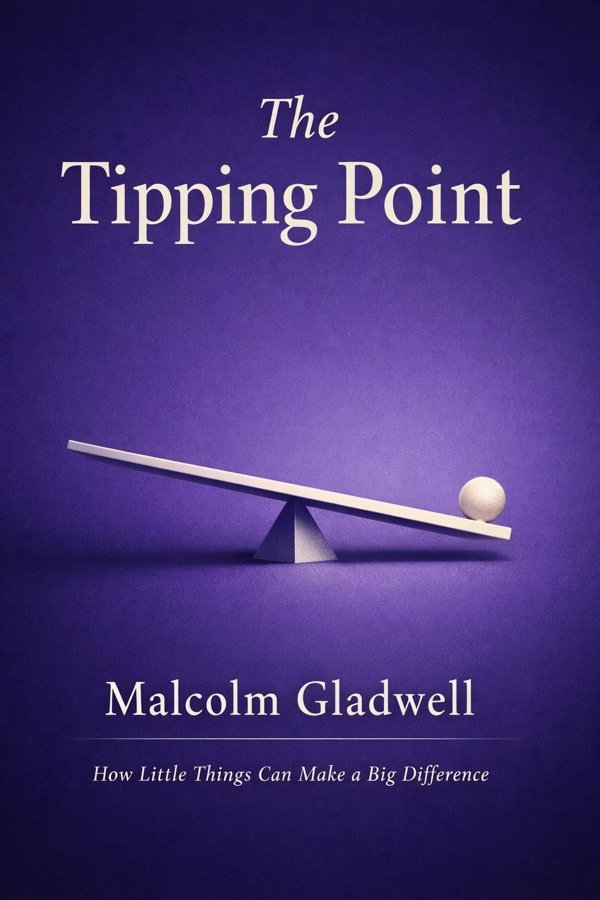
The Tipping Point: How Little Things Can Make a Big Difference: Summary & Key Insights
 10 min9 chaptersAudio available
Key Takeaways from The Tipping Point: How Little Things Can Make a Big Difference
Big social changes are often sparked by very small groups of people.
Not all well-connected people are equally valuable.
People rarely act on information alone; they act when information feels trustworthy and compelling.
An idea does not spread just because people hear it; it spreads because they remember it and feel compelled to pass it on.
We often assume that meaningful behavior change requires major reform.
What Is The Tipping Point: How Little Things Can Make a Big Difference About?
The Tipping Point: How Little Things Can Make a Big Difference by Malcolm Gladwell is a sociology book spanning 4 pages. Why do some ideas explode while others disappear unnoticed? Why does a product suddenly become fashionable, a crime wave unexpectedly collapse, or a message spread through a population almost overnight? In The Tipping Point, Malcolm Gladwell argues that social change often works less like steady growth and more like an epidemic: slow at first, then suddenly unstoppable. Published in 2000, the book became a landmark work in popular sociology because it gave readers a vivid language for understanding how trends, behaviors, and beliefs spread. Gladwell draws from psychology, sociology, marketing, and real-world case studies to show that major shifts are often triggered by surprisingly small causes. He organizes his argument around three core forces: the Law of the Few, the Stickiness Factor, and the Power of Context. Together, they explain why certain messages catch on, why a handful of influential people matter so much, and why environment can shape behavior more than we realize. As a longtime journalist and staff writer for The New Yorker, Gladwell is known for turning complex research into memorable stories. This book matters because it changes how we think about influence, change, and the hidden mechanics of social epidemics.
This FizzRead summary covers all 9 key chapters of The Tipping Point: How Little Things Can Make a Big Difference in approximately 10 minutes, distilling the most important ideas, arguments, and takeaways from Malcolm Gladwell's work. Also available as an audio summary and Key Quotes Podcast.
The Tipping Point: How Little Things Can Make a Big Difference
Why do some ideas explode while others disappear unnoticed? Why does a product suddenly become fashionable, a crime wave unexpectedly collapse, or a message spread through a population almost overnight? In The Tipping Point, Malcolm Gladwell argues that social change often works less like steady growth and more like an epidemic: slow at first, then suddenly unstoppable. Published in 2000, the book became a landmark work in popular sociology because it gave readers a vivid language for understanding how trends, behaviors, and beliefs spread.
Gladwell draws from psychology, sociology, marketing, and real-world case studies to show that major shifts are often triggered by surprisingly small causes. He organizes his argument around three core forces: the Law of the Few, the Stickiness Factor, and the Power of Context. Together, they explain why certain messages catch on, why a handful of influential people matter so much, and why environment can shape behavior more than we realize.
As a longtime journalist and staff writer for The New Yorker, Gladwell is known for turning complex research into memorable stories. This book matters because it changes how we think about influence, change, and the hidden mechanics of social epidemics.
Who Should Read The Tipping Point: How Little Things Can Make a Big Difference?
This book is perfect for anyone interested in sociology and looking to gain actionable insights in a short read. Whether you're a student, professional, or lifelong learner, the key ideas from The Tipping Point: How Little Things Can Make a Big Difference by Malcolm Gladwell will help you think differently.
- ✓Readers who enjoy sociology and want practical takeaways
- ✓Professionals looking to apply new ideas to their work and life
- ✓Anyone who wants the core insights of The Tipping Point: How Little Things Can Make a Big Difference in just 10 minutes
Want the full summary?
Get instant access to this book summary and 100K+ more with Fizz Moment.
Get Free SummaryAvailable on App Store • Free to download
Key Chapters
Big social changes are often sparked by very small groups of people. That is one of Gladwell’s most counterintuitive claims: influence is not evenly distributed across society. Some individuals have an unusually large impact on whether an idea, trend, or behavior spreads. These people sit at the center of social epidemics.
Gladwell divides them into three types. Connectors know many people across different worlds and act as bridges between social circles. Mavens are information specialists who love gathering knowledge and sharing it with others. Salesmen are persuasive personalities whose energy and conviction help convince people to act. A trend becomes far more likely to spread when these three roles work together. One person may introduce an idea to many people, another may validate it with expertise, and a third may make it emotionally compelling.
The key insight is that social networks are not flat. A recommendation from the right person can matter more than a mass broadcast. This helps explain why some products become cult favorites, why some movements gain momentum quickly, and why word-of-mouth can outperform expensive advertising.
In practical terms, this idea applies to marketing, leadership, hiring, and advocacy. If you want to spread a message, don’t just ask, “How many people can I reach?” Ask, “Who are the people others listen to?” A startup should identify trusted early adopters. A nonprofit should find respected community voices. A teacher can use socially central students to help shape classroom norms.
Actionable takeaway: Map the handful of people in your world who connect, inform, and persuade—and involve them first when you want an idea to spread.
Not all well-connected people are equally valuable. The people who truly accelerate change are often those who move easily between different groups. Gladwell calls them Connectors: individuals with an exceptional ability to link people, communities, and opportunities that would otherwise remain separate.
A Connector is not just popular. They are structurally important. They know colleagues from work, neighbors from different backgrounds, old school friends, people from hobbies, and acquaintances across industries. Because they sit at the intersection of many networks, they can introduce an idea into multiple circles at once. That dramatically increases the odds that a local signal becomes a wider trend.
This matters because ideas do not spread in isolation; they travel along human relationships. If your message stays trapped in one small group, it may never reach critical mass. But when it passes through a Connector, it can jump social boundaries. A local fashion trend becomes citywide. A niche app becomes a mainstream tool. A community campaign becomes a national conversation.
Organizations often overlook Connectors because they may not hold formal authority. Yet they are often the people who know everyone, make introductions naturally, and seem to have a finger on the pulse of multiple worlds. In workplaces, these are the employees who connect departments. In communities, they know parents, business owners, activists, and educators. Online, they may not have the biggest audience, but they have unusually diverse networks.
Actionable takeaway: Find the bridge-builders in your personal or professional network and nurture those relationships, because diffusion depends as much on connection paths as on the quality of the idea itself.
People rarely act on information alone; they act when information feels trustworthy and compelling. Gladwell argues that two kinds of people are especially important here: Mavens and Salesmen. Mavens gather knowledge obsessively and share it generously. Salesmen create belief through enthusiasm, confidence, timing, and emotional influence.
A Maven is the person who always knows the best product, the smartest deal, or the most reliable source. They do not spread information for status alone; they enjoy helping others make better decisions. Because of that, they are trusted. In social epidemics, Mavens reduce uncertainty. They tell us what matters, why it matters, and whether it is worth trying.
Salesmen perform a different role. They make ideas move. Where a Maven might explain, a Salesman persuades. Gladwell suggests that body language, tone, charisma, and emotional contagion can all shape whether a message takes root. People often think they are making purely rational choices, but in reality they are highly responsive to social cues.
The strongest diffusion happens when these roles reinforce each other. A Maven gives credibility. A Salesman adds momentum. For instance, in launching a wellness program, a respected health expert may convince employees that the plan is legitimate, while an energetic leader makes participation feel exciting and normal.
This concept is useful for anyone trying to influence behavior. Businesses need both product experts and persuasive advocates. Social campaigns need credible educators and emotionally resonant messengers. Even in everyday life, advice is more effective when it combines trust and energy.
Actionable takeaway: Pair expertise with persuasion—make sure your message is both credible enough to trust and compelling enough to act on.
An idea does not spread just because people hear it; it spreads because they remember it and feel compelled to pass it on. Gladwell calls this quality the Stickiness Factor. Some messages are inherently more memorable, engaging, or behavior-changing than others, even when the difference seems minor.
Stickiness is not about loudness. It is about design. Small adjustments in presentation—word choice, repetition, format, timing, emotional tone, or context—can dramatically affect whether a message lingers in the mind. Gladwell points to examples from education and media, showing that simple changes in how information is packaged can lead people to pay more attention and retain more.
This matters because many failed campaigns are not failing due to lack of exposure. They fail because the message slides off people’s attention. A public health announcement may be important, but if it is boring, abstract, or forgettable, it will not alter behavior. By contrast, a sticky message creates mental hooks. It is vivid, simple, and easy to recall later.
In practice, stickiness can be improved. Teachers can structure lessons around stories instead of lectures. Companies can refine onboarding materials so users experience quick wins. Leaders can repeat a clear phrase until it becomes shorthand for a shared mission. Communicators should ask: what exactly will people remember one hour after hearing this?
The deeper lesson is that quality of transmission matters as much as reach. A mediocre message shown to millions may still die quickly, while a memorable one can travel organically.
Actionable takeaway: Redesign important messages for memory—make them simple, concrete, emotionally resonant, and easy to repeat.
We often assume that meaningful behavior change requires major reform. Gladwell argues the opposite: tiny adjustments can have outsized effects when they alter how people notice, feel, or respond to a situation. This is one of the book’s most empowering ideas. Social epidemics do not always begin with giant interventions; sometimes they begin with smart, precise ones.
A message can become more effective if its format changes slightly. A product can become more appealing if early users have a better first experience. A neighborhood can feel safer if visible disorder is addressed before it signals decline. These are not dramatic changes, but they can shift the direction of a system.
Why does this happen? Because people respond to cues. Human behavior is highly sensitive to details that seem trivial on the surface: whether a request comes from a friend or a stranger, whether a room feels orderly or chaotic, whether instructions are abstract or concrete. Small changes can alter interpretation, and interpretation drives action.
This insight is particularly valuable in business, education, and public policy. If customers abandon a service, the problem may not be the entire product but one confusing step in signup. If students disengage, the issue may be lesson framing rather than content difficulty. If a team lacks momentum, one visible ritual or norm may help reset expectations.
The point is not that every problem has a tiny fix. Rather, leverage often comes from understanding where a small intervention can trigger a larger chain reaction.
Actionable takeaway: Before launching a massive solution, identify the smallest friction point or cue in the system that may be shaping behavior more than you think.
People like to believe character drives behavior, but Gladwell insists that situations often matter more than personality. The Power of Context means that human actions are deeply influenced by environment, mood, social setting, and local norms. A small shift in surroundings can produce a surprisingly large shift in conduct.
This idea challenges the comforting notion that behavior is stable across circumstances. In reality, people are highly responsive to cues from their immediate environment. Disorder may encourage more disorder. Calm may invite calm. Expectations, group behavior, noise levels, crowd density, and physical surroundings all shape what feels acceptable.
One of Gladwell’s most discussed examples involves urban crime and the idea that addressing minor signs of disorder can help prevent more serious problems. Whether or not one agrees with every policy conclusion drawn from this theory, the broader insight remains powerful: context is not background noise. It is an active force.
In everyday life, this means behavior can often be improved by redesigning environments instead of lecturing individuals. Want better focus? Remove distractions from your workspace. Want healthier habits? Put healthy options within reach and make unhealthy ones inconvenient. Want better meetings? Change the room setup, expectations, and sequence of participation.
Leaders often overestimate motivation and underestimate environment. Yet often the quickest route to change is not persuading people to become different kinds of humans; it is creating conditions that make the desired behavior easier and more natural.
Actionable takeaway: Audit the environments around you—home, work, school, digital spaces—and change the cues that quietly shape behavior every day.
The ultimate value of Gladwell’s framework is strategic: once you understand how tipping points happen, you can design for them. Social change may never be fully controllable, but it is more shapeable than it first appears. The book invites readers to become architects of spread rather than passive observers of trends.
Creating a tipping point begins with clarity about the behavior or idea you want to spread. Then you identify the few people most able to transmit it, sharpen the message so it sticks, and shape the environment so adoption feels natural. These steps sound simple, but together they create leverage. Instead of trying to convince everyone at once, you work through social structure, psychology, and context.
This approach can be used in many domains. A business launching a new product can target respected early users, simplify the core benefit, and create visible signs of popularity. A manager trying to change team culture can enlist influential employees, repeat memorable norms, and redesign routines that support the new behavior. A public campaign can focus first on neighborhoods or groups where early adoption is likely to spread outward.
Gladwell’s point is not that all change can be engineered neatly. Luck, timing, and complexity still matter. But he does show that the spread of ideas is often less mysterious than it seems. By thinking in terms of contagion, leverage, and thresholds, we can act more intelligently.
Actionable takeaway: To create momentum, focus on the right people, a memorable message, and a supportive environment rather than relying on effort alone.
All Chapters in The Tipping Point: How Little Things Can Make a Big Difference
About the Author
Malcolm Gladwell is a bestselling author, journalist, and speaker known for making complex social science ideas accessible to general readers. Born in England in 1963 and raised in Canada, he began his career in journalism before gaining wide recognition as a staff writer for The New Yorker. Gladwell’s work often explores the hidden patterns behind human behavior, success, decision-making, and social influence. He is especially admired for blending research, storytelling, and surprising examples into highly readable narratives. In addition to The Tipping Point, his major books include Blink, Outliers, What the Dog Saw, David and Goliath, and Talking to Strangers. His writing has had broad influence across business, education, psychology, and popular culture.
Get This Summary in Your Preferred Format
Read or listen to the The Tipping Point: How Little Things Can Make a Big Difference summary by Malcolm Gladwell anytime, anywhere. FizzRead offers multiple formats so you can learn on your terms — all free.
Available formats: App · Audio · PDF · EPUB — All included free with FizzRead
Download The Tipping Point: How Little Things Can Make a Big Difference PDF and EPUB Summary
Key Quotes from The Tipping Point: How Little Things Can Make a Big Difference
“Big social changes are often sparked by very small groups of people.”
“Not all well-connected people are equally valuable.”
“People rarely act on information alone; they act when information feels trustworthy and compelling.”
“An idea does not spread just because people hear it; it spreads because they remember it and feel compelled to pass it on.”
“We often assume that meaningful behavior change requires major reform.”
Frequently Asked Questions about The Tipping Point: How Little Things Can Make a Big Difference
The Tipping Point: How Little Things Can Make a Big Difference by Malcolm Gladwell is a sociology book that explores key ideas across 9 chapters. Why do some ideas explode while others disappear unnoticed? Why does a product suddenly become fashionable, a crime wave unexpectedly collapse, or a message spread through a population almost overnight? In The Tipping Point, Malcolm Gladwell argues that social change often works less like steady growth and more like an epidemic: slow at first, then suddenly unstoppable. Published in 2000, the book became a landmark work in popular sociology because it gave readers a vivid language for understanding how trends, behaviors, and beliefs spread. Gladwell draws from psychology, sociology, marketing, and real-world case studies to show that major shifts are often triggered by surprisingly small causes. He organizes his argument around three core forces: the Law of the Few, the Stickiness Factor, and the Power of Context. Together, they explain why certain messages catch on, why a handful of influential people matter so much, and why environment can shape behavior more than we realize. As a longtime journalist and staff writer for The New Yorker, Gladwell is known for turning complex research into memorable stories. This book matters because it changes how we think about influence, change, and the hidden mechanics of social epidemics.
More by Malcolm Gladwell
You Might Also Like

Between the World and Me
Ta-Nehisi Coates
10 min
Half the Sky
Nicholas D. Kristof, Sheryl WuDunn
10 min
Men Explain Things To Me
Rebecca Solnit
10 min
Rational Ritual
Michael Suk-Young Chwe
10 min
The New Jim Crow
Michelle Alexander
10 min
Beyond Culture
Edward T. Hall
10 minBrowse by Category
Ready to read The Tipping Point: How Little Things Can Make a Big Difference?
Get the full summary and 100K+ more books with Fizz Moment.