
Freakonomics: Summary & Key Insights
 10 min10 chaptersAudio available
Key Takeaways from Freakonomics
Thinking like a Freak starts with the most radical admission you can make: acknowledging your ignorance.
One of the central ideas in the Freakonomics worldview is that incentives drive behavior, but not always in the way we expect.
Big problems often tempt us into big, dramatic solutions.
Many people work hard on the wrong problem.
A hallmark of the Freakonomics approach is the insistence on evidence over intuition.
What Is Freakonomics About?
Freakonomics by Steven Levitt is a non-fiction book published in 2014 spanning 10 pages. Why do people cheat in some situations but act generously in others? Why do smart policies sometimes fail, while simple changes create outsized results? These are the kinds of questions that made the Freakonomics approach famous. In this book, Steven D. Levitt and Stephen J. Dubner invite readers to go beyond surface explanations and learn a more useful skill: how to think clearly when the world seems confusing. Rather than offering motivational slogans or neat formulas, they show how curiosity, data, and a willingness to challenge assumptions can uncover the hidden logic behind human behavior. What makes this book matter is its practicality. The ideas are not limited to economics classrooms or policy debates; they apply to parenting, business, negotiation, career choices, and everyday decisions. Levitt, a University of Chicago economist known for his work on crime and incentives, teams up with Dubner, a journalist and storyteller, to translate complex insights into memorable lessons. Together, they make a compelling case that better thinking starts with humility, sharper questions, and a habit of following evidence instead of intuition. If you want to solve problems more creatively and understand why people do what they do, this book offers a powerful mental toolkit.
This FizzRead summary covers all 10 key chapters of Freakonomics in approximately 10 minutes, distilling the most important ideas, arguments, and takeaways from Steven Levitt's work. Also available as an audio summary and Key Quotes Podcast.
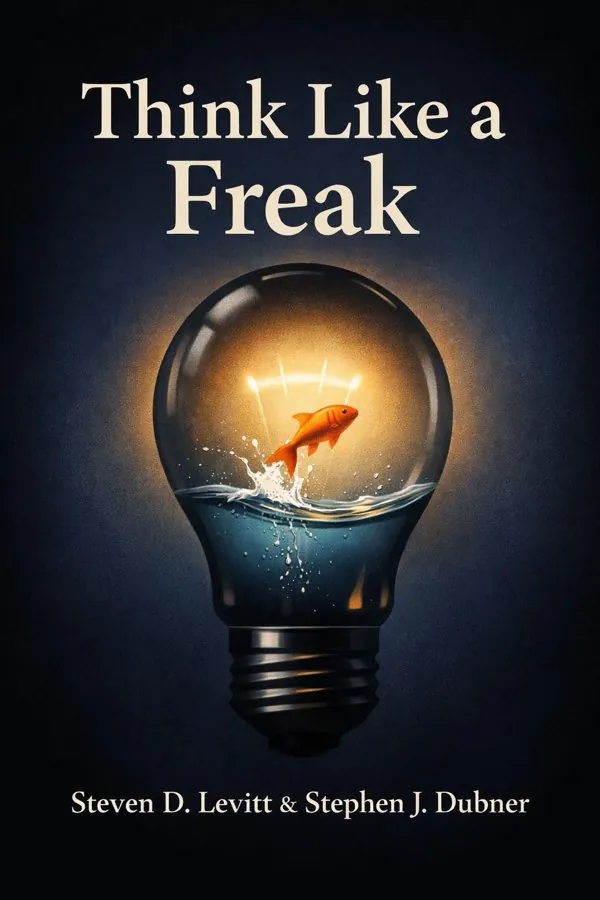
Think Like a Freak: The Authors of Freakonomics Offer to Retrain Your Brain
Why do people cheat in some situations but act generously in others? Why do smart policies sometimes fail, while simple changes create outsized results? These are the kinds of questions that made the Freakonomics approach famous. In this book, Steven D. Levitt and Stephen J. Dubner invite readers to go beyond surface explanations and learn a more useful skill: how to think clearly when the world seems confusing. Rather than offering motivational slogans or neat formulas, they show how curiosity, data, and a willingness to challenge assumptions can uncover the hidden logic behind human behavior.
What makes this book matter is its practicality. The ideas are not limited to economics classrooms or policy debates; they apply to parenting, business, negotiation, career choices, and everyday decisions. Levitt, a University of Chicago economist known for his work on crime and incentives, teams up with Dubner, a journalist and storyteller, to translate complex insights into memorable lessons. Together, they make a compelling case that better thinking starts with humility, sharper questions, and a habit of following evidence instead of intuition. If you want to solve problems more creatively and understand why people do what they do, this book offers a powerful mental toolkit.
Who Should Read Freakonomics?
This book is perfect for anyone interested in non-fiction and looking to gain actionable insights in a short read. Whether you're a student, professional, or lifelong learner, the key ideas from Freakonomics by Steven Levitt will help you think differently.
- ✓Readers who enjoy non-fiction and want practical takeaways
- ✓Professionals looking to apply new ideas to their work and life
- ✓Anyone who wants the core insights of Freakonomics in just 10 minutes
Want the full summary?
Get instant access to this book summary and 100K+ more with Fizz Moment.
Get Free SummaryAvailable on App Store • Free to download
Key Chapters
Thinking like a Freak starts with the most radical admission you can make: acknowledging your ignorance. When Levitt and Dubner studied markets, crime, and social behavior, they found that real progress began only after someone stopped pretending to have the answer. In most environments, confidence is rewarded more than accuracy. Leaders are expected to sound certain, experts feel pressure to defend their opinions, and ordinary people often cling to assumptions because uncertainty feels uncomfortable. But the book argues that saying “I don’t know” is not weakness; it is the starting point of discovery.
A powerful example is the attempt to explain the major drop in crime during the 1990s. Popular explanations such as better policing or stronger economic conditions sounded sensible, yet the data did not fully support them. By admitting that the obvious answers were incomplete, Levitt was able to explore less conventional possibilities and uncover a surprising relationship between earlier social policy and later outcomes. The lesson is simple: curiosity works only when ego steps aside.
In everyday life, this means resisting the urge to defend your first opinion. At work, instead of rushing to explain why sales dropped, ask what you may be missing. In relationships, replace assumptions with questions. A useful habit is to say, “What evidence would change my mind?” That single question turns certainty into learning and helps you become a sharper, more honest thinker.
One of the central ideas in the Freakonomics worldview is that incentives drive behavior, but not always in the way we expect. People respond to rewards, punishments, social pressure, identity, convenience, and status. Money matters, but so do pride, guilt, embarrassment, and belonging. To understand why people act as they do, you have to look beneath their stated motives and examine the incentives shaping their choices.
The daycare example captures this perfectly. When a center fined parents for picking up children late, lateness increased rather than decreased. Before the fine, parents felt a social and moral obligation not to inconvenience teachers. After the fine, the situation changed: being late no longer felt rude, it felt like purchasing extra time. The incentive had shifted from emotional accountability to a market transaction. This is a classic Freakonomics lesson: poorly designed incentives can erase the very behavior they were meant to encourage.
The practical takeaway is to think carefully before trying to change behavior. If you want employees to collaborate, don’t reward only individual performance. If you want children to tell the truth, avoid punishments so harsh that lying becomes more attractive. If you’re trying to change your own habits, make the desired action easier and more immediately rewarding. The best incentives align with how people really behave, not how we wish they behaved.
Big problems often tempt us into big, dramatic solutions. But one of the most useful lessons in this book is that meaningful progress usually begins small. Thinking like a Freak means breaking down a complicated challenge into a narrow, manageable part that can actually be studied, tested, and improved. Instead of trying to solve everything at once, you isolate one behavior, one friction point, or one decision and start there.
This approach matters because broad questions are often too vague to answer well. Asking, “How do we fix education?” is overwhelming. Asking, “What small change helps students attend class more regularly?” is much more useful. By shrinking the problem, you move from opinion to experimentation. Small questions also reduce defensiveness. People may resist sweeping reforms, but they are more open to modest changes that produce visible results.
In practical terms, thinking small helps in work and personal life. If your team is missing deadlines, don’t begin with a massive productivity overhaul. First ask where projects most often stall. If you want to improve your health, don’t redesign your entire lifestyle overnight; start with one repeatable habit such as a daily walk or a fixed bedtime. Small wins create momentum, reveal better data, and often expose the real issue hiding behind the bigger one. Freak thinking favors progress over grand gestures.
Many people work hard on the wrong problem. That is why asking the right question is often more valuable than having a quick answer. Levitt and Dubner emphasize that clever thinking begins by reframing the issue. If the question is poorly designed, even smart analysis leads nowhere. The goal is not to ask the most impressive question, but the most revealing one.
For example, instead of asking, “Why are people irrational?” a better question may be, “What incentive or constraint makes this behavior reasonable from their point of view?” That shift immediately produces more useful insight. It moves you away from judgment and toward explanation. In business, instead of asking, “How do we get customers to buy more?” you might ask, “What is making the purchase feel risky or inconvenient?” In parenting, instead of “Why won’t my child listen?” try “What is getting in the way of cooperation?” Better questions uncover hidden assumptions and direct your attention to levers you can actually influence.
A practical technique from this mindset is to keep asking one layer deeper. When you think you have found the problem, ask why it exists. Then ask again. Often the first answer is just a symptom. The right question acts like a flashlight: it doesn’t solve the puzzle by itself, but it shows you where to look.
A hallmark of the Freakonomics approach is the insistence on evidence over intuition. Stories can be persuasive, traditions can feel trustworthy, and expert opinions can sound convincing, but none of them are enough without data. Levitt and Dubner repeatedly show that many widely accepted beliefs collapse when tested against actual evidence. The point is not that intuition is useless, but that intuition should be a starting hypothesis, not the final verdict.
Data matters because human beings are naturally drawn to vivid anecdotes. One dramatic story can outweigh a hundred quiet facts in our minds. But evidence has a way of correcting those distortions. It helps us see patterns we would otherwise miss and challenges explanations that merely feel true. In this sense, data is a discipline of honesty. It forces you to separate what you want to believe from what the world is showing you.
In daily life, this lesson can be surprisingly practical. If you think you are too busy to exercise, track your time for a week. If you believe a product launch failed because of price, compare customer behavior before changing strategy. If you are making hiring decisions, use structured criteria instead of vague impressions. Evidence will not eliminate uncertainty, but it improves your odds of getting reality right. Freak thinking means following the numbers, especially when they challenge your favorite story.
One of the hardest parts of thinking clearly is recognizing how often our judgments are shaped by emotion, loyalty, and identity rather than facts. Levitt and Dubner argue that people do not simply misunderstand information; they actively filter it through what they want to be true. We protect our egos, defend our groups, and stick with comforting narratives even when the evidence points elsewhere. That is why overcoming bias is not just an intellectual exercise; it is an emotional one.
This matters because bias affects every stage of decision-making. It shapes the questions we ask, the evidence we notice, and the conclusions we accept. Confirmation bias pushes us to seek support for what we already believe. Loss aversion makes us cling to failing plans because admitting defeat feels painful. Social bias makes us adopt opinions that fit our tribe rather than the facts. Freak thinking requires distance from these instincts.
A useful practice is to deliberately argue against your own position. Before making a major choice, list the strongest reasons you may be wrong. Ask someone who disagrees with you to critique your assumptions. In meetings, invite disconfirming evidence before finalizing a decision. Emotion is not the enemy, but unexamined emotion is. The authors encourage readers to pause before reacting, especially when an issue feels personal. Better thinking often begins with calming the emotional noise long enough to see the underlying reality.
Facts alone rarely change minds. One of the more practical insights in the book is that if you want people to understand an idea, you must communicate it in a way that feels clear, memorable, and human. Storytelling is not the opposite of evidence; it is often the vehicle that helps evidence travel. Levitt and Dubner use surprising examples, vivid comparisons, and conversational language because they understand that persuasion depends on more than being correct.
This matters especially when a truth is unintuitive or uncomfortable. People resist information that threatens their identity or contradicts common sense. A dry pile of statistics may be accurate, but it often fails to move anyone. A good story creates curiosity and lowers resistance. It gives abstract concepts emotional texture. That is why the Freakonomics style has had such broad impact: it turns hidden incentives and data-driven thinking into narratives people can actually remember.
In practical terms, if you want to persuade a team, don’t present only conclusions; explain the puzzle, the false leads, and the insight that changed your mind. If you’re teaching a child or colleague, connect the lesson to a concrete example from daily life. Good persuasion respects the audience. It does not overwhelm them with information; it organizes information into a shape the mind can hold. To think like a Freak is also to communicate like one.
Failure is uncomfortable, but in the Freakonomics framework it is also deeply informative. Most people treat failure as a verdict on their talent or intelligence, so they hide it, rationalize it, or move on too quickly. Levitt and Dubner encourage a different response: use failure as data. If something did not work, the first question is not “Who is to blame?” but “What does this reveal?” This mindset turns setbacks into feedback and keeps you moving toward better answers.
Failure teaches because it exposes hidden assumptions. Maybe the incentive was wrong. Maybe the question was poorly framed. Maybe your evidence was weaker than you thought. A failed experiment is valuable when it narrows the field and helps you avoid repeating the same mistake. In this sense, smart thinkers are not people who avoid error entirely; they are people who extract insight from it faster.
This lesson is especially useful in careers, entrepreneurship, and creative work. A job rejection can reveal a skills gap. A product flop may show that customers care about convenience more than features. A difficult conversation can highlight a flawed approach rather than a flawed goal. The actionable takeaway is to conduct a short review after each setback: What did I expect? What happened instead? What assumption was wrong? That process transforms failure from a source of shame into a tool for improvement.
Persistence is often praised as a virtue, but Levitt and Dubner point out that quitting can be just as rational, and sometimes far wiser. People stay in bad jobs, failing projects, draining relationships, and losing strategies because they fear being seen as weak or inconsistent. They confuse perseverance with wisdom. Freak thinking challenges that reflex by asking a harder question: if you were starting from scratch today, would you choose this path again?
The reason quitting feels so difficult is that human beings are vulnerable to sunk-cost thinking. Once we have invested time, money, or pride into something, we feel pressure to continue even when the evidence says stop. But past investment is not a reason to keep making future mistakes. A decision should be judged by future costs and benefits, not by how much effort has already been spent.
This idea is liberating in practice. If a business initiative is draining resources without realistic upside, ending it may free energy for something better. If a habit, commitment, or goal no longer serves your values, quitting may be a sign of clarity rather than failure. The key is to quit thoughtfully, not impulsively. Set criteria in advance: under what conditions would I stop? This removes ego from the process and helps you make cleaner decisions. Sometimes the smartest move is not pushing harder, but walking away earlier.
The ultimate value of the book is that its ideas are not abstract theories; they are tools for ordinary decisions. Applying Freak thinking means approaching life with more curiosity, more skepticism, and less attachment to easy answers. Whether you are managing money, raising children, making career choices, or trying to change a habit, the same principles apply: admit what you do not know, ask better questions, examine incentives, look for evidence, and stay open to surprising conclusions.
In daily life, this can be simple but powerful. Before making a purchase, ask what incentive the seller has and what information may be missing. When dealing with conflict, ask what the other person is optimizing for rather than assuming bad intent. If a goal feels stuck, shrink the problem and test one small adjustment. If you feel strongly about an issue, seek out data that could prove you wrong. These habits make you less reactive and more effective.
What makes this mindset distinctive is that it combines humility with practicality. It does not demand that you become an economist or data scientist. It asks only that you become more honest about uncertainty and more disciplined about how you reach conclusions. Over time, this way of thinking can improve not just your decisions, but your relationship with the world itself. Problems become less threatening and more interesting, because you learn to treat them as puzzles rather than personal defeats.
All Chapters in Freakonomics
About the Author
Steven D. Levitt is a professor of economics at the University of Chicago, best known for his work on crime and incentives. Stephen J. Dubner is a journalist and radio host, co-author of the Freakonomics series, and creator of the Freakonomics Radio podcast. Together, they have helped popularize economic and behavioral thinking for a broad audience by turning complex social questions into engaging, accessible stories. Their collaborative style blends Levitt’s analytical approach with Dubner’s narrative skill, making the Freakonomics books especially effective for readers who want to better understand how people think, choose, and respond to incentives.
Get This Summary in Your Preferred Format
Read or listen to the Freakonomics summary by Steven Levitt anytime, anywhere. FizzRead offers multiple formats so you can learn on your terms — all free.
Available formats: App · Audio · PDF · EPUB — All included free with FizzRead
Download Freakonomics PDF and EPUB Summary
Key Quotes from Freakonomics
“Thinking like a Freak starts with the most radical admission you can make: acknowledging your ignorance.”
“One of the central ideas in the Freakonomics worldview is that incentives drive behavior, but not always in the way we expect.”
“Big problems often tempt us into big, dramatic solutions.”
“Many people work hard on the wrong problem.”
“A hallmark of the Freakonomics approach is the insistence on evidence over intuition.”
Frequently Asked Questions about Freakonomics
Freakonomics by Steven Levitt is a non-fiction book that explores key ideas across 10 chapters. Why do people cheat in some situations but act generously in others? Why do smart policies sometimes fail, while simple changes create outsized results? These are the kinds of questions that made the Freakonomics approach famous. In this book, Steven D. Levitt and Stephen J. Dubner invite readers to go beyond surface explanations and learn a more useful skill: how to think clearly when the world seems confusing. Rather than offering motivational slogans or neat formulas, they show how curiosity, data, and a willingness to challenge assumptions can uncover the hidden logic behind human behavior. What makes this book matter is its practicality. The ideas are not limited to economics classrooms or policy debates; they apply to parenting, business, negotiation, career choices, and everyday decisions. Levitt, a University of Chicago economist known for his work on crime and incentives, teams up with Dubner, a journalist and storyteller, to translate complex insights into memorable lessons. Together, they make a compelling case that better thinking starts with humility, sharper questions, and a habit of following evidence instead of intuition. If you want to solve problems more creatively and understand why people do what they do, this book offers a powerful mental toolkit.
Compare Freakonomics
You Might Also Like
Featured In
Browse by Category
Ready to read Freakonomics?
Get the full summary and 100K+ more books with Fizz Moment.