
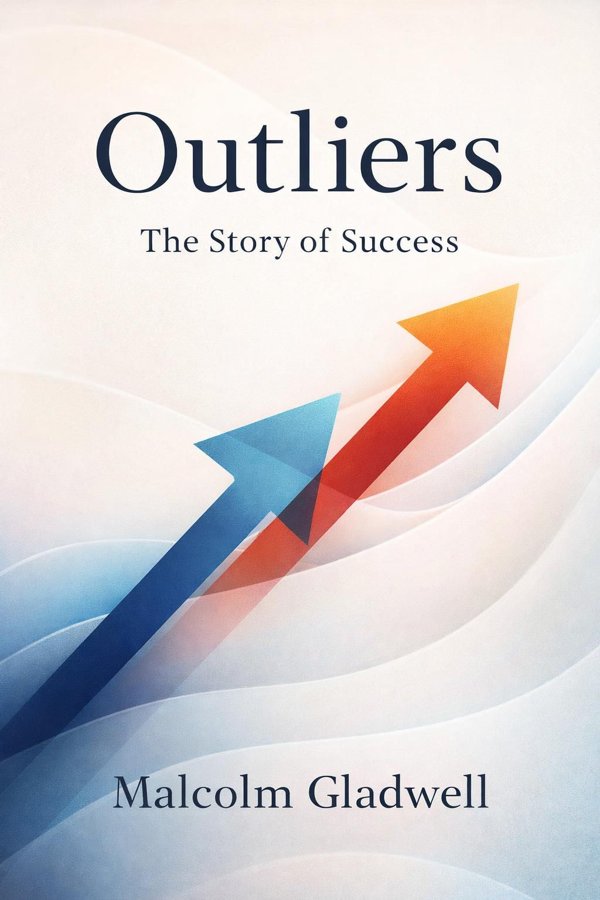
Outliers: Summary & Key Insights
 10 min8 chaptersAudio available
Key Takeaways from Outliers
One of Gladwell’s most memorable insights in Outliers is that success often begins with small, almost invisible advantages that compound over time.
Gladwell popularized the idea that world-class mastery often requires around 10,000 hours of deliberate practice.
Gladwell argues that intelligence matters, but only up to a point.
Joe Flom’s story shows that success is often tied to historical timing as much as personal skill.
One of the most striking chapters in Outliers examines aviation disasters through the lens of culture.
What Is Outliers About?
Outliers by Malcolm Gladwell is a non-fiction book published in 2008 spanning 8 pages. Why do some people rise to extraordinary heights while others, who seem just as smart or hardworking, never get the same chance? In Outliers, Malcolm Gladwell challenges the comforting myth that success is purely a matter of talent and grit. Instead, he shows that exceptional achievement usually grows from a powerful mix of opportunity, timing, cultural inheritance, family background, and sustained practice. The result is a book that changes how you think about winners—not as isolated geniuses, but as products of environments that made their success possible. Gladwell is uniquely suited to tell this story. As a longtime writer for The New Yorker and the bestselling author of books like The Tipping Point, Blink, and David and Goliath, he has built a reputation for turning research and case studies into memorable, thought-provoking stories. In Outliers, he uses examples from hockey, technology, aviation, education, and math to reveal the hidden architecture behind success. This book matters because it doesn’t just explain why some people make it big. It also asks a more important question: if opportunity shapes outcomes so strongly, how can we build fairer systems that help more people thrive?
This FizzRead summary covers all 8 key chapters of Outliers in approximately 10 minutes, distilling the most important ideas, arguments, and takeaways from Malcolm Gladwell's work. Also available as an audio summary and Key Quotes Podcast.
Outliers: The Story of Success
Why do some people rise to extraordinary heights while others, who seem just as smart or hardworking, never get the same chance? In Outliers, Malcolm Gladwell challenges the comforting myth that success is purely a matter of talent and grit. Instead, he shows that exceptional achievement usually grows from a powerful mix of opportunity, timing, cultural inheritance, family background, and sustained practice. The result is a book that changes how you think about winners—not as isolated geniuses, but as products of environments that made their success possible.
Gladwell is uniquely suited to tell this story. As a longtime writer for The New Yorker and the bestselling author of books like The Tipping Point, Blink, and David and Goliath, he has built a reputation for turning research and case studies into memorable, thought-provoking stories. In Outliers, he uses examples from hockey, technology, aviation, education, and math to reveal the hidden architecture behind success. This book matters because it doesn’t just explain why some people make it big. It also asks a more important question: if opportunity shapes outcomes so strongly, how can we build fairer systems that help more people thrive?
Who Should Read Outliers?
This book is perfect for anyone interested in non-fiction and looking to gain actionable insights in a short read. Whether you're a student, professional, or lifelong learner, the key ideas from Outliers by Malcolm Gladwell will help you think differently.
- ✓Readers who enjoy non-fiction and want practical takeaways
- ✓Professionals looking to apply new ideas to their work and life
- ✓Anyone who wants the core insights of Outliers in just 10 minutes
Want the full summary?
Get instant access to this book summary and 100K+ more with Fizz Moment.
Get Free SummaryAvailable on App Store • Free to download
Key Chapters
One of Gladwell’s most memorable insights in Outliers is that success often begins with small, almost invisible advantages that compound over time. In Canada’s junior hockey system, many elite players are born in the first few months of the year. That pattern is not random. Because youth leagues use a calendar-year cutoff, a child born in January may be nearly a year older than a child born in December. At age eight or nine, that gap can mean being taller, stronger, and more coordinated. Coaches select the bigger, more mature children for advanced teams, and those children then receive better coaching, tougher competition, and more time on the ice.
This is the “Matthew Effect,” named after the biblical idea that “to those who have, more will be given.” Early advantage becomes cumulative advantage. The principle extends far beyond sports. In school, students who begin ahead are often placed into enriched tracks, praised more often, and encouraged to take on harder work. In business, those who gain early access to networks or mentors can keep widening the gap.
The actionable lesson is clear: don’t confuse early performance with fixed potential. Parents, teachers, and leaders should look for late bloomers, reconsider arbitrary cutoff dates, and create second-chance systems. Talent matters, but systems decide whose talent gets noticed, nurtured, and rewarded.
Gladwell popularized the idea that world-class mastery often requires around 10,000 hours of deliberate practice. But his deeper point is frequently missed: those hours are only possible when people have unusual access to time, tools, and opportunities. Bill Gates did not become a software pioneer through ambition alone. As a teenager, he had access to a computer terminal at a time when such access was incredibly rare. That allowed him to spend thousands of hours programming before the personal computer revolution exploded. The Beatles followed a similar path. Their marathon performances in Hamburg forced them to play for long stretches, sharpening their stamina, stage presence, and musical instincts long before global fame arrived.
The lesson is not that success is mechanical or guaranteed after a certain number of hours. Rather, practice at that scale requires conditions most people never receive. Supportive environments, financial flexibility, mentorship, and being in the right place at the right time all matter.
For readers, this is both humbling and empowering. If you want mastery, ask not only, “Am I working hard enough?” but also, “How can I structure my life for deep repetition?” Create protected practice time, seek environments rich in feedback, and invest in the tools your field requires. The 10,000-hour rule is really a lesson about access: effort counts most when opportunity makes effort sustainable.
Gladwell argues that intelligence matters, but only up to a point. Once someone reaches a high enough level of cognitive ability, additional IQ does not reliably translate into greater real-world success. In other words, being brilliant is helpful, but it is not a golden ticket. What often matters more are practical intelligence, social skill, confidence, and the ability to navigate institutions that reward certain kinds of behavior. A person can have extraordinary analytical ability and still struggle if they cannot communicate clearly, advocate for themselves, or read social situations well.
This chapter pushes back against the popular fantasy that geniuses inevitably rise to the top. Gladwell highlights how gifted individuals can be overlooked when they lack access, guidance, or the cultural tools needed to convert intelligence into opportunity. A brilliant student from a disadvantaged background may never receive the same mentoring, encouragement, or elite credentials as a slightly less gifted student from a more connected family.
The actionable takeaway is to broaden how we define ability. If you are hiring, teaching, or mentoring, don’t overvalue test scores or raw intellectual firepower. Look for judgment, persistence, communication, and adaptability. If you are developing your own career, remember that expertise alone is not enough. Learn how to present ideas, ask for help, build relationships, and operate effectively within systems. Success depends not just on how smart you are, but on whether your environment lets that intelligence become useful.
Joe Flom’s story shows that success is often tied to historical timing as much as personal skill. Flom was undeniably talented and hardworking, but he also entered the legal profession at a moment when elite law firms looked down on certain kinds of work—especially hostile takeovers and proxy fights. Those areas were considered undesirable, so they were often left to outsiders and overlooked lawyers. Flom took the opportunities that more established firms ignored, developed expertise in a niche others dismissed, and eventually benefited when that niche became central to corporate America.
The lesson is powerful: what looks like a disadvantage in one era can become a strategic advantage in another. Sometimes the best opportunities are hidden in fields that prestigious people currently avoid. Timing matters because industries change. Markets shift. Technologies mature. Cultural values evolve. The winners are often those who are well positioned when the world suddenly revalues their skills.
This idea encourages a more patient view of career building. Instead of chasing only glamorous paths, pay attention to neglected spaces where demand may grow. Ask: what work are others underestimating? Where are structural changes creating new openings? Gladwell’s point is not that success is random, but that ambition works best when aligned with emerging trends. Skill matters greatly, yet timing determines when and where that skill becomes exceptionally valuable.
One of the most striking chapters in Outliers examines aviation disasters through the lens of culture. Gladwell argues that in some contexts, people are shaped by communication norms so deeply that those norms can become dangerous. In airline cockpits, where clear and direct speech can save lives, cultural habits around hierarchy and deference may prevent copilots from strongly challenging captains during moments of crisis. If a subordinate speaks indirectly out of respect, the warning may be too soft or too vague to change the outcome.
Gladwell uses this case to show that culture is not an abstract background force. It shapes how we speak, disagree, obey authority, and respond under pressure. The consequences can be dramatic when a setting demands one communication style but people are trained by their culture to use another. In aviation, improvements came when airlines recognized the issue and trained crews in more assertive, standardized communication practices.
The broader takeaway is highly practical. In any high-stakes environment—healthcare, business, education, or family life—unclear communication can be costly. Leaders should actively reduce unnecessary hierarchy and invite direct feedback. Team members should practice saying the critical thing plainly when the situation demands it. Gladwell’s point is not to blame culture, but to understand it. Once we see these hidden patterns, we can design systems that make better communication possible.
Gladwell explores how behaviors that seem personal or emotional can actually be rooted in long historical traditions. In the American South, especially in areas shaped by herding economies, a “culture of honor” developed around protecting reputation, responding strongly to insults, and projecting toughness. In environments where wealth could be easily stolen—such as livestock on open land—reputation served as a form of defense. Over generations, that historical logic embedded itself in customs and emotional reflexes.
What makes this chapter compelling is its central claim: history lingers in behavior long after the original economic conditions have changed. People may no longer live as herders, yet inherited norms still influence reactions to disrespect, conflict, and aggression. This shows that our actions are often guided by cultural scripts we barely notice.
The lesson for modern readers is to take culture seriously when trying to understand conflict. Whether in families, neighborhoods, or organizations, overreactions may be connected to values about pride, status, and respect that have deep roots. Instead of assuming behavior is purely individual, ask what traditions or shared stories are reinforcing it. The actionable insight is to build awareness of emotional triggers shaped by group identity. When you understand the historical source of a response, you are more likely to interrupt it, respond calmly, and create healthier norms for the next generation.
In this chapter, Gladwell connects mathematical achievement to culture, language, and work habits. He argues that some Asian societies have advantages in math not because of innate ability, but because of cultural attitudes that make persistence feel normal and expected. Rice farming, for example, historically demanded patience, repetition, and sustained effort. Those values carried into education, where hard work is often treated as the path to competence rather than as evidence of struggle.
Gladwell also points to language structure. Number systems in some Asian languages are highly regular, which can make early arithmetic easier to grasp. Combined with strong expectations around discipline and study, this creates an environment where children may build math confidence faster. The result is not magic. It is a culture that consistently reinforces the message that effort leads to improvement.
That message matters everywhere. Many students give up on math because they interpret difficulty as a sign that they “aren’t math people.” Gladwell’s argument reframes challenge as part of the learning process. The actionable takeaway for parents, educators, and learners is to praise persistence more than innate talent. Build routines, normalize practice, and treat mistakes as useful feedback. Outliers suggests that excellence often grows in cultures where people expect learning to be hard and believe that hard is workable.
The final message of Outliers is that success cannot be explained by individual qualities alone. Talent, discipline, ambition, and intelligence all matter, but they matter inside a larger ecosystem of family support, timing, culture, historical context, and institutional design. Gladwell invites readers to stop asking only, “What is this person like?” and start asking, “What made this person possible?” That shift changes everything. It moves the conversation from hero worship to systems thinking.
This does not mean personal effort is irrelevant. On the contrary, effort is essential. But effort becomes powerful when it meets the right opportunities: a mentor who opens doors, a school that recognizes potential, a family that values education, a social network that shares information, or a historical moment that rewards certain skills. Outliers argues that extraordinary outcomes are usually the product of this intersection.
For readers, this is a practical framework for both self-development and social change. On a personal level, look for environments that amplify your strengths and create the conditions for sustained practice. On a social level, support policies and institutions that expand access early, reduce arbitrary barriers, and nurture overlooked talent. Gladwell’s ultimate point is hopeful: if success is shaped by environment, then better environments can produce more success for more people.
All Chapters in Outliers
About the Author
Malcolm Gladwell is a Canadian journalist, author, and public speaker known for making complex ideas about social science and human behavior accessible to general readers. A longtime writer for The New Yorker, he became widely known for blending storytelling, research, and surprising case studies into bestselling books. His notable works include The Tipping Point, Blink, David and Goliath, and Outliers. Gladwell’s writing often challenges conventional wisdom by showing how environment, perception, and social structures shape human behavior. His work has made him one of the most recognizable voices in popular non-fiction.
Get This Summary in Your Preferred Format
Read or listen to the Outliers summary by Malcolm Gladwell anytime, anywhere. FizzRead offers multiple formats so you can learn on your terms — all free.
Available formats: App · Audio · PDF · EPUB — All included free with FizzRead
Download Outliers PDF and EPUB Summary
Key Quotes from Outliers
“One of Gladwell’s most memorable insights in Outliers is that success often begins with small, almost invisible advantages that compound over time.”
“Gladwell popularized the idea that world-class mastery often requires around 10,000 hours of deliberate practice.”
“Gladwell argues that intelligence matters, but only up to a point.”
“Joe Flom’s story shows that success is often tied to historical timing as much as personal skill.”
“One of the most striking chapters in Outliers examines aviation disasters through the lens of culture.”
Frequently Asked Questions about Outliers
Outliers by Malcolm Gladwell is a non-fiction book that explores key ideas across 8 chapters. Why do some people rise to extraordinary heights while others, who seem just as smart or hardworking, never get the same chance? In Outliers, Malcolm Gladwell challenges the comforting myth that success is purely a matter of talent and grit. Instead, he shows that exceptional achievement usually grows from a powerful mix of opportunity, timing, cultural inheritance, family background, and sustained practice. The result is a book that changes how you think about winners—not as isolated geniuses, but as products of environments that made their success possible. Gladwell is uniquely suited to tell this story. As a longtime writer for The New Yorker and the bestselling author of books like The Tipping Point, Blink, and David and Goliath, he has built a reputation for turning research and case studies into memorable, thought-provoking stories. In Outliers, he uses examples from hockey, technology, aviation, education, and math to reveal the hidden architecture behind success. This book matters because it doesn’t just explain why some people make it big. It also asks a more important question: if opportunity shapes outcomes so strongly, how can we build fairer systems that help more people thrive?
Compare Outliers



More by Malcolm Gladwell
You Might Also Like
Featured In
Browse by Category
Ready to read Outliers?
Get the full summary and 100K+ more books with Fizz Moment.