
Blink: Summary & Key Insights
 10 min9 chaptersAudio available
Key Takeaways from Blink
Sometimes the mind sees the truth before it can explain it.
We like to imagine that good thinking is slow, careful, and fully conscious.
In moments of crisis, there is rarely time for perfect analysis.
We form opinions about people almost instantly, and those impressions often feel definitive.
In medicine, more information sounds like a clear advantage.
What Is Blink About?
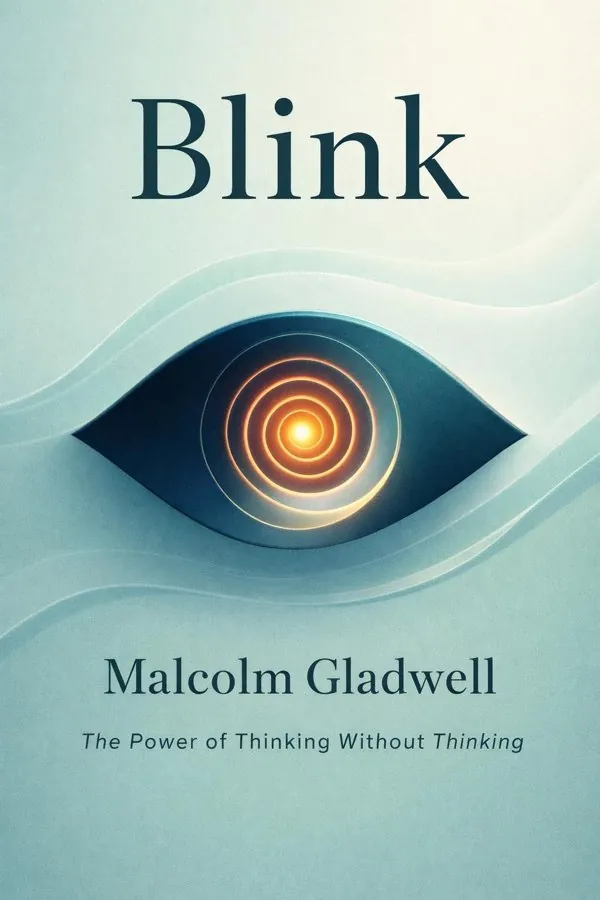
Blink by Malcolm Gladwell is a non-fiction book published in 2005 spanning 9 pages. What happens in the first two seconds of a decision? In Blink, Malcolm Gladwell argues that some of our most important judgments are made before conscious reasoning fully begins. These “blink” moments—rapid, instinctive conclusions—can be astonishingly accurate, but they can also be distorted by fear, bias, stress, and misleading information. The book explores the hidden machinery of intuition, showing how the mind can detect patterns, read situations, and arrive at conclusions faster than deliberate thought ever could. Gladwell builds his case through memorable stories from art, psychology, emergency medicine, military command, and consumer research. He explains concepts like thin-slicing, unconscious pattern recognition, and snap judgment in a way that feels vivid rather than academic. As a longtime New Yorker writer known for translating social science into compelling narratives, Gladwell brings both journalistic curiosity and intellectual range to the subject. Blink matters because modern life demands quick decisions: hiring, leading, diagnosing, negotiating, and assessing risk. The book challenges the belief that more information always leads to better choices and invites readers to ask a deeper question: when should we trust our instincts, and when should we slow down and think again?
This FizzRead summary covers all 9 key chapters of Blink in approximately 10 minutes, distilling the most important ideas, arguments, and takeaways from Malcolm Gladwell's work. Also available as an audio summary and Key Quotes Podcast.
Blink
What happens in the first two seconds of a decision? In Blink, Malcolm Gladwell argues that some of our most important judgments are made before conscious reasoning fully begins. These “blink” moments—rapid, instinctive conclusions—can be astonishingly accurate, but they can also be distorted by fear, bias, stress, and misleading information. The book explores the hidden machinery of intuition, showing how the mind can detect patterns, read situations, and arrive at conclusions faster than deliberate thought ever could.
Gladwell builds his case through memorable stories from art, psychology, emergency medicine, military command, and consumer research. He explains concepts like thin-slicing, unconscious pattern recognition, and snap judgment in a way that feels vivid rather than academic. As a longtime New Yorker writer known for translating social science into compelling narratives, Gladwell brings both journalistic curiosity and intellectual range to the subject.
Blink matters because modern life demands quick decisions: hiring, leading, diagnosing, negotiating, and assessing risk. The book challenges the belief that more information always leads to better choices and invites readers to ask a deeper question: when should we trust our instincts, and when should we slow down and think again?
Who Should Read Blink?
This book is perfect for anyone interested in non-fiction and looking to gain actionable insights in a short read. Whether you're a student, professional, or lifelong learner, the key ideas from Blink by Malcolm Gladwell will help you think differently.
- ✓Readers who enjoy non-fiction and want practical takeaways
- ✓Professionals looking to apply new ideas to their work and life
- ✓Anyone who wants the core insights of Blink in just 10 minutes
Want the full summary?
Get instant access to this book summary and 100K+ more with Fizz Moment.
Get Free SummaryAvailable on App Store • Free to download
Key Chapters
We like to imagine that good thinking is slow, careful, and fully conscious. Gladwell argues that this view is incomplete. A large share of human judgment happens outside awareness, and this rapid cognition can be both efficient and sophisticated. The mind is constantly sorting signals, detecting patterns, and drawing conclusions before deliberate reasoning catches up.
Psychologists often distinguish between two styles of thinking: one deliberate and analytical, the other fast and automatic. Blink focuses on the second. This quick system helps us read facial expressions, sense danger, recognize status shifts, and navigate social situations with remarkable speed. It allows a firefighter to know a floor is about to collapse, a basketball player to pass before a defender moves, or a parent to detect distress in a child’s voice instantly.
Gladwell’s point is not that unconscious thought is always better than conscious thought. Instead, he shows that fast thinking has its own logic. It can synthesize complex information quickly, especially when the situation is familiar and feedback has trained the mind well. In those moments, analysis may actually get in the way by slowing reaction or creating doubt.
At the same time, rapid cognition is vulnerable to contamination. Stress, prejudice, ego, and misleading cues can distort what feels like intuition. That is why understanding how the fast mind works matters. You do not need to reject intuition; you need to know when it deserves confidence.
The practical application is broad: in negotiations, presentations, management, and personal relationships, your first interpretation often shapes everything that follows. Actionable takeaway: treat rapid cognition as a serious mental faculty, but test whether your environment and experience have trained it well before relying on it in high-stakes situations.
In moments of crisis, there is rarely time for perfect analysis. Gladwell shows that under pressure, the best decisions often come from highly trained intuition rather than from lengthy deliberation. Military commanders, firefighters, athletes, and emergency responders operate in environments where delay can be deadly. Their excellence depends on learning to recognize patterns fast and act decisively.
This kind of intuition is earned, not inherited. Through repeated exposure, feedback, and correction, experts build mental libraries of situations. When a crisis unfolds, they do not consciously compare dozens of options; they recognize what kind of situation they are in and respond. A battlefield leader may sense that a plan is collapsing because small cues do not match expected patterns. A pilot may react to engine failure before fully verbalizing what has gone wrong.
Gladwell suggests that expertise compresses learning into instinct. What looks like a “gut feeling” is often the result of thousands of prior encounters. That is why novice intuition is far less reliable. Under stress, inexperienced people may panic, freeze, or rely on irrelevant details, while experts focus on the few signals that matter most.
This insight has practical implications far beyond war. Leaders in business, medicine, sports, and public safety should not wait until a crisis to discover how they think under pressure. Training should simulate real conditions, expose people to repeated decision cycles, and provide immediate feedback. That is how competence becomes usable speed.
The main lesson is that pressure does not automatically ruin judgment; it reveals the quality of preparation. Actionable takeaway: if your work involves fast decisions, build intuition deliberately through repetition, realistic practice, and post-action review so that when pressure rises, your instincts become an asset rather than a liability.
We form opinions about people almost instantly, and those impressions often feel definitive. Gladwell explores how quickly we judge trustworthiness, competence, warmth, dominance, or threat from faces, tone, posture, and tiny behavioral cues. In some cases, these judgments are surprisingly accurate. In others, they are dangerously wrong.
One of Blink’s striking themes is that people constantly “thin-slice” social reality. A short conversation, a glance across a room, even a few seconds of body language can shape hiring decisions, friendships, romantic choices, and courtroom outcomes. Research cited by Gladwell suggests that observers can infer aspects of relationships or personalities from very brief snippets of behavior. For example, a doctor’s tone may influence whether patients later sue for malpractice, independent of technical skill. A job candidate’s confidence may create a strong impression before qualifications are fully examined.
But first impressions are not neutral. They are filtered through stereotypes, expectations, and cultural narratives. This means we can quickly mistake polish for competence, similarity for trustworthiness, or unfamiliarity for danger. We may also overvalue charisma while overlooking substance.
The challenge is not to eliminate first impressions; that is impossible. The challenge is to become aware of their power and limits. Strong leaders, interviewers, teachers, and managers learn to separate immediate reactions from final judgments. They notice what they felt in the first minute, then ask whether the reaction came from valid signals or hidden assumptions.
In practical terms, this applies to dating, hiring, sales, parenting, and team building. Actionable takeaway: notice your first impression, write it down mentally if needed, but do not let it become your conclusion until you have tested it against evidence that goes beyond appearance and style.
In medicine, more information sounds like a clear advantage. Gladwell challenges that assumption by showing that in emergency situations, carefully designed simplicity can outperform complexity. He discusses how physicians and researchers use structured decision tools to identify heart attacks and other urgent conditions. These tools often rely on a small number of critical variables rather than long lists of data.
The key insight is that good rapid decision-making depends on filtering. In high-pressure environments, too much information can overwhelm judgment, create noise, and delay action. A doctor faced with a patient in distress cannot weigh every possible detail equally. The best clinicians learn which indicators truly matter and which can be ignored. This is not carelessness; it is disciplined selectivity.
Gladwell contrasts experts who know how to narrow attention with systems that drown decision-makers in complexity. In emergency medicine, simple checklists or algorithms can support the mind’s fast pattern recognition rather than burden it. That is one reason triage systems, standard protocols, and diagnostic scoring methods are so powerful. They reduce confusion and preserve focus when seconds matter.
This principle extends beyond hospitals. In business, teams can define two or three metrics that matter most during a crisis. In personal finance, investors can avoid panic by following precommitted rules instead of reacting to every market signal. In everyday decisions, fewer criteria may improve clarity.
The deeper point is that rapid cognition works best when the environment is designed intelligently. Actionable takeaway: when facing high-stakes decisions, identify the smallest set of variables that truly predict outcomes, and build your process around them instead of assuming that more data will automatically produce better judgment.
Consumers often believe they know exactly why they like what they like. Gladwell shows that the reality is messier. Much of preference is formed below awareness, shaped by subtle cues, context, framing, and emotional resonance. In business, this means that people’s stated reasons for buying are often incomplete or misleading.
Blink explores how market research can fail when it relies too heavily on what consumers say instead of observing how they actually respond. People may struggle to articulate their preferences because many judgments are intuitive. A product, advertisement, or experience “feels right” long before a customer can explain why. Packaging, atmosphere, timing, social cues, and small design choices all influence perception at a level that words often cannot capture.
This is why entrepreneurs and marketers must understand implicit reactions, not just explicit opinions. A store layout can make products seem premium or cheap. A website design can create trust within seconds. A brand voice can suggest authority, warmth, or exclusivity almost instantly. In service businesses, the first ten seconds of interaction may matter more than a carefully written mission statement.
Still, Gladwell’s message is not that consumers are irrational puppets. Rather, our preferences emerge from a blend of conscious and unconscious processes. Smart businesses respect both. They test behavior, observe context, and recognize that what customers experience may be more predictive than what customers say.
For readers, this offers a useful defense as well. Knowing that environments influence us helps us make better choices and design better systems. Actionable takeaway: whether you are selling or buying, look beyond stated reasons and examine the subtle cues, design choices, and emotional triggers that shape decisions before conscious analysis begins.
One of Blink’s most important warnings is that snap judgments do not fail only because they are fast; they fail because they can be poisoned by bias. The same rapid cognition that lets us read situations efficiently can also absorb stereotypes, fears, and cultural assumptions. When that happens, the blink becomes less a source of wisdom than a mirror of hidden prejudice.
Gladwell explores this through examples involving race, status, appearance, and social perception. A person may seem suspicious not because of behavior but because of unconscious associations. A leader may appear competent because he matches a familiar image of authority. Someone from a different background may be judged harshly within seconds for reasons the observer cannot name. These errors feel intuitive precisely because they operate below awareness.
That is what makes them so dangerous. Conscious prejudice can be challenged directly, but implicit bias hides inside ordinary decision-making. It can influence policing, hiring, promotions, classroom evaluations, and everyday social interactions. People may sincerely believe they are being objective while their quick judgments repeatedly disadvantage others.
Gladwell does not suggest that bias makes intuition useless. He argues that we must become suspicious of our own certainty, especially in areas loaded with social meaning. Better systems can help: blind auditions, structured interviews, standardized criteria, diverse teams, and deliberate pauses before irreversible judgments. These interventions reduce the chance that hidden bias will masquerade as insight.
The practical lesson is both personal and institutional. Actionable takeaway: whenever your quick judgment concerns another person’s character, competence, or threat level, ask what invisible assumptions may be shaping your reaction, and build safeguards that force evidence to outweigh instinct in socially sensitive decisions.
If intuition can mislead, can it be improved? Gladwell’s answer is yes. Fast thinking is not fixed. It can be refined through practice, better environments, and deeper self-awareness. The quality of our snap judgments depends heavily on what we have learned, what signals we attend to, and how much noise surrounds us.
Training intuition begins with exposure and feedback. The more often you encounter meaningful patterns and learn whether your judgments were right, the better your unconscious mind becomes at recognizing what matters. This is why expert chess players, nurses, negotiators, and investigators can make strong quick calls in their fields. Their brains have been trained on relevant repetitions.
Another part of training is pruning. We must learn which cues matter and which merely distract. A skilled interviewer, for example, may ignore charm and focus on clarity, examples, and consistency. A manager may stop overreacting to confidence and start noticing reliability. A parent may distinguish between a child’s temporary mood and a meaningful behavioral change.
Self-knowledge matters too. Some people become reckless under stress; others become overly cautious. Some are swayed by authority; others by appearance. By studying our own errors, we make intuition cleaner. Reflection does not oppose fast thinking; it upgrades it.
This idea is empowering because it turns instinct into a craft. You do not have to choose between blind trust in your gut and total dependence on analysis. You can educate your gut through deliberate learning.
Actionable takeaway: after important decisions, review what you noticed, what you ignored, and what outcome followed; over time, this feedback loop will strengthen the quality of your future snap judgments.
The final lesson of Blink is not that instinct beats reason. It is that good judgment comes from knowing when to use each. Some situations reward speed, pattern recognition, and minimal information. Others demand patience, analysis, and a willingness to resist first impressions. Wisdom lies in matching the mode of thinking to the nature of the problem.
Gladwell’s contribution is to restore dignity to intuition without romanticizing it. Fast thinking can be elegant, efficient, and powerful, especially in domains where experience has built true expertise. But slow thinking remains crucial when the stakes are high, the environment is unfamiliar, or bias is likely to distort perception. A surgeon may rely on intuition in the operating room but require deep analysis when planning treatment. An investor may sense market mood quickly but still need deliberate research before making a major decision.
The most effective decision-makers create systems that combine both modes. They use instinct to surface possibilities and analysis to test them. They notice the first impression, then ask whether it deserves trust. They design workflows that protect against predictable errors while preserving the speed needed for action.
This balance is deeply practical. In leadership, it means not mistaking decisiveness for wisdom. In relationships, it means honoring emotional signals without letting them rule unchecked. In work, it means simplifying where clarity helps and slowing down where complexity matters.
Blink ultimately teaches readers to become more skillful thinkers, not merely faster ones. Actionable takeaway: before any important decision, ask two questions: “Is this a domain where trained intuition is reliable?” and “What risks am I taking if my first impression is wrong?” Let the answers determine whether to move quickly or pause and analyze.
All Chapters in Blink
About the Author
Malcolm Gladwell is a Canadian journalist, author, podcaster, and public speaker known for making complex social science ideas accessible to a broad audience. Born in England and raised in Canada, he began his journalism career at The Washington Post before joining The New Yorker in 1996, where he became one of the magazine’s most recognizable writers. Gladwell rose to international prominence with The Tipping Point and went on to write several bestselling books, including Blink, Outliers, David and Goliath, and Talking to Strangers. His work often explores psychology, decision-making, success, and human behavior through surprising stories and research-driven insights. Gladwell is widely admired for his ability to connect academic concepts with everyday life in ways that are memorable, provocative, and highly readable.
Get This Summary in Your Preferred Format
Read or listen to the Blink summary by Malcolm Gladwell anytime, anywhere. FizzRead offers multiple formats so you can learn on your terms — all free.
Available formats: App · Audio · PDF · EPUB — All included free with FizzRead
Download Blink PDF and EPUB Summary
Key Quotes from Blink
“Sometimes the mind sees the truth before it can explain it.”
“We like to imagine that good thinking is slow, careful, and fully conscious.”
“In moments of crisis, there is rarely time for perfect analysis.”
“We form opinions about people almost instantly, and those impressions often feel definitive.”
“In medicine, more information sounds like a clear advantage.”
Frequently Asked Questions about Blink
Blink by Malcolm Gladwell is a non-fiction book that explores key ideas across 9 chapters. What happens in the first two seconds of a decision? In Blink, Malcolm Gladwell argues that some of our most important judgments are made before conscious reasoning fully begins. These “blink” moments—rapid, instinctive conclusions—can be astonishingly accurate, but they can also be distorted by fear, bias, stress, and misleading information. The book explores the hidden machinery of intuition, showing how the mind can detect patterns, read situations, and arrive at conclusions faster than deliberate thought ever could. Gladwell builds his case through memorable stories from art, psychology, emergency medicine, military command, and consumer research. He explains concepts like thin-slicing, unconscious pattern recognition, and snap judgment in a way that feels vivid rather than academic. As a longtime New Yorker writer known for translating social science into compelling narratives, Gladwell brings both journalistic curiosity and intellectual range to the subject. Blink matters because modern life demands quick decisions: hiring, leading, diagnosing, negotiating, and assessing risk. The book challenges the belief that more information always leads to better choices and invites readers to ask a deeper question: when should we trust our instincts, and when should we slow down and think again?
Compare Blink
More by Malcolm Gladwell
You Might Also Like
Browse by Category
Ready to read Blink?
Get the full summary and 100K+ more books with Fizz Moment.