
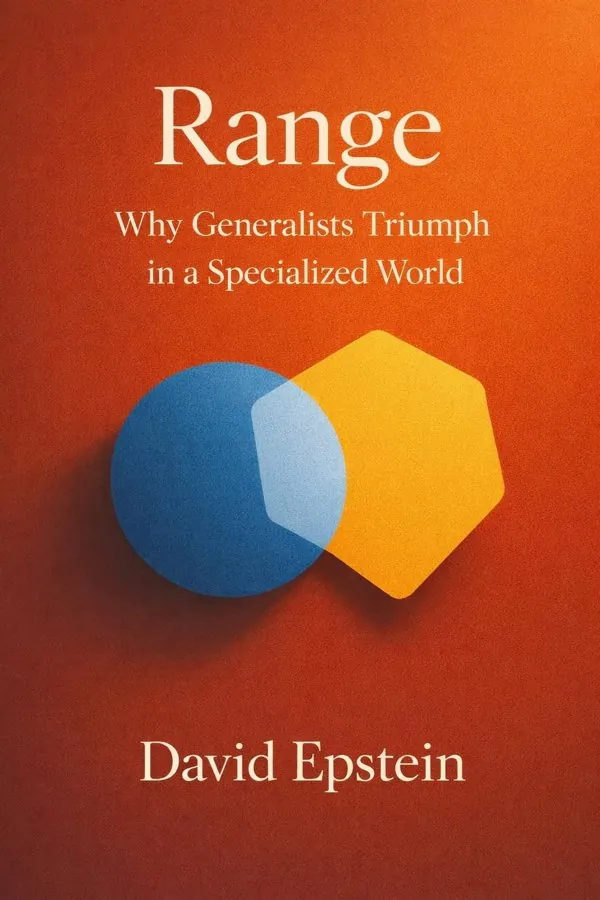
Range: Summary & Key Insights
 10 min8 chaptersAudio available
Key Takeaways from Range
We often assume that the sooner you specialize, the greater your chances of becoming world-class.
Not all expertise develops under the same conditions, and this distinction changes everything.
The pressure to decide early can make exploration feel like procrastination, but Epstein argues the opposite: a sampling period is often what produces better long-term performance.
Many of the biggest breakthroughs come not from digging deeper into one silo, but from seeing a problem through the lens of another field.
Organizations often say they want innovation while hiring and rewarding only narrow specialization.
What Is Range About?
Range by David Epstein is a non-fiction book published in 2019 spanning 6 pages. In Range, David Epstein makes a persuasive case against one of modern culture’s most cherished beliefs: that the surest path to success is early specialization. Drawing from sports, science, education, technology, and the arts, he argues that in many of today’s most important fields, people who explore widely, test different interests, and build knowledge across domains often outperform those who commit narrowly from the start. Rather than treating wandering as weakness, Epstein shows that breadth can be a major competitive advantage. The book matters because the world most of us work in is not stable, predictable, or neatly rule-bound. Careers shift, industries change, and the hardest problems rarely fit inside one discipline. In that environment, creativity, adaptability, and the ability to connect ideas matter as much as technical depth. Epstein, a journalist known for translating research on performance and human potential into compelling stories, brings together evidence and vivid examples to challenge conventional ideas about expertise. Range is both a critique of the specialization myth and a practical guide for thinking differently about learning, career development, and what real long-term excellence looks like.
This FizzRead summary covers all 8 key chapters of Range in approximately 10 minutes, distilling the most important ideas, arguments, and takeaways from David Epstein's work. Also available as an audio summary and Key Quotes Podcast.
Range
In Range, David Epstein makes a persuasive case against one of modern culture’s most cherished beliefs: that the surest path to success is early specialization. Drawing from sports, science, education, technology, and the arts, he argues that in many of today’s most important fields, people who explore widely, test different interests, and build knowledge across domains often outperform those who commit narrowly from the start. Rather than treating wandering as weakness, Epstein shows that breadth can be a major competitive advantage.
The book matters because the world most of us work in is not stable, predictable, or neatly rule-bound. Careers shift, industries change, and the hardest problems rarely fit inside one discipline. In that environment, creativity, adaptability, and the ability to connect ideas matter as much as technical depth. Epstein, a journalist known for translating research on performance and human potential into compelling stories, brings together evidence and vivid examples to challenge conventional ideas about expertise. Range is both a critique of the specialization myth and a practical guide for thinking differently about learning, career development, and what real long-term excellence looks like.
Who Should Read Range?
This book is perfect for anyone interested in non-fiction and looking to gain actionable insights in a short read. Whether you're a student, professional, or lifelong learner, the key ideas from Range by David Epstein will help you think differently.
- ✓Readers who enjoy non-fiction and want practical takeaways
- ✓Professionals looking to apply new ideas to their work and life
- ✓Anyone who wants the core insights of Range in just 10 minutes
Want the full summary?
Get instant access to this book summary and 100K+ more with Fizz Moment.
Get Free SummaryAvailable on App Store • Free to download
Key Chapters
We often assume that the sooner you specialize, the greater your chances of becoming world-class. Epstein opens by challenging that assumption through the contrast between Tiger Woods and Roger Federer. Woods became the classic model of early specialization: he was training in golf almost from infancy. Federer, by contrast, tried many sports as a child before focusing seriously on tennis later. The surprising point is not that one path is wrong and the other right, but that society tends to glorify the Woods story while ignoring how often the Federer path leads to success.
Epstein shows that in many fields, early specialization offers only a temporary edge. Young specialists may perform better early because they have logged more hours in one activity, but that head start does not always translate into long-term superiority. Broad exploration can help people discover a better personal fit, avoid burnout, and build a wider toolkit of skills that later become powerful advantages. Athletes who play multiple sports often develop better overall coordination, creativity, and resilience. Professionals who sample different roles may make wiser career decisions because they understand their strengths more clearly.
This matters beyond sports. Parents pressure children to commit early. Students feel compelled to choose a fixed identity before they have enough experience to know themselves. Workers worry that changing directions means falling behind. Range argues that exploration is not wasted time; it is often how real alignment and durable excellence are built.
Actionable takeaway: Treat exploration as an investment. Before locking into one path, deliberately sample different activities, roles, or subjects long enough to learn what truly fits your abilities and interests.
Not all expertise develops under the same conditions, and this distinction changes everything. Epstein uses psychologist Robin Hogarth’s framework of “kind” and “wicked” learning environments to explain why specialists thrive in some domains but struggle in others. Kind environments have clear rules, fast feedback, and patterns that repeat reliably. Think of chess, certain musical training systems, or golf. In these settings, practice maps closely onto performance because the same situations recur and feedback is immediate.
Wicked environments are different. They are ambiguous, delayed, and full of hidden variables. Success depends less on memorizing patterns and more on judgment, flexibility, and interpretation. Business strategy, scientific research, medicine, investing, public policy, and entrepreneurship often fall into this category. In these fields, outcomes can be misleading, feedback can arrive late or not at all, and old rules may stop working when conditions change.
This is why the specialization mantra becomes dangerous when applied too broadly. A method that works in a kind environment may fail badly in a wicked one. Someone trained only to follow familiar patterns can struggle when problems are novel. Generalists, however, are often better prepared for wicked environments because they can draw from different models, question assumptions, and adapt to uncertainty.
In everyday life, many of our biggest decisions happen in wicked environments: choosing careers, hiring people, launching products, managing teams, or solving complex social problems. Rigid expertise can become a liability when the world refuses to stay stable.
Actionable takeaway: Before copying expert advice, ask what kind of environment you are in. If feedback is noisy, delayed, or uncertain, prioritize adaptability, broad learning, and cross-domain thinking over narrow repetition.
The pressure to decide early can make exploration feel like procrastination, but Epstein argues the opposite: a sampling period is often what produces better long-term performance. He points to research showing that many top performers did not choose their eventual field immediately. Instead, they moved through a period of trying different activities, comparing experiences, and gradually identifying where their abilities and interests intersected.
This process matters because match quality is crucial. Success is not just about effort; it is also about finding work that fits your temperament, motivations, and capacities. A person who samples broadly has more data about what energizes them, where they improve fastest, and what kind of challenges they are willing to sustain. That leads to better choices and greater persistence once a direction is chosen.
The sampling period also expands skill transfer. A child who tries different sports may bring footwork from soccer into tennis or strategic thinking from basketball into football. A student who studies history, math, and art may later approach business or design with unusual originality. Career changers often discover that earlier experiences, once seen as unrelated, become assets in their new field.
Importantly, sampling should not be confused with endless drifting. Exploration becomes useful when it is active and reflective. You try, observe, compare, and learn. Over time, what looked like a scattered path often forms a strong foundation for deeper specialization later.
Actionable takeaway: Create your own sampling period. If you are choosing a major, career path, or new direction, test multiple options through small experiments—courses, projects, internships, side work, or volunteer roles—and review what each teaches you about fit.
Many of the biggest breakthroughs come not from digging deeper into one silo, but from seeing a problem through the lens of another field. Epstein highlights how analogical thinking—the ability to recognize structural similarities across very different situations—is one of the signature strengths of people with range. Generalists are often better at this because they have encountered more varied frameworks, tools, and mental models.
When you work in only one domain for too long, you can become trapped by its default assumptions. Breadth helps you escape those limits. A doctor might learn from aviation safety systems. A product designer might borrow from behavioral psychology. A teacher might improve classroom instruction using principles from coaching or game design. Innovation often comes from recombination rather than from isolated depth.
Epstein also shows that analogical thinking improves problem-solving in uncertain environments. If a challenge is new, there may be no exact precedent inside your field. But there may be a useful parallel somewhere else. The more mental categories you have encountered, the more likely you are to make a productive connection. This is one reason interdisciplinary thinkers can be so valuable: they transfer insight where others see no overlap.
You do not need to be a genius to benefit from this. Reading outside your profession, talking to people in different industries, and studying adjacent disciplines can all improve your ability to spot hidden similarities. Over time, this makes your thinking less literal and more inventive.
Actionable takeaway: For any important problem, ask: where else does this pattern appear? Deliberately seek one or two analogies from outside your field and use them to generate fresh solutions.
Organizations often say they want innovation while hiring and rewarding only narrow specialization. Epstein argues that this is a mistake, especially when teams face complex, fast-changing problems. In many settings, the strongest teams are not made up of identical experts, but of people who bring different experiences, disciplines, and ways of thinking. Range at the team level creates cognitive diversity.
This diversity matters because complex problems rarely have one clean answer. A specialist may optimize one part of a system while missing the broader consequences. A team that includes varied backgrounds is more likely to surface blind spots, challenge assumptions, and integrate competing priorities. In product development, for example, engineers, designers, customer support staff, and marketers each see different failure points and opportunities. In healthcare, better decisions often come when physicians, nurses, administrators, and patients’ perspectives are integrated rather than isolated.
Epstein’s broader point is that organizations should not think of breadth as the opposite of competence. People with range often become translators between silos. They connect departments, synthesize information, and help ideas spread. They may be especially valuable in leadership roles because leaders must make sense of interdependent systems rather than optimize one technical niche.
For managers, this changes hiring and development. Instead of looking only for perfect linear resumes, it can be wise to value unusual combinations of experience, career pivots, and evidence of learning agility. Strong organizations also create room for internal mobility so employees can build broader understanding over time.
Actionable takeaway: Build teams for complementary range, not just individual expertise. Include people who can bridge functions, ask unfamiliar questions, and connect specialized knowledge into a coherent whole.
Educational systems often push students toward premature certainty. They reward fast answers, narrow tracks, and early commitment, even though many learners develop best when they have time to explore. Epstein compares educational models and shows that systems allowing students to delay specialization often produce stronger long-term matching between people and professions. Students may commit later, but they choose more wisely and are less likely to switch or drop out after making poor early decisions.
This is especially important because young people are frequently asked to define themselves before they have enough exposure to make informed choices. A student may think they are “not a math person” because of one poor class, or choose a major based on prestige rather than genuine interest. When institutions force early narrowing, they can turn temporary impressions into long-term constraints.
Epstein’s argument is not anti-discipline. It is pro-development. Curiosity, experimentation, and interdisciplinary learning help people discover hidden strengths. A broad educational base also creates better citizens and professionals because real-world problems do not arrive labeled by department. Climate change, public health, inequality, and technological disruption all demand integrated thinking.
In practical terms, this suggests that students should not panic if their path looks indirect. Taking a broad set of courses, changing majors, or combining unrelated subjects can be an advantage rather than a sign of confusion. Educators and institutions should also create environments where revision is normal and exploration is structured rather than stigmatized.
Actionable takeaway: If you are studying or advising students, prioritize broad foundations and informed choice. Leave room for switching direction, combining disciplines, and discovering strengths through experience rather than pressure.
One of the most reassuring ideas in Range is that a winding path is often a normal path. Epstein challenges the cultural obsession with tidy career narratives: the child prodigy who always knew, the graduate who followed a straight ladder, the entrepreneur whose success appears inevitable in hindsight. Real development is usually messier. People change interests, discover strengths late, and gain crucial skills from detours that only make sense afterward.
This matters because linear myths create unnecessary anxiety. When people believe success requires certainty from the beginning, they interpret confusion as failure. But in a world where industries shift and job categories evolve, the ability to pivot may be more valuable than unwavering commitment. Many successful people build careers by moving across functions, industries, or disciplines and then combining those experiences in a distinctive way.
A non-linear career also creates optionality. Someone who has worked in different roles may be better positioned to adapt during downturns or technological change. They understand multiple parts of a system and can translate between them. That broader view often becomes especially valuable in leadership, entrepreneurship, and strategy work.
The key is not random movement but reflective movement. Each transition should teach you something: about what you enjoy, where you add value, or which environments help you perform. Seen this way, career experimentation becomes a form of learning rather than a sign of instability.
Actionable takeaway: Rewrite your career story around learning, not just titles. Identify the transferable skills and perspectives gained from each step, and use them to shape your next move with more confidence.
All Chapters in Range
About the Author
David Epstein is an American author and journalist known for exploring performance, science, sports, and human potential. He worked as a senior writer for Sports Illustrated, where he covered a wide range of topics related to athletic achievement, and also reported for ProPublica. Epstein gained major recognition with his first book, The Sports Gene, a New York Times bestseller that examined the relationship between genetics, training, and elite performance. In Range, he broadened that inquiry to investigate how people learn, develop expertise, and succeed in complex environments. His writing is known for combining rigorous research with memorable storytelling, making difficult ideas accessible to a wide audience. Across his work, Epstein consistently challenges simplistic explanations of talent and success.
Get This Summary in Your Preferred Format
Read or listen to the Range summary by David Epstein anytime, anywhere. FizzRead offers multiple formats so you can learn on your terms — all free.
Available formats: App · Audio · PDF · EPUB — All included free with FizzRead
Download Range PDF and EPUB Summary
Key Quotes from Range
“We often assume that the sooner you specialize, the greater your chances of becoming world-class.”
“Not all expertise develops under the same conditions, and this distinction changes everything.”
“The pressure to decide early can make exploration feel like procrastination, but Epstein argues the opposite: a sampling period is often what produces better long-term performance.”
“Many of the biggest breakthroughs come not from digging deeper into one silo, but from seeing a problem through the lens of another field.”
“Organizations often say they want innovation while hiring and rewarding only narrow specialization.”
Frequently Asked Questions about Range
Range by David Epstein is a non-fiction book that explores key ideas across 8 chapters. In Range, David Epstein makes a persuasive case against one of modern culture’s most cherished beliefs: that the surest path to success is early specialization. Drawing from sports, science, education, technology, and the arts, he argues that in many of today’s most important fields, people who explore widely, test different interests, and build knowledge across domains often outperform those who commit narrowly from the start. Rather than treating wandering as weakness, Epstein shows that breadth can be a major competitive advantage. The book matters because the world most of us work in is not stable, predictable, or neatly rule-bound. Careers shift, industries change, and the hardest problems rarely fit inside one discipline. In that environment, creativity, adaptability, and the ability to connect ideas matter as much as technical depth. Epstein, a journalist known for translating research on performance and human potential into compelling stories, brings together evidence and vivid examples to challenge conventional ideas about expertise. Range is both a critique of the specialization myth and a practical guide for thinking differently about learning, career development, and what real long-term excellence looks like.
More by David Epstein

You Might Also Like

Featured In
Browse by Category
Ready to read Range?
Get the full summary and 100K+ more books with Fizz Moment.